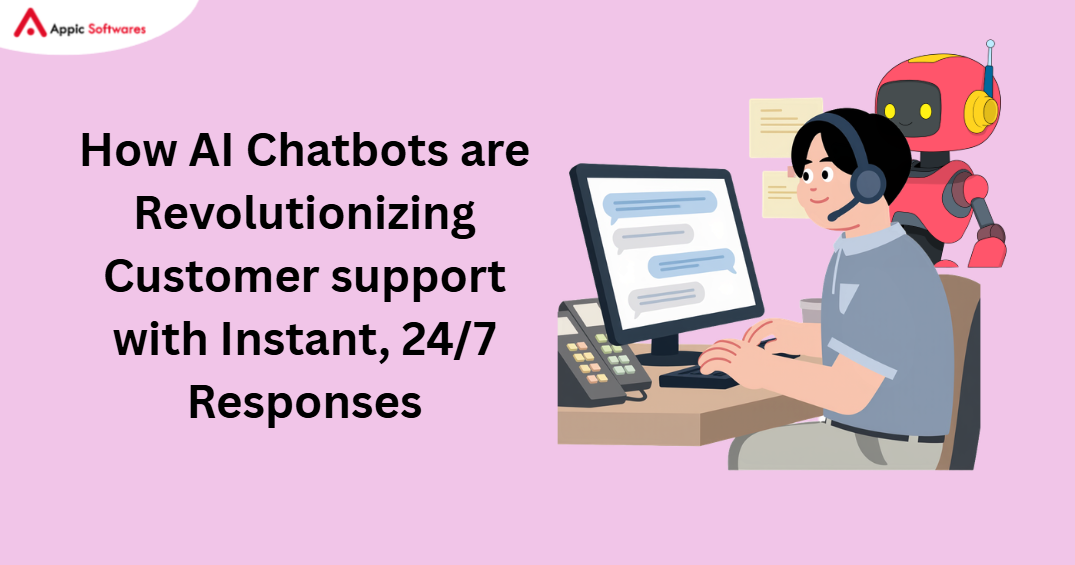
You operate in an environment where customers expect immediate responses at any time. Even for a second, if customer if facing delay, that is reducing their trust and you lost conversions. AI chatbots in customer service will solve this problem by delivering instant, consistent, and scalable support across channels.
The role of AI chatbot in customer service in automating the customer support process is becoming very important. Companies are beginning to replace their manual and time-consuming workflows with automated, real-time, multi-channel support systems. These AI-based systems can manage thousands of conversations simultaneously and provide a similar experience to each individual who interacts with the bot.
The global chatbot market exceeded 5.4 billion dollars and is expected to cross 15.5 billion dollars within a few years, based on MarketsandMarkets data. This growth shows strong enterprise investment in customer support automation.
How AI Chatbots In Customer Service Deliver Instant 24/7 Responses
Natural Language Processing and Machine Learning are two of the technologies used by AI chatbot in customer service to provide customers with immediate responses. Using these technologies enables AI-based chatbots to understand customer intent, process customer inquiries or questions, and provide accurate information to the customer in real time.
| Capability | Business Impact |
| Real time response | Eliminates wait time |
| 24/7 availability | Supports global users |
| Multi conversation handling | Handles high volume queries |
| Consistent replies | Reduces human error |
AI chatbots in customer service maintain performance during peak demand and ensure uninterrupted support.
AI Chatbot Development Cost And Investment Range

You must evaluate cost before implementing AI chatbots in customer service. The development cost at Appic Softwares ranges between $10000 and $80000.
| Chatbot Type | Cost Range |
| Basic Chatbot | $10000 to $20000 |
| Mid Level AI Chatbot | $20000 to $50000 |
| Advanced AI Chatbot | $50000 to $80000 or more |
A basic chatbot handles simple queries with predefined responses. A mid level AI chatbot supports contextual conversations and integrates with core systems. An advanced AI chatbot includes machine learning models, predictive capabilities, and enterprise level integrations.
This cost depends on complexity, features, integrations, and training requirements. You should align your investment with business goals and expected return.
You select features based on your support workflow and customer expectations. These features ensure your chatbot delivers accurate and efficient responses.
Natural language processing improves query understanding. CRM integration provides access to customer history and previous interactions. AI personalization ensures relevant responses based on user behavior. Multilingual capability supports global communication. Voice support enables AI call center functionality.
AI chatbots in customer service must integrate with ecommerce systems, CRM platforms, payment gateways, and analytics tools. AI chatbot and ecommerce store integration allows real time product queries, order tracking, and checkout assistance. This improves conversion rates and reduces drop offs.
Cost Drivers And Return On Investment
You need to understand how cost translates into value. Investment depends on multiple factors including complexity, features, integrations, and data requirements.
| Factor | Cost Impact | Business Outcome |
| Chatbot complexity | Higher intelligence increases cost | Better automation and accuracy |
| Feature set | More features increase scope | Improved customer experience |
| System integrations | Increases backend effort | Seamless operations |
| Data training | Custom models increase cost | Higher response accuracy |
| Development timeline | Faster delivery increases cost | Early deployment advantage |
AI chatbots in customer service reduce support cost by up to 50 percent and improve response time by up to 90 percent. They increase conversion rates by assisting users during decision making and reducing drop offs.
This explains how AI in customer success can be a game changer. You shift from reactive support to proactive engagement. Your chatbot identifies issues early and provides instant solutions.
Real World Examples Of AI Chatbots In Customer Service

Ecommerce Customer Support Automation
You use AI chatbots in customer service to manage high volume ecommerce queries without delays. The chatbot assists with product discovery, order tracking, and returns. Customers receive instant answers during the buying journey. This reduces cart abandonment and increases conversion rates.
Data shows ecommerce businesses report up to 30 percent higher conversion when chatbots assist during purchase decisions. You improve sales and reduce support workload at the same time.
Banking And Financial Services Support
You deploy AI chatbots in customer service to handle sensitive financial queries with speed and accuracy. The chatbot provides account updates, transaction history, and fraud alerts in real time. Customers access critical information without waiting for support teams.
Banks report up to 40 percent reduction in support cost after chatbot implementation. You improve response speed and maintain service consistency across channels.
SaaS Onboarding And Support Experience
You use AI chatbots in customer service to guide users during onboarding and feature adoption. The chatbot provides step by step assistance based on user behavior. Users complete setup faster and face fewer issues.
SaaS companies report improved retention when onboarding support is automated. You reduce churn and increase product adoption through guided assistance.
These examples of AI agents show how automation improves efficiency across industries and directly impacts revenue and retention.
Common Mistakes Businesses Make With AI Chatbots

Lack Of Proper Training Data
You risk poor performance when your chatbot lacks quality training data. The system fails to understand queries and provides incorrect responses. This leads to user frustration and reduced trust.
You should train your chatbot with real customer conversations and update data regularly to improve accuracy.
Poor System Integration
You limit chatbot effectiveness when you do not connect with backend systems. Without CRM or database access, the chatbot cannot resolve real issues. Customers receive incomplete answers.
You should integrate your chatbot with CRM, ecommerce systems, and support tools to deliver meaningful responses.
Focus On Cost Over Scalability
You face long term issues when you select low cost solutions without planning for scale. These systems fail under high demand and require replacement.
You should invest in scalable architecture that supports growth and handles increasing user volume and improve results when you focus on accuracy, integration, and long term performance.
Role Of AI Agents And Advanced Capabilities
Context Aware Conversation Systems
It improves response accuracy when your chatbot maintains conversation history. The system understands user intent across multiple interactions and delivers relevant answers.
Omnichannel Communication Support
They provide consistent support when your chatbot operates across websites, mobile apps, and messaging platforms. Customers receive the same experience on every channel.
Workflow Automation And Task Execution
Workflow automation reduce manual effort when your chatbot triggers workflows such as ticket creation, order updates, and notifications. This improves operational efficiency.
You increase accuracy over time when your chatbot learns from interactions. The system improves responses based on user behavior and feedback.
AI agent features such as analytics dashboards and automation workflows support data driven decisions and long term efficiency.
For example, you are into fintech chatbot development, you include compliance, encryption, and secure transaction handling. These requirements increase development effort and ensure reliability.
Competitor Analysis For AI Chatbots In Customer Service
Most of the time, people notice that most competitors provide surface level content on AI chatbots in customer service. They focus on general benefits and basic pricing. They do not explain cost drivers, integration depth, or measurable return.
Top performing companies focus on scalability, personalization, and system integration. They highlight enterprise use cases and provide clear outcomes.
You improve ranking potential when you cover cost, features, integrations, and ROI in detail. This aligns with search intent and improves engagement.
Why Businesses Should Choose Appic Softwares
You choose a development partner based on execution capability and understanding of business needs. Appic Softwares, best AI agent development company, builds AI chatbots in customer service tailored to your requirements.
The team focuses on scalable architecture, system integration, and performance optimization. You receive end to end support from planning to deployment.
The company has experience across ecommerce, fintech, healthcare, and SaaS industries. This ensures your chatbot aligns with real business requirements and delivers measurable results.

If you plan to implement AI chatbots in customer service, take the next step with a clear cost strategy.
Request a custom AI chatbot development cost estimate from Appic Softwares and build a scalable solution designed for performance, efficiency, and measurable return.
FAQs
How do AI chatbots improve customer service efficiency?
Chatbots improve the efficiency of customer service by reducing response time; reducing the number of repetitive inquiries; and freeing agents to work on more complex issues. Therefore, the overall efficiency and consistency of customer support is improved.
What is the cost of AI chatbot development?
AI chatbot development cost ranges between $10000 and $80000 based on complexity, features, and integrations.
Are AI chatbots better than human support?
Chatbots are fast and efficient at completing repetitive tasks, while human agents assist customers with more complex and sensitive issues. The two working together provide the most effective customer service.
How to implement AI chatbots in customer service?
To implement customer service chatbots, you need to define your use case, select features that will work with your use case, integrate the chatbot system with your existing systems, train the system, and deploy it across multiple customer service channels. To ensure long-term success you should optimize the chatbot system on an ongoing basis.