Not long ago, fitness required waking up at an early hour to hit the gym, following a diet chart or hiring an expensive and unreliable personal trainer. Now, people have everything they need in their hands via their smartphones. They can track calories, stream workout videos and monitor their heart rate live using fitness apps. In 2024, fitness applications produced nearly $4 billion of revenues generating 345 million users globally, an impressive growth trend that suggests a high willingness for acceptance of this new service.
Fitness apps such as MyFitnessPal and Nike Training Club did not reach success by mere chance, they reached success through effective fitness application development, thoughtful user experience design and continuous improvement. For many new companies in the fitness app development space, fitness app development is more than a technology project; it is becoming one of the most important parts of the company’s growth strategy.
One of the best ways to ensure a successful fitness application is to work with a quality fitness app development company. Product planning increasingly aligns with emerging standards outlined in mobile app development trends, which shape how modern users interact with digital products.
Why Fitness Apps Are Winning User Attention
People want convenience, customized assistance, and visible outcomes. The combination of fitness mobile applications provides this through an easy to use user interface (UI). As mobile devices become more popular for accessing fitness resources, all types of people will find these applications useful for achieving their goals, be they weight loss, muscle gain, reducing stress, or simply being active.
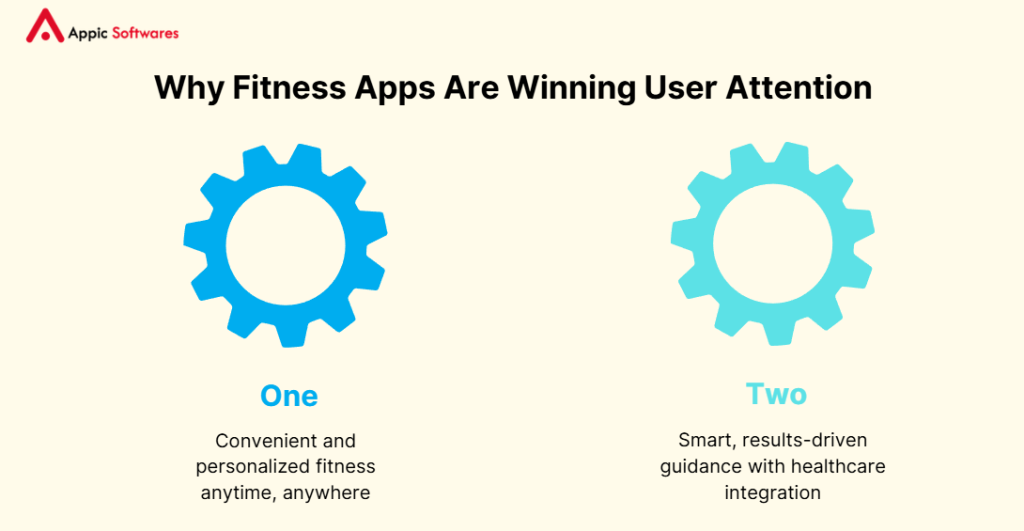
Another area that is growing in conjunction with the fitness application industry is development of healthcare applications. Healthcare applications use digital resources to provide users the ability to track their vitals, manage chronic diseases, and develop positive lifestyle habits. In that way, fitness applications are becoming part of the continuum of care in preventative healthcare, rather than being the sole resource associated with one’s overall well-being.
New technology-enabled solutions utilize AI prediction analytics in healthcare and predictive modeling techniques to develop user-specific routines in order to help prevent injuries prior to occurrence.
What Makes MyFitnessPal and Nike Training Club So Addictive?
Excellent fitness applications provide motivation for action in addition to recording data. the number of global fitness application downloads exceeded 850 million, showing extreme popularity and large user engagement among varied demographics
The MyFitnessPal application has effectively simplified how its users keep track of what they consume through the use of bar-codes, a user friendly method to remotely log food items, immediate calorie count and macro-nutrient overview. This type of application creates a sense of clarity and control over the overall nutrition and fitness routines of the users thus assisting them in developing habits that positively contribute to improving their overall health on a daily basis.
Nike’s Training Club has been designed for the user experience because of the high-quality video demonstrations of workouts, well-defined training programs and motivating trainers. This creates an emotional connection with users and they feel as if there is a personal trainer in their phone.
Through these examples, they prove that the best fitness app development uses both technology and human behavior to create strong user experiences.
Many entrepreneurs start by refining their concept using frameworks from app ideas, ensuring their idea matches real user needs and market demand.
How to Build a Fitness App That People Actually Love
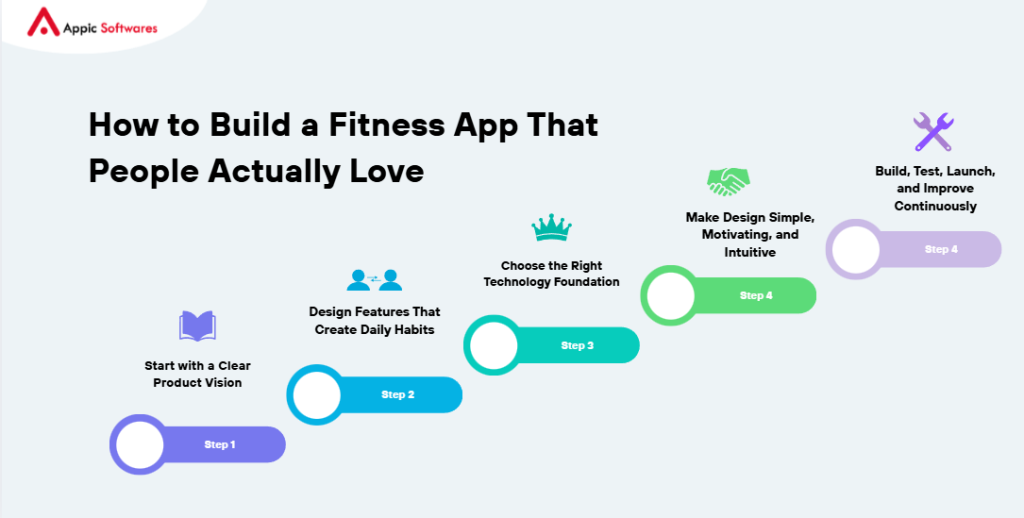
Start with a Clear Product Vision
Every successful app begins with clarity. Who is your user? What problem are you solving? How will your app stand out? Answering these questions early prevents feature overload and unnecessary spending later.
Personalization has become a major differentiator. Many platforms now use intelligent automation and personalization engines supported by custom AI solutions to deliver adaptive training recommendations and smarter user journeys.
Design Features That Create Daily Habits
Users don’t return because of fancy technology, they return because the app fits seamlessly into their routine.
Core features usually include:
- Simple onboarding and profile setup
- Activity and workout tracking
- Goal setting and progress dashboards
- Smart reminders and notifications
Advanced functionality adds differentiation through wearables, AI insights, social challenges, and video-based training.
Scalability models used in platforms such as news app development demonstrate how content delivery and real-time data handling keep engagement consistent even at high traffic levels.
Choose the Right Technology Foundation
Behind every smooth app is a strong technical foundation. Cloud architecture enables fast performance and flexible scaling. Cross-platform frameworks reduce launch time, while native development ensures superior user experience.
Infrastructure principles similar to those used in weather app development highlight the importance of reliability, uptime, and high-frequency data processing for real-world applications.
Make Design Simple, Motivating, and Intuitive
Design influences how long users stay and how often they return. Clean layouts, easy navigation, and clear progress visualization keep users motivated. A fitness app should feel encouraging, not overwhelming.
Build, Test, Launch, and Improve Continuously
Agile development allows teams to release updates quickly, gather feedback, and refine features. Strong testing ensures security, performance stability, and cross-device compatibility.
Budget planning often follows benchmarks established in cost to create an app, which helps businesses forecast investment and ROI realistically.
Understanding Fitness App Development Cost
Estimating fitness app development cost depends on the level of customization, integrations, security requirements, and long-term scalability goals.
Basic apps may cost less but offer limited differentiation. Advanced platforms with AI and wearable integrations require higher upfront investment but deliver stronger engagement and monetization potential.
Read More: How much does it cost to create a weather info app like AccuWeather
Smart planning helps businesses balance quality with budget efficiency.
How Fitness Apps Make Money
Revenue models should align naturally with user behavior.
Subscription plans create recurring income and predictable growth. Freemium access encourages mass adoption before converting users into paying customers. In-app purchases unlock premium programs, while partnerships generate brand revenue.
Financial scalability insights drawn from platforms that choose fintech apps to simplify your finance demonstrate how recurring revenue models build long-term sustainability.
Protecting User Data and Your App Idea
Fitness apps manage sensitive personal data. Strong encryption, secure authentication, and regulatory compliance protect user trust and brand reputation.
Protecting innovation is equally important. Legal strategies detailed in a complete guide to patent an app idea help founders secure intellectual property and competitive advantage.
Scaling Your Fitness Platform for the Future
Future-ready platforms integrate predictive analytics, IoT devices, and personalization engines. Expansion strategies often reflect market intelligence shared in top app development trends in the USA, guiding regional growth and technology adoption.
Scalability lessons can also be learned from platforms analyzed in cost to create an app like Playhouse, demonstrating infrastructure optimization and content scalability models.
Why Appic Softwares Is Your Ideal Fitness App Development Company
Appic Softwares has combined its strong business strategy, focus on user-experience design, and well-experienced engineers to deliver effective digital solutions for developing fitness apps. With extensive experience in developing fitness applications with a healthcare focus, Appic Software’s fitness app developers will ensure your digital product complies with all regulations while being scalable and ready for the future.
Appic Software is able to support you through the entire product life cycle, from ideation through user-experience design to AI integration and post-launch optimization.
If you want to build a fitness app that users will love and trust, Appic Software has the experience and expertise needed to turn that vision into reality. Additionally, Appic Software will assist you in optimizing fitness app development cost, expediting your time-to-market, and establishing a long-term growth strategy.
FAQs
- What features should you look for when you are building apps like MyFitnessPal or Nike Training Club?
Most important features would include user onboarding, tracking of any activities or workout, goal setting and reminders. Additionally, advanced apps include features like AI driven insights, video training modules, etc.
- What is the cost to build a fitness app?
The fitness app development cost depends on various factors such as complexity of an app, features and platform choice. A basic MVP would cost around $10,000-$30,000 while fully featured app with AI integration would cost around $70,000-$80,000 and more.
- How can a fitness app generate revenue?
Fitness apps mostly earn from subscription fees, advertising and partnerships. These strategies help in recurring revenue for fitness apps and at the same time, they deliver the value to customers.