What Is Composable Commerce & Why B2B Businesses prefer It?
Modern headless, microservices-based technology is being adopted by firms that prioritize speed, innovation, flexibility, and scalability to power their e-commerce experiences. These digital commerce platforms with MACH design emphasize composable architecture by enabling business executives to adopt a more modular, best-of-breed strategy.
Describe composable trade, please. How is this strategy being used by firms today?
What is composable commerce?
The development method known as “composable commerce” involves taking the best-of-breed commerce components and “composing” them. It creates a unique application designed to meet certain business requirements.
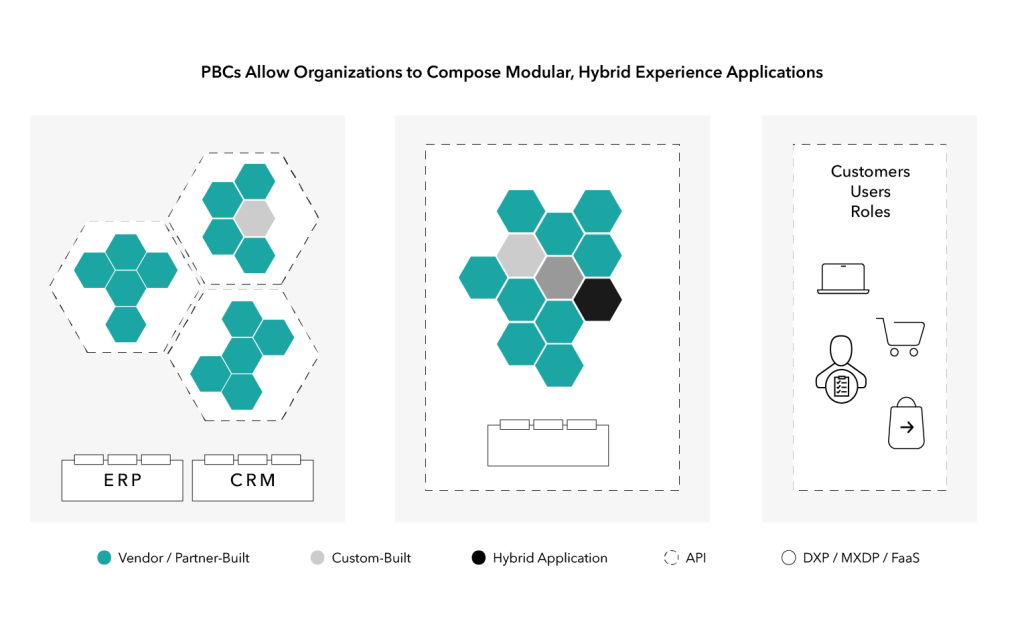
This is accomplished by composing or merging Packaged Business Capabilities (PBCs) in composeable commerce. Every PBC consists of third-party software components and is an application feature or capability. A PBC could be a business user, a shopping cart and checkout, or a promotion.
Rather than depending on a single vendor to provide standard functionality as a one-size-fits-all solution, a composable strategy leverages multiple vendors. It provides strong, complete functionality for the one item they do.
What are the differences between Microservices and PBCs?
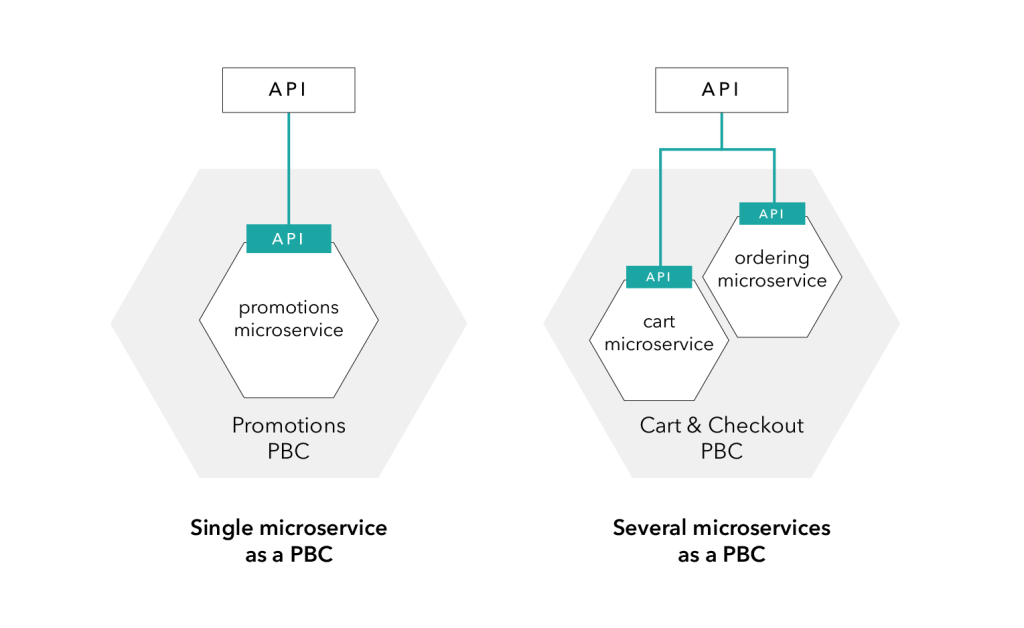
These two concepts can be misleading because they are complementary to one another and have similarities. An application can be divided into discrete features or functions using microservices. Microservices come together to form Packaged Business Capabilities.
How is this related to MACH architecture?
MACH architecture stands for Microservices, API-First, Cloud-Native, and Headless. This is how composable commerce should be implemented.
- Microservices: PBCs can be made modular with the use of microservice-based architecture. However, monolithic programs do not allow for the independent deployment of capabilities because they are too tightly connected.
- API-first: By connecting
two or more apps or services, a composable approach to e-commerce development can be adopted when all functionality is made available via API. - Cloud-native: By utilizing the cloud’s full potential, an application’s scalability and flexibility are guaranteed. Additionally, it lets you skip upgrades and makes it simple to utilize every feature of the program as needed.
- Headless: Because headless apps are decoupled, you can expand them to any number of endpoints, such as linked devices, and thus guarantees ongoing enhancement of the customer interface.
You can take advantage of a modular approach to e-commerce by shifting toward MACH architecture.
Composable commerce, akin to MACH architecture, facilitates the selection and implementation of top-tier, modular applications. As your demands develop and evolve, you can quickly add, swap out, or delete certain capabilities. “That’s how a technology stack should be,” as our friends at Amplience put it.
Why are B2B businesses choosing composable commerce?
No single vendor can provide the optimal functionality required for your particular complex business and the always-changing expectations and needs of your clientele. Conventional commerce platforms discouraged integrations with other best-of-breed PBCs and microservices and instead offered more closely tied features and services as an all-in-one bundle.
By switching to composable commerce, you may get more control over the functionality and efficiency of your application while removing the risk of purchasing fundamental out-of-the-box capabilities.
Composable commerce is:
Modular: Since each PBC may be installed separately, there are no longer any dangers associated with tightly tying services, and you have the freedom to change out modules as needed.
Open: Composable commerce promotes simple integrations and modification because it is based on open standards, extensible models, and integration patterns.
Flexible: Composable commerce offers the adaptability and flexibility required to expand into new markets, channels, and consumer kinds.
Business-focused: Full control over the innovation and iteration process at a reduced cost and risk is provided by the availability of all required tools and capabilities for both development teams and business buyers.
Businesses can use and develop only the features and capabilities required to run their business because of composable commerce’s flexibility. These programs are frequently faster, more nimble, and more adaptable. This development strategy allows you to effortlessly mix many best-of-breed components, from payment processing to content management, to work even faster and offer a considerably greater experience.
Businesses now have more control over how their e-commerce application is provided thanks to composable commerce, as customer needs continue to evolve. The need for digital transformation has become more
pressing than ever. Managing e-commerce experiences across channels is made simple with the decoupled approach. This also positions you for success with a future-proof application.
When creating your modular business, what qualities ought you prioritize?
When creating a composable commerce strategy, there are a few factors to take into account:
- MACH architecture: Any digital strategy should be built around technology that offers the adaptability, scalability, and flexibility required for future-proof success. MACH architecture, with its contemporary, cloud-native, decoupled architecture, is essential for developing a fully composable commerce strategy.
- Rapid development tools and fully documented APIs are essential for composable commerce, as it involve choosing best-of-breed providers to build a unique technology stack. Development tasks will be simpler and take less time if strong fast development tools are combined with best-in-class documentation.
- Support: Rapid and thorough support, like that provided by Slack groups or other open forums. Facilitating cross-functional application development and cross-vendor cooperation are more support features.
Conclusion
We hope that through this post you were guided well on what composable commerce is and why the majority of the B2B businesses prefer it. Shortly, Composable commerce offers a range of benefits to businesses looking to enhance their ecommerce systems.
However, if you are looking for an ecommerce development company, that can help you gain the best out of your software, then you should check out Appic Softwares. Our experienced e-commerce developers can assist you with all your requirements and even create an ecommerce app for you.
Moreover, if you can even hire dedicated developers from us and let them manage your development. So, what are you waiting for?
Related Articles

Digital Wallets In Ecommerce 2025: Know Everything Here!
As the owner of an online store, you’re constantly searching for fresh approaches to enhance the purchasing experience for your clients and boost conversion rates. Using digital wallets is one of the newest trends in digital payments that you shouldn’t ignore. These wallets, which are digital copies of real wallets, keep track of a user’s […]

Top 5 Ecommerce Platform for Fashion (Tried & Tested)
Do you know which industry suffered the most from the COVID-19 pandemic? You guessed correctly. It’s the fashion business. Clothing manufacturing in Europe fell by 37% in 2020, while sales fell by 43% in comparison to 2019. Doesn’t that seem disastrous? The pandemic’s impacts did not touch all fashion enterprises equally. You surely understand that […]

11 Ways To Reduce Ecommerce Operational Cost
Every online retailer wants to lower its operating costs. But it shouldn’t be carried out without careful consideration. The profitability of the company may suffer if you continue cutting operating expenses without considering the demands of your industry and the state of the market. Allow me to explain. Assume you cut back on salary expenses. […]

Unforgettable Unboxing Experience For Ecommerce Brand
The unpacking experience has become increasingly popular on social media over the last few years. Today, it plays a crucial role in shaping customer perception and enhancing brand value. As an Ecommerce App Development Company, focusing on the unboxing experience isn’t just about packaging—it’s about creating a memorable emotional connection with users. The term “unboxing […]
Retail Software Development: Cost, Process, Features & Complete Guide