To hire React.js developers from India, define the role and level, shortlist through an agency, a dedicated team or direct hiring, screen with a real coding task and a technical interview, and agree contract terms on code ownership before you start. Published 2026 estimates put salaries for React developers in India at about ₹3 to 10 lakh a year for juniors, ₹10 to 22 lakh for mid-level and ₹22 to 50 lakh for seniors, and vendor rates at roughly $18 to $50 per hour.
Key Takeaways
- Write the role around outcomes and level: junior, mid-level or senior React, and whether you also need Next.js, TypeScript or React Native.
- Test current React skills: hooks, Server Components, Actions and the React Compiler, and not just older class-component knowledge.
- Pay depends more on employer type and city than on years of experience. Metro cities add a premium of 15% to 30% in one estimate.
- Use a short, paid, real-world task to screen. It tells you more than a quiz or a resume.
- Protect yourself with an NDA, IP assignment, code in your own repository and a trial period.
What should a React.js developer know in 2026?
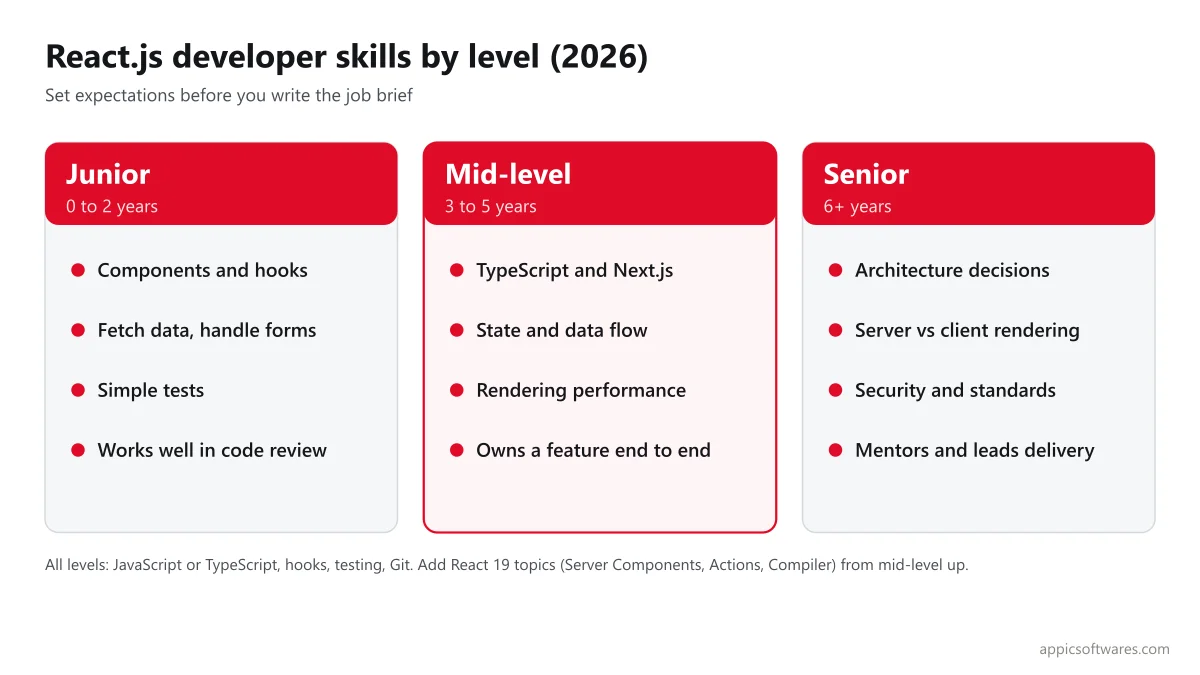
React moved fast in the last two years. React 19, released in December 2024, brought Actions, a new use API and stable Server Components, and React Compiler 1.0 followed in October 2025 (React 19, React Compiler v1.0). Most new React apps also use a framework such as Next.js. Use this table to set expectations by level.
| Level | Experience | What they should be able to do |
| Junior | 0 to 2 years | Build components with hooks, fetch data, handle forms, write simple tests, follow a code review |
| Mid-level | 3 to 5 years | Design state and data flow, use TypeScript, work with Next.js, optimize rendering, write solid tests, own a feature end to end |
| Senior | 6+ years | Choose architecture, balance server and client rendering, set standards, mentor, review security and performance, lead delivery |
Skills to check across levels: JavaScript and TypeScript, hooks, component design, state management, data fetching, testing (unit and end-to-end), accessibility, Git, REST or GraphQL APIs and basic performance tuning. For senior roles add Server Components, caching, security and CI/CD. See also Next.js App Router vs Pages Router if your stack includes Next.js.
How much does it cost to hire React.js developers from India?
There are two ways to look at cost: what a person earns in salary, and what an agency or vendor charges per hour. Salary guides come from third-party sites that use different methods, so treat the numbers as ranges. Sources: Second Talent and Codegnan.
| Level | Typical salary (India, per year) | Notes |
| Junior (0 to 2 years) | About ₹3 to 10 lakh | Service companies sit near the low end, good product companies much higher |
| Mid-level (3 to 6 years) | About ₹10 to 22 lakh | Skills and employer type matter more than years |
| Senior (6+ years) | About ₹22 to 50 lakh | Top product firms pay several times a mid-size firm |
Metro cities such as Bengaluru, Mumbai and Delhi NCR add a premium of about 15% to 30% in one guide. Salary is only part of the cost of a direct hire. You also pay for recruiting, benefits, equipment, payroll and management. Agencies and dedicated teams charge an hourly or monthly rate that covers these costs, and published vendor ranges for India are about $18 to $50 per hour. Appic's average rate is about $35 per hour, and typical projects start around $10,000. For a cost breakdown by role, read our cost to hire React developers from India guide.
What are the ways to hire React.js developers in India?
- Agency or fixed-scope project: best for MVPs and defined work. See our guide to outsourced React.js development services.
- Dedicated React developers: developers work only on your product, and the vendor handles HR and replacement. Our hire developers in India page covers this.
- Freelancers: good for small tasks. You manage quality and continuity.
- Direct hire through an employer of record: the developer joins your team and you control the work. It takes longer and costs more to set up.
For a broader view of models, time zones and contracts, see how to hire Indian developers.
Not sure what level you need? Share your project and we will suggest a team shape and hiring model. Get your project scoped
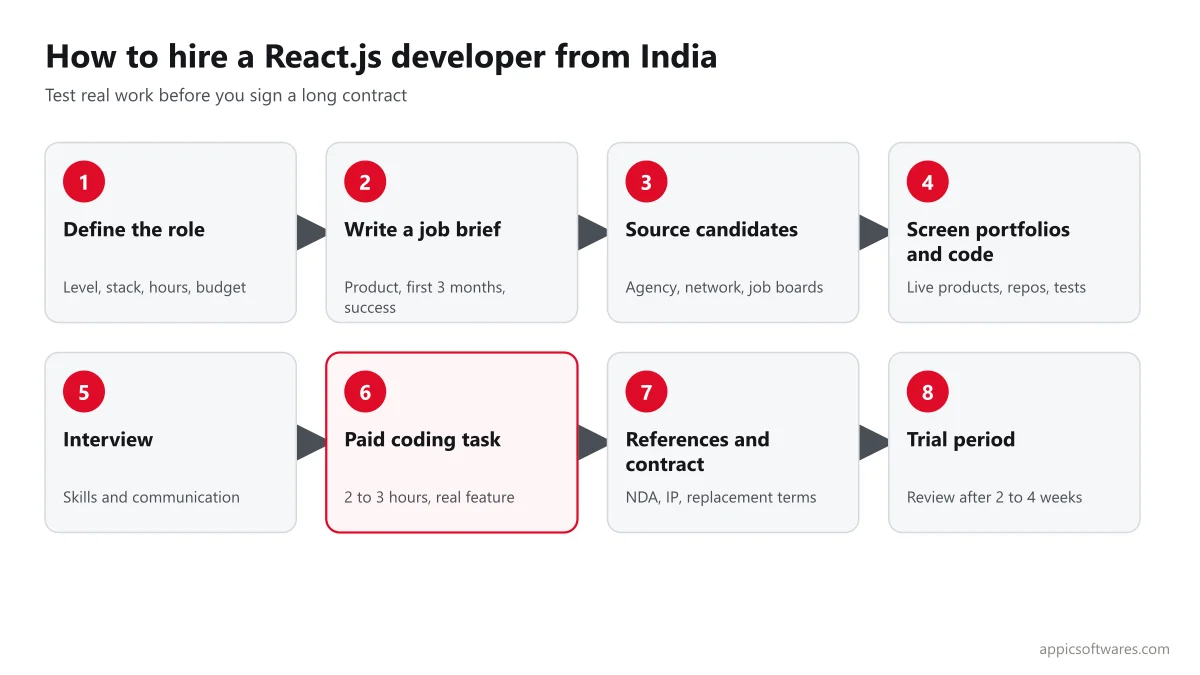
What is the step-by-step process to hire a React.js developer?
- Define the role. Level, stack (React, TypeScript, Next.js, React Native), duration, hours and budget.
- Write a clear job brief. Describe the product, the first three months of work and how you will measure success.
- Source candidates. Ask agencies for two or three profiles, post on job boards or use your network.
- Screen portfolios and code. Review live products and public repositories.
- Interview on skills and communication. Use the questions below.
- Run a paid coding task. Two to three hours on a small real feature.
- Check references and sign the contract. NDA, IP assignment, notice period and replacement terms.
- Start with a trial period. Review output after two to four weeks.
What should a React.js job description include?
- The product and team: what you are building, team size and who they report to.
- Level and years: junior, mid-level or senior, with the main skills required and the nice-to-haves.
- Stack: React version, TypeScript, Next.js or other framework, state management, testing tools, design system.
- Responsibilities: features to build, code review, testing and who they work with.
- Working hours and overlap: the hours you need them online and your time zone.
- Engagement and budget: full-time or part-time, duration and rate or salary range.
- Hiring steps: interview and task, so candidates know what to expect.
How do you screen React.js developers?
- Live products: open them, check speed, mobile layout and basic accessibility, and ask what the developer personally built.
- GitHub or code samples: look for readable components, tests, clear commits, a useful README and signs of code review.
- Communication: ask for a short written answer or a video call. Clear explanations matter for remote work.
- Current skills: ask about hooks, TypeScript, testing and what they have used recently, such as Next.js, React 19 features or React Native.
- References: speak to a past client or manager.
Red flags: copied portfolio projects, no ability to explain their own code, reluctance to do a small task, vague answers about testing and a resume with years of experience but no live work.
What interview questions should you ask React.js developers?
Use questions that test thinking and not memory. The right-hand column says what a good answer covers.
| Question | A good answer covers |
| What causes a component to re-render, and how would you reduce needless renders? | State and prop changes, parent renders, keys, memoization, and when the React Compiler helps |
| When do you use state, context or an external state library? | Local versus shared state, trade-offs, avoiding prop drilling, server state with a data library |
How do useEffect dependencies work, and what are common mistakes? | Stale closures, cleanup, avoiding effects for derived data |
| What is the difference between a Server Component and a Client Component? | Where each renders, what each can access, when to add 'use client' |
How do React 19 Actions and hooks such as useActionState and useOptimistic help with forms? | Pending and error states, optimistic updates, progressive form handling |
What does the use API do? | Reads a promise or context in render, works with Suspense |
| How would you fetch and cache data in a list with search and pagination? | Loading and error states, debounce, caching, cancellation, URL state |
| How do you test a component that loads data? | Testing library, mocking requests, testing behavior and not implementation |
| How do you make a React page fast? | Code splitting, image handling, avoiding large bundles, measuring with real tools |
| Tell me about a bug you fixed that took a long time. | Process, communication, learning from the bug |
What coding task should you give?
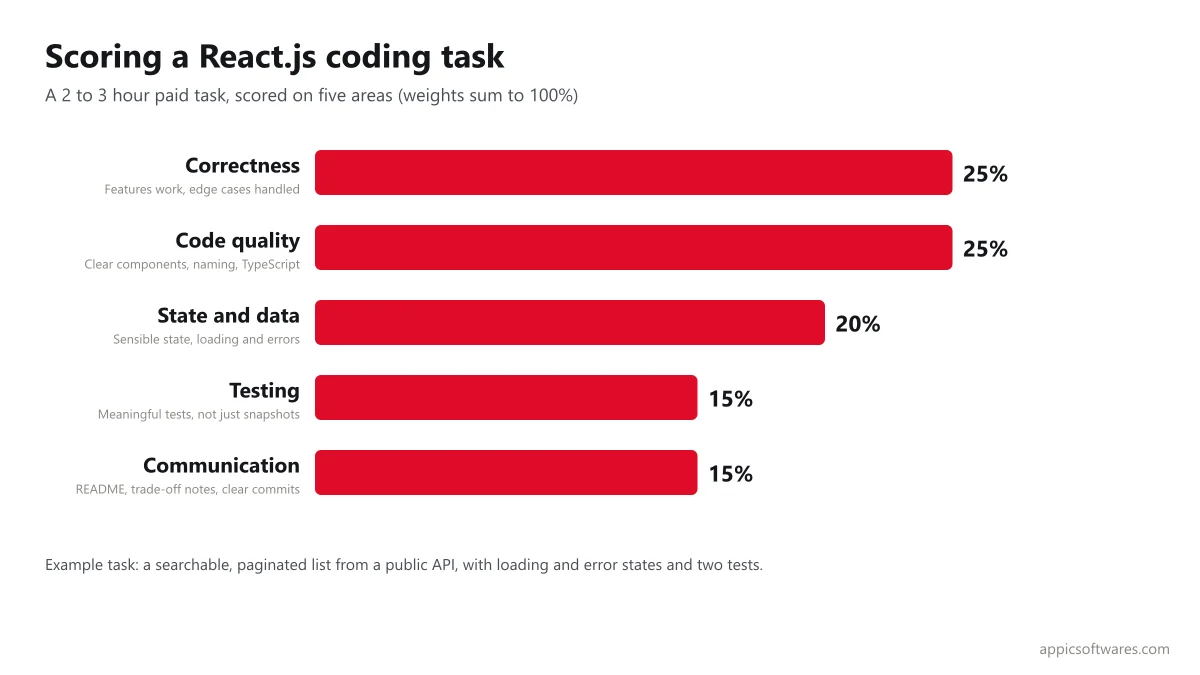
Give a small, realistic task that takes two to three hours and pay for it. Example: "Build a searchable, paginated list of items from a public API with loading and error states, and write two tests." Review it with a rubric.
| Area | What to check | Weight |
| Correctness | Features work, edge cases handled | 25% |
| Code quality | Clear components, naming, TypeScript use | 25% |
| State and data | Sensible state, loading and error handling | 20% |
| Testing | Meaningful tests, not just snapshots | 15% |
| Communication | README, notes on trade-offs, clear commits | 15% |
Free developer shortlist: share your stack and level. We will send profiles of React.js developers you can interview and test before you commit. Request your shortlist
How do you onboard a React.js developer in the first 30 days?
- Week 1: access to the repository, environments, design files and documentation. Pair on a small first task.
- Week 2: ship a small feature through code review.
- Weeks 3 and 4: own a larger task and join planning. Review quality, communication and pace.
Set up daily written updates, a weekly demo, agreed overlap hours and clear coding standards. See how to onboard Indian remote developers for a fuller checklist.
What contract points matter when you hire from India?
- NDA and IP assignment so all code and designs belong to you from the first commit.
- Code in your own repository and cloud accounts under your organization.
- Replacement and notice terms if a developer leaves.
- Data protection and security rules for any personal data.
- Payment terms, currency and invoice process.
Ask a lawyer to review contracts, especially for personal data. More detail is in our guide to legal and contractual aspects of hiring developers in India.
How Appic helps you hire React.js developers
Appic Softwares has built custom software since 2018, with offices in Jaipur (India), Frisco, Texas (USA) and Munich (Germany), and holds a 5.0 rating on Clutch from 24 verified reviews. Our React web development team builds React and Next.js apps, and you can add developers to your team, start a dedicated team or build a full software development team. See how we screen in our vetting process and the Next.js development company page. Typical projects start around $10,000.
What changed from the earlier version of this post?
The earlier version, published in 2023, was a long general guide that covered how to hire in many regions, with no prices, no technical questions and no mention of recent React versions. This update focuses on India and React specifically, adds skills by level, salary and rate ranges, a screening checklist, interview questions with good-answer notes, a coding task with a rubric and an onboarding plan.
Ready to hire React.js developers from India? Send us your stack, level and start date. We will reply with matching profiles, a trial plan and a cost range you can review with your team. Talk to our team