To manage remote employees well, manage outcomes and not hours, put expectations in writing, set a simple rhythm of updates and one-to-one meetings, and give people the tools and onboarding they need to work on their own. Trust grows when goals are clear and results are visible. Close monitoring of keystrokes and screen time usually damages trust without improving results.
Key Takeaways
- Remote and hybrid work is settled, not a trend. Gallup reports that roughly half of US remote-capable employees work hybrid and about a quarter work fully remote.
- Set clear outcomes for each role, and review them weekly in a short one-to-one.
- Write things down: goals, decisions, handoffs and updates. Writing replaces many meetings.
- Remote workers can feel isolated. Gallup's 2025 global workplace report, as cited in roundups, found 25% of fully remote employees reported loneliness versus 16% of on-site employees. Plan for connection on purpose.
- Pick a small, secure tool stack. Fewer tools used well beat many tools used badly.
How common is remote work in 2026?
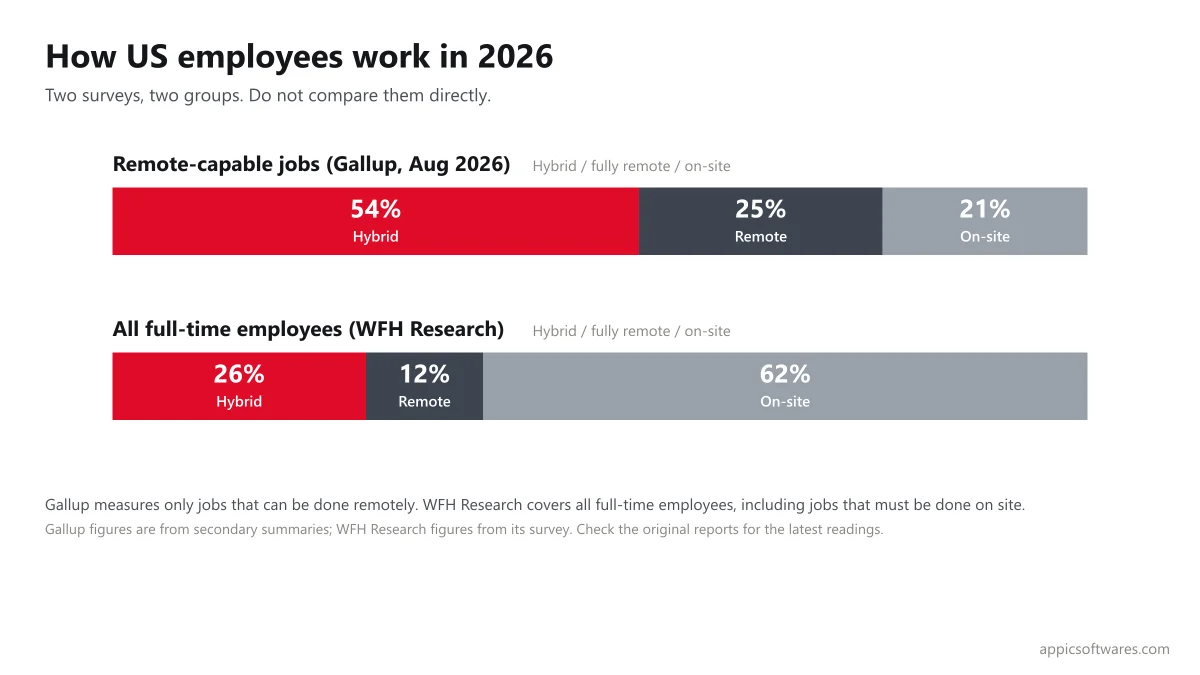
Among US employees whose jobs can be done remotely, Gallup's readings in 2026 show about 52% to 54% hybrid, 25% to 26% fully remote and 21% to 22% fully on-site. These shares have been roughly flat since late 2022. When asked what they prefer, 61% of remote-capable employees said hybrid, 33% fully remote and 6% fully on-site. All of these numbers cover only jobs that can be done remotely. WFH Research, which covers all full-time US employees, finds 26% hybrid, 12% fully remote and 62% fully on-site, and about 26% of paid workdays done from home (Carly summary of Gallup, WFH Research). We read these figures through secondary summaries, not Gallup's own pages.
One experiment is often cited on hybrid work: a study published in Nature in 2024 found that hybrid work cut resignations by about a third without hurting performance in the company studied (Nature, 2024). It covers one large company, so apply it with care.
What are the best practices to manage remote employees?
| Practice | What to do | Why it works |
| 1. Define outcomes | Write 3 to 5 clear goals per role and quarter | People can work independently when they know what good looks like |
| 2. Write it down | Keep goals, decisions and handoffs in shared documents | Cuts meetings and helps across time zones |
| 3. Set a rhythm | Daily or weekly written updates, a weekly one-to-one, a monthly review | Predictable contact prevents drift |
| 4. Agree on overlap hours | Fix a few hours when everyone is online | Fast answers without constant availability |
| 5. Make communication rules | Say which channel is for what and expected reply times | Reduces noise and interruptions |
| 6. Measure results, not activity | Track delivered work and quality | Fair and focused on what matters |
| 7. Give regular feedback | Short, specific notes weekly, plus a deeper review monthly | Remote workers miss hallway feedback |
| 8. Invest in onboarding | A 30-day plan with a buddy and early wins | New hires ramp up faster |
| 9. Build connection | Team check-ins, virtual coffee, occasional in-person meetups | Counters isolation |
| 10. Protect wellbeing | Respect working hours, encourage breaks and time off | Prevents burnout and turnover |
How should a remote team communicate?
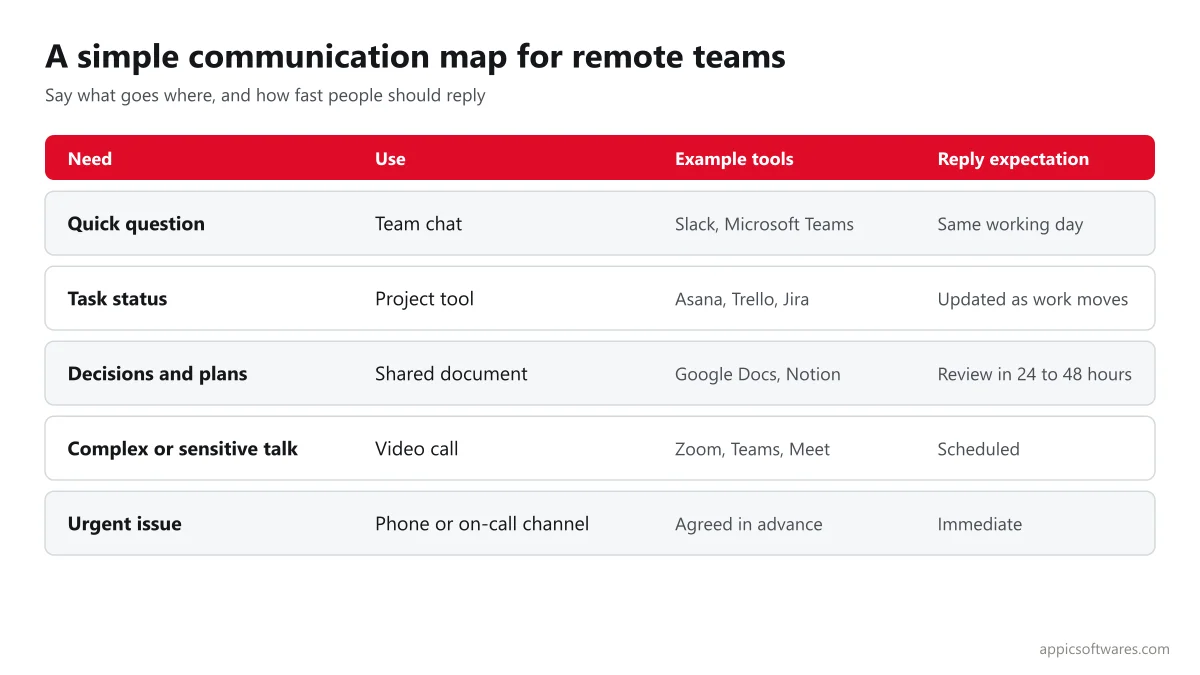
Most remote problems are communication problems. A simple map of what goes where prevents confusion.
| Need | Use | Reply expectation |
| Quick question | Team chat (Slack or Microsoft Teams) | Same working day |
| Task details and status | Project tool (Asana, Trello, Jira) | Updated as work moves |
| Decisions and plans | Shared document (Google Docs, Notion, Confluence) | Review within 24 to 48 hours |
| Complex or sensitive talk | Video call (Zoom, Teams, Google Meet) | Scheduled |
| Urgent issue | Phone call or an agreed on-call channel | Immediate |
Meeting habits matter too. Our guide on virtual meeting mistakes lists common errors, and our post on managing asynchronous work explains how to cut live meetings.
Building a remote or offshore team? We can help you set up the team, the process and the tools. Get your project scoped
Measure what people deliver and the quality of it, and agree on the measures in advance. Examples by role:
- Software developers: work completed against plan, code review turnaround, defects found after release and delivery time per feature.
- Support: response and resolution times, customer satisfaction and re-opened tickets.
- Sales: qualified pipeline, conversion rates and deal progress.
- Design and content: deliverables on time, revision counts and results of the work.
- Operations: accuracy, processing time and issues resolved.
Be careful with monitoring software that tracks keystrokes, screenshots or mouse activity. Rules about employee monitoring and privacy differ by country and state, and heavy monitoring can reduce trust. If you use any tracking, tell employees what is collected and why, and ask a lawyer to review it.
| Need | Example tools | Tip |
| Team chat | Slack, Microsoft Teams | Use channels by project, not one big room |
| Video meetings | Zoom, Microsoft Teams, Google Meet | Record key meetings and share notes |
| Project and task tracking | Asana, Trello, Jira, Todoist | One source of truth for status |
| Documents and storage | Google Drive, OneDrive, Dropbox, Notion | Use shared folders and clear naming |
| Time tracking (if needed for billing) | Timeular and similar tools | Use for billable work, not surveillance |
| Remote support | TeamViewer | Use only with consent and logging |
| Security | Password manager, multi-factor login, device encryption, VPN where needed | Set rules for personal devices |
Skype appeared in our earlier list, but Microsoft retired it in May 2025 and points users to Microsoft Teams, so we removed it. Pick tools your team will actually use, and review the stack once a year.
How do you onboard a remote employee?
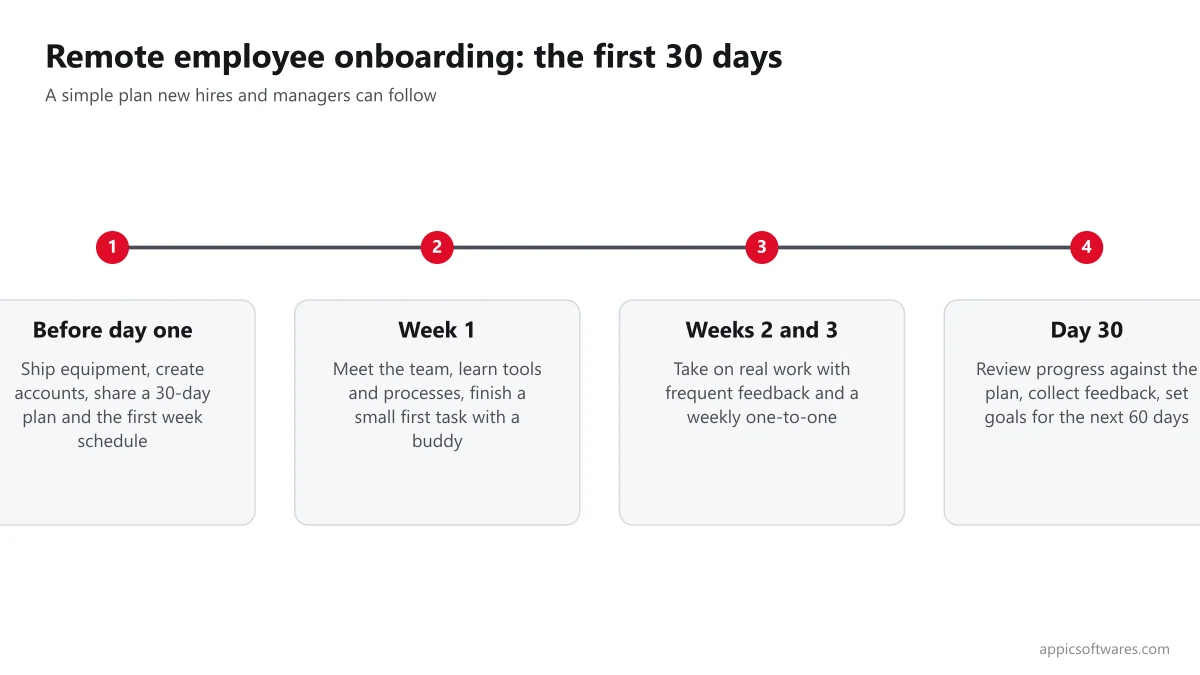
- Before day one: ship equipment, create accounts, share a welcome note, a 30-day plan and the first week's schedule.
- Week 1: meet the team, learn tools and processes, and finish a small first task with a buddy.
- Weeks 2 and 3: take on real work with frequent feedback. Hold a one-to-one at least weekly.
- Day 30: review progress against the plan, collect feedback on the onboarding and set goals for the next 60 days.
See also our guides to remote onboarding and onboarding Indian remote developers.
How do you manage remote teams across time zones?
- Agree on overlap hours of two to four hours when everyone is online, and keep the rest of the day flexible.
- Default to written updates so teammates can pick up work when they come online.
- Rotate meeting times so the same people do not always join late or early.
- Record and summarize important calls.
- Use a shared calendar that shows working hours and holidays.
For offshore setups, read our guide to how to hire Indian developers, which includes a time difference table for Germany, the UK and the US.
How do you keep remote employees connected and healthy?
Isolation is a real risk. Roundups of Gallup's 2025 global workplace report say 25% of fully remote employees reported loneliness, compared with 16% of on-site employees. Ideas that work in practice:
- Short, regular team check-ins that cover more than tasks.
- Pairing and mentoring, especially for new hires.
- Occasional in-person meetups or team days when budget allows.
- Clear limits on after-hours messages, and managers who model them.
- Encouraging time off, and noticing signs of overload early.
Free remote team setup call: tell us about your team and projects. We will suggest a communication rhythm, tools and a plan to onboard remote developers or staff. Book your call
What legal and HR basics should you check?
- Employment status: employee or contractor, and the rules of the country where the person works.
- Contracts: IP assignment, confidentiality, working hours and notice terms.
- Payroll and tax: some companies use an employer of record to hire in other countries.
- Data security: access control, device rules and breach reporting.
- Monitoring and privacy: follow local law and tell employees what you collect.
These rules vary widely, so ask a qualified HR or legal adviser before you hire across borders. For contract points on hiring in India, see legal and contractual aspects of hiring developers in India.
What are common mistakes when managing remote employees?
- Managing by presence. Online status says little about results.
- Too many meetings, or none at all.
- Unclear goals. People fill the gap with guesses.
- Tool overload. Five chat apps and three trackers confuse everyone.
- Ignoring time zones. The same people always take the awkward hours.
- Skipping onboarding and feedback. New hires drift and leave.
For more on what goes wrong, see why companies fail in remote work and how to manage remote agile teams.
How Appic helps you build and manage remote teams
Appic Softwares has built custom software since 2018, with offices in Jaipur (India), Frisco, Texas (USA) and Munich (Germany), and holds a 5.0 rating on Clutch from 24 verified reviews. We work with clients across time zones every day. If you need to add developers to your team, see hire developers in India and our dedicated software development team option, and read our guide to hiring remote developers. Typical projects start around $10,000.
What changed from the earlier version of this post?
The earlier version, published in 2023, was a list of 13 tools, with short feature notes, no data and no advice on managing people. It still included Skype, which has been retired. This update focuses on how to manage remote employees, adds current remote work data, practices, a communication map, performance measures, onboarding and legal basics, and keeps a shorter tools section.
Need developers for your remote team? Send us your stack, time zone and start date. We will reply with matching profiles, a working rhythm and a cost range you can review with your team. Talk to our team