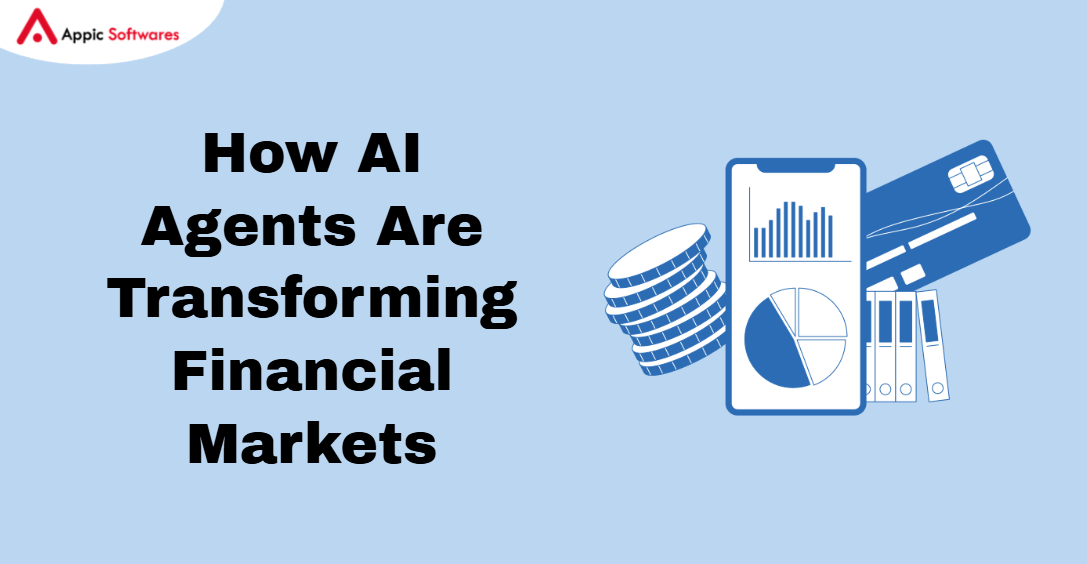
Financial markets have constantly changed in response to advancements. Electronic trading systems, mobile banking, and other technologies continue to revolutionize how money changes hands. The biggest driver of this change is AI agents in finance. These intelligent systems are no longer just experimental tools being tested by tech companies. They are now the backbone of today’s electronic trading platforms, digital banks, asset managers, and fintech companies.
When you examine the way in which financial markets operate now, you will notice some significant differences. Decisions are made faster than they used to be; fraud detection is smarter; customer experiences are tailored to meet the specific needs of each customer; and risk management analyses are predictive rather than reactive. AI agents are at the center of these developments: software systems that can analyze millions of records and identify patterns to take action autonomously.
For companies that want to build financial services scalable across multiple platforms, they must recognize this change as being fundamental to their success.
Understanding the Role of AI Agent in Finance
AI agents in finance are automated intelligence systems that gather large amounts of data about the financial markets. They will analyse these patterns over time to provide feedback to improve the decision-making process and therefore can execute tasks on behalf of a human being. Traditional methods of automation require the use of fixed, pre-defined rules. AI agents adapt and improve their performance based on the outcome of their actions.
Similarly, AI Agents can analyse numerous transactions occurring in a bank at once to identify potentially fraudulent transactions before they spread throughout the entire market. Similarly, AI can analyse a borrower’s potential ability to repay a loan using alternative data sources not typically seen by traditional lenders, such as rent or utility bills.
The scale of this transformation is hard and McKinsey estimates that AI technologies can deliver between $2.6 trillion and $4.4 trillion worth of value annually to the global banking industry alone! This number illustrates just how entrenched AI will become globally within the financial services industry.
The adoption of AI by financial institutions is not voluntary; it has become necessary for these businesses to remain competitive in the digital economy. Speed, intelligence, and forecasting capabilities are now the competitive advantages for today’s financial institutions. Businesses studying finance for enterprise are already recognizing how AI-driven systems are redefining enterprise-level financial operations.
How AI Agents Are Reshaping Financial Markets

Smarter and Faster Trading Systems
Before, Human analysts were responsible for traditional trading. As important as that skill still is today, AI agents are quickly changing and processing data at a rate that no human team can match. The current capabilities of AI agents to identify micro-patterns and correlations in real time allow them to make decisions much quicker and more accurately.
For high-frequency firms, AI systems are the lifeblood of their operations. These systems enable them to process thousands of trades per second while doing their best to eliminate emotional bias and respond to market signals without hesitation. The evolution of autonomous agents in AI demonstrates how independent decision-making models are transforming industries, especially financial trading environments.
AI trading agents do not just react to market changes. They predict trends based on behavioral data and historical analysis. That predictive ability is what transforms volatility into opportunity.
Predictive Risk Management
Moreover, AI trading agents do not just correlate their reactions to what the market does. They also have the ability to predict market behavior with behavioral and historical data – it is that predictive ability that will convert volatility to opportunity.
Historically, risk management has been reactive in nature, whereby an institution would identify potential threats only after they had already happened. With AI, it is possible to completely transform this angle of risk management by using AI agents to constantly monitor transactions and user behaviors. They flag suspicious activities in real time and reduce exposure to financial crime. Understanding the various types of AI agents helps organizations choose the right intelligence model for fraud detection, credit assessment, and compliance monitoring.
Instead of responding to crises, financial institutions now anticipate them. That shift strengthens regulatory compliance while building customer trust.
Personalized Financial Experiences
Modern customers expect more than standardized banking services. They want tailored recommendations, intelligent insights, and seamless transactions across platforms. AI agents make personalization scalable and efficient.
These systems analyze user behavior, spending patterns, and investment preferences. Based on this data, they recommend customized savings plans and portfolio adjustments. Businesses leveraging goal-based AI agents are successfully aligning financial services with customer objectives, ensuring smarter financial planning experiences.
Personalization is no longer optional in digital finance. It is a competitive necessity.
AI in Finance: From Development to Deployment
The Importance of Choosing the Right Finance App Development Company
Building intelligent financial platforms requires more than technical coding skills. It demands regulatory awareness, cybersecurity expertise, and scalable system architecture. A reliable Finance app development company understands how to integrate AI models securely while ensuring optimal user experience.
At Appic Softwares, AI-driven financial solutions are developed with long-term scalability and compliance in mind. Their expertise enables fintech startups and enterprises to launch secure and future-ready platforms. Businesses exploring sites to hire fintech app developers often discover that selecting the right development partner significantly influences project success.
Selecting the right technology partner determines whether your AI strategy thrives or struggles in competitive markets.
Building the Right Technology Stack
AI-driven financial systems rely on robust infrastructure. Cloud computing supports scalability, while advanced analytics frameworks process large volumes of structured and unstructured data. APIs allow integration with payment gateways and banking systems. Blockchain enhances transparency and security.
Choosing the correct architecture ensures operational efficiency and long-term sustainability. Companies studying the ideal tech stack for fintech understand how technology selection directly impacts performance, scalability, and compliance standards.
Strategic architecture decisions today define financial innovation tomorrow.
Embedded Finance and Digital Wallet Integration
The financial experience is increasingly embedded within digital platforms. Customers now complete transactions within apps without switching between multiple systems. AI agents support this ecosystem by evaluating transaction risks in real time.
Modern fintech platforms also prioritize Digital wallet integration to simplify payments and enhance user convenience. Businesses analyzing best embedded finance startups are witnessing how AI-powered payment ecosystems are reshaping digital commerce globally.
Embedded finance supported by AI creates seamless and secure customer journeys.
Understanding Development Costs and Strategic Investment
Adopting AI in finance requires strategic budgeting. Development costs vary based on compliance requirements, scalability needs, AI complexity, and system integrations.
Companies evaluating project feasibility often should see SaaS fintech development cost to estimate infrastructure and AI implementation expenses accurately.
Similarly, understanding the complete fintech app development cost structure helps businesses plan long-term investments while minimizing technical debt.
Although initial investment may appear significant, AI integration enhances operational efficiency, reduces fraud, and increases user retention, ultimately delivering strong returns.
The Intersection of AI and Blockchain in Trading
AI agents are increasingly integrated with blockchain systems to enhance trading transparency and execution efficiency. Smart contracts automatically process transactions when predefined conditions are met. AI systems monitor market conditions and trigger these contracts intelligently.
Organizations often analyze the future of blockchain in trading finance by discovering how decentralized systems combined with AI intelligence are reshaping global trading infrastructures.
This convergence signals a future where financial systems operate with greater transparency, automation, and security.
Why Businesses Partner with Appic Softwares
AI agents provide technical insight and forecasting to change the way traditional business models operate. Appic Softwares provides AI financial innovations that include integration with secure, seamless systems.
The financial services marketplace is rapidly changing from traditional, manual processes to automated or predictive intelligence processes. Ultimately, any organization that develops an AI agent will be a leader in its market.

The most important question you need to ask yourself is whether your current system is ready for an AI agent in Finance. If you want to improve or create a Fintech product, the integration of an AI agent should be one of the primary objectives of your overall business strategy moving forward. By partnering with Appic Softwares, your organization will have access to intelligent, reliable, secure, robust, scalable systems built on total data synergy. The entire team at Appic Softwares will work together with you to convert complex concepts for implementing and utilizing AI based technology into clear and measurable results at your organization.
FAQs
AI agents in finance are intelligent software systems that can analyze financial data, learn from patterns and automatically make decisions such as trading, fraud detection, credit assessments, and providing personalized financial advice.
AI is transforming financial markets through greater accuracy in trading, improvements in fraud detection and predictive risk management. By creating more personalized experiences for customers and increased overall operational efficiency at lower costs due to reduced human error and lower financial risk.