Artificial Intelligence (AI) has moved from being a futuristic idea to becoming an ingrained part of business strategy for growth and competition. The global investments in AI are expected to reach approximately $2.52 trillion by 2026, reflecting significant investments in technology and businesses that are on the cutting edge of building a solid AI ecosystem from which they can drive their growth
The single question on the minds of all entrepreneurs and business owners when thinking about creating their first AI application is:
What is the actual cost to develop an AI app in 2026?
The answer to this question is complex because developing AI applications depends on several factors such as, the specific functionality you want the application to have, how smart or advanced you want it to be, how secure and dependable you want it to be and finally who your partners are for developing and deploying the application.
By 2026, it is estimated that at least 80% of enterprises will use or implement Generative AI applications into their production environments; therefore businesses will need to incorporate AI into their competitive strategies in order to remain competitive, since AI will be widely adopted by most industries.
This guide outlines pricing expectations based on various factors affecting the final AI app development cost, provides insights on the modern capabilities and use cases of generative AI, and provides several examples of how other companies have implemented generative AI into their business models in order to provide insight to businesses to develop and implement generative AI based applications in an informed and confident manner.
Understanding the AI App Landscape in 2026
The AI ecosystem in 2026 has matured, has more accessible options for users, and has a much more competitive landscape than ever before. Furthermore, businesses can now include intelligent options for their products via API’s, rather than needing to create an entire system from scratch to accomplish that task.
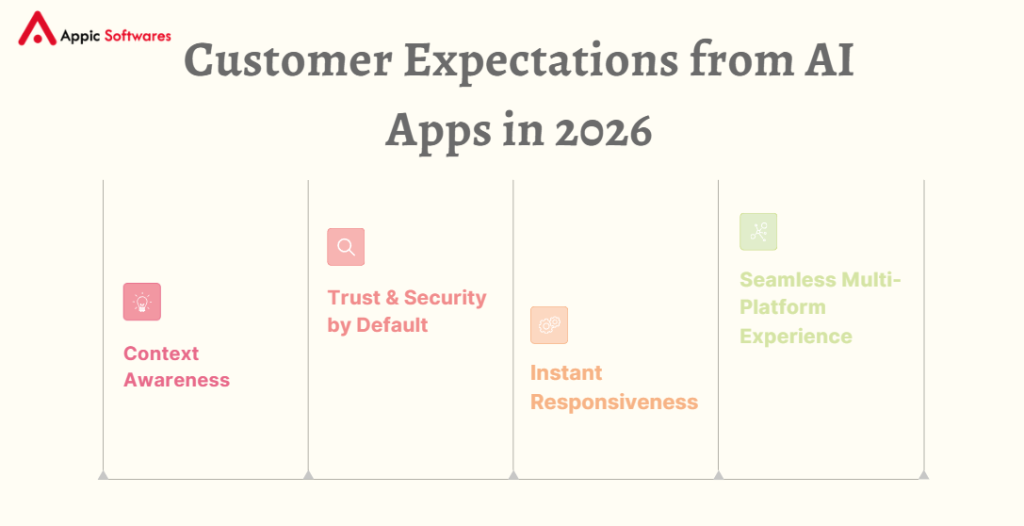
Consumers’ evolving expectations can also be attributed to continuous advancements in automating and generating AI, using intelligent Agents, and building effective pipelines for their data. As businesses continue to follow-up-to-date on AI development trends, they will also gain a tactical advantage over those companies that do not.
What Does AI App Development Cost in 2026 Really Look Like?
When clients ask about AI app development cost, the most accurate response is a range rather than a fixed number. A lightweight MVP with limited intelligence may cost significantly less than a full-scale enterprise platform with autonomous decision-making capabilities.
| Types Of App | Estimated Cost (USD) |
| AI MVP (basic features, limited users) | $10,000 – $20,000 |
| Mid-scale AI application | $20,000 – $40,000 |
| Enterprise-grade AI platform | $40,000 – $60,000+ |
| Autonomous AI Agent System | $60,000 – $80,000+ |
As an application’s intelligence level increases, the price to develop it rises. Apps that use natural language processing, image recognition, predictive analysis, and self-learning models have a higher demand for engineering time, testing cycles, and computing power.
Read More: AI Meeting Assistant: Top Tools For Client Calls & Meetings
Also hidden in the initial AI app development cost is ongoing optimization. AI systems need to be monitored, retrained, fine-tuned for performance, and updated for security regularly. Companies with good foresight account for these continuing costs when developing their AI apps and don’t only focus on the initial build-out.
What Drives the Cost to Build an AI App?
AI Functionality and Intelligence Level
Not every AI Application has the same functionality. Some are designed only to automate business processes and follow pre-defined business rules; while other applications rely on machine learning to provide predictions or make immediate decisions – such as those that operate as Autonomous Systems. Autonomous systems need to provide a highly developed level of orchestration, create feedback loops and support continual learning.
Data Availability and Data Quality
AI thrives on data. If your organization already has clean, labeled datasets, development becomes faster and more affordable. If data must be collected, cleaned, labeled, and validated, your timeline and cost expand.
The overall AI app development cost includes many factors outside just development. Data pipelines, cloud computing options, compliance requirements and monitoring are just some of the items that can lead to higher than expected budgets in many organizations as they often underestimate these costs.
Customization Versus Ready-Made Models
The quickest way to develop an AI application is to use an off-the-shelf (OTS) model but these will generally not be as accurate for that industry as building a company-specific model through custom app development.
Additionally, custom AI applications can be developed using the company’s proprietary data which allows training the model on data specific to that business and then optimizing work processes in order to gain competitive advantage.
Talent and Development Partner Selection
The selection of the right company for the development of an AI application can greatly impact the ability to maximize development savings. Companies with experience in creating and developing AI applications can build faster, avoid the mistakes in architecture and deliver scalable AI systems for a much lower cost to maintain. Many organizations also choose to hire AI engineers when significant long-term development is needed.
Essential Features of a Modern AI App in 2026
Today’s AI Application is not simply an algorithm combined with some sort of front end User Interface (UI) but rather is a complete Digital Ecosystem that has been created with Performance, Reliability, and Trust in Mind.
AI Applications will have Intelligent Automation, which learns dynamically from users’ behavioral patterns instead of relying on previously established logic as well as Personalization, which learns from users’ historical behavior and current input (real-time input).
AI Applications will also have the ability for third-party systems, including API’s, CRM’s, ERP’s and/or Analytics to integrate with these applications. From the user’s perspective, Intuitive User Interfaces and Transparent Explanations of an AI Application’s Decisions will promote User Adoption & Trust. In addition, Technical Features, including Model Monitoring, Automated Retraining Pipelines, and Cloud Scalability, will support Long-term Stability.
For those businesses looking to develop an intelligent system, they will want to review the AI Agents features so that they can understand how Autonomy, Memory, Planning, And Decision Logic translates into the potential for Commercial value.
High-Impact AI Use Cases Across Industries
Regardless of your industry, there’s likely an application for AI within it. Let’s look at three of the most in-demand and profit-driven applications for AI today.
Autonomous Agents Or AI Agents
Autonomous agents are capable of completing multi-faceted activities on behalf of their human counterparts, including booking travel arrangements to processing customer inquiries in support.
- Common Examples of AI Agents:
- Virtual Planning Agents for Travel
- Automated Onboarding Agents for Customers
- Automated Workflow Management Agents
- AI Assistants for Internal Teams
When it comes to automating tasks, organizations frequently explore using autonomous AI agents to better understand how autonomous agents operate at scale and ultimately derive the most value. However, organizations also explore other types of AI Agents in AI for different use cases, depending upon the organization’s goals, enhancing customer interactions or improving their own productivity.
FinTech AI Application
AI is disrupting and revolutionizing the Financial Services Industry With:
- Fraud Detection Technology
- Credit Risk Scoring Technology
- Robotic Advisor Services
- Intelligent Customer Support Technology
- Automated Monitoring of Regulatory Compliance Agencies
Progressive Companies searching for the future of AI in Fintech alongside Emerging Fintech Technologies will design a platform that meets the competitive marketplace’s demands and is adaptable for a rapidly changing ecosystem.
Travel & Hospitality AI Applications
Travel and Hospitality Applications Automated:
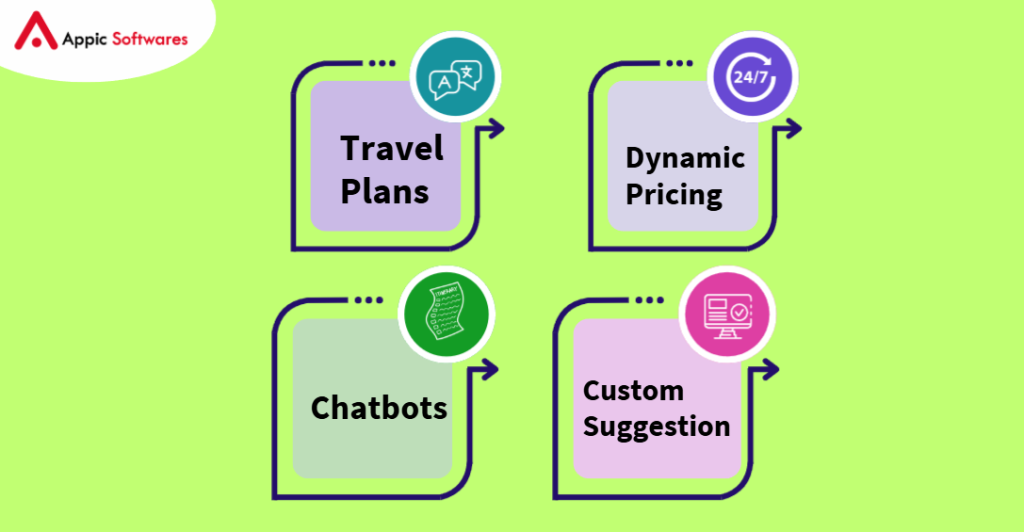
- Travel Plans
- Dynamic Pricing
- Chatbots for Customer Service
- Custom Recommendations
For businesses evaluating this sector, insights from the travel AI agent development help determine implementation strategies and cost factors.
Mobile Banking Platforms
Smart alerts, personalized financial insight, voice assistants, and automated fraud prevention, are just some of the examples where AI assists users within mobile banking. Competitor analysis for mobile banking apps typically involves examining other top-tier mobile banking app development organizations for design standard design innovation benchmarks.
Real Estate and Property Management
AI assists Property Management by Predictive maintenance, automated Tenants Support, Intelligent Reporting, and Price Optimization. Many developers are interested in learning about how to create AI property management software, so they will often study other AI Property Management software solutions to develop their Operational Architecture and Scalable Requirements.
Real Cost Examples Based on Business Scenarios
The budget for a startup creating a chatbot for customer support with CRM integration will likely range between $20,000 to $40,000 dollars. This budget would include costs for integrating an NLP engine, developing basic analytics, and setting up the infrastructure needed to deploy the chatbot.
A mid-sized business planning to create an AI travel agent platform will likely spend between $40,000 to $80,000 depending on how many different integrations, and how scalable their platform will need to be.
Enterprises within the fintech sector that build risk analytics systems and then will also automate compliance and utilize predictive modelling systems may require a budget above $80,000. This is likely due to various regulatory requirements, data pipeline requirements, and security architecture requirements.
When businesses begin to research agent-based systems, they can set realistic budgets based on understanding the development costs associated with AI agents in order to establish realistic expectations at the onset of a project.
How to Optimize Your AI App Investment
Cost efficiency does not mean cutting corners. It means making strategic choices that maximize ROI.
Starting with a focused MVP allows validation before scaling. Leveraging proven frameworks accelerates development. Prioritizing features based on business impact prevents unnecessary complexity. Designing scalable architecture early avoids expensive refactoring later.
Working with experienced AI development services ensures your system is built with performance, security, and growth in mind from day one.
Why Appic Softwares Is the Right AI Partner
Finding the right development partner is crucial to a project’s success. A complete end-to-end AI solution for your unique business needs, timeline, and budget is what Appic Softwares does.
As an established AI agent development company, Appic Softwares builds secure intelligent automation systems that can scale and produce quantifiable business benefit. Expertise includes strategy, architecture, data engineering, deployment, and ongoing optimization.
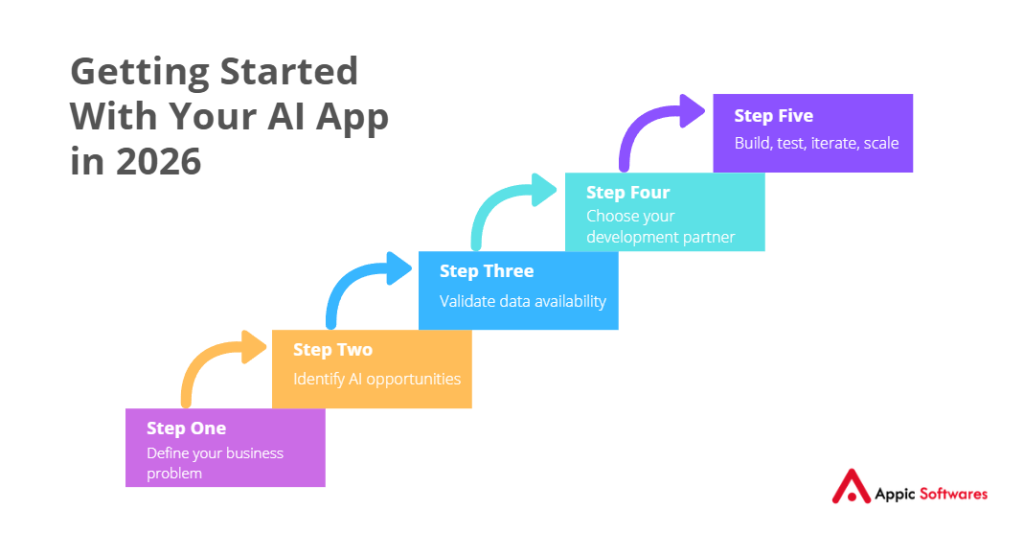
Due to our collaborative approach, there is complete transparency about cost estimates, development milestones, and performance benchmarks. It allow businesses to anticipate everything and get the maximum return on investment.
Working with an experienced company that specializes in AI app development services will provide you right path from the beginning of your project.
Ready to Build Your AI App in 2026?
If you are planning to build or grow an AI-powered product, the time to get started is now. Appic Softwares provides guidance and services at every step of your project, whether you’re looking for a MVP, enterprise-grade automation or autonomous AI agents.
From concept validation and architecture design to deployment and optimization, their team ensures your investment delivers measurable business impact.
Get a custom AI app development cost estimate from our AI experts!
Our team will turn your vision into a high-performing AI solution that leads to greater efficiency, innovation, and growth.
FAQs
- How much does it actually cost to build an AI app in 2026?
The average cost to develop an AI app would cost you between $10,000-$80,000. The cost will depend upon complexity of features you need in your application, integrations and security needs and market scenario. The final cost may depend upon the customization level and the experience of your AI app development company.
- How much does it take to build an AI app?
Building an AI app would usually takes 3 to 8 months. It would again depend on the complexity of the application. Planning and data preparation would also affect the timings.
- Is it possible to reduce AI development cost without reducing quality?
Absolutely! If we are reducing the cost that doesn’t mean, we will compromise on quality. Everything is about making smarter decisions from day one and being consistent. We need to focus on the features which create the highest business impact first.