Today, the financial service industry is no longer reliant on simply looking back at previous years of data. Institutions expect that they will be able to not only predict and mitigate risks but also forecast potential market fluctuations and provide personalized customer experiences in real time through predictive analytics. Predictive analytics is an important area that uses statistical models and algorithms to process historical data to create predictions for future events with high levels of accuracy.
Companies that use predictive intelligence within their organization will also gain a competitive advantage over other firms. Predictive analytics will help firms reduce operational risks, increase operational efficiency, and improve customer satisfaction at the same time. Additionally, the global predictive analytics industry is projected to be approximately $35.45 billion by 2027, which reflects the volume of predictive technology now being incorporated into businesses across many different industry sectors, particularly the financial services sector.
With the use of AI in the fintech industry, predictive analytics will continue to serve as the cornerstone for innovation in this area of the financial sector. By integrating predictive analytics with data, analytics, and automation, financial organizations can build smarter systems that will enhance financial performance. At Appic Softwares, we are focused on designing custom predictive analytics solutions to help financial organizations efficiently and securely scale their businesses.
The examples below are seven different ways the implementation of predictive analytics in finance is providing real value.
Use Cases of Predictive Analytics In Finance Everyone Should Know
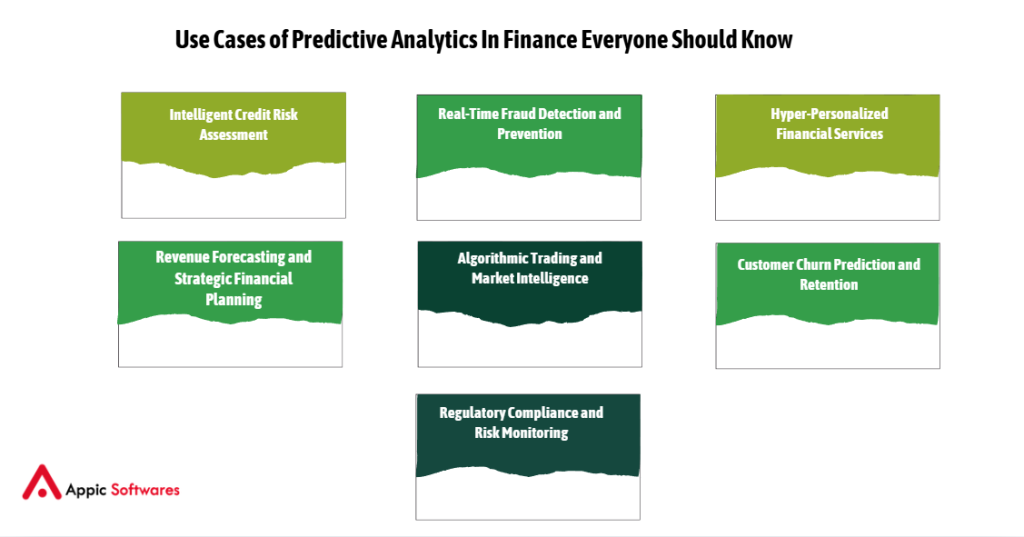
1. Intelligent Credit Risk Assessment
Decisions made when lending money affect the financial performance of lenders. Conventional credit scoring methodologies generally apply a limited history of financial transactions to establish credit scores, which are then compared to a fixed scoring system.
Thus, these scoring techniques can omit valuable behavioral insights that are not visible within the relatively small financial data sets available.
Predictive analytics will enhance an organization’s ability to assess the credit risk associated with potential borrowers by analyzing transaction patterns, repayment history, spending habits, and other sources of data outside of the conventional scope of data available for credit evaluation purposes. By utilizing machine-learning models, lenders can identify more accurately the patterns associated with likely defaults than through previous conventional methods.
Modern Enterprise finance software now embeds predictive scoring mechanisms directly into its core systems, allowing real-time loan approvals and dynamic risk evaluation. Organizations adopting advanced enterprise finance strategies are aligning their digital transformation initiatives with frameworks similar to finance for enterprise, where intelligent analytics strengthens financial infrastructure.
Smarter lending powered by predictive analytics ensures balanced growth while minimizing financial exposure.
2. Real-Time Fraud Detection and Prevention
These predictive analytics use user behavior, transactions with anomalies, device information, and geolocation data to create models that continuously learn from new incoming data, therefore increasing their accuracy.
According to IBM’s report, the average worldwide cost of a data breach in 2023 was $4.45 million. Therefore, it is critical for organizations to work toward preventing fraud from increasing before it damages their revenue and reputation.
Within AI in fintech ecosystems, predictive systems flag suspicious transactions instantly without interrupting legitimate customer activities. The increasing reliance on analytics-driven security solutions reflects the transformation seen in data science in fintech, where machine learning enhances fraud intelligence.
By integrating predictive fraud detection, financial institutions strengthen security while maintaining seamless user experiences.
3. Hyper-Personalized Financial Services
Customers want their financial services to reflect their unique needs. Financial institutions can utilize predictive analytics to better understand the behavior of users so they can proactively suggest suitable products.
By analyzing users’ spending behaviors, savings habits, and desired financial goals, predictive models can provide users with customized investment plans, loan offers, and budgeting guidance.
According to a study performed by Accenture, 91% of consumers are more likely to interact with brands that provide relevant recommendations. This highlights the strong correlation between personalization and customer loyalty/lifetime value in the digital finance industry.
A knowledgeable finance application development firm can embed predictive recommendation engines smoothly into finance applications, thus providing users with an intuitive user experience. The rapid growth of embedded finance platforms mirrors the innovation showcased in the best embedded finance startups, where personalization plays a central role in user engagement.
Predictive personalization transforms customer interactions from reactive to proactive.
4. Revenue Forecasting and Strategic Financial Planning
Accurate forecasting supports confident decision-making. Traditional financial forecasting methods rely heavily on static spreadsheets and manual projections. These approaches struggle to adapt to volatile market conditions.
Predictive Analytics in Finance analyzes historical revenue data, seasonal fluctuations, macroeconomic trends, and operational metrics to generate forward-looking projections.
According to Deloitte, data-driven organizations are five times more likely to make faster decisions than competitors. Predictive forecasting provides leadership teams with actionable insights that reduce uncertainty.
Advanced top financial reporting software integrates predictive dashboards that allow scenario analysis and dynamic forecasting. Businesses planning scalable SaaS solutions often evaluate analytics capabilities alongside investment considerations such as SaaS fintech development cost.
By leveraging predictive forecasting, financial institutions improve strategic agility and financial resilience.
5. Algorithmic Trading and Market Intelligence
Financial markets operate at extraordinary speed. Human decision-making alone cannot process the massive volume of real-time data generated every second.
Predictive analytics powers algorithmic trading systems that analyze historical trends, price movements, and market signals instantly. These systems execute trades automatically based on predefined predictive models, reducing emotional bias and increasing precision.
The integration of predictive analytics with blockchain-driven financial systems reflects broader technological advancements, such as the future of blockchain in trading finance.
Institutions leveraging predictive market intelligence gain a faster response capability, improved portfolio optimization, and enhanced risk management.
6. Customer Churn Prediction and Retention
Long-term customer retention is an important part of maintaining a healthy financial growth trajectory. By using predictive Analytics, organizations can identify possible indicators of lost customers by looking at things like transaction frequency, login frequency, or past service complaints.
Using these same data trends, predictive models create churn scores based on the likelihood of a customer leaving before they actually do, which means that companies can begin using proactive engagement strategies to retain customers before they leave.
Organizations investing in scalable fintech platforms carefully evaluate infrastructure and feature planning, and consider fintech app development cost.
Retention-focused predictive strategies strengthen long-term customer relationships and stabilize recurring revenue streams.
7. Regulatory Compliance and Risk Monitoring
Regulatory compliance has become increasingly complex in global financial markets. Manual monitoring processes are inefficient and prone to oversight.
Predictive Analytics in Finance automates compliance monitoring by identifying unusual reporting patterns and potential risk exposures in real time.
Modern Enterprise finance softwares embed predictive compliance dashboards to enhance transparency and automate regulatory reporting. The broader adoption of intelligent governance systems aligns with evolving fintech trends, where AI-driven compliance frameworks are shaping the future of financial oversight.
Predictive compliance reduces penalties, improves audit readiness, and enhances institutional credibility.
Why Predictive Analytics in Finance Is a Strategic Imperative
The landscape of finance is changing at a rapid rate. There is a growing number of data and expectations from customers. Regulatory obligations are becoming more stringent.
If an organization doesn’t leverage predictive intelligence, it will fall behind competitively. Predictive Analytics for Finance enables organizations to have foresight, pinpoint accuracy, and operational efficiency.
Successful deployment calls for proficiency in system architecture, data engineering, and secure integrations. Financial institutions evaluating development partnerships often assess expertise and hire fintech app developers.
A robust technical foundation, supported by the right tech stack for fintech, ensures scalability, security, and long-term performance.
Build Intelligent Financial Systems with Appic Softwares
Appic Softwares creates advanced predictive analytics solutions that are customized for contemporary financial institutions. Our expertise in Fintech AI will enable us to utilize scalable development techniques to produce safe, high-performance platforms.
As a professional finance app development company, we will develop predictive engines that improve fraud detection, forecasting accuracy, monitoring compliance, and customer engagement. Our solutions will be built such that they will integrate into existing financial systems while also being compliant with regulations and providing enterprise-level security.
Implementing predictive analytics provides more than just an enhancement in technology; rather, it provides an investment in the sustainable growth required to achieve success tomorrow.