Fintech Solutions: 10 Types, Real Examples, 2026 Data and How to Choose or Build One

Fintech solutions are software products and services that use technology to deliver financial services: payments, banking, lending, investing, insurance, compliance, and business finance. They can be consumer apps such as digital wallets, tools sold to banks and companies such as fraud detection, or platforms that let other businesses offer financial features inside their own products.
Key Takeaways
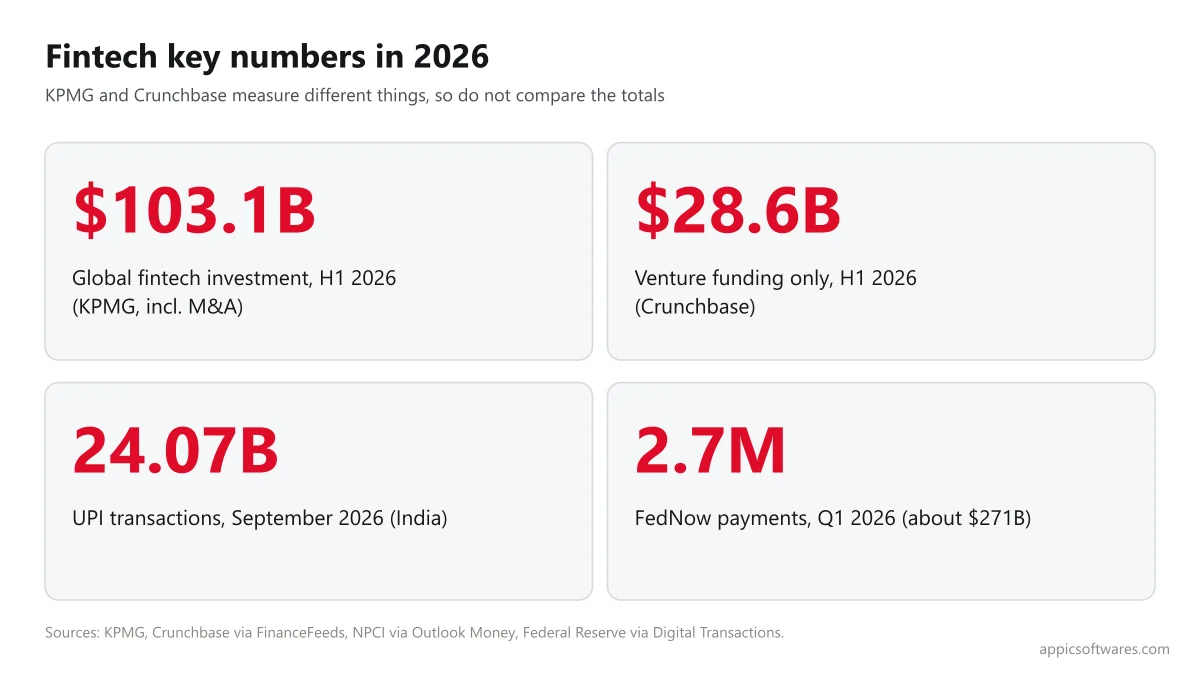
- KPMG reported $103.1 billion of global fintech investment in H1 2026, including M&A, while Crunchbase counted $28.6 billion of venture funding. The totals differ because they measure different things.
- Deal counts fell while money concentrated in larger deals, led by payments and AI.
- Real-time payments are now mainstream: India's UPI processed 24.07 billion transactions in September 2026, and FedNow processed about 2.7 million payments in Q1 2026.
- Compliance (KYC, AML, data protection and licensing) shapes every fintech product and often decides the build approach.
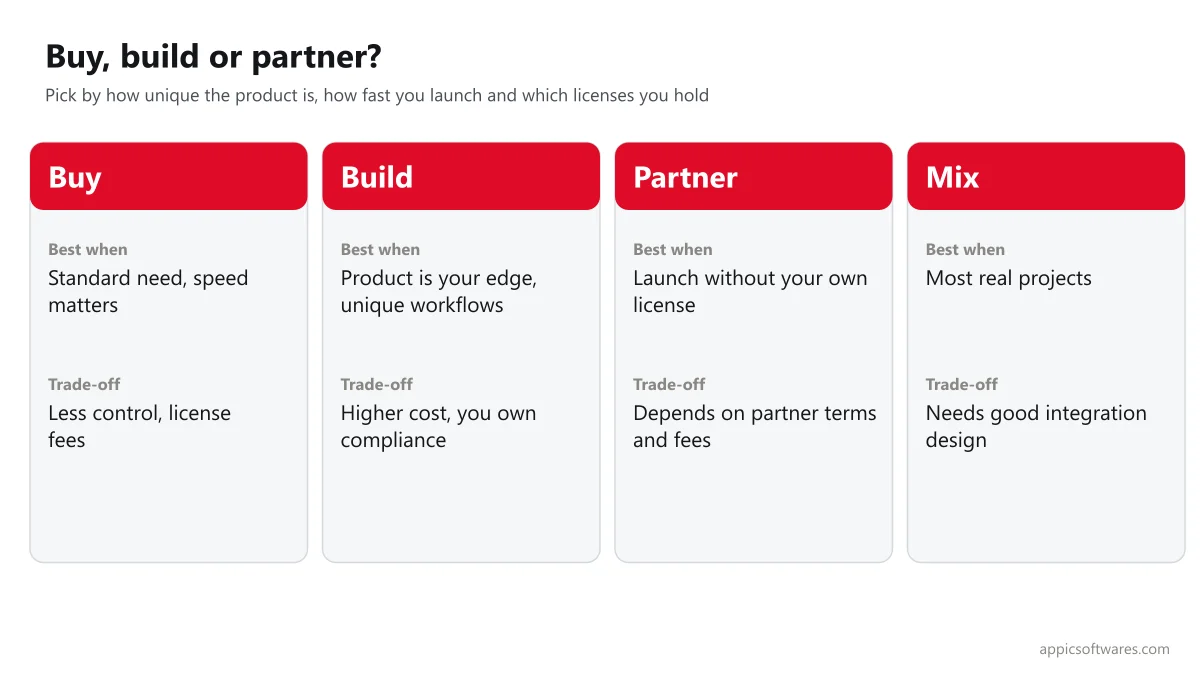
- Choose to buy, build or partner based on how unique your product is, how fast you must launch and which licenses you hold.
What are fintech solutions?
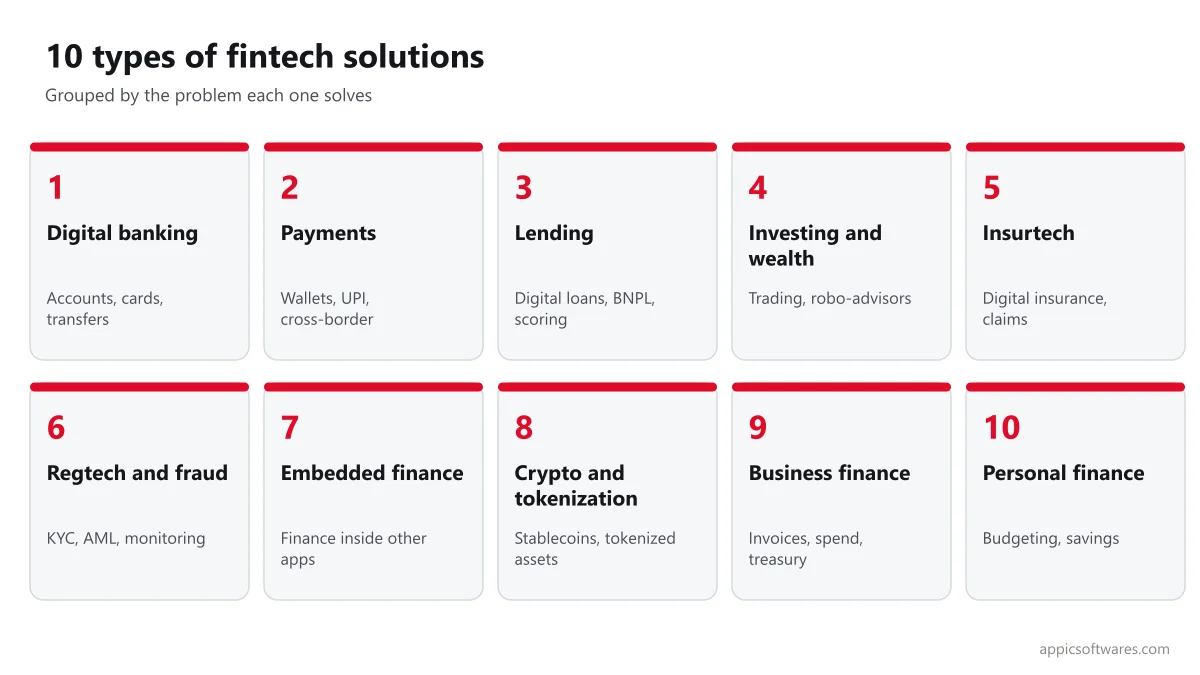
"Fintech" combines "finance" and "technology". A fintech solution is any product that makes a financial service faster, cheaper, easier or more personal. Banks, insurers, startups and non-financial companies all build or buy them. They can be grouped by the problem they solve.
What are the main types of fintech solutions?
| Type | What it does | Examples |
| Digital banking | Accounts, cards and transfers through apps | Neobanks, mobile banking apps |
| Payments | Moves money between people and businesses | Digital wallets, UPI apps, card acquiring, cross-border transfers |
| Lending | Applications, credit decisions and servicing | Digital lenders, buy now pay later, credit scoring |
| Investing and wealth | Trading, portfolios and advice | Stock trading apps, robo-advisors, portfolio tools |
| Insurtech | Sells, prices and services insurance | Digital insurers, claims automation |
| Regtech and fraud | Compliance, identity checks and fraud prevention | KYC and AML tools, transaction monitoring |
| Embedded finance | Financial features inside non-financial products | Payments, lending or insurance at checkout |
| Crypto and tokenization | Digital assets, stablecoins, tokenized assets | Exchanges, wallets, tokenization platforms |
| Business finance | Invoices, expenses, treasury and accounting | B2B payments, spend management, ERP finance |
| Personal finance | Budgeting, savings and money coaching | Expense trackers, savings apps |
Which fintech solution types should you look at first?
Digital banking and mobile payments
Mobile banking and wallets are the most used fintech products. See our guide to mobile banking app development companies and our mobile banking app development service.
Lending
Digital lending speeds up applications and uses data for credit decisions. Our loan and lending app development page covers the build, and AI in credit scoring covers scoring.
Trading and investing
Trading apps depend on broker partners, real-time data, and strong compliance. Read about stock trading app development companies and our trading app development service.
Insurtech
Insurtech applies technology to underwriting, claims and distribution. See what insurtech is and our insurance app development service.
Regtech
Regtech automates compliance checks, reporting and monitoring. Our guide on what is RegTech has examples.
Crypto, blockchain and tokenization
Stablecoins, tokenized assets and DeFi are the main blockchain finance uses. Read blockchain use cases and our blockchain development services.
Business finance
Invoice automation, expense control and finance systems help companies close books faster. See ERP finance for modules and costs.
Have a fintech idea? Tell us the problem and the market, and we will help you scope a first version. Get your project scoped.
How much money is going into fintech in 2026?
The answer depends on what you count. KPMG's Pulse of Fintech reported $103.1 billion of global fintech investment in H1 2026 across about 2,100 deals, including $67.9 billion of mergers and acquisitions (394 deals) and $31.5 billion of venture capital (1,641 deals). The total was lifted by a $24.3 billion acquisition of a large payments company (KPMG). Crunchbase, which counts venture funding only, reported about $28.6 billion for H1 2026, up 22.7% on a year earlier, with deal count down 25.7% to 1,605 (FinanceFeeds). Do not compare these two totals directly.
Across sources, the pattern is the same: fewer, larger deals, with payments and AI attracting the most capital, and the US taking about half of venture funding.
What do real-time payments look like in 2026?
- India (UPI): 24.07 billion transactions worth Rs 29.37 lakh crore in September 2026, up about 23% in volume from a year earlier, with an average of more than 800 million transactions a day (Outlook Money). Reports also say a 0.4% merchant discount rate applies from October 15 to certain person-to-merchant UPI payments above Rs 2,000, so check current rules if you build for India.
- United States (FedNow): about 2.7 million payments worth about $271 billion in Q1 2026, with more than 1,700 to 1,800 participating institutions depending on the report (Digital Transactions). The RTP network reported 128 million transactions worth $480 billion in the same quarter.
These figures come from press coverage of official releases. Check NPCI and the Federal Reserve for the latest numbers.
What are the main fintech trends in 2026?
- AI in finance: fraud detection, credit scoring, support chat and document processing. Keep a person in charge of key decisions and keep records of how models decide.
- Real-time payments: instant transfers are becoming the default in India, the US, Europe and elsewhere.
- Embedded finance: payments, credit and insurance sold inside other apps through APIs.
- Stablecoins and tokenization: growing use for payments and for tokenized funds and treasuries.
- Open banking and data sharing: rules differ by region. In the US, the CFPB's Section 1033 rule has been under litigation and reconsideration, so check its current status before you plan around it.
- Consolidation: large acquisitions in payments and a focus on scale.
What rules apply to fintech solutions?
- Licensing: lending, payments, trading, insurance and crypto often need licenses or a licensed partner.
- KYC and AML: identity checks, sanctions screening and transaction monitoring.
- Data protection: GDPR in Europe, India's data protection law and state laws in the US.
- Payment security: PCI DSS for card data, strong authentication and secure APIs.
- Consumer protection and disclosures: fair terms, clear fees and complaint handling.
Rules differ by country and product. Ask a regulatory specialist before you design the product. For security, read cybersecurity in fintech and fintech compliance.
Should you buy, build or partner for a fintech solution?
| Approach | Best when | Trade-off |
| Buy a ready platform | Your need is standard and speed matters | Less control, license fees, shared roadmap |
| Build custom | The product is your differentiator or workflows are unique | Higher cost and ownership of compliance and security |
| Partner through APIs (banking-as-a-service, payment providers) | You want to launch without your own license | Depends on the partner's terms, fees, and approvals |
| Mix | Most real projects | Needs good integration design |
Free fintech MVP scoping session: share your idea, market and partners. We will outline the features, the integrations, the compliance steps and a cost range. Book your session
How much does it cost to build a fintech solution?
Published 2026 estimates come from agencies and vary with scope. A lean fintech MVP is often quoted at about $20,000 to $90,000, a mobile banking app at about $45,000 to $600,000 or more, and a compliant, fully featured app at about $120,000 to $180,000 (RaftLabs, CMARIX). Compliance, security, and integrations drive most of the premium over a standard app. Appic projects typically start around $10,000 for a focused scope. For details, read our guide to fintech app development cost and compare partners in best fintech app development companies.
How do you choose a fintech solution or partner?
- Define the problem and the user. One clear job to be done.
- Map regulation early. Licenses, KYC, data rules, and who holds the risk.
- Check integrations. Banks, payment providers, identity checks and your existing systems.
- Review security. Encryption, access control, testing and incident plans.
- Ask for proof. Live products, named references and independent reviews.
- Start small. A focused MVP with a limited first release.
- Plan for operations. Support, monitoring, reconciliation and reporting after launch.
How Appic builds fintech solutions
Appic Softwares has built custom software since 2018, with offices in Jaipur (India), Frisco, Texas (USA) and Munich (Germany), and holds a 5.0 rating on Clutch from 24 verified reviews. Our team builds finance apps, digital wallet integrations, and AI fintech solutions, and we help early teams launch with MVP development. Our average rate is about $35 per hour.
What changed from the earlier version of this post?
The earlier version, published in 2024, listed 12 solution types with one-paragraph descriptions and used market numbers from 2019 and 2022. This update groups solutions into 10 types, adds 2026 funding, payment and regulation data, explains buy, build or partner, covers cost and compliance, and links to our deeper guides.
Ready to build a fintech solution? Send us your idea, target market and partners. We will reply with an MVP plan, the compliance steps involved,d and a cost range you can review with your team. Talk to our team
Frequently Asked Questions
What are fintech solutions?
Fintech solutions are software products and services that use technology to deliver or improve financial services. They include digital banking, payments, lending, investing, insurance technology, compliance tools, embedded finance, crypto platforms and business finance software. Banks, insurers, startups and other companies use them to cut costs and improve customer experience.
What are examples of fintech solutions?
Examples include mobile banking apps, digital wallets and UPI apps, buy now pay later and digital lending platforms, stock trading apps and robo-advisors, claims automation for insurers, KYC and fraud detection tools, and invoice or expense software for businesses. Many consumer apps are built on APIs from payment and banking partners.
How big is the fintech industry in 2026?
It depends on what you measure. KPMG reported $103.1 billion of global fintech investment in H1 2026 including mergers and acquisitions, while Crunchbase counted $28.6 billion of venture funding. Deal counts fell while money concentrated in larger deals. The two figures cover different things, so do not compare them directly.
What are the main fintech trends?
Key trends in 2026 are AI for fraud, credit and support, real-time payments such as UPI and FedNow, embedded finance, stablecoins and tokenization, open banking and industry consolidation. Regulation is changing in several regions, so check current rules for your market before building.
How much does it cost to build a fintech solution?
Published estimates put a lean fintech MVP at about $20,000 to $90,000 and a compliant, full-featured app at about $120,000 to $180,000, with mobile banking apps costing more. Appic projects typically start around $10,000 for a focused scope. Compliance, security and integrations drive the price.
Do I need a license to launch a fintech product?
It depends on the product and country. Lending, payments, trading, insurance and crypto services often need a license or a licensed partner. Many startups launch through banking-as-a-service or payment provider APIs that hold the license. Ask a regulatory specialist before you design the product or marketing.
Related Articles

Cost To Create An App Like Zoya Investing In 2025
With the increasing interest in ethical investing, apps like Zoya Investing have become a crucial part of the financial landscape. Zoya Investing, known for its Shariah-compliant investment platform, has gained significant traction among investors. If you’re considering developing a similar app, it’s essential to understand the costs involved in 2024. This article breaks down these […]

Fintech Technologies: Top 12 Technologies To Consider
Big changes are happening in how financial services are provided, used, and regulated in 2024 because of new technologies in the financial technology (fintech) business. As the world goes digital, banks are using new technologies to make the customer experience better, run their businesses more efficiently, and come up with new goods. From the rise […]

B2B Fintech Software Development Cost, Examples, And More
The B2B fintech sector is rapidly evolving, transforming the way businesses operate and interact financially. With advancements in technology, companies are increasingly adopting fintech solutions to streamline operations, enhance security, and improve overall efficiency. This article delves into the B2B fintech market size, trends, software development costs, notable companies, and the future outlook of this […]

Expense Tracker App Development- Cost, Monetization, etc 2025
Before the launch of some now-famous expense tracker apps such as Mint, Quickbooks, and more managing expenses was a tedious task. But not now, you can easily manage expenses with the help of these apps and probably save more by tracking where to spend your money and where not. Moreover, the expense-tracking software market is […]
How AI Agents Are Transforming Financial Markets
Financial markets have continually evolved in response to technological advancements. Electronic trading systems, mobile banking, and other technologies continue to revolutionize how money changes hands. The biggest driver of this change is AI agents in finance. These intelligent systems are no longer just experimental tools being tested by tech companies. They are now the backbone […]
7 Use Cases of Predictive Analytics In Finance
Today, the financial service industry is no longer reliant on simply looking back at previous years of data. Institutions expect that they will be able to not only predict and mitigate risks but also forecast potential market fluctuations and provide personalized customer experiences in real time through predictive analytics. Predictive analytics is an important area […]