What Is InsurTech? Meaning, Use Cases, Examples and How to Build One

InsurTech is the use of technology such as artificial intelligence, data analytics, mobile apps, connected devices and cloud software to make insurance faster, cheaper and easier to use. It covers everything from buying a policy and pricing risk to handling claims and preventing losses. The term includes both new startups and traditional insurers that modernize their own systems.
Key Takeaways
- InsurTech applies technology to the insurance value chain: distribution, underwriting, policy administration, claims and risk prevention.
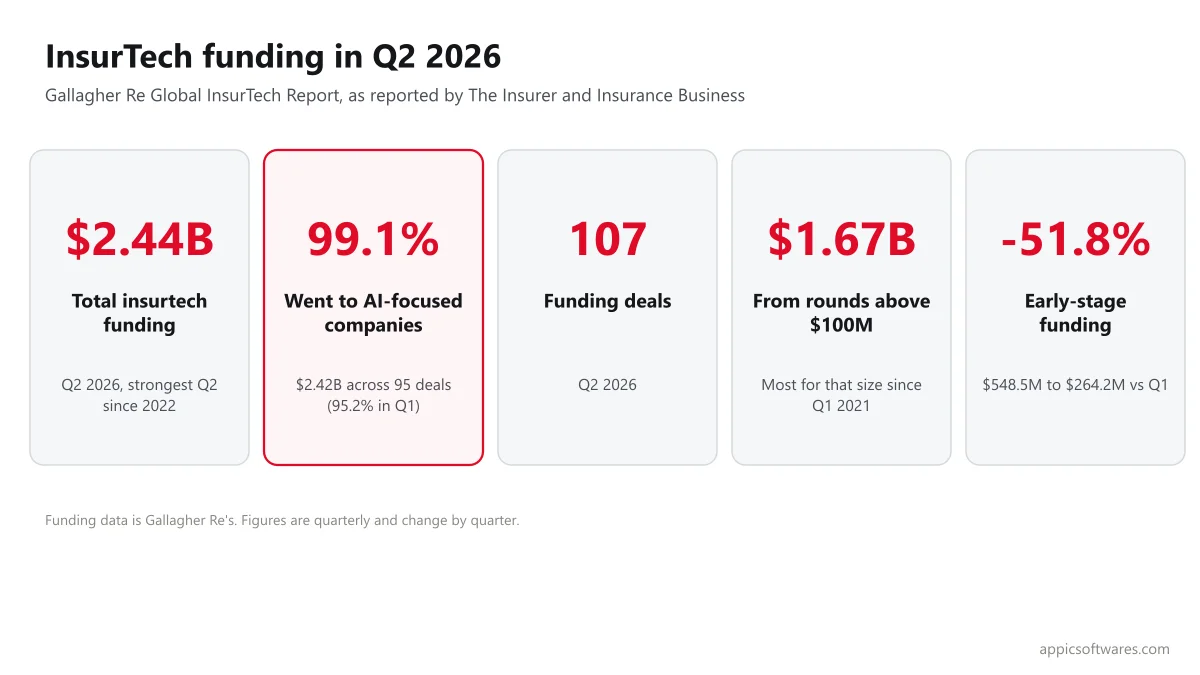
- Global insurtech funding reached $2.44 billion in Q2 2026, and AI-focused companies took 99.1% of it, according to Gallagher Re.
- Results are mixed: Oscar Health reported $388.6 million in operating earnings in Q2 2026, Lemonade is growing fast but not yet profitable on an adjusted basis, and Root is profitable but shrinking in policy count.
- The main hurdles are old core systems, data quality, regulation of AI in pricing and claims, and the need for a licensed carrier or partner.
- To build an insurtech product, start with one painful step in the value chain, such as quotes or claims, and ship a focused MVP.
What is InsurTech?
InsurTech is a mix of "insurance" and "technology". It describes products, companies and tools that use digital technology to improve how insurance is sold, priced, serviced and paid out. It is closely related to fintech, which covers finance in general, but insurtech focuses on risk, policies and claims.
Insurtech companies take different forms. Some are full insurers that run their own technology, some sell policies on behalf of carriers, and some provide software to insurers. We cover these models in a table below.
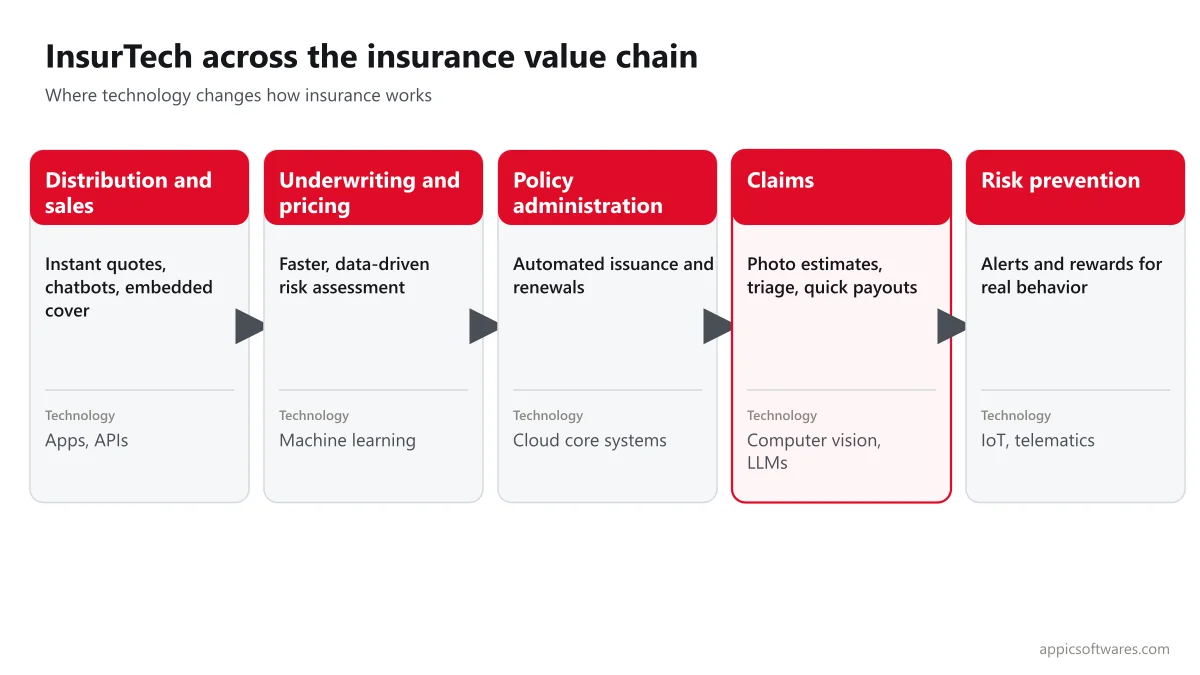
How does InsurTech change the insurance value chain?
| Stage | What insurtech changes | Typical technology |
| Distribution and sales | Instant online quotes, comparison sites, chatbots and insurance sold inside other apps | Mobile apps, APIs, chatbots |
| Underwriting and pricing | Faster, data-driven risk assessment with less paperwork | Machine learning, external data |
| Policy administration | Automated issuance, renewals and changes | Cloud core systems, workflow automation |
| Claims | Photo-based estimates, automatic triage and faster payouts | Computer vision, language models |
| Risk prevention | Alerts and discounts based on real behavior | IoT sensors, telematics |
What are the main InsurTech use cases?
1. Automated underwriting
Algorithms review an application and available data, then approve, price or refer it to a person. This cuts days to minutes for simple policies. Underwriters keep control of complex or high-value risks.
2. Claims automation
Customers submit photos and details in an app. Software checks the policy, estimates damage and routes the claim. Simple claims can be paid quickly, and adjusters focus on complex ones. See our guide to AI agents in insurance.
3. Fraud detection
Machine learning flags unusual patterns, such as repeated claims, mismatched details or networks of related accounts. Good systems explain why a claim was flagged so investigators can act on it.
4. Usage-based insurance
Telematics from phones or connected cars lets insurers price car insurance on how a person actually drives. Safer drivers can pay less. Customers need clear consent and privacy terms.
5. Parametric insurance
A policy pays automatically when a defined event is measured, such as a flight delay, an earthquake magnitude or a rainfall level. Smart contracts and trusted data feeds can trigger the payout. See blockchain use cases for how this works.
6. Embedded insurance
Insurance sold at the point of need inside another product, for example phone cover at checkout or travel cover when booking a flight. APIs connect the seller to an insurer in a few lines of code.
7. Digital distribution and service
Apps, chatbots and online marketplaces let customers compare, buy and manage policies without a call. Round-the-clock support and self-service lower costs and raise satisfaction.
8. Personalization and risk prevention
Sensors in homes, cars and wearables can warn customers about leaks, fires or risky behavior, and insurers can reward prevention. Predictive models also help set fair prices and spot growing risks. For related methods, read predictive analytics in fintech.
Planning an insurance product? Tell us which step you want to fix first and we will help you scope it. Get your project scoped
What are some real InsurTech examples?
Public companies show how mixed the results can be. These figures come from company reports for Q2 2026.
| Company | Model | Q2 2026 snapshot |
| Lemonade | AI-driven insurer for renters, home, car and pet | In-force premium up 32% to $1.43 billion; 3.31 million customers; revenue up 79% to $294 million; adjusted EBITDA loss of $19 million |
| Oscar Health | Technology-led health insurer | About 2.96 million members, up 46%; earnings from operations of $388.6 million |
| Root | Telematics-based car insurer | About 484,000 policies in force, up 6%; gross premiums written down 2% to $340 million; net income of $25 million |
Sources: Lemonade Q2 2026 shareholder letter, Pulse 2.0 on Oscar Health and Coverager on Root. Oscar's outlook for the rest of 2026 differs between reports, so check its filings for guidance.
The lesson: technology helps, but insurers still live or die on pricing and claims results. Growth alone does not make an insurer profitable.
How much money is going into InsurTech in 2026?
Gallagher Re's Global InsurTech Report for Q2 2026 reports $2.44 billion of funding across 107 deals, the strongest second quarter since 2022. AI-focused companies took $2.42 billion across 95 deals, or 99.1% of the total, up from 95.2% in Q1 2026. Rounds above $100 million contributed $1.67 billion. Early-stage funding fell 51.8% from the previous quarter to $264.2 million (The Insurer, Insurance Business, Gallagher Re).
The pattern for founders is clear: investors are backing AI-centered companies and larger later-stage rounds, and early-stage money is tighter. Gallagher Re noted it is too early to say whether the surge in large deals will continue.
What types of InsurTech business models exist?
| Model | How it works | Main challenge |
| Full-stack insurer | Holds a license, carries risk and runs its own technology (Lemonade, Oscar Health and Root are examples) | Capital, regulation and underwriting results |
| Managing general agent (MGA) | Designs and sells a product for a carrier that holds the risk | Depends on carrier partners |
| Digital distributor or embedded | Sells policies online or inside other apps | Customer acquisition and commissions |
| Software provider | Sells claims, underwriting or core systems to insurers | Long sales cycles |
What are the benefits and challenges of InsurTech?
- Speed: quotes, policies and simple claims in minutes.
- Lower cost: automation reduces manual work.
- Better fit: pricing based on real behavior and tailored products.
- Access: digital channels reach people who avoid agents and branches.
- Legacy systems: many insurers run decades-old core platforms that are hard to connect.
- Data quality: models are only as good as their data, and bad data creates unfair or wrong prices.
- Trust and fairness: customers and regulators want clear reasons for prices and claim decisions.
- Licensing: selling or underwriting insurance needs licenses or a licensed partner.
How is AI in insurance regulated?
Rules are moving quickly. In the US, the National Association of Insurance Commissioners adopted a model bulletin on insurers' use of AI in December 2023. It is guidance, and it becomes enforceable only when a state adopts it. Reports put the number of states that have adopted it, or something close to it, in the mid-20s in 2026, but counts differ, so check the NAIC's tracker. Some states, including California, Colorado, New York and Texas, run their own frameworks. In the EU, the AI Act treats AI used for risk assessment and pricing in life and health insurance as high-risk (EU AI Act, Annex III), and application dates have been under discussion, so confirm the current timeline.
For your product this means: keep records of how models make decisions, test for bias, keep a person in the loop for important decisions and manage your vendors carefully. Ask a lawyer to review your plan for each market.
Free insurtech MVP scoping session: share your idea, target market and partners. We will outline the features, the integrations and a cost range for a first version. Book your session
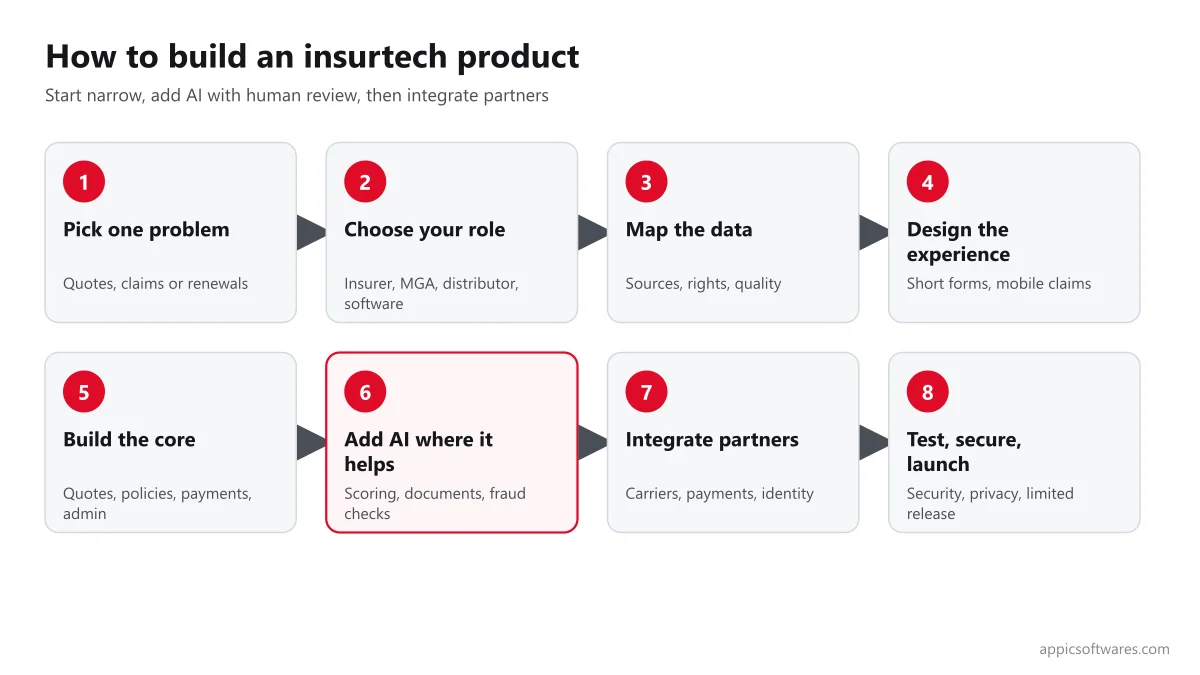
How do you build an InsurTech product?
- Pick one problem. Slow quotes, painful claims or poor renewals are good starting points.
- Choose your role. Insurer, MGA, distributor or software provider. This decides your licenses and partners.
- Map the data. What you need, where it comes from and what you may legally use.
- Design the experience. Short forms, clear prices and simple claim filing on mobile.
- Build the core. Quote engine, policy records, payments, claims workflow and an admin panel.
- Add AI where it helps. Scoring, document reading, chat support and fraud checks, with human review for key decisions.
- Integrate partners. Carriers, payment gateways, identity checks, data providers and reinsurers.
- Test, secure and launch. Security testing, privacy review and a limited first release.
For features and costs, read our guides on insurance app development and insurance app development features and cost. If you build a regulated product, see what is RegTech and cybersecurity in fintech.
How Appic builds InsurTech solutions
Appic Softwares has built custom software since 2018, with offices in Jaipur (India), Frisco, Texas (USA) and Munich (Germany), and holds a 5.0 rating on Clutch from 24 verified reviews. Our insurance app development company team builds quote and policy apps, claims workflows and customer portals. We add AI features through AI fintech app development services and AI development services, and help early teams launch with MVP development. Typical projects start around $10,000. See also our finance app development services.
What changed from the earlier version of this post?
The earlier version, published in 2024, defined insurtech and listed use cases but had no figures, examples or sources, and its section on technologies was left unfinished. This update adds the value chain, current company results and funding data, business models, regulation, a build process and an FAQ.
Ready to build an insurtech product? Send us your idea, target market and partners. We will reply with an MVP plan, a stack recommendation and a cost range you can share with your team or investors. Talk to our team
Frequently Asked Questions
What is InsurTech in simple words?
InsurTech means using technology to improve insurance. Examples are getting a quote in an app, having a claim assessed from photos, paying for car insurance based on how you drive, or buying cover at checkout. Both startups and traditional insurers use insurtech tools to lower costs and speed up service.
What is the difference between InsurTech and FinTech?
FinTech covers technology in all financial services, such as payments, lending, banking and investing. InsurTech is the part focused on insurance: selling policies, pricing risk, administering policies and paying claims. The two overlap in areas like digital payments, identity checks and fraud detection.
What are examples of InsurTech companies?
Lemonade, Oscar Health and Root are well-known examples that run their own insurance businesses with technology at the core. Others sell software to insurers, act as managing general agents or sell cover inside other apps. Public results show that technology alone does not guarantee profit.
How does AI help in insurance?
AI helps with faster underwriting, claims triage and photo-based damage estimates, fraud detection, chat support and risk prediction. Gallagher Re reported that AI-focused companies took 99.1% of insurtech funding in Q2 2026. Insurers should keep humans in the loop for key decisions and test models for bias.
Is InsurTech regulated?
Yes. Selling or underwriting insurance requires licenses or a licensed partner, and AI use faces growing rules. In the US, the NAIC's AI model bulletin has been adopted by many states, and some run their own frameworks. In the EU, the AI Act treats AI used for life and health insurance pricing as high-risk.
How much does it cost to build an InsurTech app?
Appic projects typically start around $10,000 for a focused MVP. Cost depends on the features, integrations with carriers and payment providers, AI models, security testing and compliance work. Share your scope with us and we will give you a feature list, timeline and cost range.
Related Articles

NeoBanking App Development: A Complete Guide
Neobanking app development is becoming more and more popular in the financial industry in this day and age of everything and everyone being online. To keep up with the increasing demand for digital banking services, fintech startups and companies are devoting a large amount of resources to the development of these applications. A neobanking app, […]

Stock Trading App Development Companies: 6 Picks for 2026 and How to Choose
Do you know the stock trading app market is growing at a rate of 21.1% and is estimated to reach US$ 1,10,624.4 million by the end of 2033? If you too are planning to launch a Stock trading app and are looking for Trading app development companies that can assist you with the same then […]

Cost To Create An App Like Bank Of America in 2025
Our lives are so much easier now that we have mobile banking apps. We can quickly do any banking task with a few screen taps. A mobile banking app can quickly do many functions, such as monitoring account balances and sending money to friends and relatives who live far away. There is no longer a […]

What Is Cloud Computing In Fintech? A Complete Guide
The days of finance being associated with difficult jargon, requiring a ton of paperwork, and requiring long hours at physical banks are long gone. The adoption of cloud computing in fintech is the driving force behind the rapid expansion of finance in this digital era. In addition to altering how we keep our data, papers, […]
How AI Agents Are Transforming Financial Markets
Financial markets have continually evolved in response to technological advancements. Electronic trading systems, mobile banking, and other technologies continue to revolutionize how money changes hands. The biggest driver of this change is AI agents in finance. These intelligent systems are no longer just experimental tools being tested by tech companies. They are now the backbone […]
7 Use Cases of Predictive Analytics In Finance
Today, the financial service industry is no longer reliant on simply looking back at previous years of data. Institutions expect that they will be able to not only predict and mitigate risks but also forecast potential market fluctuations and provide personalized customer experiences in real time through predictive analytics. Predictive analytics is an important area […]