
Stock Trading App Development Companies: 6 Picks for 2026 and How to Choose
The best stock trading app development company for you depends on what you are building: a custom app on top of a broker's API, a white-label trading platform, or exchange-grade infrastructure. This guide compares six companies, including Appic Softwares, which publishes this page, and explains the build options, costs and compliance rules before you choose.
Disclosure: Appic Softwares is one of the six companies and we wrote this guide. We list the companies in alphabetical order, use each company's own site for facts, and mark company claims as claims. This is a shortlist, not a ranking.
Key Takeaways
- Decide first whether to build on a broker API, license a white-label platform or build your own brokerage. This choice drives cost and timeline more than the vendor.
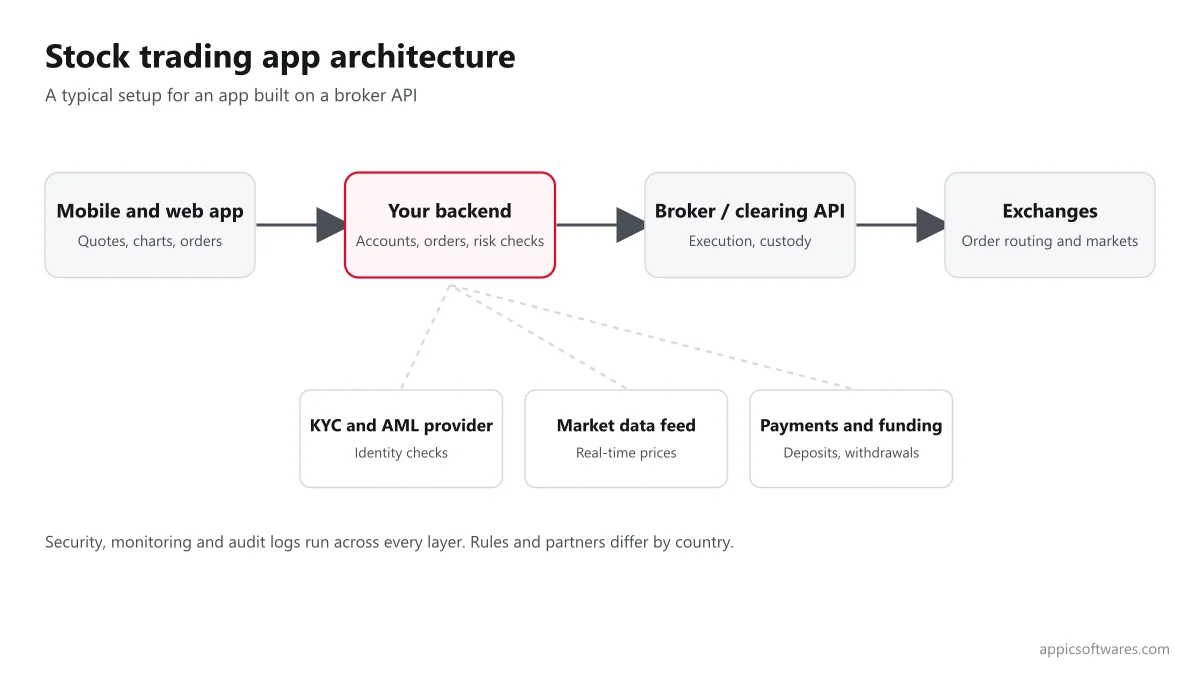
- Most startups avoid becoming a full broker-dealer. They use an introducing-broker model with a licensed clearing partner and a broker API.
- Published estimates put a lean equity-trading MVP at roughly $40,000 to $90,000, with market data and compliance extra.
- Ask for trading-specific proof: order flow, real-time data, KYC and security experience, plus a named reference.
- Appic's average rate is about $35 per hour, and typical projects start around $10,000 for a focused scope.
Which stock trading app development companies should you shortlist?
| Company | Type | Trading focus | Best for |
| Appic Softwares | Custom development | Trading and finance apps with AI features | Startups building a first trading app |
| Cleveroad | Custom development | Full-cycle stock trading apps (self-described) | Mobile and web trading apps |
| Devexperts | Platform vendor and engineering | White-label trading platform, exchange technology, charting | Brokers who want a ready platform |
| EffectiveSoft | Custom development | Multi-asset trading platform case study | Large multi-asset platforms |
| S-PRO | Fintech engineering | Mobile trading app for a crypto exchange, neobroker AI support | Regulated and crypto-adjacent platforms |
| ScienceSoft | Custom development and consulting | Portfolio management and trading automation software | Enterprise and quantitative tools |
Planning a trading product? Tell us your market, broker partner and features and we will say honestly if we are the right fit. Get your project scoped
How did we pick these companies?
- Trading-specific evidence: a trading or capital-markets page, product or case study on the company's own site.
- Technical depth: real-time data, order handling, security and compliance work mentioned publicly.
- Independent reviews: a Clutch profile you can check. We do not copy ratings that may change.
- Different types of partner: custom developers, a platform vendor and security-focused firms, so you can compare approaches.
Many agencies list "trading apps" without any public trading project. We left those out. Our earlier list included more names with little verifiable detail. For other lists, see best fintech app development companies.
Appic Softwares
Appic Softwares is a custom software and AI development company founded in 2018, based in Jaipur, India, with offices in Frisco, Texas and Munich. We build trading apps with watchlists, charts, order flows, portfolio views and KYC, and we add AI fintech features such as insights and alerts. See our wider finance app development services.
- Pricing signals: average rate about $35 per hour; typical projects start around $10,000.
- Reviews: 5.0 on Clutch from 24 verified reviews.
- Best for: startups and SMBs that want a focused first version of a trading app on a broker's API.
- Consider something else if: you need to run a matching engine or an exchange-grade, ultra-low-latency platform.
Cleveroad
Cleveroad says it builds stock trading apps as full-cycle projects: real-time market data feeds, WebSocket price streaming, order management and execution flows, brokerage and exchange API integrations, and KYC and AML with payment rails. It lists a 2011 founding year, a $50 to $99 hourly rate, ISO 9001 and ISO 27001 certifications and a 4.9 Clutch rating from more than 70 reviews (Cleveroad). That description comes from Cleveroad's own ranking page, and we did not find a public trading case study with named results.
- Best for: mobile and web trading apps with standard broker integrations.
- Check: ask for a trading reference, since the public case study evidence is thin.
Devexperts
Devexperts was founded in 2002 and sells trading technology as products and custom engineering. Its products include DXtrade, a white-label multi-asset trading platform, DXmatch, exchange infrastructure with a matching engine, dxFina, a white-label broker solution, and DXcharts, a charting library. Its site shows client logos such as tastytrade, eToro and Deriv, cites more than 30 industry awards and displays a SOC report badge. It states that it does not provide investment advice or brokerage services (Devexperts).
- Best for: brokers and prop firms that want a ready, configurable platform or exchange technology.
- Consider something else if: you want a fully custom consumer app with your own design and flows.
EffectiveSoft
EffectiveSoft is an engineering company with 23 years of experience, offices in the US, Costa Rica and Poland, and a 4.9 Clutch rating from 19 reviews. Its services include trading platforms and cryptocurrency exchange software. Its trading case study is a multi-asset trading platform built from an early-stage idea that the company says serves more than one million registered users in over 50 countries, which is a company claim. It reports ISO/IEC 27001:2022-backed processes (EffectiveSoft).
- Best for: larger multi-asset or exchange-style platforms.
- Check: the case study client is not named on the page we reviewed, so ask for a reference.
S-PRO
S-PRO is a Swiss fintech engineering company with 250+ people, offices in Zurich and Salt Lake City, ISO 27001 and ISO 27701 certifications and a 4.9 Clutch rating from 46 reviews. Its work includes a mobile trading app for a European crypto exchange, which it says reached more than 1 million users, and an AI support agent for a German neobroker, where it reports that 95% of AI-drafted responses were accepted with minimal edits. Both are company claims. It also cites experience with FINMA, BaFin, DORA and MiCA rules (S-PRO).
- Best for: regulated brokers, neobrokers and crypto-adjacent trading apps in Europe.
- Check: its showcased trading work is crypto-focused, so ask about equities.
ScienceSoft
ScienceSoft has operated since 1989 and lists trading software among its services, with principal architects experienced in complex trading solutions. Its product development page includes a case study titled Portfolio Management and Trading Automation Software Powered by Data Science, and Clutch reviews mention security testing for brokerage clients (ScienceSoft). It reports ISO 9001, ISO 27001 and ISO/IEC 27701 certifications. We could not confirm details of the trading case study from public text.
- Best for: enterprise tools, trading automation and security testing.
- Check: ask which trading platforms it has built end to end.
Should you build on a broker API, use a white-label platform or build a brokerage?
| Approach | How it works | Best for | Trade-off |
| Custom app on a broker API | You build the app, a licensed broker or clearing partner handles trades and custody | Startups and fintech apps adding trading | Depends on the partner's features and fees |
| White-label platform | You license a ready platform and brand it | Brokers that want to launch quickly | Less design freedom, license costs |
| Own brokerage and infrastructure | You become the regulated broker and connect to exchanges | Established financial firms | Highest cost, licensing and capital needs |
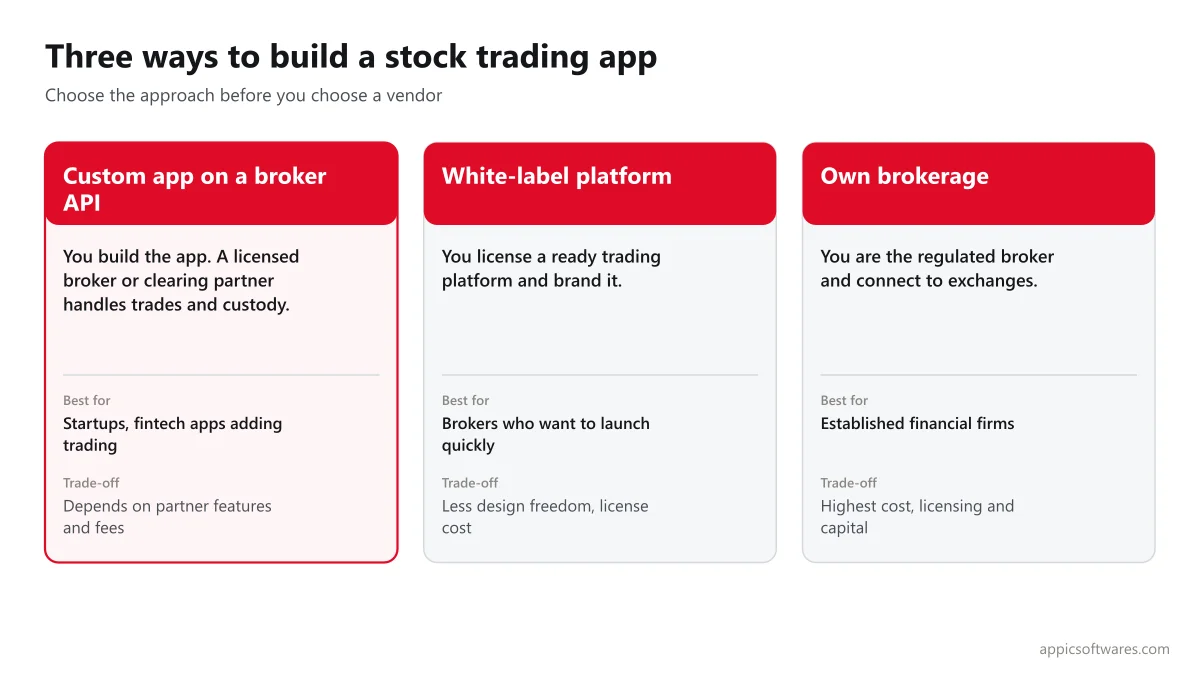
A recent example of the first approach: when Gemini added stock trading in July 2026, its FINRA-registered subsidiary acted as an introducing broker, with Apex as the clearing broker and custodian (Apex Fintech Solutions). Developer-friendly broker APIs exist for US equities as well, and you should compare their coverage, fees and support for your market.
What regulations apply to a stock trading app?
- Broker-dealer rules (US): if customers place their own trades through you, you generally need FINRA registration or must partner with a registered broker. Check the details with FINRA and the SEC, and with a lawyer.
- Other markets: each country has its own regulator. India, for example, has SEBI-registered brokers.
- KYC and AML: identity checks, sanctions screening and transaction monitoring.
- Market data licenses: exchanges charge for real-time data and have rules for redistribution.
- Disclosures and suitability: risk warnings and fair marketing rules.
- Security and privacy: encryption, two-factor authentication, audit logs and data protection law.
For the security side, read our guide to cybersecurity in fintech.
How much does it cost to develop a stock trading app in 2026?
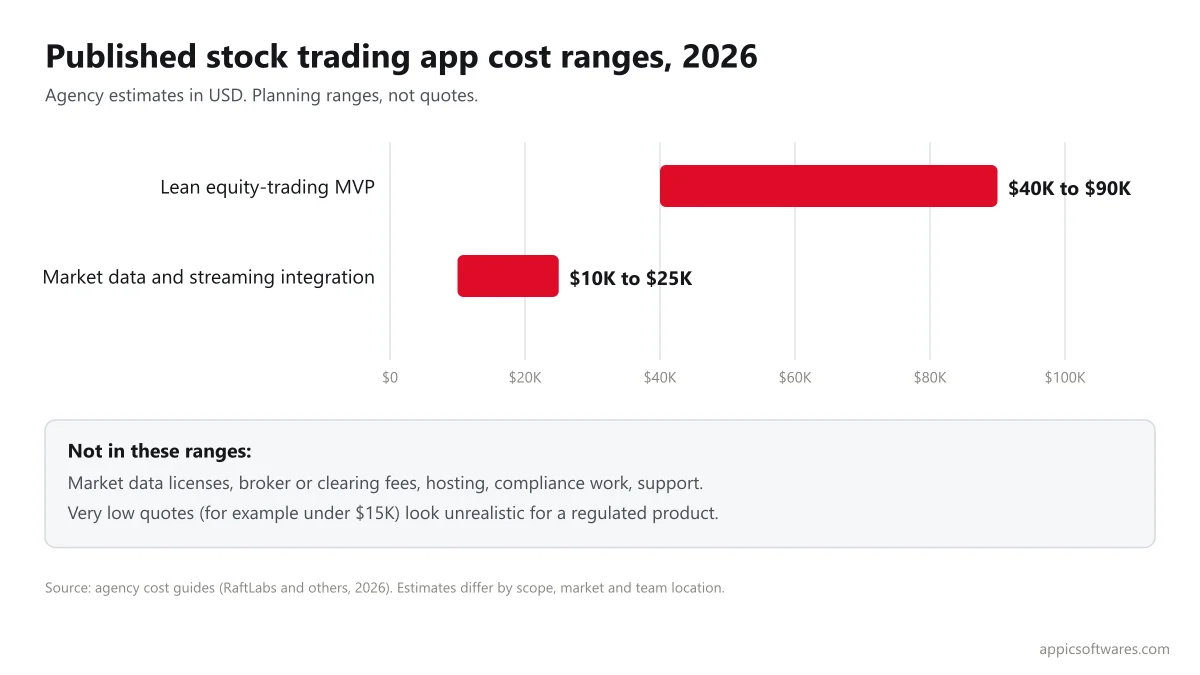
Published estimates come mostly from agencies, so treat them as planning ranges. A RaftLabs guide puts an MVP with KYC, real-time quotes and basic orders at $55,000 to $75,000 over 14 to 18 weeks (RaftLabs). A 2026 estimate for a lean equity-only app, including KYC, broker API integration and real-time data, is $60,000 to $90,000, and another puts a lean MVP at $40,000 to $80,000. One breakdown adds $10,000 to $25,000 for market data and WebSocket integration. Some sources quote much lower prices, such as $8,000 to $15,000, which look unrealistic for a regulated product.
| Scope | Typical published range (USD) |
| Lean equity-trading MVP on a broker API | About $40,000 to $90,000 |
| Market data and real-time streaming integration | About $10,000 to $25,000 of development |
| Full-featured app (options, funding, advanced orders, admin) | Higher, depends on scope |
| Running costs | Market data licenses, broker fees, hosting, compliance and support |
Appic projects typically start around $10,000 for a focused scope, and the final price depends on features, broker integrations and compliance. For a deeper cost view, see how to create a stock market app.
Free trading app estimate: send us your market, broker partner and feature list. We will reply with a cost range, a timeline and the compliance steps your product needs. Request your estimate
What features does a stock trading app need?
- Onboarding: sign-up, KYC and funding.
- Real-time quotes and charts: streaming prices, candlesticks and indicators.
- Orders: market, limit and stop orders, with order status and history.
- Portfolio: holdings, profit and loss and transactions.
- Watchlists and alerts: price and news notifications.
- Security: two-factor authentication, biometrics and session controls.
- Admin and reporting: user management, compliance reports and support tools.
- AI features: personalized insights, support chat and fraud checks. Keep them informational and follow advice rules.
How do you choose a stock trading app development company?
- Ask for trading work like yours. Equities, options, crypto and forex have different flows and rules.
- Check broker and data integrations. Which broker APIs and market data feeds have they used?
- Test their understanding of compliance. KYC, AML, data licenses and your target regulator.
- Review security practice. Encryption, penetration testing, secrets handling and incident plans.
- Ask about performance. Streaming data, load testing and what happens when markets are busy.
- Talk to a past client. Verify named case studies and recent independent reviews.
- Start with discovery. A paid scoping phase gives a realistic scope and risks.
- Confirm code ownership and support. Source code, accounts and a post-launch support plan.
See also our guides on how to build a trading app like Robinhood, creating a trading app like Webull and must-have features in a stock trading app.
What changed from the earlier version of this post?
The earlier version, published in 2024, listed 12 companies with ratings copied from review sites, mostly general web and mobile agencies with no trading evidence, and an outdated Appic rate of $15 to $25 per hour. This update keeps six companies we could verify on their own sites, corrects Appic's details and adds build options, regulation, cost and a buyer checklist.
Ready to build a trading app? Send us your market, broker partner and feature list. We will reply with a scoped plan, the compliance steps involved and a cost range you can review with your team. Talk to our team
Frequently Asked Questions
Which company is best for stock trading app development?
There is no single best company. Match the partner to your approach: a custom developer for an app on a broker API, a platform vendor for a white-label product, or an engineering firm for exchange-style systems. Check trading-specific case studies, security and compliance experience, independent reviews and code ownership before you choose.
How much does it cost to build a stock trading app?
Published 2026 estimates put a lean equity-trading MVP at roughly $40,000 to $90,000, with market data and streaming integration adding about $10,000 to $25,000. Running costs include data licenses, broker fees and compliance. Appic projects typically start around $10,000 for a focused scope, and the final cost depends on your features.
Do I need a broker license to launch a trading app?
If your customers trade through you, you generally need to be a registered broker or partner with one. Many startups use an introducing-broker model with a licensed clearing partner and a broker API. Rules differ by country and product, so ask a securities lawyer before you design the product or marketing.
How long does it take to develop a trading app?
One estimate puts a basic MVP with KYC, real-time quotes and basic orders at 14 to 18 weeks. Timelines grow with extra markets, order types, funding methods and compliance reviews. Broker API onboarding and approvals can also add time, so plan them early.
Should I build on a broker API or use a white-label platform?
Build on a broker API if you want your own design, flows and brand with a licensed partner handling trades. Choose a white-label platform if you want to launch quickly and accept less design freedom. Build your own brokerage only if you are an established financial firm ready for licensing and capital needs.
Does Appic Softwares build stock trading apps?
Yes. Appic builds trading apps with real-time quotes, charts, order flows, portfolio views and KYC, plus AI features. Our average rate is about $35 per hour, and typical projects start around $10,000. We hold a 5.0 Clutch rating from 24 verified reviews. We also publish this guide, so please compare us with the others.
Related Articles

What Is InsurTech? Meaning, Use Cases, Examples and How to Build One
The intersection of insurance and technology, or insurTech, has completely changed how we obtain and use insurance services. Customers and insurance firms today rely heavily on technology, which has led to the emergence of creative insurtech platforms that are revolutionizing the sector. This progress is characterized by enhanced accessibility, increased efficiency, and a more tailored […]

What Is Cloud Computing In Fintech? A Complete Guide
The days of finance being associated with difficult jargon, requiring a ton of paperwork, and requiring long hours at physical banks are long gone. The adoption of cloud computing in fintech is the driving force behind the rapid expansion of finance in this digital era. In addition to altering how we keep our data, papers, […]

NeoBanking App Development: A Complete Guide
Neobanking app development is becoming more and more popular in the financial industry in this day and age of everything and everyone being online. To keep up with the increasing demand for digital banking services, fintech startups and companies are devoting a large amount of resources to the development of these applications. A neobanking app, […]

12 Fintech Trends To Watchout In 2025 {Updated}
Technology has permeated every area of our lives in the modern day, and the financial industry is no exception. Fintech, or financial technology, has grown significantly in the past ten years. Let’s examine the fintech trends that have emerged in India in recent years and make some predictions about the sector’s future. Fintech’s Development In […]

How AI Agents Are Transforming Financial Markets
Financial markets have continually evolved in response to technological advancements. Electronic trading systems, mobile banking, and other technologies continue to revolutionize how money changes hands. The biggest driver of this change is AI agents in finance. These intelligent systems are no longer just experimental tools being tested by tech companies. They are now the backbone […]

7 Use Cases of Predictive Analytics In Finance
Today, the financial service industry is no longer reliant on simply looking back at previous years of data. Institutions expect that they will be able to not only predict and mitigate risks but also forecast potential market fluctuations and provide personalized customer experiences in real time through predictive analytics. Predictive analytics is an important area […]