Best Fintech App Development Companies in 2026: 8 Picks and How to Choose
The best fintech app development company for you is one that has shipped regulated financial products like yours, can show its compliance and security process, and gives you code ownership. This guide compares eight fintech app development companies, including Appic Softwares, which publishes this page. It then covers what fintech apps cost in 2026 and how to choose a partner.
Disclosure: Appic Softwares is one of the eight companies and we wrote this guide. To keep it fair, we list the companies in alphabetical order, use each company's own site or public profile for facts, and mark company claims as claims. This is a shortlist, not a ranking.
Key Takeaways
- Look for fintech-specific proof: regulated products shipped, named case studies, and a clear compliance process (PCI DSS, SOC 2, PSD2, KYC/AML).
- Published estimates put a lean fintech MVP at roughly $20,000 to $90,000, and a regulated banking app at $120,000 or more.
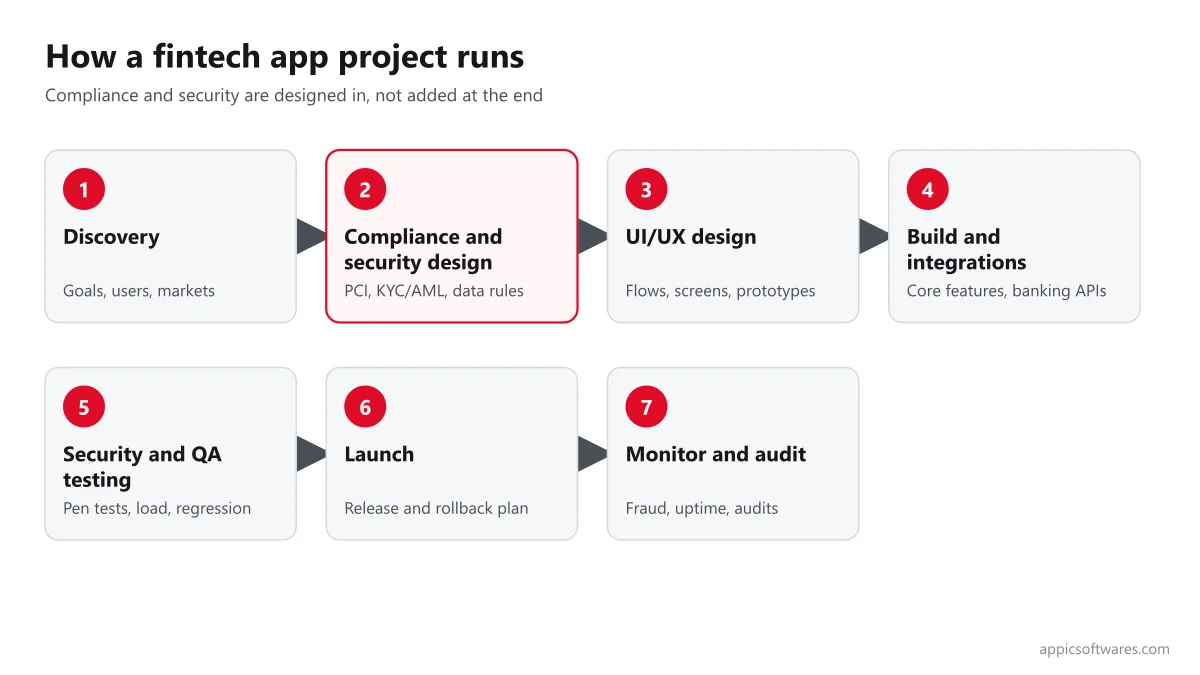
- Compliance, security and integrations add most of the cost compared with a standard app.
- Ask for a paid discovery phase before a fixed quote, and make sure you own the source code.
- Rates vary by region and company. Two companies below publish their Clutch rate ranges: $25 to $49 per hour and $50 to $99 per hour.
Which fintech app development companies should you shortlist?
The table lists each company in alphabetical order with facts from its own site or public profile. Click through to verify current details before you contact anyone.
| Company | Base | Founded | Fintech focus | Best for |
| Appic Softwares | Jaipur, India (offices in Texas and Munich) | 2018 | Lending, banking, trading, insurance, wallets | Startups and SMBs that want fintech MVPs and AI features |
| Cleveroad | Tallinn, Estonia (also Delaware and Oslo) | 2011 | Investment, trading, wallets, P2P, lending, banking | Cross-platform fintech apps |
| Itexus | Warsaw, Poland (per Clutch) | 2013 | Digital banking, trading, investment, crypto, insurance | Compliance-heavy platforms |
| Miquido | Krakow, Poland | Not stated | Mobile fintech, AI credit scoring | Mobile-first products with AI |
| Netguru | Poznan, Poland | Not stated (17+ years) | Product design and engineering with a banking client | Product design plus engineering |
| Praxent | Not stated | Not stated (25+ years) | AI transformation for financial services | Banks and lenders modernizing legacy systems |
| ScienceSoft | McKinney, Texas, USA | 1989 | Banking, lending, payments, investment, insurance | Enterprise programs with strict process needs |
| Yalantis | Dnipro, Ukraine (per public profiles) | 2008 | Payments, digital banking, neobanks | Payment and banking apps |
Not sure which partner type fits your product? Tell us what you are building and we will say honestly if we are the right fit. Get your project scoped
How did we pick these fintech app development companies?
- Fintech-specific work: a fintech or financial services page, or a named fintech case study.
- Compliance and security signals: stated experience with PCI DSS, SOC 2, PSD2, ISO 27001 or KYC/AML.
- Independent reviews: a profile on a review platform such as Clutch, which we point you to instead of copying ratings.
- Range of buyers: from startups to enterprises, so the list helps different budgets.
We left out many well-known agencies for lack of public fintech evidence we could check. Ratings, headcounts and rates change often, so we only quote them where a company or its Clutch profile publishes them, and we tell you to confirm them.
Appic Softwares
Appic Softwares is a custom software and AI development company founded in 2018, based in Jaipur, India, with offices in Frisco, Texas and Munich. We build finance apps, lending platforms, mobile banking apps, trading apps and digital wallet integrations, with AI fintech features such as scoring and fraud checks. Our fintech portfolio includes CreditEnable and Aavas Finance.
- Pricing signals: average rate about $35 per hour; typical projects start around $10,000.
- Reviews: 5.0 on Clutch from 24 verified reviews.
- Best for: startups and SMBs that want a fintech MVP with a clear scope, or AI features added to an existing product.
- Consider something else if: you need a very large enterprise program with a dedicated bank-grade PMO.
Cleveroad
Cleveroad lists 2011 as its founding year and offices in Tallinn (Estonia), Claymont (Delaware, USA) and Oslo (Norway). Its site lists fintech work across investment, trading, wallets, peer-to-peer and lending platforms, plus banking and insurance software. A case study describes a cross-platform micro-investment and savings app for a client in Saudi Arabia, built under NDA to meet SAMA fintech regulations with multi-factor authorization and KYC verification (Cleveroad).
- Best for: investment, wallet and lending apps across iOS, Android and web.
- Check: team size and rates are not published on the page we reviewed.
Itexus
Itexus is a fintech-focused development company. Its Clutch profile lists a 2013 founding year, a Warsaw location and 300+ clients across the US, Europe and the Middle East and North Africa. It focuses on digital banking, stock trading, investment management, crypto and insurance, and states compliance with SOC 2, PCI DSS and ISO 27001. Clutch shows a 4.9 overall rating, a minimum project size of $10,000+ and rates of $25 to $49 per hour (Clutch). Clutch details are self-reported and reviews can change, so confirm them on the live profile.
- Best for: compliance-heavy trading, banking and insurance platforms.
Miquido
Miquido is a Krakow-based mobile and AI company with 200+ experts and 250+ digital solutions delivered, according to its site. Its named fintech case study is Nextbank, an AI credit scoring and loan origination system. Miquido reports 500M+ loan applications processed and 97% prediction accuracy, and a finalist place at the 2019 Singapore FinTech Awards. These are company claims (Miquido).
- Best for: mobile-first fintech products with AI such as credit scoring.
Netguru
Netguru is a Poznan-based product company with 400+ people, 2,500+ projects delivered and 17+ years in the market, per its site. It is a general product studio. Fintech is an industry it serves, and its named finance example is a mobile app design revamp for UBS (Netguru).
- Best for: teams that need product design and engineering together.
- Check: ask for fintech references, because the site does not describe fintech-specific services.
Praxent
Praxent describes itself as an AI transformation firm for financial services, with 25+ years in the industry and 200 specialized experts. It serves banking, lending, payments, capital markets and insurance. It names case studies in payment reconciliation modernization for a global processor handling over $2 billion in daily transactions, digital banking modernization, and an SBA and small business loan platform, with results such as 3X faster funding. These figures are company-reported. Praxent lists a 4.8 Clutch rating and was ranked #5 in American Banker's 2026 Best Places to Work in Fintech, according to its site (Praxent).
- Best for: banks and lenders modernizing legacy systems with AI.
ScienceSoft
ScienceSoft says it has operated since 1989, has 750+ staff and has delivered 4,300+ projects, with headquarters in McKinney, Texas. It lists banking, lending, payments, investment and insurance among its industries, and names lending AI agents for Atlas Credit and an automated trading system among its work. It reports ISO 9001, ISO 27001 and ISO/IEC 27701 certifications (ScienceSoft). These are self-reported.
- Best for: large programs that need formal processes and certifications.
Yalantis
Yalantis was founded in 2008 and public profiles place its headquarters in Dnipro, Ukraine, with offices in Kyiv, Lviv, Larnaca and Warsaw. It publishes payment app and mobile banking pages and cites PCI DSS, PSD2, SOC 2 and GDPR compliance work. Its Clutch profile shows a 4.8 rating and a $50 to $99 hourly range (Yalantis). The company says it helped build software for one of the largest US neobanks. That is a company claim and the client is not named.
- Best for: payment, digital banking and neobank apps.
How much does fintech app development cost in 2026?
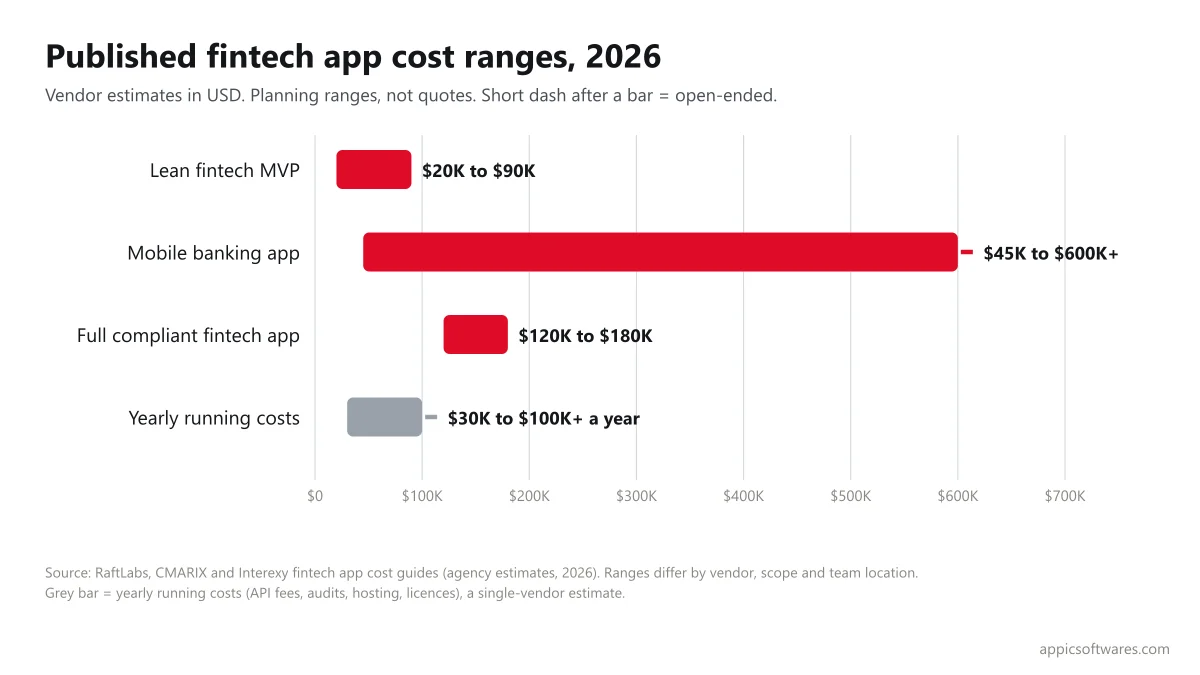
Fintech apps cost more than standard apps because of compliance, financial data security, banking API integrations and KYC/AML flows. Published estimates come mostly from development agencies, so use them as planning ranges. Sources: RaftLabs, CMARIX and Interexy.
| What you are building | Typical published range (USD) | Notes |
| Lean fintech MVP | About $20,000 to $90,000 | Single core flow; ranges differ by vendor |
| Mobile banking app | About $45,000 to $600,000+ | Depends on transfers, bill pay, card controls, core banking links |
| Full compliant fintech app | About $120,000 to $180,000 | One vendor estimate; includes compliance work |
| Yearly running costs | About $30,000 to $100,000+ | API fees, audits, hosting, licences (one vendor estimate) |
One vendor estimates compliance, KYC/AML and security can take up to 40% of total spend, and that the same project can cost two to three times more depending on where the team is based. Appic projects typically start around $10,000 for a focused MVP. For more detail, read our fintech app development cost guide.
Free fintech project estimate: send us your feature list and target markets. We will reply with a cost range, timeline and the compliance steps your product needs. Request your estimate
How do you choose a fintech app development company?
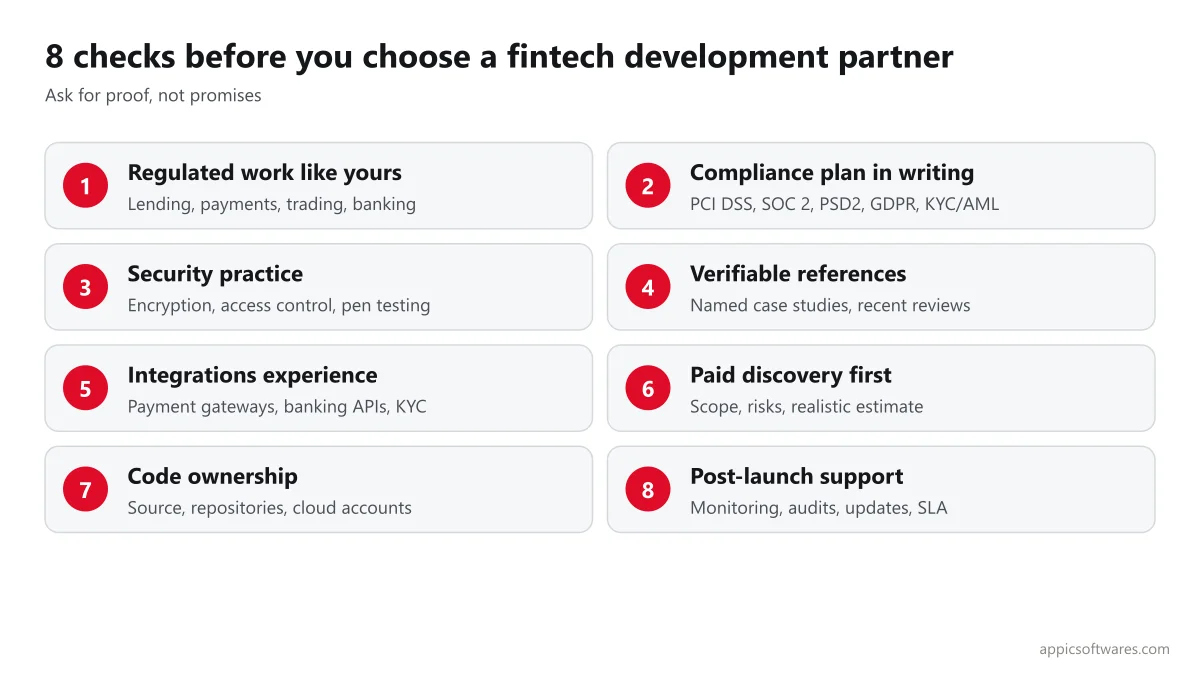
- Ask for regulated work like yours. A lending app, a payments app and a trading app face different rules.
- Check the compliance plan. Ask how they handle PCI DSS, SOC 2, PSD2, GDPR and KYC/AML for your target markets. Get it in writing.
- Review security practice. Encryption, access control, penetration testing and secrets handling should be part of the standard process.
- Talk to a past client. Verify named case studies and read recent reviews on independent platforms.
- Check integrations experience. Payment gateways, banking APIs, open banking, credit bureaus and identity providers.
- Start with discovery. A paid discovery phase gives you a scope, risks and a realistic estimate before the big commitment.
- Confirm code ownership and exit terms. Source code, repositories and cloud accounts should be yours from day one.
- Plan for after launch. Monitoring, audits, updates and support should have a price and a service level.
What types of fintech apps can these companies build?
- Payments and wallets: payment gateways, P2P transfers and digital wallets.
- Banking and neobanks: mobile banking apps with accounts, cards and transfers.
- Lending: loan origination and lending platforms.
- Investing and trading: trading apps and robo-advisors.
- Insurance: insurance apps for quotes, claims and policy management.
- AI features: credit scoring, fraud detection and chat support. See AI fintech app development services.
What are the main challenges in building fintech apps?
- Cybersecurity: financial apps are a target for fraud and account takeover. Read our guide to cybersecurity in fintech.
- Compliance across regions: rules differ by country and by product type.
- Integrations: banking and payment APIs have different standards and uptime.
- AI and data: scoring and fraud models need clean data and explainable decisions.
- Tech stack: pick one that scales and that your team can hire for.
Ready to build a fintech product? Send us your idea, target markets and timeline. We will reply with a scoped plan, the compliance steps involved and a cost range you can review with your team. Talk to our team
Frequently Asked Questions
Which company is best for fintech app development?
There is no single best company. Choose by fit: regulated products like yours shipped, a clear compliance process, independent reviews you can verify, and code ownership. Startups often prefer smaller teams with MVP experience, while banks tend to look for firms with enterprise security certifications and larger delivery capacity.
How much does it cost to build a fintech app?
Published 2026 estimates put a lean fintech MVP at about $20,000 to $90,000 and a compliant, full-featured app at $120,000 or more. Mobile banking apps range from about $45,000 to over $600,000. Compliance, KYC/AML, security and integrations drive the premium over a standard app.
How long does it take to develop a fintech app?
A focused MVP often takes about three to four months, and a regulated banking or lending platform can take six to twelve months or more. Timeline depends on integrations, compliance reviews and how fast you approve designs. A discovery phase gives you a more reliable schedule.
What compliance rules apply to fintech apps?
It depends on your product and markets. Common ones are PCI DSS for card payments, SOC 2 for security controls, PSD2 and open banking rules in Europe, GDPR for personal data, and KYC and AML checks for identity and fraud. Ask your partner which apply to you and get the plan in writing.
Should I hire a fintech agency or build an in-house team?
Hire an agency when you need to launch quickly, lack fintech specialists, or want to test an idea before building a team. Build in-house when fintech is your long-term core product. Many companies start with an agency for the MVP and bring development in-house later, so insist on code ownership.
Does Appic Softwares build fintech apps?
Yes. Appic builds finance apps, lending platforms, banking apps, trading apps and wallet integrations with AI features. Our average rate is about $35 per hour, and typical projects start around $10,000. We hold a 5.0 Clutch rating from 24 verified reviews. We are also the publisher of this guide, so please compare us with the others.
Related Articles

Blockchain Use Cases in 2026: 10 Real-World Examples and When They Fit
Blockchain technology has completely changed the way we view security, transparency, and data storage. Blockchain, which was first recognized as the underlying technology of cryptocurrencies like Bitcoin, has opened up a wide range of applications in diverse industries. Blockchain use cases change the way we conduct business, from supply chain management to healthcare record-keeping. As […]

How Much Does It Cost To Create An App?

Best Online Shopping Apps in 2026: US, UK, India and More
Does anyone not enjoy shopping? For many people, it’s the most enjoyable pastime. Purchasing something elevates our satisfaction to a new level, especially when we shop online, place an order from the comfort of our home, and receive the item delivered right to our door. Not long ago, we had to visit a shopping center, […]
How Much Does Logistics App Development Cost in 2026
Logistics is driving cross-border trade like never before, enabling trade on a grand scale, thanks to faster and more linked than ever before transportation. By introducing novel approaches to streamlining operations, enhancing customer service, and reducing expenses, innovations in logistics app development have sparked a dramatic shift in the sector. As more and more businesses […]
9 AI Real Estate Startups With Funding in 2026
The advent of artificial intelligence (AI) and the rise of real estate AI companies have caused a paradigm change in the real estate sector. Appraisers, mortgage lenders, developers, and homeowners have all seen tremendous changes in their daily operations as a result of this ground-breaking technology. In this piece, we examine the creative Real Estate […]

Cost To Create A Temple Management System In 2025
In an era where technology intertwines with tradition, temples are not exempt from the digital revolution. The advent of Temple Management Systems (TMS) has streamlined administrative processes, enhanced visitor experiences, and facilitated efficient resource management. However, one pertinent question remains: What is the cost to develop a Temple Management System in 2024? In this comprehensive […]