9 AI Real Estate Startups With Funding in 2026

Venture money is flowing to AI real estate startups again, but it is going to companies that automate a specific, paid workflow: leasing, legal review, property tax, deal underwriting and homebuilding. This list covers nine funded AI real estate startups, with the round size, date and lead investors from public announcements, plus what founders can learn from how they raised.
Key Takeaways
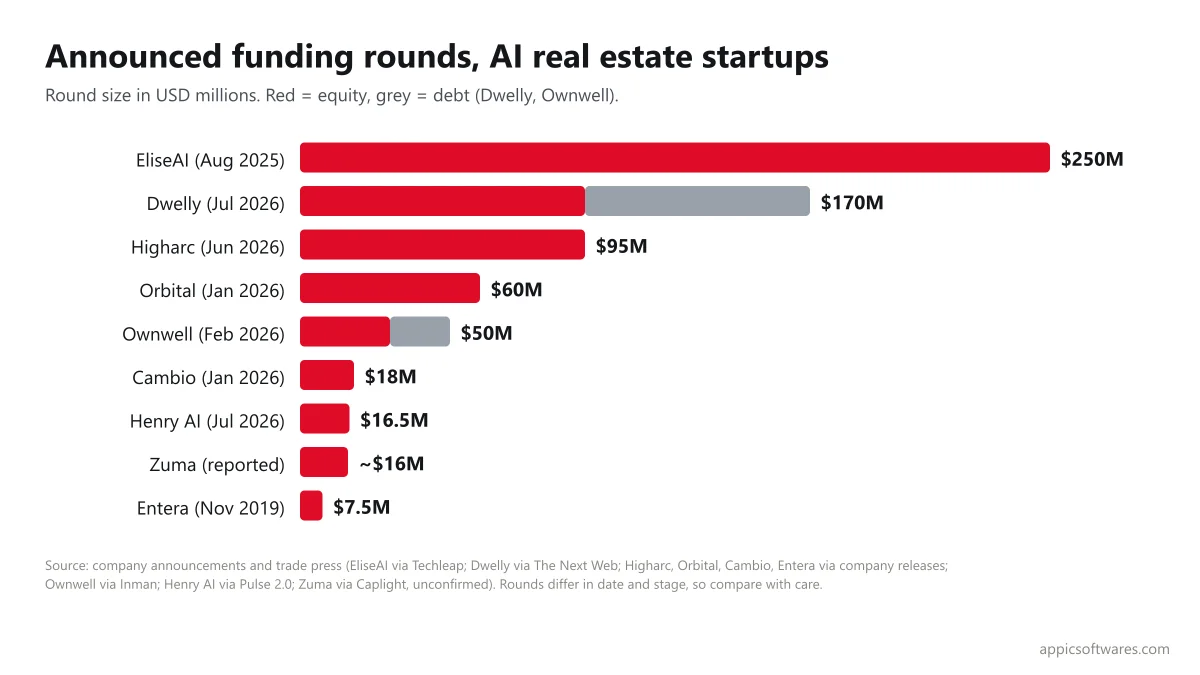
- The largest recent rounds in this list are EliseAI ($250 million Series E, August 2025), Dwelly ($170 million package, July 2026) and Higharc ($95 million Series C, June 2026).
- Most funded startups sell AI that does one job end to end, such as answering leasing inquiries or reviewing property title documents.
- Two companies in this list paired equity with debt: Dwelly ($95 million equity, $75 million debt) and Ownwell ($30 million equity, $20 million debt).
- Several numbers on the web are wrong or outdated. Aggregator sites list different dates and amounts for the same round, so we used company releases and trade press where possible.
- If you are building in this space, start with one workflow and a measurable result. Appic projects typically start around $10,000 for an MVP.
Which AI real estate startups have raised funding?
Here are nine AI real estate startups with funding, ordered by the size of their latest announced round. Amounts are the announced round size, and a note says where debt is included.
| Startup | What it does | Latest round | Date | Lead or key investors |
| EliseAI | AI assistant for leasing, maintenance and renewals | $250M Series E (about $2.2B valuation, as reported) | Aug 2025 | Reported: Andreessen Horowitz |
| Dwelly | Buys UK lettings agencies and runs them on an AI platform | $170M ($95M equity + $75M debt) | Jul 2026 | EQT Growth; debt from Trinity Capital |
| Higharc | AI platform for designing and estimating new homes | $95M Series C | Jun 2026 | Insight Partners |
| Orbital | AI for real estate legal work | $60M Series B | Jan 2026 | Brighton Park Capital |
| Ownwell | AI property tax appeals | $50M Series B ($30M equity + $20M debt) | Feb 2026 | Alpha Edison, Mercato Partners |
| Cambio | Agentic AI for commercial real estate capital planning | $18M Series A | Jan 2026 | Maverick Ventures |
| Henry AI | AI for commercial real estate deal documents | $16.5M Series A | Jul 2026 | FirstMark Capital |
| Zuma | AI leasing agent for property managers | About $16M Series A (reported) | See note | Reported: BlackRock, Fin Capital |
| Entera | Platform for residential real estate investors | $7.5M | Nov 2019 | Bullpen Capital, Craft Ventures |
Planning an AI product for real estate? We help founders pick one workflow worth building first. Get your project scoped
1. EliseAI: AI for leasing and resident communication
EliseAI automates communication for multifamily housing and healthcare providers. In housing it handles leasing inquiries, maintenance tickets and renewals over text, email, voice and chat in 17 languages. It reportedly raised a $250 million Series E in August 2025 at a valuation of about $2.2 billion, and reported revenue of about $100 million (Techleap, Multiples). Most reports name Andreessen Horowitz as the lead, though one tracker lists a different lead, so check the company's announcement before quoting it.
2. Dwelly: buying lettings agencies and running them on AI
Dwelly does not sell software to agents. It buys independent UK lettings businesses and moves them onto a shared AI platform while keeping local brands and teams. In July 2026 it announced a $170 million Series B package made up of $95 million equity and a $75 million debt facility, with EQT Growth leading the equity and Trinity Capital leading the debt (The Next Web, PropTech Connect). Its model shows that AI can be applied to a service business by owning the operation instead of selling a tool.
3. Higharc: AI for homebuilding design and estimating
Higharc builds homes as structured data that encodes code requirements and construction standards, so builders can design, price and document homes in one system. It announced a $95 million Series C on June 30, 2026, led by Insight Partners, with Wellington Management joining and Fifth Wall, Spark Capital and Lux Capital returning. Total funding now exceeds $170 million (Higharc). The company reports that builders on the platform cut time to community opening by 25% to 50% and raised margins by 10% to 15%. These are company claims and not independent results.
4. Orbital: AI for real estate legal work
Orbital uses AI, mapping and property data to automate document-heavy review for real estate lawyers. It raised a $60 million Series B in January 2026 led by Brighton Park Capital, bringing total capital raised to $75 million since 2018. The company says it supported 200,000 real estate transactions across the US and UK in 2025 (Orbital, LawNext). The funds go toward growth in the US.
5. Ownwell: AI property tax appeals
Ownwell helps homeowners and property owners appeal property tax assessments. It closed a $50 million Series B in February 2026: $30 million in equity led by Alpha Edison and Mercato Partners, and $20 million in debt from Western Alliance Bank. It operates in 12 US states and earns a contingency fee only when an appeal succeeds (Inman, Crunchbase News). Reported fee levels vary by source, so check the company site for current terms.
6. Cambio: agentic AI for commercial real estate operations
Cambio applies large language models and agent workflows to building data, covering capital planning, retrofit identification and compliance. It launched publicly in January 2026 with an $18 million Series A led by Maverick Ventures, with Y Combinator also participating. Crunchbase reports a $100 million valuation and $22 million raised in total (Business Wire, Crunchbase News). The company names large institutional real estate firms as customers.
7. Henry AI: deal automation for commercial real estate
Henry AI automates the documents around commercial real estate deals. On July 29, 2026 it announced a $16.5 million Series A led by FirstMark Capital with Thomson Reuters Ventures participating, and launched Henry Deal, which extends the product into underwriting and the wider deal lifecycle. It reports use by more than 150 firms and over 20,000 client-ready deliverables. These are company figures. A $4.3 million seed round was announced in February 2025 (Pulse 2.0).
8. Zuma: an AI leasing agent for property managers
Zuma sells an AI leasing agent called Kelsey that handles lead engagement, tour scheduling and rent collection for property managers (Zuma). Funding details are less clear. Caplight lists a $16 million Series A led by BlackRock and Fin Capital in March 2025 (Caplight), while another tracker dates the Series A to February 2024, and Zuma's job posts say the company has raised over $17 million. Treat the exact round and lead as unconfirmed until the company publishes them.
9. Entera: data-driven investing in single-family homes
Entera is a platform that helps investors find, evaluate and buy residential properties using data. It raised $7.5 million in November 2019, led by Bullpen Capital and Craft Ventures with ValueStream Ventures and former Keller Williams CEO Chris Heller participating (Entera). We did not find a larger, newer announced round, so it is the oldest data point on this list.
What problems do AI real estate startups solve?
The funded companies cluster around five jobs where AI replaces slow, repeated work.
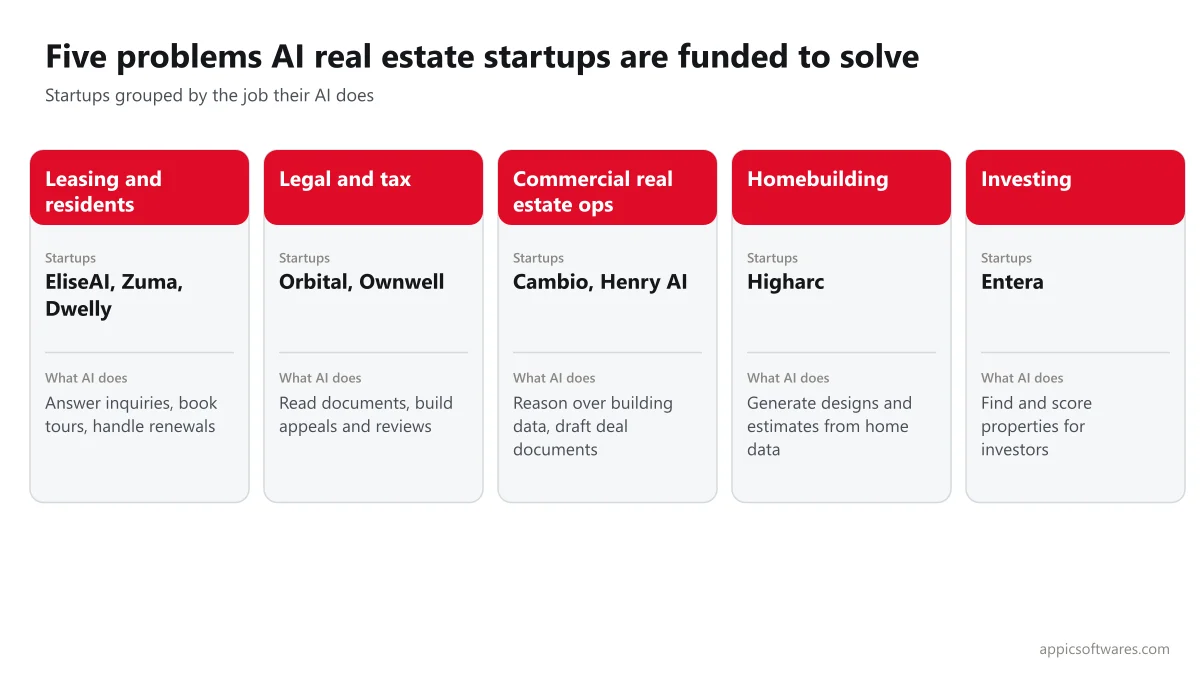
| Problem area | Startups | What AI does |
| Leasing and resident communication | EliseAI, Zuma, Dwelly | Answers inquiries, books tours, handles maintenance and renewals |
| Legal and tax | Orbital, Ownwell | Reads documents and builds the case for appeals or due diligence |
| Commercial real estate operations | Cambio, Henry AI | Reasons over building data and drafts deal documents |
| Homebuilding | Higharc | Generates designs and estimates from structured home data |
| Investing | Entera | Finds and scores properties for investors |
What can founders learn from how these startups raised?
- Sell one workflow with a measurable result. Leasing replies, title review and tax appeals are all easy for a buyer to price against current manual cost.
- Debt can sit next to equity. Dwelly and Ownwell both added debt facilities to their rounds, which fits businesses with predictable revenue or assets to finance.
- You can own the operation. Dwelly's roll-up model shows that AI does not have to be sold as software.
- Industry investors show up. Thomson Reuters Ventures backed Henry AI, and RELX's venture arm backed Orbital, which signals that legal and data companies see real estate workflows as worth buying into.
- Claims need proof. Several startups publish usage numbers themselves. Buyers and investors expect case studies behind those numbers.
How do you build an AI real estate product?
Free MVP scoping session: tell us the real estate workflow you want to automate. We will outline the features, the data you need, a stack and a cost range. Book your session
- Pick one workflow. Choose a task people already pay for, such as lead qualification, document review or valuation.
- Collect the data. Listings, leases, title records, maintenance logs or building data, with rights to use them.
- Choose the AI approach. Language models for documents and chat, machine learning for scoring and prediction, rules for anything that must be exact.
- Build a narrow MVP. One user type, one integration, one measurable result.
- Add human review. Real estate decisions carry legal and financial risk, so keep a person in the loop for high-stakes steps.
- Measure and expand. Track time saved or revenue gained, then add the next workflow.
For examples of where AI already works, see our guides to AI in real estate examples, AI agents in real estate and how to develop AI real estate valuation software. For market context, read PropTech statistics and top market players.
How Appic builds AI real estate software
Appic Softwares has built custom software since 2018, with offices in Jaipur (India), Frisco, Texas (USA) and Munich (Germany), and holds a 5.0 rating on Clutch from 24 verified reviews. Our real estate app development company team builds listing platforms, CRMs, chatbots and AI tools. See generative AI real estate software development, real estate CRM, real estate chatbot and PropTech development. For early-stage teams, we offer MVP development and AI development services. Browse our Roccabox project and other portfolio work.
What changed from the earlier version of this list?
An earlier version of this post listed ten companies using 2021 to 2023 data. We rechecked each one and removed names where the information was out of date or did not match real estate.
| Company | Why it was removed or changed |
| Hyro | Its recent coverage is about healthcare. Its $45 million Series C in October 2025 supports health system customers, and we found no real estate customers. |
| Localize (LocalizeOS) | Sources conflict on whether it is still operating. We could not confirm its current status. |
| Plunk | Last verified round is a $6.5 million seed in May 2021. We found no newer information. |
| Likely.AI, Built.AI, Crex Capital, DatFlik, Oda Portal | We could not verify current status or funding from reliable sources, so they were removed. |
| Entera, Zuma | Kept, with the funding details we could verify and notes where sources differ. |
Have an AI real estate idea? Send us the workflow you want to automate and the data you have. We will reply with an MVP plan, a stack recommendation and a cost range you can share with your team or investors. Talk to our team
Frequently Asked Questions
Which AI real estate startups raised funding in 2026?
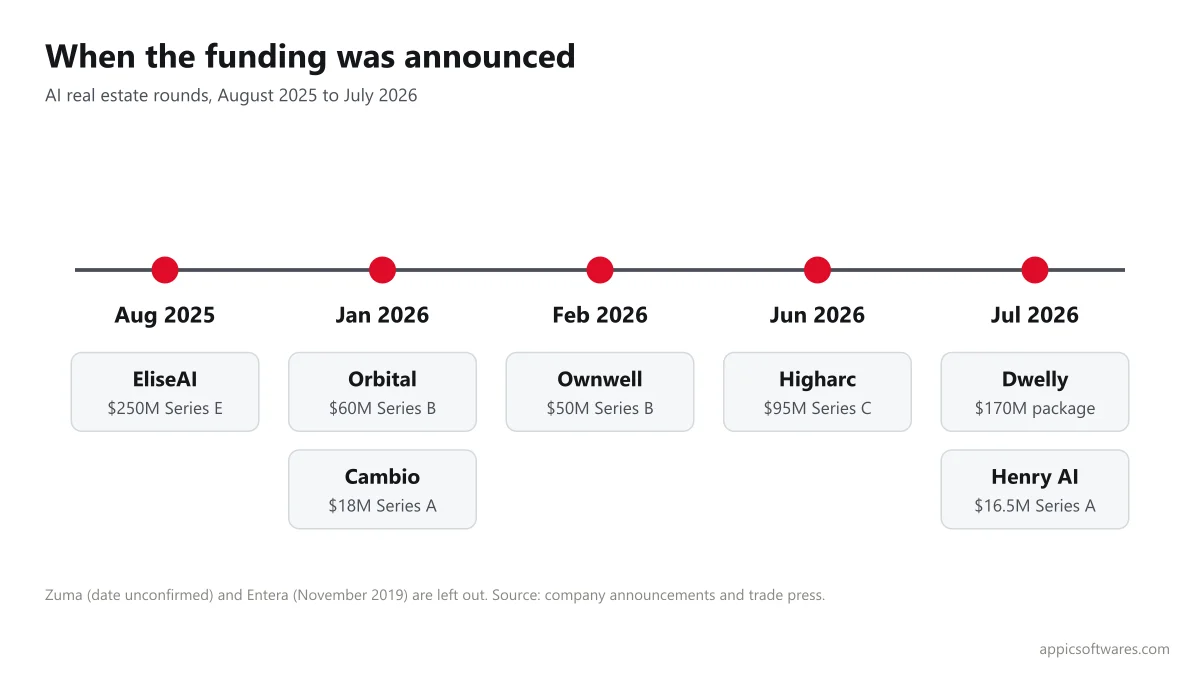
In 2026, Orbital raised a $60 million Series B in January, Cambio an $18 million Series A in January, Ownwell a $50 million Series B in February, Higharc a $95 million Series C in June, and Dwelly a $170 million package in July. Henry AI raised a $16.5 million Series A in July.
Which AI real estate startup raised the most money?
In this list, EliseAI has the largest single round: a $250 million Series E in August 2025 at a reported valuation of about $2.2 billion. In 2026 the largest announcement here is Dwelly's $170 million package, which includes $95 million of equity and a $75 million debt facility.
What problems do AI real estate startups solve?
The funded startups focus on repeated, document-heavy or communication-heavy work: answering leasing inquiries, scheduling tours, reviewing legal documents, appealing property taxes, drafting commercial deal materials, and designing and estimating homes. They tend to sell one clear workflow instead of a general-purpose tool.
Do AI real estate startups use debt as well as equity?
Some do. Dwelly paired $95 million of equity with a $75 million debt facility, and Ownwell paired $30 million of equity with $20 million of debt. Debt tends to suit businesses with predictable revenue or assets to finance. Most early-stage software startups still raise equity only.
How do I start an AI real estate startup?
Pick one workflow people already pay for, such as lead qualification or document review. Secure the data you need, build a narrow MVP for one user type, keep a human in the loop for high-stakes steps, and measure the time or money saved. Then expand to the next workflow.
How much does it cost to build an AI real estate app?
Appic projects typically start around $10,000 for an MVP. Cost depends on features, data sources, integrations such as MLS feeds, and whether you need custom AI models. Share your scope with us and we will give you a feature list, timeline and cost range.
Related Articles

Outsourced React.js Development Services: Benefits, Cost and How to Choose a Provider
The time and resources needed to build an in-house ReactJS team are substantial. To begin, you must assess the project’s scope, identify qualified developers, assemble a team without allocating funds, and then provide consistent work and compensation to the team. This is why many businesses hire outside firms to create their React JS. Only those […]

Best Online Shopping Apps in 2026: US, UK, India and More
Does anyone not enjoy shopping? For many people, it’s the most enjoyable pastime. Purchasing something elevates our satisfaction to a new level, especially when we shop online, place an order from the comfort of our home, and receive the item delivered right to our door. Not long ago, we had to visit a shopping center, […]

17 Sites To Hire Web Developers
In 2023, a company’s website will be as important as ever. It is critical to employ web developers who are on the same page as you. They must also possess technical and creative abilities to create a positive user experience. You should not engage just any web developer if you value your website and other […]

Blockchain Use Cases in 2026: 10 Real-World Examples and When They Fit
Blockchain technology has completely changed the way we view security, transparency, and data storage. Blockchain, which was first recognized as the underlying technology of cryptocurrencies like Bitcoin, has opened up a wide range of applications in diverse industries. Blockchain use cases change the way we conduct business, from supply chain management to healthcare record-keeping. As […]

How to Hire Indian Developers in 2026: Where to Find Them, What They Cost and What to Check
Organizations that assist you in hiring developers from India simplify the process of finding, screening, and assigning your software development project to the most qualified team. Working with well-established businesses in the sector also lessens the possibility of encountering difficulties when implementing. Our staff at Aloa is experienced in managing software development projects that are […]

Best Fintech App Development Companies in 2026: 8 Picks and How to Choose
Fintech, which stands for Financial Technology, is a term used to characterize new technologies aimed at digitizing and automating services related to money. Using cutting-edge technology, leading fintech app development companies craft innovative financial solutions. When designing a user-friendly fintech app, the top developers should keep several factors in mind, including the technology, difficulties, pricing, […]