Blockchain Use Cases in 2026: 10 Real-World Examples and When They Fit
Blockchain use cases work best where several parties need to share one record, do not fully trust each other and want to cut out a middleman. In 2026 the clearest examples are stablecoin payments, tokenized real-world assets, supply chain traceability and digital credentials. This guide covers ten use cases with current numbers, then shows how to tell whether your project really needs a blockchain.
Key Takeaways
- Tokenized real-world assets reached about $39.26 billion on rwa.xyz on October 19, 2026, not counting stablecoins.
- Stablecoins are the most used blockchain product for payments, with a supply of roughly $290 billion or more depending on the tracker.
- Supply chain traceability, digital identity, insurance and real estate are growing, but mostly in pilots and regulated niches.
- Use a blockchain when multiple organizations need a shared, tamper-evident record. Use a normal database when one company controls the data.
- Keep personal data off-chain, audit smart contracts and check local rules before you build.
What are the main blockchain use cases in 2026?
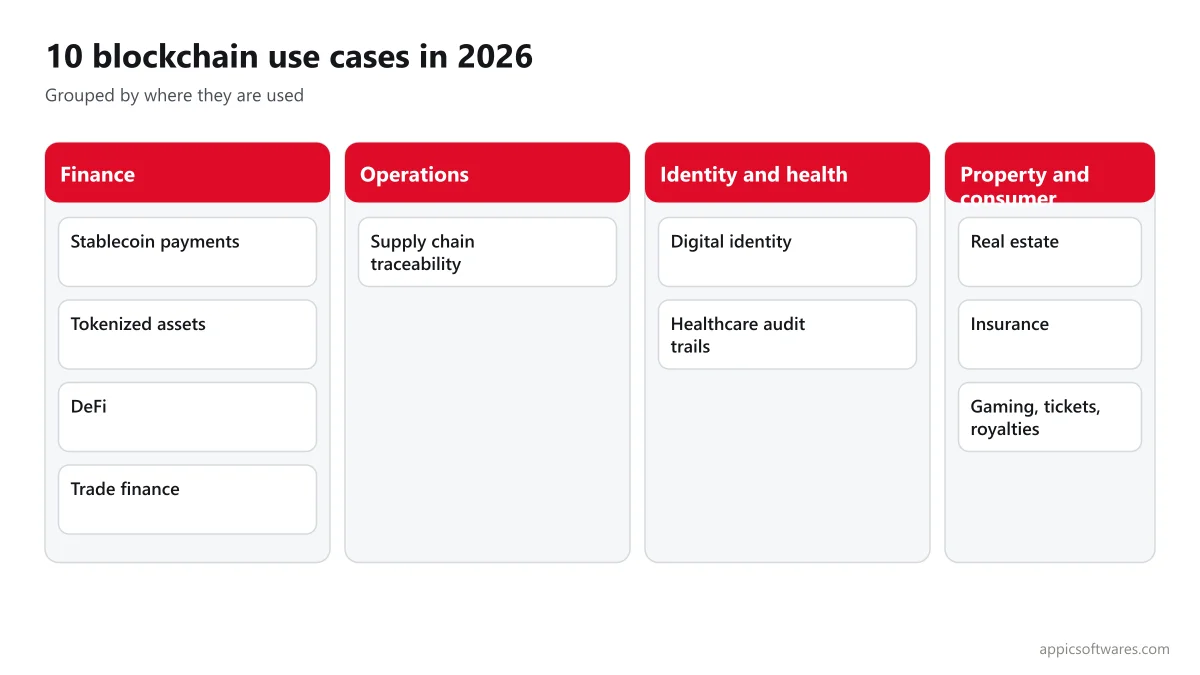
| Use case | What the blockchain does | Maturity |
| Stablecoin payments | Moves dollar-pegged tokens across borders in minutes | In wide use |
| Tokenized real-world assets | Represents treasuries, credit and property as tokens | Growing fast |
| Decentralized finance (DeFi) | Runs lending and trading through smart contracts | In wide use, higher risk |
| Trade finance and settlement | Shares documents and settles between banks | Pilots and some production |
| Supply chain traceability | Records where goods came from and who handled them | Production in some sectors |
| Digital identity and credentials | Lets people prove facts without sharing everything | Early |
| Healthcare records and trials | Keeps audit trails and consent logs | Early |
| Real estate ownership and rentals | Records title, fractional ownership and payments | Early |
| Insurance | Pays claims automatically when a condition is met | Early to growing |
| Gaming, ticketing and creator royalties | Proves ownership and automates revenue splits | Niche |
1. Stablecoin payments and cross-border transfers
Stablecoins are tokens designed to hold a steady value, usually one US dollar. They let businesses and individuals send money across borders at any hour, and they are the blockchain product with the most real payment use. Trackers disagree on exact supply. rwa.xyz lists stablecoins at about $291 billion on October 19, 2026, and other trackers show figures above $300 billion earlier in the year (rwa.xyz). Much of the raw transfer volume is trading and automated activity, so do not read volume charts as payment volume. Chainalysis coverage of its 2025 index also reported India at the top of global crypto adoption for the third year in a row, driven by remittances, dollar access and mobile-first payments (The Block).
- Good fit: remittances, supplier payments, treasury moves between countries, payouts to gig workers.
- Watch out for: licensing and compliance rules for stablecoin issuers and payment providers differ by country.
2. Tokenized real-world assets
Tokenization puts a claim on an asset, such as a US Treasury fund, a loan or a building, on a blockchain. rwa.xyz showed about $39.26 billion of distributed tokenized real-world assets, excluding stablecoins, on October 19, 2026 (rwa.xyz). Tokenized US Treasuries make up the largest part, roughly $13 to $15 billion depending on how they are counted. BlackRock's BUIDL fund, launched in March 2024, was the first tokenized Treasury fund to pass $1 billion (The Block) and was reported at roughly $2.5 to $2.8 billion in 2026.
- Good fit: funds, private credit, fractional ownership, faster settlement and 24-hour transfers.
- Watch out for: securities law. A token that represents an investment is usually regulated like one.
3. Decentralized finance (DeFi)
DeFi apps run lending, borrowing and trading through smart contracts instead of a bank or broker. They work around the clock and anyone with a wallet can use them. The trade-offs are smart contract bugs, price manipulation and unclear legal status in some regions. Build DeFi products only with audited contracts, limits on risky actions and a clear compliance plan.
4. Trade finance and settlement
Trade finance still relies on paper letters of credit, bills of lading and invoices. A shared ledger lets the buyer, seller, bank and shipper see the same record and trigger payment when conditions are met. Gains include fewer errors, less fraud and faster payment. Adoption is slower than the payments use cases because banks, ports and customs must all agree on shared standards.
5. Supply chain traceability
A blockchain can record each handover of a product, from farm or factory to shelf. IBM's food page says Walmart tracks food products through its supply chain using IBM Food Trust (IBM). Regulation is pushing traceability too. Food rules such as the FDA's FSMA 204 and new EU digital product passport rules, reported to start with batteries in February 2027, require products to carry traceable records (Circularise). Dates for these rules have shifted, so confirm them with the regulators.
- Good fit: food safety, luxury goods authenticity, battery and materials tracking, pharma.
- Watch out for: a blockchain cannot confirm that the first entry was true. Pair it with sensors, audits or trusted sources.
6. Digital identity and credentials
Verifiable credentials let a person prove a fact, such as a degree or age, without handing over a full document. The credential is signed by the issuer, stored in the user's wallet and checked against a public record. This lowers identity fraud and repeated KYC checks. Keep personal data off the chain. Store only proofs or hashes there.
7. Healthcare records and clinical trials
Healthcare data is sensitive, so patient records stay in secure systems. Blockchain fits as an audit layer: who accessed a record, when consent was given, which batch of a drug moved where and which trial data was changed. This helps with clinical trial integrity and medicine supply chains. Design for HIPAA and GDPR from the start.
8. Real estate ownership and rentals
Real estate involves many parties and paperwork. Blockchain can record title, support fractional ownership through tokens, and automate rent or escrow payments with smart contracts. Legal recognition of on-chain title varies by country, so most projects run alongside the official registry. See our Web3 in real estate guide for more.
9. Insurance
Parametric insurance pays automatically when a trusted data feed reports an event, such as a flight delay or a rainfall level. A smart contract releases the payout without a long claims process. Reliable data sources (oracles) and clear policy terms matter more than the blockchain itself.
10. Gaming, ticketing and creator royalties
NFTs can prove ownership of in-game items, tickets or digital art and can split revenue to creators on resale. After the 2021 hype, the lasting uses are practical ones: anti-scalping tickets, loyalty rewards and in-game assets players can trade. Treat speculation-driven NFT projects with caution.
Not sure whether your idea needs blockchain? We will tell you honestly, even if the answer is "use a database". Get your project scoped
Do you really need a blockchain?
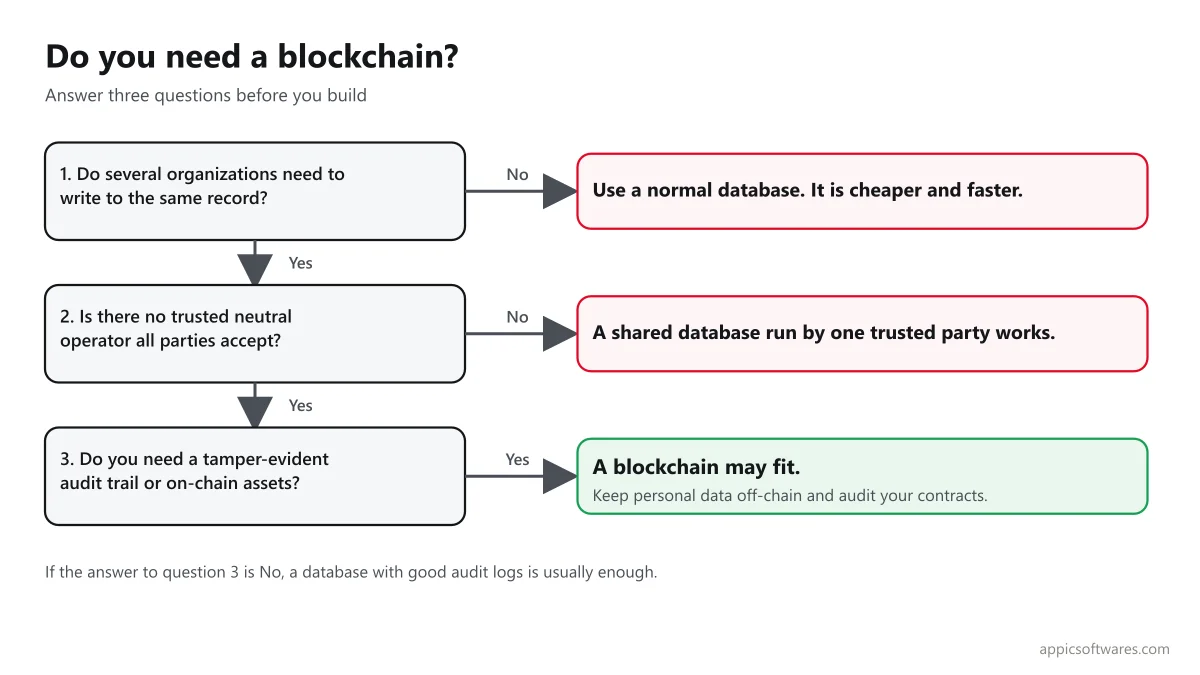
Many projects that start with "we need blockchain" end up better served by a standard database. Use this check before you commit.
| Question | If yes | If no |
| Do several organizations need to write to the same record? | Blockchain may fit | Use a normal database |
| Do those parties lack a trusted neutral operator? | Blockchain may fit | A shared database run by one party works |
| Must records be tamper-evident and auditable? | Blockchain may fit | Database logs may be enough |
| Is the data private or personal? | Store it off-chain, keep proofs on-chain | Public or permissioned chain is easier |
| Do you need value or assets to move on-chain? | Public chain or tokens fit | Not needed |
Which blockchain platform should you choose?
- Ethereum and Layer 2 networks: the largest smart contract ecosystem, with wide tooling and many developers.
- Solana: built for fast, low-fee transactions. See our Solana blockchain development company page.
- Polygon: an Ethereum-compatible network with low fees. See Polygon blockchain development.
- Hyperledger Fabric: a permissioned network for enterprises that need private shared records. See Hyperledger development services.
- Cosmos and Substrate: toolkits for building your own application-specific chain. See Cosmos development and Substrate development.
Free blockchain feasibility call: describe your idea. We will tell you whether it needs a blockchain, which network fits and what the first version should include. Book your call
What are the risks of blockchain projects?
- Regulation: rules for tokens, stablecoins and securities differ by country and change often.
- Smart contract bugs: on-chain code is hard to change after launch. Get an independent audit.
- Key management: lost or stolen keys can mean lost funds. Plan secure custody and recovery.
- Privacy: do not store personal data on a public chain. Keep it off-chain and store proofs.
- Cost and speed: fees and delays vary by network. Test with real volumes.
- Weak input data: a blockchain records what it is told. Bad inputs stay bad.
How do you build a blockchain solution?
- Confirm the need. Use the table above and write the problem in one sentence.
- Pick the network. Public, permissioned or your own chain, based on privacy, speed and cost.
- Design the data. What goes on-chain, what stays off-chain and who can read it.
- Build smart contracts and the app. Wallet connection, admin tools and integrations.
- Audit and test. Independent security audit, test network trials and load tests.
- Launch in stages. Start with a small group and expand.
- Monitor and upgrade. Track transactions, fees and security alerts.
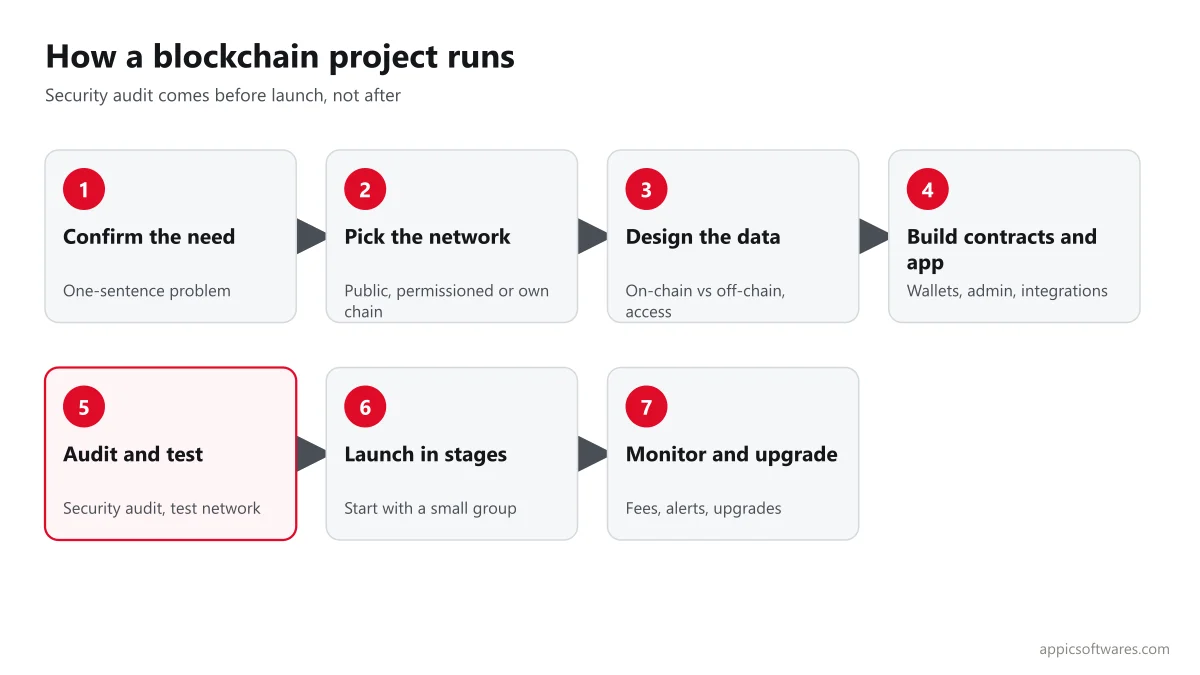
How Appic builds blockchain solutions
Appic Softwares has built custom software since 2018, with offices in Jaipur (India), Frisco, Texas (USA) and Munich (Germany), and holds a 5.0 rating on Clutch from 24 verified reviews. Our team offers blockchain development services, blockchain consulting and Web3 development, including digital wallet integration. We start with the question above, whether you need a blockchain at all. Typical Appic projects start around $10,000. For costs, read our blockchain app development cost guide and our blockchain in finance overview.
What changed from the earlier version of this post?
The earlier version, published in 2024, listed use cases with no statistics or sources, had a few garbled headings and leaned on metaverse and entertainment-strike examples. This update replaces those with current data and examples, adds a "do you need blockchain" check and a risks section, and drops claims we could not support.
Ready to test a blockchain idea? Send us the problem, the parties involved and the data you have. We will reply with a recommendation, a first-version scope and a cost range you can review with your team. Talk to our team
Frequently Asked Questions
What are the main use cases of blockchain?
The main uses in 2026 are stablecoin payments, tokenized real-world assets, decentralized finance, trade finance, supply chain traceability, digital identity, healthcare audit trails, real estate records, insurance payouts and creator royalties. Payments and tokenization have the most real usage today. Others are growing but are often at pilot stage.
Which industries use blockchain?
Finance and banking use it most, for payments, settlement and tokenized assets. Supply chain and food companies use it for traceability. Healthcare, insurance, real estate, gaming and government projects also use it. Adoption varies by region, and many deployments run on permissioned networks rather than public chains.
Do I need a blockchain for my project?
Only if several organizations must share and write to one tamper-evident record without a trusted central operator. If one company controls the data, a standard database is cheaper and faster. If you need to move tokens or assets between parties, a public chain can help. Start with the problem and not the technology.
What is tokenization of real-world assets?
Tokenization represents ownership of an asset, such as a Treasury fund, loan or property, as a digital token on a blockchain. It can enable fractional ownership, 24-hour transfers and faster settlement. The token is usually regulated like the underlying asset, so legal structure and compliance are as important as the technology.
How much does it cost to build a blockchain app?
Appic projects typically start around $10,000 for a focused MVP. Cost depends on the network, smart contract complexity, security audits, wallet and exchange integrations, and compliance work. Share your scope with us and we will give you a feature list, timeline and cost range.
Is blockchain secure?
The ledger itself is hard to alter, but projects can still fail through smart contract bugs, stolen keys, weak inputs and poor access controls. Use independent audits, secure key management, limits on high-risk actions and a plan for incidents. Keep personal data off public chains.
Related Articles
Best Online Shopping Apps in 2026: US, UK, India and More
Does anyone not enjoy shopping? For many people, it’s the most enjoyable pastime. Purchasing something elevates our satisfaction to a new level, especially when we shop online, place an order from the comfort of our home, and receive the item delivered right to our door. Not long ago, we had to visit a shopping center, […]

Best Fintech App Development Companies in 2026: 8 Picks and How to Choose
Fintech, which stands for Financial Technology, is a term used to characterize new technologies aimed at digitizing and automating services related to money. Using cutting-edge technology, leading fintech app development companies craft innovative financial solutions. When designing a user-friendly fintech app, the top developers should keep several factors in mind, including the technology, difficulties, pricing, […]
9 AI Real Estate Startups With Funding in 2026
The advent of artificial intelligence (AI) and the rise of real estate AI companies have caused a paradigm change in the real estate sector. Appraisers, mortgage lenders, developers, and homeowners have all seen tremendous changes in their daily operations as a result of this ground-breaking technology. In this piece, we examine the creative Real Estate […]

How Much Does It Cost To Create An App?
Outsourced React.js Development Services: Benefits, Cost and How to Choose a Provider
The time and resources needed to build an in-house ReactJS team are substantial. To begin, you must assess the project’s scope, identify qualified developers, assemble a team without allocating funds, and then provide consistent work and compensation to the team. This is why many businesses hire outside firms to create their React JS. Only those […]
How Much Does Logistics App Development Cost in 2026
Logistics is driving cross-border trade like never before, enabling trade on a grand scale, thanks to faster and more linked than ever before transportation. By introducing novel approaches to streamlining operations, enhancing customer service, and reducing expenses, innovations in logistics app development have sparked a dramatic shift in the sector. As more and more businesses […]