Outsourced React.js development services mean hiring an outside agency or dedicated developers to design, build and maintain your React web app. Companies do it to hire faster, control cost and reach skills they cannot find locally. It works best when you match the engagement model to your scope and check code ownership, testing and communication before you sign.
Key Takeaways
- Outsourcing React.js shortens hiring and gives you senior skills without a long recruitment cycle.
- Published hourly rates vary widely by region and vendor. India is usually the lowest, the USA the highest, and Eastern Europe sits in between.
- Pick the model by scope: fixed price for a clear MVP, time and materials for evolving products, a dedicated team for long-term work.
- React 19 and Next.js are the current baseline. Ask any provider how they use Server Components, TypeScript and testing.
- The biggest risks are unclear scope, weak communication and unclear code ownership. All three can be fixed in the contract and the first sprint.
- Appic's average rate is about $35 per hour, and typical projects start around $10,000.
Why do companies outsource React.js development?
React is still the default choice for building interactive web interfaces. In Stack Overflow's 2025 developer survey, React is listed at 52.2% admired (developers who used it and want to keep using it) and 29.7% desired (developers who want to use it next) in the web frameworks section (Stack Overflow Developer Survey 2025). The tool is also moving fast. React 19, released in December 2024, made Server Components, Actions and the use API stable (React blog), and most new production apps pair React with a framework such as Next.js.
That pace is a hiring problem. A team has to know modern React, TypeScript, state management, API design and testing, and good people are hard to find and slow to hire. Outsourcing fills that gap. Statista estimates the global IT outsourcing market at about $634 billion in 2026, growing to roughly $807 billion by 2030 (Statista). Forecasts differ by publisher because each defines "IT outsourcing" differently, so treat the numbers as a range.
What do outsourced React.js development services include?
- Custom web apps and dashboards: single-page apps, admin panels, SaaS products and customer portals.
- Next.js builds: server-side rendering and static pages for speed and SEO. See our Next.js development company page.
- Migrations: moving from WordPress, jQuery or AngularJS to React. Our WordPress to React migration guide covers the steps.
- React upgrades: moving older class-based codebases to current React with hooks and a clean component structure.
- UI component libraries and design systems: reusable components so new screens ship faster.
- API integration: REST and GraphQL back ends, payments, CRMs and analytics.
- Testing and performance audits: unit and end-to-end tests, bundle size and Core Web Vitals fixes.
- Maintenance and support: bug fixes, dependency updates and monitoring after launch.
For a broader view, see our React web development services.
What are the benefits of outsourcing React.js development?
- Faster start: you can onboard a vetted developer in days instead of running a months-long search.
- Lower total cost: you skip recruiting fees, benefits, equipment and idle time between projects. You pay for the work you need.
- Flexible team size: add developers for a launch and scale down afterward.
- Wider skill range: one provider can cover front end, back end, design and QA, which one hire usually cannot.
- Focus: your in-house team keeps working on product and customers, not on React upgrades.
There are trade-offs. You give up some day-to-day control, and your results depend on how clearly you brief the team. The comparison below shows where each option fits.
| In-house team | Freelancer | Outsourcing agency / dedicated team |
| Time to start | Slowest (recruit, interview, notice period) | Fast | Fast |
| Cost structure | Salary plus benefits, tools and overhead | Hourly, no overhead | Hourly or monthly, overhead included |
| Management effort | High | High (you coordinate everything) | Lower (a project lead handles delivery) |
| Continuity if someone leaves | Risky | Risky | Provider replaces and hands over |
| Skill coverage | Whatever you hired | One person's skills | Front end, back end, QA, design |
| Best for | Core product, long-term ownership | Small, short tasks | MVPs, scaling, long projects without hiring |
Weighing outsourcing against hiring in-house? We can walk through both with your numbers. Get your project scoped
How much does it cost to outsource React.js development?
Rates depend on region, seniority and whether you hire a freelancer or an agency. Published figures come mostly from vendor guides, and they disagree with each other, so use the ranges below for ballpark budgeting and confirm with real quotes. Sources: Lemon.io and SecondTalent.
| Region | Typical published hourly range (USD) | Notes |
| India | About $12 to $54 | Lowest range; wide spread between freelancers and agencies |
| Eastern Europe | About $30 to $80 | Strong talent pool, mid-range cost |
| USA | About $50 to $150 | Vendors disagree most here; agency rates are higher than freelance rates |
Appic's average rate is about $35 per hour, and typical projects start at around $10,000. Your final price depends on:
- Scope and screens: number of pages, user roles and integrations.
- Seniority mix: a senior lead plus mid-level developers costs less than an all-senior team.
- Design: ready Figma files versus design from scratch.
- Back end and APIs: building new services versus connecting to existing ones.
- Compliance and security: HIPAA, SOC 2 or PCI add review and testing time.
- Timeline: tight deadlines need more people in parallel.
For more detail, read our guides on the cost to hire React developers from India and the cost of hiring developers.
Which engagement model should you choose?
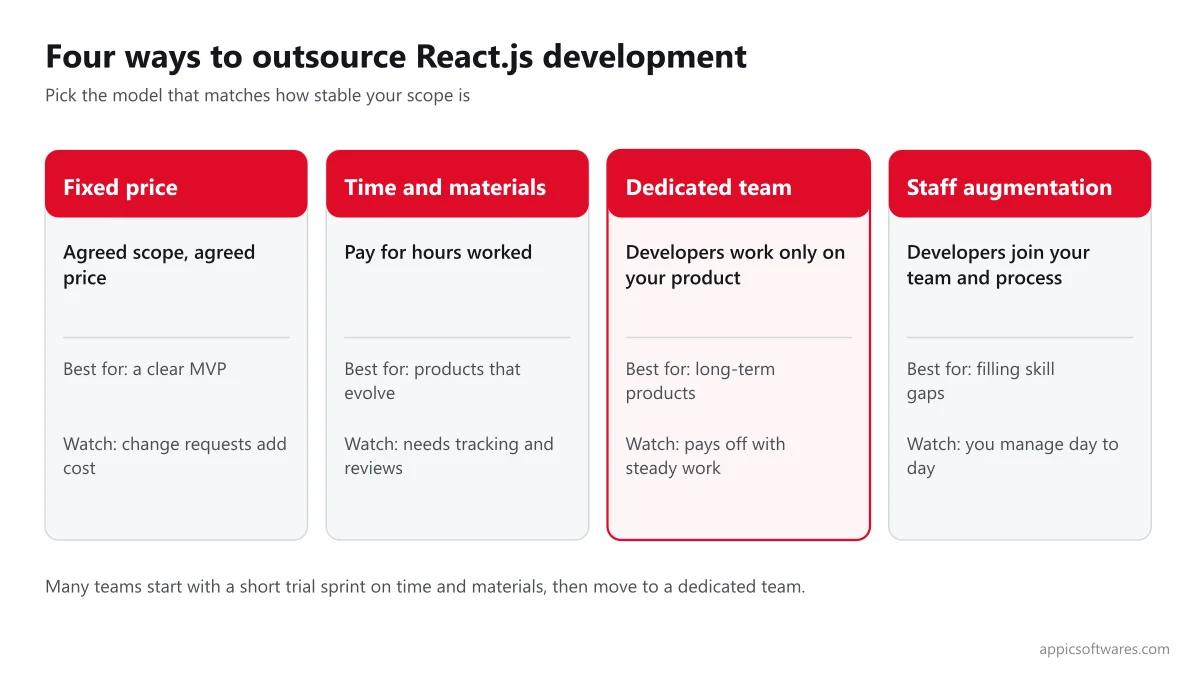
| Model | How it works | Best for | Watch out for |
| Fixed price | Agreed scope, agreed price | A clear MVP with a stable brief | Change requests add cost; scope must be precise |
| Time and materials | You pay for hours worked | Products that evolve as you learn | Needs good tracking and regular reviews |
| Dedicated team | Developers work only on your product for a monthly fee | Long-term products and scaling | Pays off only with steady work |
| Staff augmentation | Developers join your team and your process | Filling gaps in an existing team | You manage the work day to day |
Free developer shortlist: share your project and stack, and we will send profiles of React.js developers you can interview before you commit. Request your shortlist
How do you choose an outsourced React.js development company?
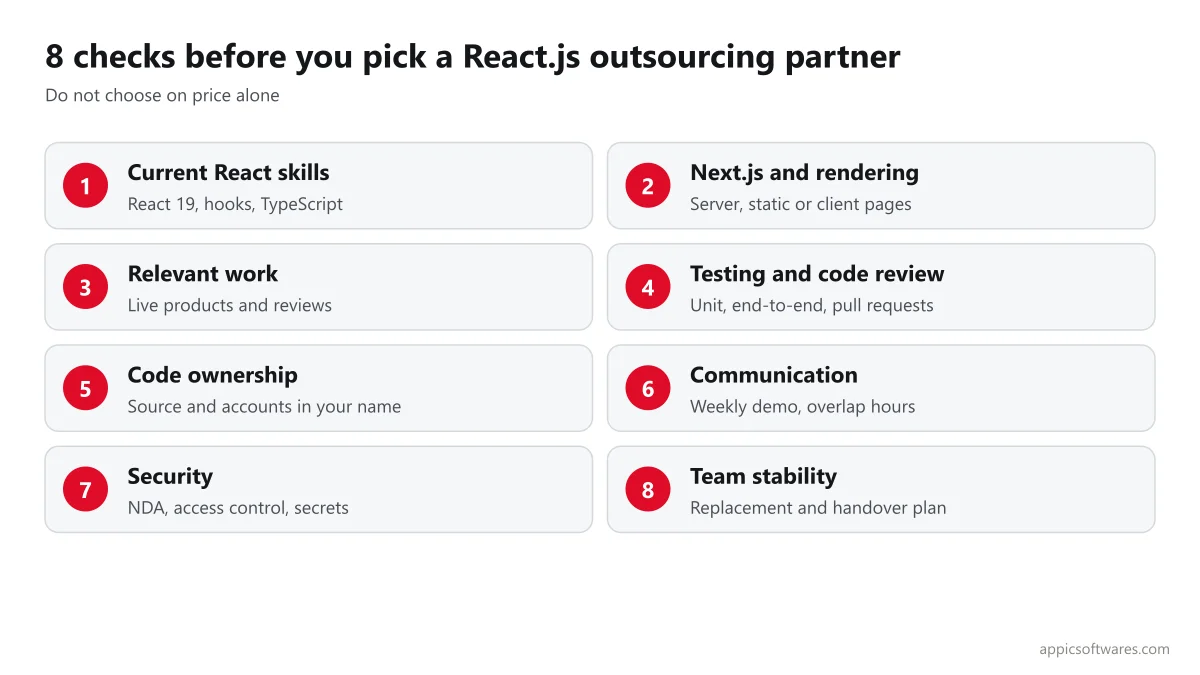
Do not pick on price alone. Check these eight things before you sign:
- Current React skills. Ask how they use React 19, Server Components, hooks and TypeScript. Old class-component habits are a warning sign.
- Next.js and rendering strategy. They should explain when to use server rendering, static pages or client-only pages for your product.
- Relevant work. Ask for two or three live products, and talk to a past client if you can. Check reviews on independent sites such as Clutch.
- Testing and code review. Look for unit tests, end-to-end tests and a pull-request review process.
- Code ownership. The contract should state that you own the source code, designs and accounts from day one.
- Communication. Agree on a weekly demo, a shared board, response times and overlap hours.
- Security. NDA, access control, secrets handling and a clear policy on data.
- Team stability. Ask how they replace a developer and how they hand over knowledge.
Red flags: a price far below every other quote, no live examples, refusing a trial sprint, vague answers about who writes the code, and no mention of testing. For a deeper hiring guide, see how to hire React.js developers from India and our developer vetting process.
What are the risks of outsourcing React.js development, and how do you reduce them?
| Risk | How to reduce it |
| Unclear scope leads to cost overruns | Write user stories and acceptance criteria. Start with a paid discovery or a two-week trial sprint. |
| Weak communication across time zones | Fix overlap hours, a weekly demo and one named project lead on each side. |
| Low code quality | Require pull-request reviews, linting, TypeScript and automated tests in the contract. |
| Unclear ownership of code | Put source code, design files and repository ownership in your name from the first commit. |
| Dependence on one developer | Ask for documentation, a second developer on the account and regular handover notes. |
| Security and data exposure | Sign an NDA, use role-based access and keep production secrets out of the repository. |
How does an outsourced React.js project run?
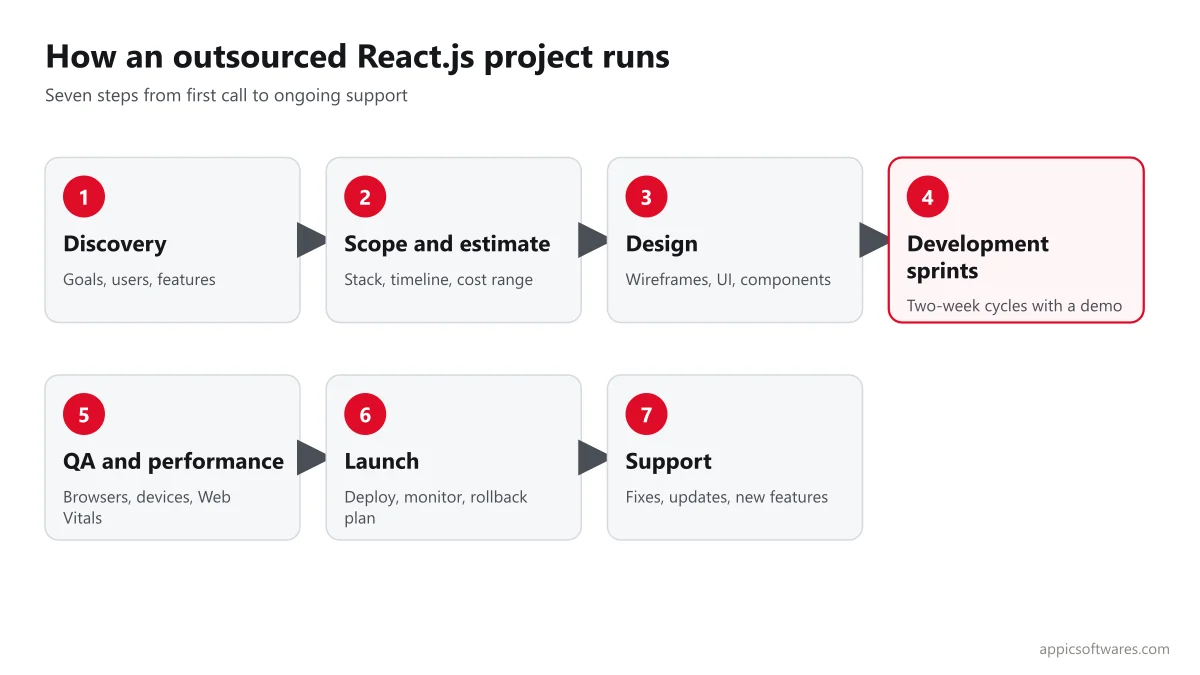
The steps are similar for most providers, and a good one will show you theirs in the first call.
- Discovery: goals, users, features, existing systems.
- Scoping and estimate: a feature list, a stack recommendation, a timeline and a cost range.
- Design: wireframes, UI design and a component library.
- Development sprints: two-week cycles with a demo at the end of each.
- QA and performance checks: testing across browsers and devices, and Core Web Vitals review.
- Launch: deployment, monitoring and rollback plan.
- Support: fixes, updates and new features.
How Appic delivers outsourced React.js development
Appic Softwares has built custom software since 2018 and has delivered more than 500 projects from offices in Jaipur (India), Frisco, Texas (USA) and Munich (Germany). We hold a 5.0 rating on Clutch from 24 verified reviews. Our React web development team works in two-week sprints with a demo at the end of each, and you own the code from the first commit. You can start with a single developer through hire developers in India, or build a full dedicated software development team. See our portfolio and case studies for delivered work.
Ready to start? Send us your idea, stack and timeline. We will reply with a scoped plan, team suggestion and cost range you can review with your team. Talk to our team