How to Build a Fitness App Like MyFitnessPal or Nike Training Club
How to build a fitness app: choose one target user and habit, pick a route (white-label platform, no-code builder or custom code), scope a small MVP, design the core loop, build with Apple HealthKit and Android Health Connect, beta test, then launch and improve retention. A custom MVP usually costs $15,000 to $40,000 and takes 3 to 4 months.
A fitness app is a mobile or web application that helps people plan, track or improve exercise, nutrition, sleep or recovery. Most combine workout or program content, activity data from phones and wearables, and progress feedback such as streaks, charts and coaching.
Demand is real. Health and fitness apps earned over $5 billion in 2024, up 14%, with about three quarters from subscriptions, according to Business of Apps (2025). ResearchAndMarkets values the wider fitness app market at $10.59 billion in 2024 (Business Wire, 2025); the figures differ because the second counts more app categories and revenue streams.
This guide is for founders, gym and studio owners, personal trainers and product leaders in the US, UK and Australia. You will learn the three ways to build a fitness app, the nine build steps, the features, architecture, compliance rules, costs and timelines, and when to bring in a fitness app development partner.
Key takeaways
- There are three routes: white-label coaching platforms from about $19 to $25 a month (Everfit, Trainerize), no-code builders from $65 a month to publish (Adalo), or custom development from $15,000.
- A custom fitness app MVP takes about 3 to 4 months; a mid-level app with wearables and subscriptions takes 5 to 7 months.
- Health and fitness apps earned over $5 billion in 2024, about 75% from subscriptions (Business of Apps, 2025).
- Android apps should use Health Connect, because Google Fit APIs are supported only until the end of 2026 (Android Developers).
- Store fees reduce subscription revenue: Apple charges 15% to Small Business Program members, and Google Play charges 10% plus a 5% billing fee in the US, UK, EEA, Australia and Japan (2026).
Apps such as MyFitnessPal and Nike Training Club did not succeed by accident. They won through strong product thinking, thoughtful UX, and constant iteration. This guide explains what it takes to build one: the features, architecture, integrations, data security and privacy rules, monetization, cost and timeline. Working with a quality fitness app development company helps, and product planning increasingly follows mobile app development trends.
Can you build a fitness app yourself? Three routes compared
Yes. Personal trainers and studios can launch a branded coaching app within days on a white-label platform, and non-developers can build a simple app with a no-code builder. A custom build makes sense when the app itself is the product, needs features no platform offers, or must scale to many thousands of users.
| Route | Best for | Typical cost (Nov 2026) | Time to launch | Main limits |
| White-label coaching platform (Trainerize, Everfit) | Personal trainers, studios and gyms selling programs | Trainerize Pro from $23 to $25 a month for 5 clients, plus a $169 one-time setup fee for its custom branded app; Everfit from $19 a month | Days to 2 weeks | Shared feature set, limited design control, the vendor owns the roadmap |
| No-code builder (Adalo, FlutterFlow, Bubble) | Prototypes and simple apps with standard screens | Adalo Builder plan $65 a month to publish to the app stores; Business plan $200 a month | 2 to 8 weeks | Performance ceilings, limited wearable and sensor access, vendor lock-in |
| Custom development (Flutter, React Native or native) | Startups and brands whose app is the product | $15,000 to $40,000 for an MVP, $40,000 to $80,000 mid-level, $80,000+ advanced (Appic planning ranges) | 3 to 12 months | Higher upfront cost and ongoing maintenance |
If you need a hybrid, a team of experienced FlutterFlow developers can start in low-code and export the code when you outgrow the builder.
Takeaway: Coaches can validate demand on a white-label or no-code app first; go custom when differentiation, data ownership or scale matter.
How to build a fitness app in 9 steps
Building a custom fitness app follows nine steps, from defining the user to improving retention after launch. Most MVPs move through steps 1 to 8 in about 3 to 4 months, because design, compliance planning and back-end work overlap.
- Define one user and one habit. For example, a fitness tracking app for new runners who want to complete three runs a week. Write a one-page product brief.
- Validate demand. Interview 10 to 15 target users, tear down 5 competing apps and test a landing page or clickable prototype.
- Choose the route and platform. Pick white-label, no-code or custom, then native or cross-platform; our complete fitness app development guide compares the stacks.
- Scope the MVP. Limit it to 6 to 9 must-have features and keep a written "not now" list.
- Design the core loop. Make the first workout or log happen in the first session, then prototype in Figma and test with 5 users.
- Plan data, privacy and compliance. Map every health data point you collect and the consent it needs under GDPR, CCPA/CPRA and state health privacy laws.
- Build and integrate. Develop the app and back end, connect Apple HealthKit and Android Health Connect, and set up App Store and Google Play billing.
- Test and run a beta. Cover offline use, battery drain, wearable sync and security, then recruit testers through TestFlight and Google Play testing tracks.
- Launch and iterate. Optimize the store listing, track day-7 and day-30 retention and trial-to-paid conversion, and release improvements every two weeks.
| Step | Main output | Typical time |
| 1. Define user and habit | One-page product brief | 2 to 3 days |
| 2. Validate demand | Interview notes, competitor teardown, prototype feedback | 1 to 2 weeks |
| 3. Choose route and platform | Build approach and tech stack decision | 2 to 3 days |
| 4. Scope the MVP | Prioritized feature list and "not now" list | 1 week |
| 5. Design the core loop | Clickable prototype tested with users | 3 to 6 weeks |
| 6. Plan data and compliance | Data map, consent flows, privacy policy | 1 to 2 weeks, in parallel with design |
| 7. Build and integrate | Working iOS and Android app, back end and integrations | 8 to 16 weeks |
| 8. Test and beta | Beta builds and a fixed bug list | 3 to 4 weeks |
| 9. Launch and iterate | Store listing, analytics dashboard, release plan | Ongoing |
Takeaway: Skipping validation (step 2) and scoping (step 4) is the fastest way to overspend; both cost weeks, not months.
Why Fitness Apps Win User Attention
People want convenience, personalization, and visible results. A good fitness app delivers all three in one simple interface, whether the goal is weight loss, muscle gain, stress reduction, or just staying active.
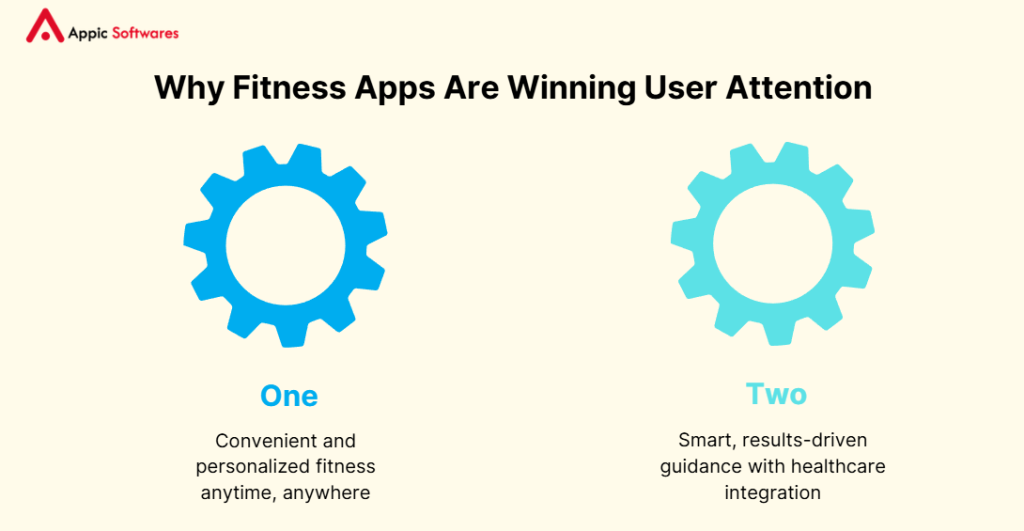
Fitness is also merging with digital healthcare. Apps now help users track vitals, manage chronic conditions such as diabetes and hypertension, and build preventive habits. AI predictive analytics in healthcare can personalize routines and flag injury risk before it becomes a problem. For many companies, a fitness app is no longer a side project but a core growth channel.
Takeaway: Fitness apps win when they deliver convenience, personalization and visible results in one simple interface.
What Makes MyFitnessPal and Nike Training Club So Sticky?
MyFitnessPal and Nike Training Club stay sticky because they motivate action, not just record data. Fitness apps were downloaded 858 million times worldwide in 2023, according to Business of Apps data cited by ResearchAndMarkets (2025), which shows how broad the appeal is.
- MyFitnessPal made nutrition tracking easy with a huge food database, barcode scanning, instant calorie and macro counts, and integrations with other health tools. Clarity and low effort build the daily logging habit.
- Nike Training Club focuses on high-quality video workouts, structured programs, and motivating trainers, so users feel they have a coach in their phone.
The lesson is that the best fitness apps combine technology with an understanding of human behavior: low friction, quick wins, visible progress, and a reason to come back tomorrow. Many founders refine the concept first with frameworks for app ideas.
Takeaway: MyFitnessPal and Nike Training Club keep users by making the daily action fast (logging food, starting a workout) and making progress visible.
Start With a Clear Product Vision
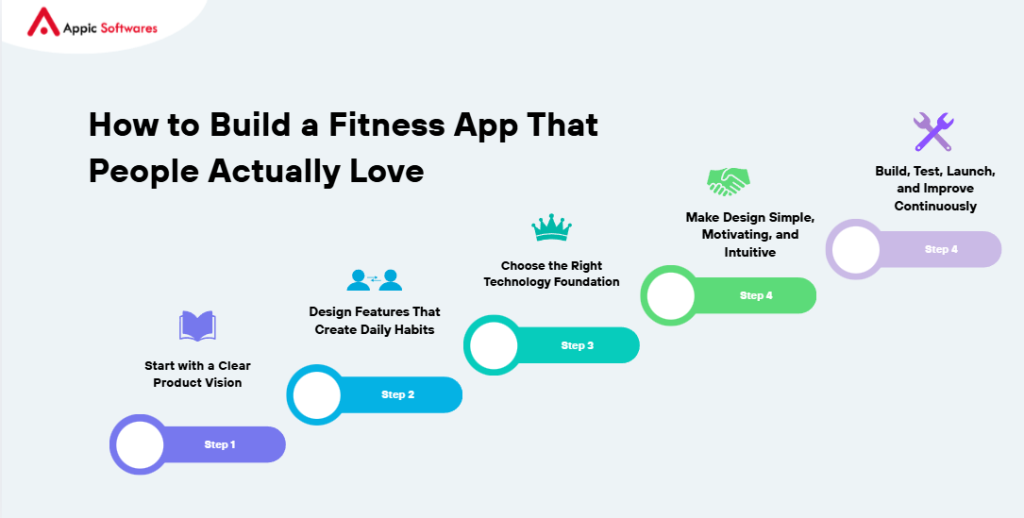
Before writing code, answer four questions:
- Who is the user? Beginners, gym-goers, runners, seniors, patients, corporate wellness programs?
- What problem are you solving? Nutrition tracking, guided workouts, coaching, rehab, community?
- What makes you different? A niche, a celebrity trainer, better personalization, a clinical angle?
- How will you make money?
Clear answers prevent feature overload and wasted spend. Validate the idea with user interviews and a clickable prototype before committing to a full build. Personalization is now a major differentiator, and many platforms use custom AI solutions to deliver adaptive training recommendations.
Takeaway: A fitness app with one clear user, problem and revenue model is cheaper to build and easier to market.
Core Features
MVP Features
| Feature | What it does |
| Onboarding and profile | Collects goals, age, height, weight, fitness level, and preferences |
| Sign-up and login | Email, phone, Google and Apple sign-in |
| Activity and workout tracking | Logs workouts, steps, distance, duration and calories burned |
| Workout library | Video or text workouts with filters by goal, level and equipment |
| Nutrition tracking | Food search, barcode scanner, calories and macros (if nutrition is in scope) |
| Goals and progress dashboard | Charts, streaks and milestones |
| Smart reminders | Push notifications for workouts, water, meals and streaks |
| Wearable and Health sync | Apple Health, Google Health Connect and basic device data |
| Settings and privacy controls | Notification preferences, data export and account deletion |
Advanced Features
| Feature | What it does |
| AI personalization | Adaptive plans based on performance, recovery and preferences |
| Wearable integrations | Fitbit, Garmin, Apple Watch, WHOOP, Oura and heart-rate straps |
| Live and on-demand classes | Streaming, scheduling and trainer chat |
| Social and community | Friends, challenges, leaderboards, groups and activity feeds |
| Gamification | Badges, points, streaks and rewards |
| Coach and trainer marketplace | Booking, messaging and payments for 1:1 coaching |
| Meal planning and recipes | Personalized plans, grocery lists and dietary filters |
| Sleep, stress and recovery | Sleep tracking, HRV, meditation and breathing exercises |
| GPS route tracking | Running and cycling maps, pace and elevation |
| Computer-vision form checks | Camera-based rep counting and posture feedback |
| Health coaching and clinical tools | Condition-specific programs, clinician dashboards, remote monitoring |
| Admin and content panel | Manage users, workouts, programs, subscriptions and analytics |
Designing for Daily Habits
Users return when the app fits their routine, not because of fancy technology. Keep onboarding short, show value in the first session, make logging take seconds, celebrate streaks, and send reminders that feel helpful rather than nagging. The interface should feel encouraging, not overwhelming.
Takeaway: Launch with the nine MVP features in the first table and add advanced features only after day-30 retention is healthy.
Architecture of a Fitness App
A scalable fitness platform is usually organized into layers.

The gateway is the single entry point; services own their data and reach AI models and partners through adapters.
1. Client layer. iOS and Android apps, optionally a web app and a smartwatch companion. Cross-platform frameworks (Flutter, React Native) cut cost and launch time; native (Swift, Kotlin) gives the best access to sensors, background tracking, HealthKit and Health Connect.
2. API gateway. A single entry point that handles authentication, rate limiting, routing, and logging.
3. Back-end services. Start as a well-structured modular monolith and split into microservices as scale demands. Typical services:
- User and authentication
- Workout and program management
- Activity and tracking data
- Nutrition and food database
- Recommendation and personalization engine
- Subscription and payments
- Notifications
- Social and community
- Analytics
4. Data layer.
- Relational database (PostgreSQL) for users, subscriptions and transactions
- Time-series or NoSQL store for high-volume sensor and activity data
- Redis for caching, sessions and leaderboards
- Object storage and a CDN for workout videos, images and audio
- A data warehouse for analytics and model training
5. Media and streaming. Video transcoding, adaptive bitrate streaming (HLS) and CDN delivery so workouts start fast on any connection, with offline downloads for premium users.
6. Integration layer. Adapters for wearables, health platforms, payment providers, food databases and notification services.
7. AI and ML layer. Models for personalized plans, calorie estimation, churn prediction and, optionally, pose estimation. Keep the model pipeline separate from the core API so it can be updated independently.
8. Infrastructure and DevOps. Cloud hosting (AWS, Azure or GCP), containers, auto-scaling for traffic spikes such as New Year, CI/CD, monitoring and backups. Reliability and uptime matter as much here as in any real-time data product.
Design principles
- Offline first: workouts and tracking must keep working without a signal and sync later.
- Battery-aware: be careful with continuous GPS and sensor polling.
- Idempotent sync: avoid duplicate or lost records when devices reconnect.
- Scale the read path: dashboards and feeds are read-heavy, so cache aggressively.
Takeaway: Start with a modular monolith, offline-first sync and a CDN for video, and split into microservices only when load requires it.
APIs and Integrations
| Category | Purpose | Examples |
| Health platforms | Read and write steps, workouts, heart rate, sleep | Apple HealthKit, Google Health Connect |
| Wearables | Device data and biometrics | Fitbit, Garmin, WHOOP, Oura, Polar, Withings (directly or via aggregators such as Terra, Vital or Validic) |
| Nutrition data | Food database and barcodes | Nutritionix, Edamam, FatSecret, Open Food Facts, USDA FoodData Central |
| Maps and location | Routes, distance and elevation | Google Maps, Mapbox |
| Payments and subscriptions | Billing and in-app purchases | Stripe, Apple In-App Purchase, Google Play Billing, RevenueCat |
| Video and streaming | Hosting and delivery | Mux, AWS MediaConvert and CloudFront, Vimeo OTT, Cloudflare Stream |
| Live classes | Real-time video | Agora, Twilio, Zoom SDK |
| Notifications and messaging | Push, SMS, email | Firebase Cloud Messaging, OneSignal, Twilio, SendGrid |
| Analytics | Product and retention analytics | Mixpanel, Amplitude, Firebase |
| AI and ML | Personalization, recommendations, vision | Custom models, cloud ML services, pose-estimation libraries |
API best practices
- Version your public API and document it with OpenAPI.
- Use OAuth 2.0 for third-party device connections and store refresh tokens securely.
- Process wearable data through webhooks and queues, since devices send data in bursts.
- Wrap every vendor in an adapter so you can switch providers without rewriting the app.
- Handle rate limits and failures gracefully, and keep users informed when a device sync is delayed.
Takeaway: Use Apple HealthKit on iOS and Health Connect on Android; Google Fit APIs are supported only until the end of 2026, according to Android Developers.
Security and Data Privacy
Fitness apps hold sensitive personal data: body measurements, location trails, heart rate, sleep, diet and sometimes medical conditions. A breach damages trust and brings regulatory penalties, so security has to be designed in from the start.
Security measures
- Authentication: secure sign-in with optional MFA and biometric unlock; short-lived tokens with refresh rotation; session timeout on sensitive screens.
- Encryption: TLS 1.2+ in transit, AES-256 at rest, and keys managed in a cloud KMS. Use certificate pinning in the mobile app for high-risk data.
- Secure device storage: keep tokens in iOS Keychain and Android Keystore, never in plain preferences or logs.
- API protection: input validation, rate limiting, WAF, and protection against OWASP API Top 10 risks.
- Access control: least-privilege roles for staff, audit logs for every access to personal data, and separation of production and test data.
- Payment safety: never store card data; use tokenized providers such as Stripe or the app stores.
- Testing and monitoring: static and dynamic scans in CI, regular penetration tests, alerting and a documented incident-response plan.
- Third-party risk: vet SDKs and analytics tools, since they can leak data or track users without clear consent.
Privacy and regulation
Which rules apply depends on your users and features:
- GDPR (EU/UK): lawful basis and explicit consent for health data, data minimization, the right to access, export and delete, and breach notification within 72 hours.
- CCPA/CPRA (California) and other US state laws, including Washington's My Health My Data Act, which covers consumer health data outside HIPAA.
- HIPAA (US): applies if you work with healthcare providers, insurers or clinical programs and handle protected health information. It requires business associate agreements, access controls, audit trails and breach procedures.
- FTC Health Breach Notification Rule (US): covers health apps that fall outside HIPAA.
- India's DPDP Act, Canada's PIPEDA, Australia's Privacy Act and similar regional laws.
- COPPA and age rules: extra care if minors can use the app.
- Medical-device rules: if the app diagnoses, treats or monitors a medical condition, it may be regulated as software as a medical device (for example by the FDA or under EU MDR). Keep wellness claims accurate.
- App store policies: Apple and Google require clear privacy labels, permission explanations and in-app account deletion.
Privacy-by-design checklist
- Ask only for the permissions you need, at the moment you need them (location, motion, Bluetooth, camera, health data).
- Give users clear controls to see, export and delete their data.
- Never sell health data or use it for advertising without explicit consent.
- Anonymize or pseudonymize data used for analytics and model training.
- Store data in the region your regulations require.
Takeaway: Treat fitness data as health data: encrypt it, collect only what you need, and check GDPR, CCPA/CPRA, Washington's My Health My Data Act and the FTC Health Breach Notification Rule before launch.
Technology Stack
| Layer | Common choices |
| iOS | Swift, SwiftUI, HealthKit, WatchKit |
| Android | Kotlin, Jetpack Compose, Health Connect, Wear OS |
| Cross-platform | Flutter, React Native |
| Back end | Node.js, Python (Django/FastAPI), Java/Spring Boot, Go |
| Database | PostgreSQL, MongoDB, TimescaleDB or InfluxDB, Redis |
| Cloud and DevOps | AWS, GCP or Azure, Docker, Kubernetes, Terraform, GitHub Actions |
| Media | HLS streaming, CDN, Mux or AWS media services |
| AI and data | Python, TensorFlow or PyTorch, MediaPipe for pose, BigQuery or Snowflake |
| Messaging | Firebase Cloud Messaging, OneSignal, Twilio |
Choose native (Swift and Kotlin) when the app needs deep sensor access, smartwatch apps or heavy background tracking, and cross-platform (Flutter or React Native) when speed to market and budget matter most. Our React Native guide for mobile apps compares the options in detail. Video-led fitness apps should cache aggressively, serve workouts through a CDN and plan for New Year traffic peaks.
Takeaway: Flutter or React Native suits most fitness MVPs; go native for watch apps and continuous background sensor tracking.
How Much Does It Cost to Build a Fitness App?
A custom fitness app costs about $15,000 to $40,000 for a basic MVP, $40,000 to $80,000 for a mid-level app, $80,000 to $200,000+ for an advanced platform and $150,000 to $300,000+ for a clinical or enterprise build. These are Appic Softwares planning ranges from our own project scoping, not quotes. For wider benchmarks, see our app development cost guide and the Android app development cost guide.
| Scope | What's included | Estimated cost |
| Basic MVP | One platform or cross-platform, onboarding, tracking, workout library, reminders, simple dashboard | $15,000 – $40,000 |
| Mid-level app | Both platforms, wearable sync, nutrition tracking, subscriptions, admin panel, social features | $40,000 – $80,000 |
| Advanced platform | AI personalization, live classes, video streaming, marketplace, advanced analytics, multiple wearables | $80,000 – $200,000+ |
| Clinical or enterprise-grade | HIPAA compliance, clinician tools, device integrations, regulatory work | $150,000 – $300,000+ |
Where the budget goes (approximate)
- Discovery, product and UX/UI design: 10–20%
- Mobile development: 30–40%
- Back end, APIs and integrations: 20–30%
- AI and data features: 5–15% (when included)
- QA, security and compliance: 10–15%
- Project management and DevOps: 5–10%
Costs people forget
- Content: filming workouts, hiring trainers, writing programs and building a food database is often a high cost for video-led apps.
- Cloud and video delivery: streaming and storage grow with every user.
- Third-party fees: wearable aggregators, food APIs, SMS and payment fees.
- App store fees: Apple charges a 15% commission to members of its Small Business Program (up to $1 million in yearly proceeds), and Google Play charges 10% plus a 5% billing fee on subscriptions in the US, UK, EEA, Australia and Japan under its 2026 fee structure (other markets stay at 15%).
- Maintenance: budget roughly 15–20% of the build cost each year (Appic estimate) for updates, OS changes and bug fixes.
- Marketing and user acquisition, which can exceed the development budget for consumer apps.
What raises or lowers the price
- Number of platforms and whether you use native or cross-platform
- Depth of AI, computer vision, and personalization
- Number of wearable and health integrations
- Original video content versus licensed or user-generated content
- Compliance needs such as HIPAA or medical-device rules
Takeaway: Budget for content, store fees and roughly 15 to 20% of the build cost each year for maintenance (Appic estimate), on top of development.
How Long Does It Take? Development Timeline
A basic fitness app MVP takes about 3 to 4 months, a mid-level app with wearables and subscriptions takes 5 to 7 months, and an advanced or clinical platform takes 8 to 12 months or more.
| Phase | Typical duration |
| Discovery, research and product planning | 2–4 weeks |
| UX/UI design and prototype | 3–6 weeks |
| MVP development (back end, app, core integrations) | 8–16 weeks |
| Testing, security review and beta | 3–4 weeks |
| App store review and launch | 1–2 weeks |
| Advanced features (AI, live classes, marketplace) | 8–20 additional weeks |

Phases overlap: design, compliance planning and back-end work run in parallel, so a basic MVP reaches launch in about 3 to 4 months, while the upper end of each range applies to mid-level scope. Advanced features follow launch in short release cycles.
Overall estimates
- Basic MVP: about 3 to 4 months
- Mid-level app with wearables and subscriptions: about 5 to 7 months
- Advanced or clinical platform: 8 to 12 months or more
The fastest way to market is to launch a focused MVP, learn from real usage and add features in short release cycles.
Takeaway: Plan about 3 to 4 months to a store-ready MVP, then ship advanced features in two-week release cycles.
Build, Test, Launch and Improve
A fitness app build runs in short agile cycles, which lets you ship quickly, gather feedback and refine. A healthy process includes:
- Discovery and validation: interviews, competitor review and a prototype.
- Design: simple, motivating interfaces with clear progress visuals and accessibility support.
- Iterative development: two-week sprints, working builds every sprint.
- Testing: functional, performance, battery, offline, cross-device and security testing, plus device-specific wearable testing.
- Beta launch: TestFlight and Google Play testing tracks with real users.
- Launch and growth: app store optimization, onboarding experiments and retention analytics.
- Continuous improvement: track activation, day-7 and day-30 retention, workout completion and subscription conversion, then improve what the data shows.
Takeaway: Measure activation, day-7 and day-30 retention, workout completion and trial-to-paid conversion from the first beta build.
Why fitness apps fail and how to avoid it
Most fitness apps fail on retention, not technology: users download them, log a few workouts and stop. Five causes come up most often, and each has a practical fix.
- Retention planned too late. Design streaks, reminders and progress views into the MVP instead of adding them after launch.
- Long, form-heavy onboarding. Ask for three or four inputs, start the first workout or log, and collect the rest later.
- Unreliable sync and no offline mode. Queue workouts on the device and sync with HealthKit and Health Connect when the connection returns.
- An over-scoped MVP. Ship the 6 to 9 core features, then add AI, live classes and social features based on usage data.
- No progression or accountability. Adapt plans as users improve and add coaching, challenges or a community so people have a reason to return.
Takeaway: Fix onboarding, sync and progression before adding new features; they decide day-30 retention.
How Fitness Apps Make Money
Fitness apps make money mainly through subscriptions, so pick a revenue model that matches user behavior.
- Subscriptions: recurring monthly or annual plans, the strongest model for most fitness apps.
- Freemium: free tracking with paid programs, advanced analytics or coaching.
- In-app purchases: one-off programs, challenges or meal plans.
- Coaching and marketplace fees: commission on 1:1 sessions and live classes.
- B2B and corporate wellness: licenses sold to gyms, employers, insurers and clinics.
- Partnerships and affiliate revenue: equipment, supplements and nutrition brands, used carefully so trust is not harmed.
- Advertising: works at large scale but can hurt the experience in a health product.
Subscriptions earned about three quarters of health and fitness app revenue in 2024, according to Business of Apps (2025). Test pricing, free-trial length and paywall placement early, because they have a large effect on revenue.
Takeaway: Lead with a subscription or freemium model, and factor in the app store commission before you set prices.
Protecting Your Idea
A fitness app idea is protected in layers: protect your brand with trademarks, your content and code with copyright and contracts, and any genuinely novel technical method with a patent where appropriate. Use NDAs and IP-assignment clauses with all developers, designers and trainers. Our guide to patenting an app idea explains the basics, and a patent attorney can advise on whether your concept qualifies.
Takeaway: File trademarks early and put IP-assignment clauses in every developer, designer and trainer contract.
Scaling Your Fitness Platform
A fitness platform scales by planning for growth from day one:
- Add predictive analytics for churn, injury risk, and plan adherence.
- Integrate more IoT devices, from smart gym equipment to connected scales.
- Expand regionally with localized content, languages, food databases and payment methods. See the top app development trends in the USA for market guidance.
- Move from a single app to a platform with trainers, communities, corporate programs and clinical partners.
- Keep infrastructure elastic and cost-aware as video and data volumes grow.
Takeaway: Grow from one app into a platform with trainers, corporate wellness and clinical partners only after the core loop retains users.
Still deciding what kind of fitness product to build? Our overview of the types of health and fitness apps compares workout, nutrition, wearable and coaching apps with examples. When you are ready to build, our fitness app development company team can scope it with you.
Why Appic Softwares Is a Good Fitness App Development Partner
Appic Softwares combines business strategy, user-experience design, and experienced engineering to build fitness and wellness apps. Because we build healthcare and fitness software, our team can help you stay compliant, build for scale and plan for the future. We support the full product life cycle, from ideation and UX design through wearable and API integrations, AI integration, and post-launch optimization, while helping you control cost and shorten time to market.
Takeaway: Choose a partner that covers product strategy, health data integrations and post-launch optimization, not only coding.
If you want to build a fitness app users love and trust, explore our fitness app development services or contact us to discuss your idea.
Frequently Asked Questions
How do I build a fitness app?
Start by defining one target user and one habit, validate demand with interviews and a prototype, then choose a white-label platform, no-code builder or custom build. Scope an MVP of 6 to 9 features, design the core loop, integrate Apple HealthKit and Health Connect, run a beta, launch and improve retention.
Can I create my own fitness app without coding?
Yes. Trainerize has a free plan for one client and Everfit offers a free trial, so personal trainers can launch a branded coaching app cheaply. No-code builders such as Adalo are free for building and testing and cost $65 a month to publish to the app stores. Expect limits on custom features, wearable integrations and data ownership.
How much does it cost to build a fitness app?
A custom fitness app costs about $15,000 to $40,000 for a basic MVP, $40,000 to $80,000 for a mid-level app with wearables and subscriptions, and $80,000 to $200,000+ for an advanced platform with AI or live classes. Clinical builds run $150,000 to $300,000+. Appic estimates maintenance at 15 to 20% of the build cost a year.
How long does it take to build a fitness app?
A basic fitness app MVP takes about 3 to 4 months from discovery to app store launch. A mid-level app with wearable sync, nutrition tracking and subscriptions takes 5 to 7 months, and an advanced or clinical platform takes 8 to 12 months or more, depending on scope and team size.
Can AI build a fitness app?
AI app builders such as Replit and Bubble can generate a working prototype from a prompt, which helps you test an idea quickly. A production fitness app still needs human-led work on health data integrations, privacy, payments, testing and app store review. AI adds more value inside the app, through adaptive plans, form feedback and coaching.
What features should a fitness app have?
A fitness app MVP needs onboarding and profiles, sign-in, activity and workout tracking, a workout library, goals and a progress dashboard, reminders, Apple Health and Health Connect sync, and privacy controls including account deletion. Add AI personalization, live classes, social challenges and more wearable integrations after launch.
Should I use Flutter, React Native or native for a fitness app?
Flutter or React Native suits most fitness MVPs because one codebase serves iOS and Android, which cuts cost and time. Choose native Swift and Kotlin when the app depends on smartwatch apps, continuous background GPS or heavy sensor processing, where platform APIs and battery control matter most.
Does a fitness app need to be HIPAA compliant?
Only if it handles protected health information for HIPAA-covered entities such as healthcare providers or health plans, or acts as their business associate. Most consumer fitness apps fall outside HIPAA but are still covered by the FTC Health Breach Notification Rule, state laws such as Washington's My Health My Data Act, and GDPR for EU and UK users.
How do fitness apps make money?
Most fitness apps earn through subscriptions, which produced about three quarters of health and fitness app revenue in 2024, according to Business of Apps (2025). Other models include freemium upgrades, one-off program purchases, coaching marketplace fees, corporate wellness licenses and carefully chosen brand partnerships.
How do I integrate Apple Health and Health Connect?
On iOS, use Apple's HealthKit framework with a clear permission prompt for each data type. On Android, integrate Health Connect, which stores data on the device, because Google Fit APIs are supported only until the end of 2026. Aggregators such as Terra add Garmin, Fitbit, Oura and WHOOP data through one API.
Related Articles
Revolutionizing Healthcare in the UK: Impact of Mobile Health Apps
Think about how great it would be to go to the doctor without having to wait in line, miss calls, or deal with convoluted booking systems. Just care that is right for you right away, directly from your phone. Doesn’t that sound perfect? This is not simply a dream anymore. Mobile health apps are making […]
How Much Does Neobank App Development Cost in 2026
Digital banking growth continues across global markets. Over 3.6 billion people use online banking worldwide. Consumers prefer fast onboarding, instant payments, and real time financial tracking through mobile apps. Traditional banks respond by improving mobile services. Fintech startups respond by launching neobanks. A neobank operates through mobile applications and web platforms without physical branches. Users […]

AI in Fashion Industry: How Technology Is Reshaping Style In 2025
In 2025, AI and fashion came together and made significant changes to how clothes are created, made, marketed, and sold. Automation, smart algorithms, and data-driven insights are improving processes and making them more useful compared to those that previously relied mostly on human imagination and intuition. AI is changing the fashion industry, and companies are […]
Flutter App Development Cost in India 2026

Data Strategy Consulting: A Business-Ready Guide
Data strategy consulting helps you through the process and allows you to make faster decisions and achieve better results out of your information. Businesses that understand how to handle and utilize their data better are in a position to make better decisions, become efficient, and outsmart their competitors. Businesses can maximize the value of every […]