ERP Finance: What It Is, Core Modules, Benefits, Cost and How to Choose a System
ERP finance is the finance and accounting part of an enterprise resource planning system. It records every financial transaction in one place, links finance to sales, purchasing, inventory and payroll, and produces reports for management, auditors and regulators. Typical modules include general ledger, accounts payable and receivable, cash management, fixed assets, budgeting, financial close and reporting.
Key Takeaways
- ERP finance replaces scattered spreadsheets and separate accounting tools with one shared ledger and one set of numbers.
- The biggest gains are a faster month-end close, fewer manual errors, clearer audit trails and real-time visibility of cash.
- An ERP is not a payments ledger. Fintech and payment companies usually need a core transaction ledger and connect it to the ERP for accounting.
- Published cost estimates for mid-size ERP projects vary widely, from tens of thousands to several hundred thousand dollars, and scope drives the price.
- SAP has said mainstream maintenance for ECC ends at the close of 2027, which is pushing many companies to plan migrations now.
What is ERP finance, and how is it different from accounting software?
Accounting software records transactions and produces statements. ERP finance does that too, but it sits inside a system that also runs purchasing, sales, inventory, projects and HR, so financial data updates as operations happen.
| Area | Basic accounting software | ERP finance |
| Data | Finance data only | Finance linked to sales, purchasing, inventory, payroll and projects |
| Entities and currencies | Usually one or few | Multiple entities, currencies and tax rules |
| Approvals and controls | Basic | Workflow approvals, segregation of duties, audit trails |
| Reporting | Standard statements | Consolidation, dimensions, dashboards and custom reports |
| Best for | Small businesses | Growing and multi-entity companies |
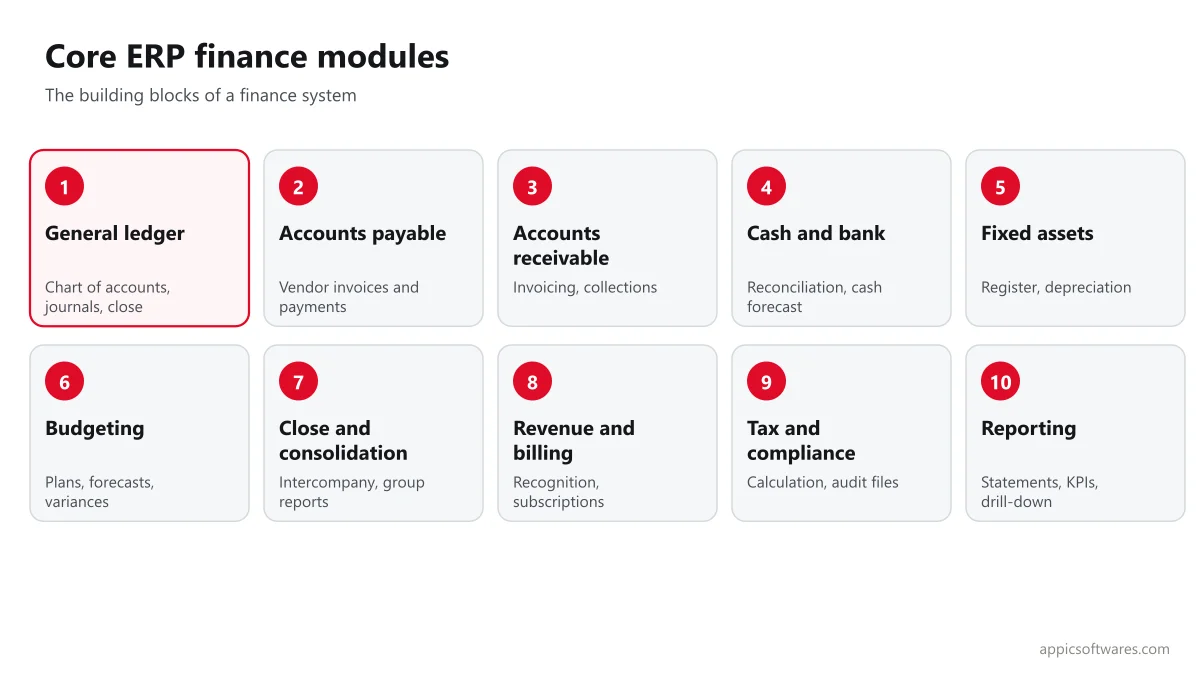
What are the core modules of an ERP finance system?
| Module | What it does |
| General ledger | Chart of accounts, journal entries, period close and the single source of financial truth |
| Accounts payable | Vendor invoices, approvals, payments and payment runs |
| Accounts receivable | Customer invoicing, collections, credit control and cash application |
| Cash and bank management | Bank feeds, reconciliation, cash position and forecasts |
| Fixed assets | Asset register, depreciation and disposals |
| Budgeting and forecasting | Plans, budgets versus actuals and rolling forecasts |
| Financial close and consolidation | Close checklists, intercompany entries and group reporting |
| Revenue and subscription billing | Revenue recognition schedules and recurring invoices |
| Tax and compliance | Tax calculation, filing support and audit documentation |
| Reporting and analytics | Statements, KPIs, dashboards and drill-down to transactions |
What are the benefits of ERP finance?
- Faster close: automated reconciliations and workflows shorten the time from month end to reports.
- Fewer errors: data is entered once and flows to the ledger, instead of being retyped between tools.
- Better visibility: cash, receivables and spending update as transactions happen.
- Stronger controls: approval workflows, permissions and a full audit trail support audits and compliance.
- Easier growth: new entities, currencies and products can be added without rebuilding the books.
- Better decisions: finance and operations data in one place supports forecasts and what-if planning.
These are typical benefits when the system is well implemented. Results depend on data quality, process design and how well people adopt the new system.
Planning an ERP finance project or a custom finance system? Tell us the problem and we will help you scope it. Get your project scoped
Does a fintech company need ERP finance?
Yes for company accounting, with an important caveat. A payments company, wallet or lending app needs a core transaction ledger that records every customer balance and movement in real time. An ERP is built for company accounting, not for processing millions of customer transactions. The usual pattern is to keep the core ledger in the product, send summarized journal entries to the ERP and reconcile against bank and payment processor reports.
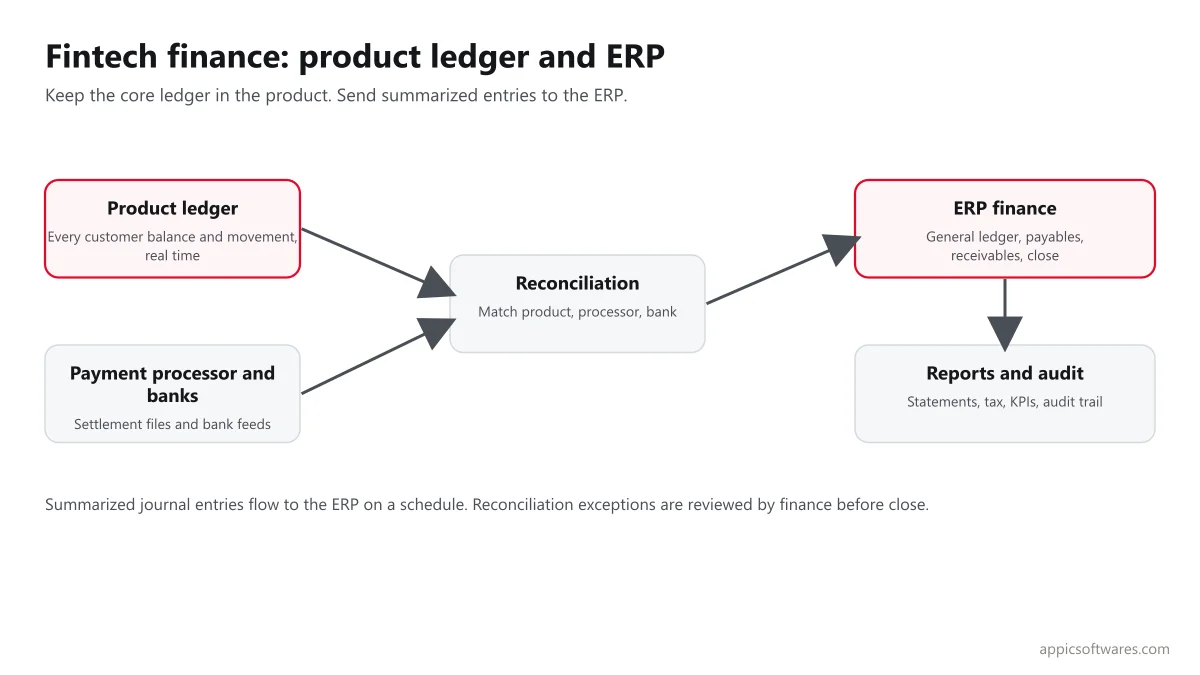
Key needs for fintech finance teams are multi-currency handling, safeguarding and client money accounting where it applies, reconciliation with banks and processors, revenue recognition and strong audit trails. For related topics, read fintech compliances and cybersecurity in fintech.
Which ERP finance systems should you consider?
This table describes how each option is generally positioned. Vendors change their products often, so confirm details and pricing with each vendor or a partner.
| Option | Generally positioned for | Consider when |
| SAP S/4HANA Finance | Large enterprises with complex, global operations | You need deep global finance and industry features |
| Oracle NetSuite or Oracle Fusion | Cloud ERP for growing and mid-size to large companies | You want a single cloud suite with multi-entity support |
| Microsoft Dynamics 365 Finance | Mid-size to large firms, strong in Microsoft environments | You use Microsoft 365, Power BI and Azure |
| Workday Financials | Large organizations that also use Workday for HR | You want finance and HR on one platform |
| Sage Intacct | Finance-led, cloud accounting for mid-size businesses | You want strong accounting and reporting without a full ERP |
| Open-source ERP (Odoo, ERPNext) | Smaller or cost-sensitive companies | You have technical skills and accept more self-management |
| Custom finance software | Unique workflows or products | Packaged systems cannot meet your rules or integrations |
Should you buy a packaged ERP or build custom finance software?
- Buy a packaged ERP when your processes are standard, you want proven controls and audit support and you can adapt to the system. It is faster to start and widely understood by auditors.
- Build custom when your workflows are unique, such as a marketplace with complex payouts or a fintech with special ledger needs, or when you need tight integration with your product. It costs more up front and needs strong controls and documentation.
- Mix both: use a packaged ERP for general ledger, payables and receivables, and build custom tools for the unusual parts, such as reconciliation engines, dashboards or integrations.
Free finance systems consultation: describe your finance process and systems. We will suggest whether to buy, build or mix, and outline the integrations you need. Book your session
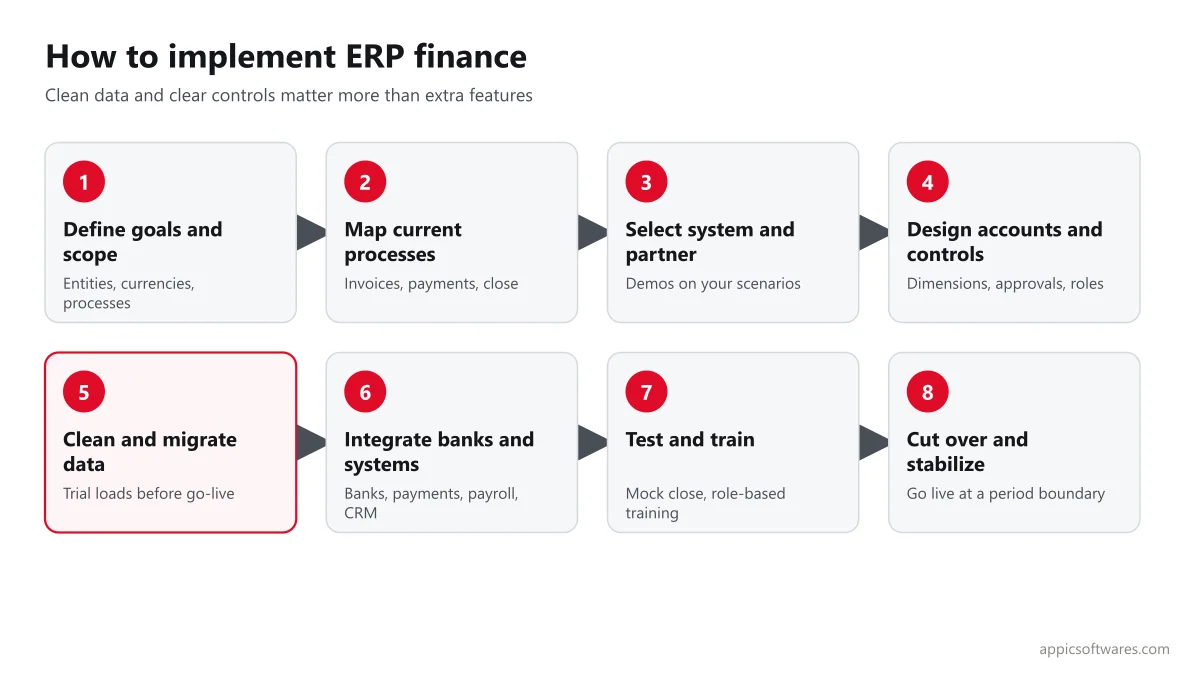
How do you implement an ERP finance system?
- Define goals and scope. Faster close, better cash visibility, audit readiness. Decide which entities, currencies and processes are in scope.
- Map current processes. Document how invoices, payments, close and reporting work today.
- Select the system and partner. Use demos on your own scenarios, and check references.
- Design the chart of accounts and controls. Agree on dimensions, approvals and permissions early.
- Clean and migrate data. Balances, open items, vendors, customers and assets. Do trial migrations.
- Integrate. Banks, payment providers, payroll, CRM, billing and your product systems.
- Test and train. Run a mock close, test reports and train users by role.
- Cut over and stabilize. Go live at a period boundary, support users and fix issues quickly.
How much does ERP finance cost?
Published figures come mostly from implementation consultancies and software vendors, and they disagree because projects differ so much. One guide puts mid-market ERP projects at $100,000 to $500,000 for companies with several departments, integrations and user groups (Innowise). A guide from an open-source ERP support vendor estimates $8,000 to $25,000 for a mid-market company using ERPNext (Ecosire). The gap reflects different software, scope and who does the work.
- Licenses or subscriptions: per user per month for cloud systems, or one-time fees for on-premise.
- Implementation: configuration, integrations, data migration, testing and training.
- Data migration: one guide suggests budgeting at least 10% to 15% of project cost, as it is often underestimated.
- After go-live: support and improvements, which one guide plans at 15% to 20% of the initial implementation cost per year.
- Customization: custom reports, workflows and integrations add cost and upgrade effort.
Treat these as rough planning numbers and get written quotes based on your scope. Appic projects typically start around $10,000 for a focused finance tool or integration.
Is SAP ECC reaching end of maintenance?
Sources agree that mainstream maintenance for SAP ECC (ERP 6.0) ends at the close of 2027, with an optional extended maintenance period to 2030 for eligible customers, and that this does not mean systems stop working on that date. Reports differ on the extra cost of extended maintenance and on which customers qualify. If you run ECC, check SAP's official maintenance roadmap and your contract, and compare options: migrate to S/4HANA, use extended maintenance as a bridge, or review other platforms (Redress Compliance, LeverX).
How is AI changing ERP finance?
AI features are appearing in finance systems and in tools that connect to them. We did not find reliable survey data on adoption, so treat vendor claims with care. Practical uses today include:
- Invoice capture: reading invoices and suggesting coding for review.
- Reconciliation: matching bank and ledger entries and flagging exceptions.
- Anomaly detection: spotting unusual payments, duplicates and policy breaches.
- Forecasting: improving cash and revenue forecasts from history.
- Assistants: answering questions about reports and drafting variance commentary.
Keep a person in charge of approvals, and log what the AI suggested and who accepted it. Controls and audit trails matter more, not less, with AI. See our guide to AI in credit scoring for another finance use of AI, and predictive analytics in finance.
Which KPIs should an ERP finance system report?
- Days to close: working days from period end to final reports.
- Days sales outstanding (DSO) and days payables outstanding (DPO).
- Cash position and cash forecast accuracy.
- Reconciliation exceptions: unmatched items and how long they stay open.
- Budget versus actual variance by department or product.
- Invoice processing time and share of invoices handled without manual touch.
- Audit findings related to finance controls.
What are the common challenges and mistakes?
| Challenge | How to reduce it |
| Poor data quality | Clean and validate data before migration, and run trial loads |
| Over-customization | Adopt standard processes first, and customize only what truly differs |
| Weak integrations | Plan bank, payment and product integrations early and test with real volumes |
| Low user adoption | Involve finance staff in design, train by role and name champions |
| Security and access gaps | Set role-based access, segregation of duties and logging from the start |
| Unclear ownership | Assign a finance process owner and an executive sponsor |
How Appic builds finance and ERP-style software
Appic Softwares has built custom software since 2018, with offices in Jaipur (India), Frisco, Texas (USA) and Munich (Germany), and holds a 5.0 rating on Clutch from 24 verified reviews. Our team builds custom finance applications and integrations, and adds AI through AI fintech app development services and AI development services. For early ideas, we offer MVP development. Related reading: ERP for healthcare and financial analytics for enterprises. Typical projects start around $10,000.
What changed from the earlier version of this post?
The earlier version, published in 2023, focused on fintech companies and listed benefits with market-size figures from 2022 to 2030, some from sources that no longer matched. This update explains what ERP finance is, the core modules, how fintech should use an ERP together with a core ledger, vendor options, implementation steps, costs, the SAP ECC timeline, AI uses and KPIs. We removed unsupported analytics claims and the old market forecasts.
Ready to improve your finance systems? Send us your process, tools and goals. We will reply with an approach, the integrations needed and a cost range you can review with your team. Talk to our team
Frequently Asked Questions
What is ERP finance?
ERP finance is the finance and accounting part of an ERP system. It records transactions in a shared general ledger, manages payables, receivables, cash, assets, budgets and closing, and links finance with sales, purchasing, inventory and payroll. It gives one set of numbers for management reports, audits and compliance.
What modules does an ERP finance system include?
Common modules are general ledger, accounts payable, accounts receivable, cash and bank management, fixed assets, budgeting and forecasting, financial close and consolidation, revenue and subscription billing, tax and compliance, and reporting. Some systems add expense management, procurement and project accounting. Choose modules based on your processes.
How much does an ERP finance implementation cost?
Published estimates range widely, from about $8,000 to $25,000 for a small open-source setup to $100,000 to $500,000 for a mid-market project with integrations. Add data migration at 10% to 15% of project cost and yearly support of 15% to 20%, according to vendor guides. Get written quotes based on your scope.
Does a fintech company need an ERP?
Usually yes, for company accounting, but not as the core ledger. Payment and wallet products need a real-time transaction ledger in the product. Summarized entries then flow to the ERP for accounting, tax and reporting, with reconciliation against bank and processor reports. This keeps the ERP fast and the audit trail clear.
How long does an ERP finance implementation take?
Small cloud implementations can take a few months, while larger projects with several entities, integrations and data migration often take six to eighteen months or more. Timelines depend on scope, data quality, integrations and how quickly decisions are made. A phased rollout reduces risk.
Should I build custom finance software instead of buying an ERP?
Buy a packaged ERP for standard accounting needs and proven controls. Build custom when your workflows are unique or you need tight integration with a product. Many companies mix both, using an ERP for the ledger, payables and receivables, and custom tools for reconciliation, dashboards and special integrations.
Related Articles

Must Know 15 Drupal Terms In 2023
Imagine this: You have a passion for automobiles, including their internal workings, exterior designs, and anything else related to automobiles. You have decided that you want to make a career out of customizing automobiles, but when you go into the garage, you realize that you know little to nothing about the tools. Learning what those […]

How To Customize Content Display In Drupal? A Complete Guide
The fundamental purpose of a content management system (CMS) is to create and manage content while also providing users with the ability to search for, customize, and publish that content. The accessibility of your website might be positively or negatively impacted by how its content is displayed. Display modes in Drupal refer to the various […]

What Is Drupal Configuration Synchronizer?
Drupal’s strong configuration Synchronization system assists developers in easily importing and exporting setups between multiple Drupal website instances. The synchronizer will assist you in several ways, such as allowing you to manage and deploy configuration changes across different environments in a structured and efficient manner. Now, if you are looking for best practices or strategies […]

Top 20 Drupal Development Companies for US Businesses (2026)
Developers, designers, and website builders who operate in digital firms or on an individual basis have a strong preference for the content management system (CMS) known as Drupal. Drupal is typically the content management system (CMS) of choice for clients of Drupal companies due to the extensive functionality, frequent security upgrades, and various customization options […]
How AI Agents Are Transforming Financial Markets
Financial markets have continually evolved in response to technological advancements. Electronic trading systems, mobile banking, and other technologies continue to revolutionize how money changes hands. The biggest driver of this change is AI agents in finance. These intelligent systems are no longer just experimental tools being tested by tech companies. They are now the backbone […]
7 Use Cases of Predictive Analytics In Finance
Today, the financial service industry is no longer reliant on simply looking back at previous years of data. Institutions expect that they will be able to not only predict and mitigate risks but also forecast potential market fluctuations and provide personalized customer experiences in real time through predictive analytics. Predictive analytics is an important area […]