Ambient AI in healthcare (often called an AI medical scribe or ambient clinical documentation) listens to a patient visit, with consent, and turns the conversation into a draft clinical note for the clinician to review and sign. It combines speech-to-text, clinical language models, and EHR integration. It can reduce documentation time and after-hours charting, but it needs strong privacy controls, clinician review and ongoing quality checks.
Documentation is one of the biggest time pressures on clinicians. Notes, orders, referrals and billing details are often finished after the clinic closes. Ambient AI aims to move that work into the visit itself. This guide covers how it fits into the clinical workflow, how speech-to-text for clinical documentation works, how to connect it to an EHR, what to do about privacy and HIPAA, the benefits and limits, and how to implement it.
Ambient AI vs traditional medical transcription
| Traditional transcription/dictation | Ambient AI scribe |
| Input | Clinician dictates after or during the visit | Natural doctor-patient conversation |
| Output | Text of what was said | Structured draft note (for example SOAP) with key details extracted |
| Understands context | No | Yes, to a degree: separates speakers, picks out symptoms, medications and plans |
| Clinician effort | Dictate, then edit | Review, edit and sign |
| EHR link | Usually paste or limited import | Designed to write into the chart |
The ambient AI clinical workflow, step by step
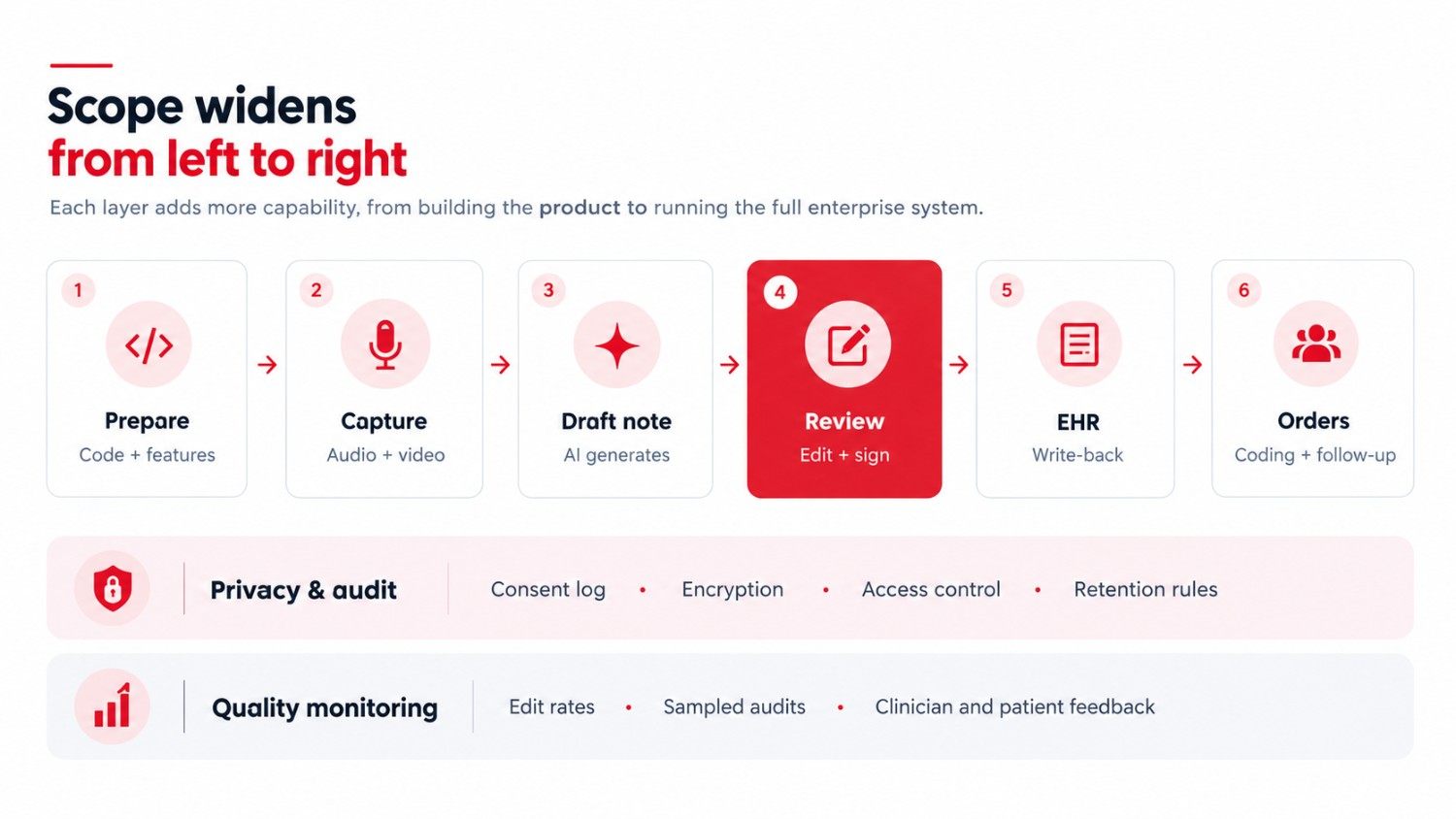
- Prepare and get consent. The clinician reviews the chart and tells the patient that an AI tool will record the visit. Consent is captured according to local law and your policy.
- Capture the visit. A phone or tablet app, a room microphone, or a telehealth integration records the conversation. The clinician talks to the patient as usual.
- Draft the note. The system transcribes the audio, separates the speakers, pulls out the clinical details and writes a note in the chosen template.
- Review, edit and sign. The clinician checks the draft against what actually happened, corrects it and signs. The clinician stays responsible for the record.
- Write to the EHR. The approved note, and optionally structured items such as medications or problems, go into the chart.
- Orders, coding and follow-up. Many tools also suggest orders, billing codes and patient-friendly visit summaries, which the clinician confirms.
Speech-to-text for clinical documentation
Everything downstream depends on accurate transcription. Clinical conversations are harder than dictation: two or more speakers, interruptions, background noise, accents and dense medical vocabulary.
- Medical vocabulary: drug names, anatomy, procedures and abbreviations need a speech model tuned for healthcare, with custom word lists for local brand names and specialty terms.
- Speaker diarization: the system must tell clinician from patient from family member, because "I take metformin" means something different from "My mother takes metformin."
- Streaming vs batch: streaming gives a live transcript and faster notes. Batch (after the visit) can be more accurate and cheaper.
- Accents and languages: test with your own patients. Multilingual and code-mixed speech, such as Hindi-English, needs extra testing and sometimes a different model.
- Audio quality: microphone placement, room noise, and mask use all change results. Hardware choices matter as much as model choices.
- Measuring accuracy: word error rate is a start, but the more useful check is whether the final note is clinically correct and complete.
After transcription, a clinical language model turns the text into a note. Good designs keep the note grounded in the transcript (for example by linking each statement to the source sentence) and use templates by specialty, so the model fills a structure instead of free-writing.
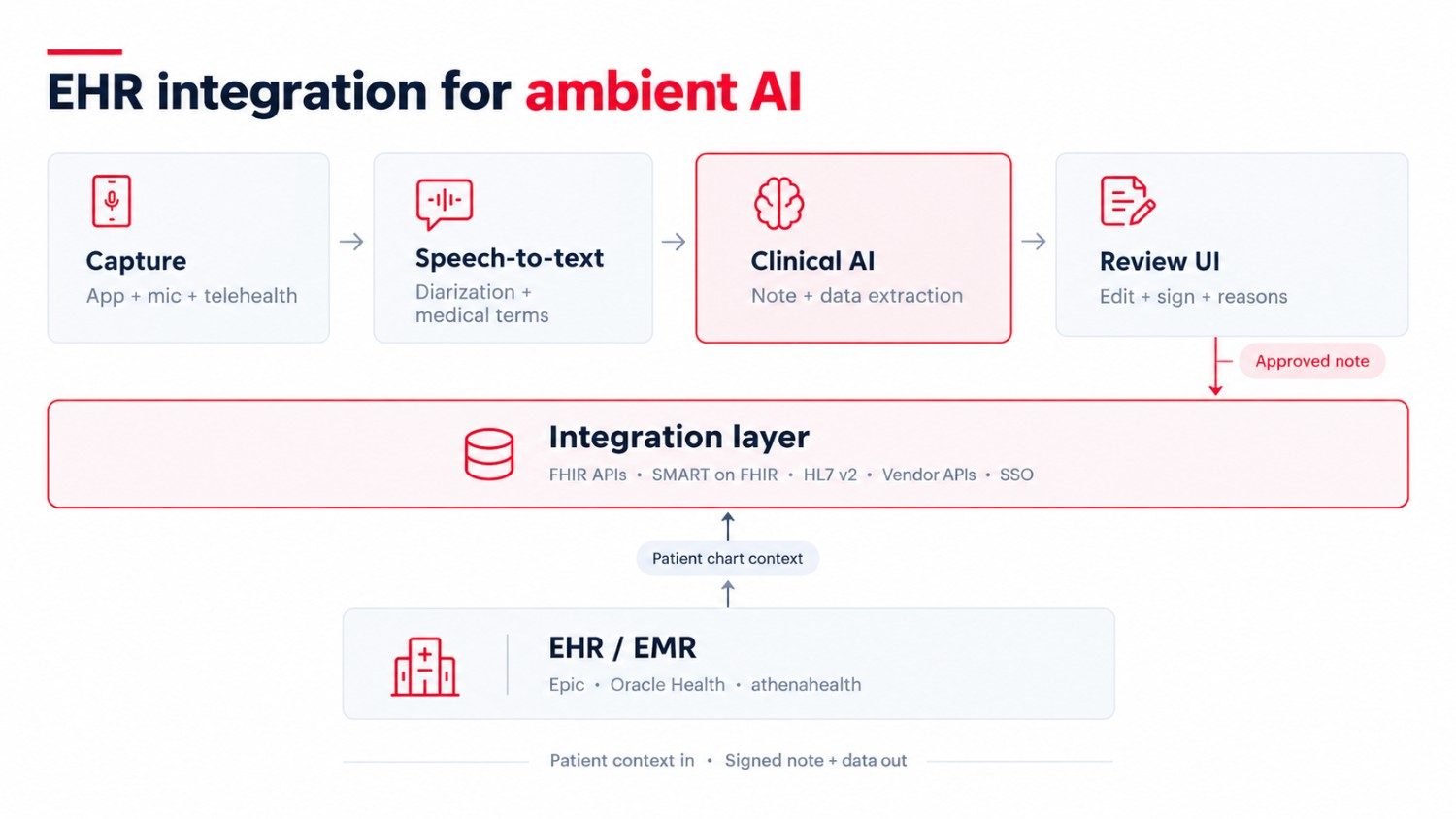
Integration is where many ambient AI projects succeed or stall. Key points:
- Context in: the AI performs better when it can read the patient's problem list, medications, allergies, and recent results, usually through FHIR resources or vendor APIs.
- Note out: the signed note is written back as a clinical document. Many integrations also push structured data (such as medications or diagnoses), but only after the clinician confirms it.
- Launch inside the EHR: SMART on FHIR lets the review screen open within the EHR with the right patient and user, so clinicians don't switch apps.
- Write access varies: what you can read and write depends on the EHR vendor, the version, and your agreement. Check this early, because it drives timelines and cost.
- Standards: expect a mix of FHIR for modern APIs and HL7 v2 for older feeds. See our guide to EMR and EHR software development for architecture and standards detail.
- Identity and audit: link every note to a verified clinician and patient encounter, and log who saw, edited, and signed it.
Privacy, security and HIPAA
Ambient AI records the most sensitive conversations in healthcare, so privacy needs to be designed in from the start.
- Consent and notice: tell patients that AI is recording, explain why, and offer a way to opt out. Recording laws differ by place, and some require consent from everyone in the conversation.
- Agreements: in the US, vendors that handle protected health information need a business associate agreement (BAA), including any cloud or AI model providers they use behind the scenes.
- Data protection: encrypt audio and text in transit and at rest, restrict access by role, and keep audit logs.
- Audio retention: decide how long audio and transcripts are kept. Many organisations delete audio soon after the note is signed and keep only the note.
- Model training: confirm in writing whether patient data is used to train or improve any model, and make sure that matches your consent and legal basis.
- Data location: check where data is stored and processed, because some regions require local storage.
- Other laws: GDPR treats health data as a special category, and India's Digital Personal Data Protection Act, 2023 requires valid consent for personal data. Confirm current rules with qualified legal counsel.
Benefits of ambient AI in healthcare
| Benefit | How it helps | How to measure it |
| Less documentation time | A draft note is ready at the end of the visit | Time spent in notes per visit or per day |
| Less after-hours charting | Fewer notes left for evenings and weekends | After-hours EHR time |
| Lower burnout risk | Less repetitive typing and screen time | Clinician satisfaction surveys |
| Better patient interaction | More eye contact and listening, less typing | Patient experience feedback |
| More consistent notes | Templates and complete capture of discussed items | Note completeness audits |
| Capacity and throughput | Faster chart closure can free up time for visits | Visits per session, days to close charts |
Published pilots and vendor reports describe lower documentation time and less after-hours work, but results vary by specialty, clinician, and workflow. Measure your own baseline before and after.
Limitations and risks
- Errors and omissions: AI can miss details, mishear drug names or add statements that weren't made. Clinician review is essential, not optional.
- Automation bias: busy clinicians may sign without careful review. Training and audits reduce this.
- Accents, languages and noise: accuracy can drop for some patients and settings. Test with your real population.
- Complex visits: procedures, multiple family members and emergency care are harder than simple follow-ups.
- Template fit: notes may not match every specialty's or organisation's style without configuration.
- Cost and licensing: pricing is often per clinician per month, plus integration and support costs.
- Patient comfort: some patients will decline recording, so you need a smooth fallback workflow.
- Accountability: the signing clinician is responsible for the final record, so policies must say so clearly.
How to implement ambient AI: a step-by-step plan
- Set goals and a baseline. Choose what to improve (for example, after-hours charting) and record current numbers.
- Pick a pilot group. Start with a few specialties and willing clinicians, including a mix of fast and slow documenters.
- Decide build vs buy (see below).
- Run a privacy and security review. Complete BAAs, consent wording, retention rules, and a risk assessment.
- Integrate with the EHR. Confirm read and write access, single sign-on, patient context and note delivery.
- Configure templates. Adapt note formats, terminology and specialty rules with clinician input.
- Pilot and gather feedback. Review edit rates, errors and workflow friction weekly, and fix issues quickly.
- Train and set review standards. Teach clinicians what to check, and sample notes for quality audits.
- Measure and scale. Compare against the baseline, then expand in stages.
- Monitor continuously. Track accuracy, edit rates, complaints, and fairness across languages and accents.
Build vs buy
| Buy an existing product | Build or customise |
| Speed to start | Fast | Slower |
| Fit to your workflow | Standard templates, limited changes | Tailored to your specialties, languages and EHR |
| Integration | Depends on vendor's supported EHRs | Built around your systems, including legacy ones |
| Data control | Vendor policies apply | You choose hosting, retention and model use |
| Cost pattern | Per-clinician subscription | Higher upfront build, then run costs |
| Best for | Common specialties, quick pilots | Regional languages, unusual workflows, custom EHRs, strict data rules |
Examples of existing products include Microsoft's Dragon Copilot, Abridge, Suki, Nabla, and Ambience. Offerings change quickly, so check current capabilities and EHR support before choosing.
Planning an ambient AI or AI medical scribe project? Appic Softwares offers AI development services, including generative AI development and LLM development, for clinical documentation tools, plus healthcare software development for EHR integration, patient apps and secure data platforms. Read more on how to integrate AI in healthcare, the ROI of healthcare software, and telemedicine app development. Get a custom estimate.