17 Must-Have Ecommerce APIs To Get High ROI

Every online store runs on APIs. They connect the storefront to payment gateways, product catalogs, order management, and inventory systems, so each part can change without breaking the rest. This guide explains the main API types, compares REST and GraphQL, walks through the four core e-commerce APIs, and ends with a security checklist and working examples.
1. API types used in e-commerce
| Type | How it works | Typical e-commerce use |
| REST | Resource URLs plus HTTP verbs (GET, POST, PUT, DELETE), usually JSON | Most storefront, order and payment APIs |
| GraphQL | One endpoint; the client asks for exactly the fields it needs | Headless storefronts, mobile apps with varied screens |
| SOAP | XML messages with a strict contract (WSDL) | Legacy ERP, tax and shipping systems |
| gRPC | Binary protocol over HTTP/2, defined by Protocol Buffers | Fast service-to-service calls inside your backend |
| Webhooks | The provider calls your URL when an event happens | Payment succeeded, order shipped, stock changed |
APIs can also be grouped by audience: public (open to developers), partner (shared with approved businesses such as marketplaces or logistics firms), and private (internal only, between your own services).
2. REST vs GraphQL
| REST | GraphQL | |
| Endpoints | Many (/products, /orders) | Usually one (/graphql) |
| Data returned | Fixed by the server; can over-fetch | Chosen by the client; fewer wasted fields |
| Fetching related data | Often several requests | One query can span product, price and stock |
| Caching | Easy with standard HTTP caching | Harder; needs query-level or persisted-query caching |
| Learning curve | Low | Higher (schema, resolvers, query cost control) |
| Best for | Payments, webhooks, simple CRUD, public APIs | Catalog-heavy, multi-channel front ends |
Practical rule: use REST for transactional operations such as payments and order creation, where clear, cacheable, well-understood endpoints matter. Consider GraphQL for the read-heavy storefront layer. Many stores run both.
3. The four core e-commerce APIs
Payments API
Creates charges, handles refunds, and reports payment status. Typical calls: create a payment intent, confirm it, capture it, refund it. Always let the gateway collect card details (hosted fields or redirect) so card numbers never touch your servers. Confirm the final result through a webhook, not only the browser redirect.
Catalog API
Serves products, variants, prices, images, and categories. It is read-heavy, so cache it. Typical calls: list products with filters, get a product by ID, search, list categories.
Orders API
Creates and tracks orders through their lifecycle (created, paid, packed, shipped, delivered, returned). Use idempotency keys on create calls so a network retry never produces a duplicate order.
Inventory API
Tracks stock per SKU and location. Reserve stock when an order is placed, release it if payment fails, and decrement it on fulfilment. Push stock changes to the storefront through webhooks or events so customers don't buy items that are gone.
4. Architecture and integration flow
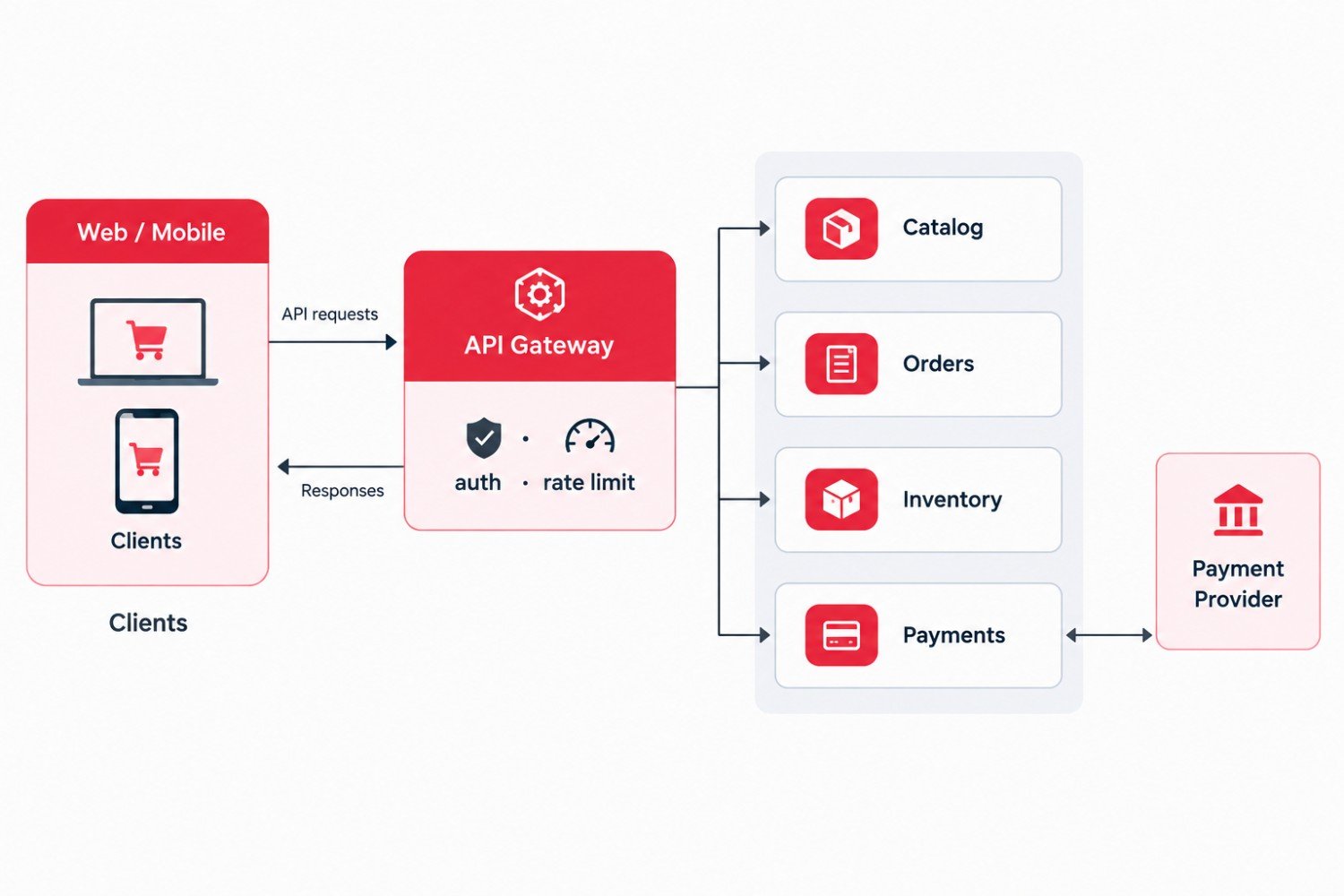
Checkout flow, step by step:
- The client requests products from the Catalog API.
- The customer checks out; the Orders API creates an order in
pendingstatus. - The Inventory API reserves the stock.
- The Payments API creates a payment with the provider.
- The provider sends a signed webhook when the payment succeeds or fails.
- On success, the order moves to
paidand stock is committed. On failure, the reservation is released. - Shipping and notification services are triggered by order events.
5. API security checklist
- Use HTTPS everywhere (TLS) and reject plain HTTP.
- Authenticate and authorise. Use OAuth 2.0 or short-lived tokens for users, and API keys with limited scopes for server-to-server calls. Check that each user can only access their own orders (broken object-level authorisation is the top risk on the OWASP API Security list [1]).
- Never expose secret keys in front-end code, mobile apps or public repositories. Store them in a secrets manager and rotate them.
- Verify webhook signatures and ignore events that fail the check.
- Validate all input on the server and return generic error messages.
- Rate-limit and throttle at the gateway. For GraphQL, also limit query depth and cost.
- Use idempotency keys for payment and order creation.
- Keep card data out of your systems by using the gateway's hosted fields or checkout. This reduces your PCI DSS scope [2].
- Log and monitor failed authentications, unusual order patterns, and webhook errors, without logging full card or personal data.
6. Examples
REST: create an order
POST /v1/orders
Authorization: Bearer <token>
Idempotency-Key: 7c1e9a52-order-1042
Content-Type: application/json

{
  "customer_id": "cus_123",
  "items": [{ "sku": "TSHIRT-BLK-M", "qty": 2 }],
  "currency": "INR"
}

201 Created
{ "id": "ord_981", "status": "pending", "total": 1798.00 }
GraphQL: product with price and stock in one request
query {
  product(id: "prod_55") {
    title
    price { amount currency }
    variants { sku inventory { available } }
  }
}
Webhook: verify the signature (Node.js)
const crypto = require('crypto');

function isValid(rawBody, signature, secret) {
  const expected = crypto
    .createHmac('sha256', secret)
    .update(rawBody)
    .digest('hex');
  return crypto.timingSafeEqual(
    Buffer.from(expected), Buffer.from(signature));
}
These are illustrative examples. Exact field names, headers, errors,s and signature formats differ by provider, so follow your gateway's own documentation.
Need help building this? Our team handles e-commerce software development, GraphQL and API development, payment and wallet integration, and custom software development. Talk to us.
Sources and further reading
Frequently Asked Questions
What are ecommerce APIs?
Ecommerce APIs are software interfaces that connect an online store with external tools and services such as payments, shipping, inventory, customer data, and analytics.
Why are ecommerce APIs important for online stores?
Ecommerce APIs help automate key processes, connect different platforms, reduce manual work, and improve the overall shopping experience.
What are the most important ecommerce APIs for an online store?
Commonly used ecommerce APIs include payment, shipping, product, inventory, order management, authentication, marketing, search, and analytics APIs.
Related Articles
Multi-Agent Systems for Real Estate: How AI Teams Are Reshaping Property Operations in 2026
How Agentic AI Is Transforming Real Estate Operations in 2026