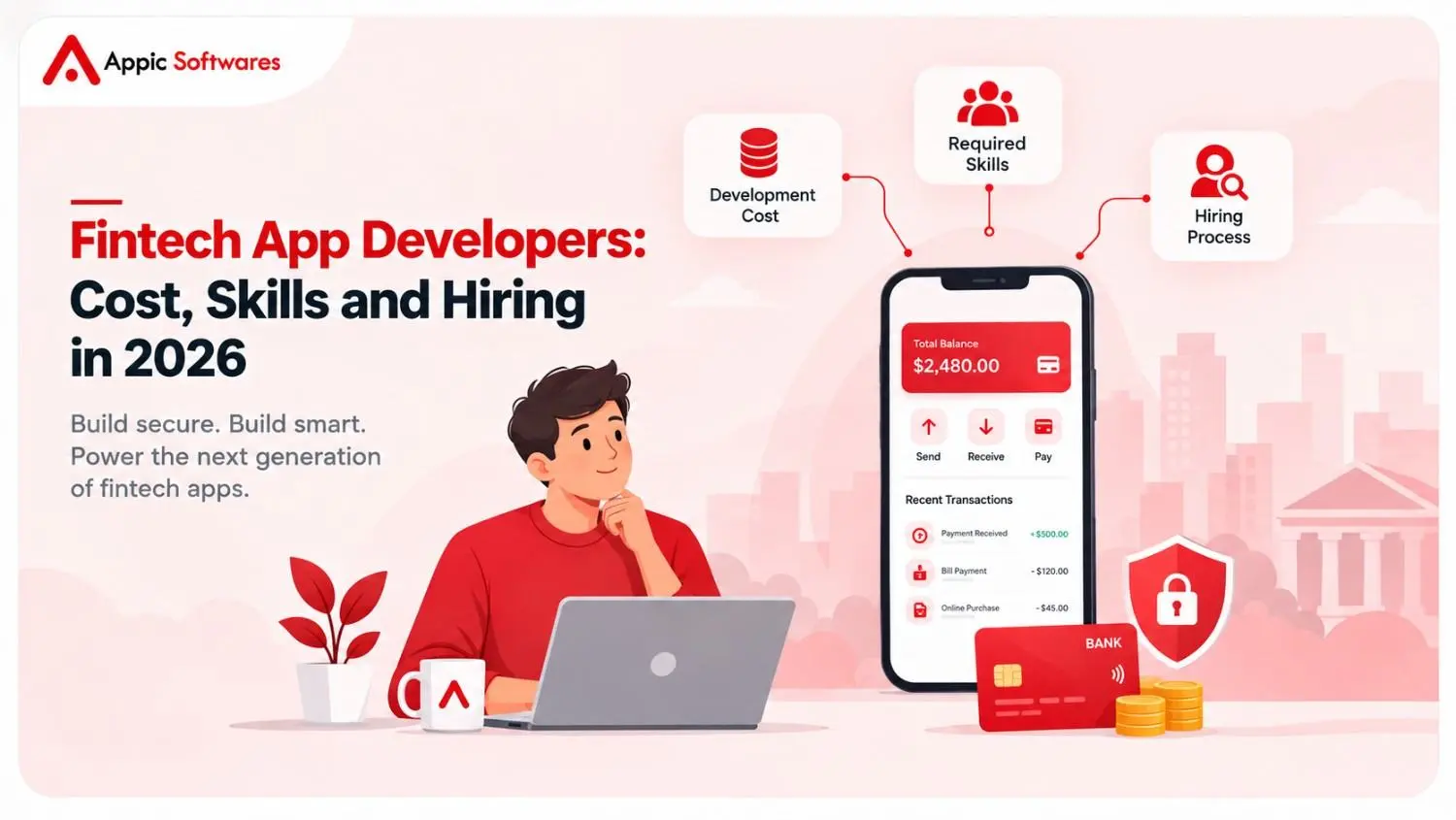
Businesses everywhere want to build apps for banking, payments, and investments. However, creating these apps takes special skills. That’s where fintech app development comes in. In 2021, there were more than 26,000 financial startups worldwide and more than 10,000 in the US alone. If you’re wondering, “How much does it cost to hire fintech app developers in 2025?” then this article will break it all down for you. We’ll talk about why you should hire dedicated fintech app developers, what to check before hiring them, their roles and responsibilities, and how much it costs to hire them from different parts of the world.
Why Hire a Dedicated Fintech App Developer?
Hiring dedicated fintech app developers makes a lot of sense for many reasons. First, fintech apps deal with money and personal information. Security is a big deal here. Dedicated developers focus only on your project. They can spend all their time making sure your app is safe from hackers and meets all the rules it needs to follow. This focus keeps your app strong and trustworthy.
Next, these developers bring special knowledge to the table. Fintech isn’t just about coding; it’s about understanding finance, too. Dedicated fintech app developers know how to build features like payment systems, loan calculators, or investment trackers. They can also help you develop a fintech MVP, which is a simple version of your app to test your idea. This saves you time and money before building the full app.
Another perk is speed. Since dedicated developers work only on your app, they finish faster. They don’t split their time between lots of projects. For fintech apps, which can get tricky with things like connecting to banks or adding security, this speed matters. Plus, they stick around after the app launches. They can fix problems, add new features, and keep everything running smoothly.
Finally, hiring dedicated developers gives you peace of mind. You don’t have to worry about managing a big team or finding people with the right skills. They handle the tough stuff, so you can focus on growing your business. In 2025, when fintech is bigger than ever, having experts like this is a smart move.
5 Things To Check Before Hiring a Fintech App Developer

Before you choose to work with a Fintech App Developer, it is wise to check several key points. This step will help you make a clear choice and avoid later problems. Here are five important things to check before hiring an expert:
1. Skills and Experience
First, look at the candidate’s skills and past work. Ask if they have worked on projects that involve fintech app development. Check if they know how to build secure systems and easy-to-use designs. Request examples of their work. This review will show you if they have the right background to work as a fintech app developer. A candidate with good skills should also know about different programming languages and tools used in the industry.
2. Security Knowledge
Since financial apps deal with sensitive data, the expert must know a lot about security. Ask how they set up safe payment systems and protect user information. They should talk about the methods they use to keep data safe. They must understand the rules of online safety. A good expert will show clear examples of how they build secure apps. This check will help you see if the person has a strong grip on the tools needed for safe fintech app development.
3. Communication Skills
Good work happens when everyone talks clearly. The candidate should be able to explain their ideas. They need to answer questions and give clear reasons for their choices. Good communication makes it easy to work together. When you speak with the expert, ask for clear examples and check if they explain things in a way that makes sense. This step is important because clear communication makes sure that no steps are lost during the project.
4. Project Management and Teamwork
A strong expert works well with other team members. They must be able to follow a schedule and meet the plan. Ask if they have worked on projects with many parts and if they can stick to deadlines. A candidate with good project skills will tell you how they handle changes in the plan and how they keep the work on track. Their role as a fintech app developer is not only to code but also to help the whole team move in the right direction.
5. Cost and Budget
Finally, check the cost of hiring the expert. Compare the fee with your available budget. Some experts work on an hourly basis, while others give a fixed rate for the whole project. Look at online reviews and ask for clear quotes. It is wise to compare the fintech app development cost from different sources before making a decision. This step helps you see if the price is fair for the work you expect.
When you check these five points, you gain a clear picture of what to expect. It is a good idea to start with a small test project. This way, you can see the expert’s work in action. For example, you might ask the candidate to work on a short task to show you how they handle a part of the project. This test helps you decide if the candidate is the right choice to build your fintech app.
Many companies ask for clear details on how the expert will work. They want to know if the person can build an app that is both safe and easy to use. They compare many financial app development companies and check the past work of each candidate. By taking the time to check skills, security, communication, teamwork, and cost, you will be able to choose a strong expert who can build a clear and effective app.
What Are The Roles And Responsibilities of Hiring a Fintech App Developer?
So, what does a fintech app developer do? Their job is big because fintech apps need to work perfectly. Here’s a clear look at their roles and responsibilities:
Designing the App
A fintech app developer begins by planning how the app will look and feel. They choose clear colors and simple layouts that make the app easy to use. They decide where buttons and menus should go to guide users smoothly. Their work creates a friendly and clear interface that helps users complete tasks with ease.
Coding the App
The developer writes the code that makes the app work well for all users. They handle both the parts that users see and the hidden parts that run the app. They work on features like payment systems and saving tools with care. Their clear coding helps the app run fast and without errors.
Keeping It Safe
Security stands as one of the top tasks for a fintech app developer. They add strong measures like encryption and secure logins to protect user data. They check every part of the app to stop any weak points from showing up. Their careful work keeps money and information safe for everyone.
Connecting to Money Systems
The developer links the app to banks, payment services, or stock market systems using smart tools. They use APIs to ensure that the app talks well with other systems. Their work makes sure that money moves quickly and correctly within the app. This clear connection helps the app work smoothly with financial services.
Testing Everything
Before the app goes live, the developer tests every part of it on different devices. They look for small mistakes that could stop the app from running well. They run many tests to be sure that the app performs as expected. This thorough check makes the app reliable and ready for real use.
Fixing and Updating
After launch, the work does not end for the fintech app developer. They fix any bugs that users may find along the way. They add new features and update the app to keep it fresh and simple to use. Their ongoing work ensures that the app stays strong and meets user needs over time.
Compliance Every Fintech App Must Handle
Compliance is the biggest hidden driver of fintech cost and timelines. A developer who has not shipped regulated products will slow you down, so check this before hiring. Our KYC and AML solutions cover the full onboarding and monitoring flow.
KYC and AML
• KYC (Know Your Customer): Verify who your users are before they transact: ID document checks, selfie or liveness checks, address proof, and database screening.
• AML (Anti-Money Laundering): Monitor transactions for suspicious patterns, screen users against sanctions and PEP lists, and file suspicious activity reports where the law requires it. See FATF for global AML standards.
• What your developer should build: Onboarding with identity verification, risk scoring, transaction monitoring rules, audit logs, and case management for flagged accounts.
• Rules depend on the market: FinCEN in the US, FCA and EU AML directives in the UK/EU, and RBI guidelines in India. Confirm exact requirements with a compliance advisor for your licence type.
PCI DSS
If your app stores, processes, or transmits card data, PCI DSS applies. The standard is maintained by the PCI Security Standards Council.
• Reduce your scope: Use tokenization and hosted payment fields from a PCI-compliant gateway (Stripe, Adyen, Razorpay) so raw card numbers never touch your servers.
• Core requirements: Network segmentation, strong encryption, access control, vulnerability scanning, logging, and regular security testing.
• Cost impact: Self-assessment is cheap for small merchants. Higher volumes can require a formal audit by a Qualified Security Assessor, which adds to your budget
Other Regulations to Know
PSD2 and SCA in Europe, GDPR for EU user data, SOC 2 for B2B trust, and local data residency rules (for example, in India).
Banking APIs and Open Banking
Most fintech apps do not talk to banks directly. They use APIs. If you are building a bank-grade product, see our mobile banking app development and open banking API integration services.
• Payment APIs: Stripe, Adyen, Razorpay, PayPal for collecting and sending money.
• Account data and aggregation: Plaid, TrueLayer, Yodlee for reading bank accounts and transactions with user consent.
• Banking-as-a-Service (BaaS): Providers that supply accounts, cards, and ledgers so you can launch a neobank without your own banking licence.
• Core banking systems: Used by banks and larger lenders. Usually the most complex integration.
What is open banking? It lets customers securely share their financial data with approved third-party apps through standardised APIs. In Europe, it is driven by PSD2; the UK has its own Open Banking framework, and India uses the Account Aggregator system. US open banking rules are still evolving, so check the current status before you plan around them.
What to check in a developer: experience with OAuth 2.0 and consent flows, API rate limits and error handling, webhooks, reconciliation, and what happens when a bank API goes down.
Security Checklist for Fintech Apps
Ask any developer or agency whether they cover each of these, and follow OWASP guidelines as a baseline:
• Encryption: TLS in transit and strong encryption (such as AES-256) at rest.
• Authentication: Multi-factor authentication, biometrics, device binding, and session timeouts.
• Fraud prevention: Velocity limits, device fingerprinting, anomaly detection, and transaction alerts.
• Secure coding: OWASP Mobile and Web guidelines, plus dependency and secrets management.
• Testing: Regular penetration tests and vulnerability scans before launch and after major releases.
• Access control: Role-based access, least privilege, and full audit trails for admin actions.
• Incident response: A written plan for breaches, including how and when users and regulators are informed.
Fintech App Developer Cost by Region (2026)
North America: The most expensive region because of high living costs and strong demand.
Western Europe: A solid middle ground between quality and price.
Eastern Europe: A sweet spot for many companies, with comparable quality at much lower rates.
Asia: The most budget-friendly option. Skills vary, so vet candidates carefully.
Want a quote for your project? Get a free fintech app cost estimate from Appic Softwares
Cost by App Type
Other Factors That Affect Cost
• Complexity: A basic payment tool costs far less than an AI-powered investment platform.
• Seniority: Senior developers charge more but make fewer costly mistakes.
• Extras: Design, QA, security audits, and compliance work add to the total.
• Hidden costs: Third-party API fees, cloud hosting, and yearly maintenance (typically 15-20% of build cost).
Hiring Models: Which One Fits You
Pricing structures:
• Fixed price: Works when scope is clear, such as an MVP. Changes cost extra.
• Time and materials: Best when requirements will evolve. You pay for hours worked.
• Monthly dedicated team: Predictable cost for ongoing development and maintenance. You can hire dedicated developers from Appic Softwares.
Quick rule: Start with a fintech MVP through an agency or dedicated team, then build an in-house team once the product is proven.
Conclusion
Total cost ranges from roughly $10,000 for a simple Asia-based MVP to $400,000+ for a complex North American build, depending on region, features, and compliance needs. Define your scope, shortlist developers with real fintech experience, and run a small test project before committing.
Ready to start? Contact Appic Softwares to discuss your fintech app goals.