Digital banking growth continues across global markets. Over 3.6 billion people use online banking worldwide. Consumers prefer fast onboarding, instant payments, and real-time financial tracking through mobile apps.
Traditional banks respond by improving mobile services. Fintech startups respond by launching neobanks.
A neobank operates through mobile applications and web platforms without physical branches. Users open accounts, manage payments, track spending, and receive financial insights directly from the app.
Businesses planning digital banking platforms ask one critical question early in the process.
What is the Neobank App development cost in 2026?
The answer depends on features, security infrastructure, banking integrations, and platform architecture. This guide explains the cost to build a neobank app and shows practical steps for launching a scalable fintech product for which you may need the best fintech app development company.
The guide also explains development stages, neobank tech stack selection, required features, and strategies that reduce development expenses.
What Is a Neobank and Why Businesses Are Investing in Digital Banking
A neobank provides banking services through digital platforms. Users interact through mobile applications instead of physical branches.
Core services include account creation, payments, fund transfers, budgeting tools, and card services. Some platforms add lending, investment tools, and financial analytics.
- Digital banking adoption continues to grow for several reasons.
- Mobile penetration increases each year.
- Consumers prefer faster onboarding processes.
- Digital banking platforms reduce operational expenses.
- AI analytics improves financial insights.
Companies studying how to create an app like neobank focus on secure infrastructure, regulatory compliance, and user experience.
Many product teams research development guides explaining how to build a neobank before launching fintech development projects.
Neobank App Development Cost in 2026
The Neobank App development cost varies based on product scope and technical complexity.
Large financial institutions often build enterprise-level digital banks with advanced services. These projects require higher investment.
Fintech startups often begin with focused platforms that include core banking features.
Appic Softwares provides cost-efficient fintech engineering services. Businesses build secure digital banking platforms without extreme development budgets.
The cost to build a neobank app through Appic Softwares ranges between 10,000 dollars and 80,000 dollars.
Development investment includes several phases:
- Product planning
- UI and UX design
- Backend architecture
- Mobile app development
- Security implementation
- Testing and deployment
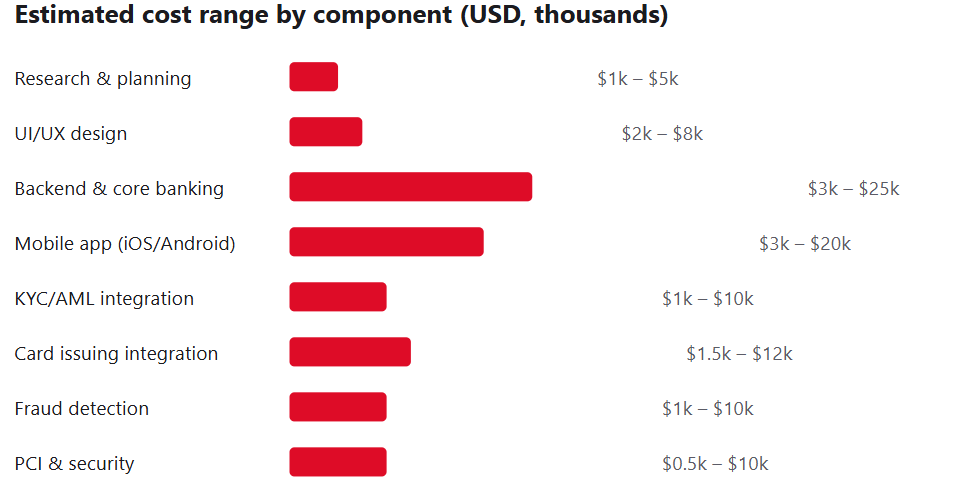
Where the budget goes: backend, mobile, and compliance infrastructure take the largest share.
KYC/AML Compliance: Cost, Flow and Pitfalls
Know Your Customer (KYC) and Anti-Money Laundering (AML) controls are non-negotiable for a digital bank. They also shape the first impression of your product, because onboarding is where most users drop off.
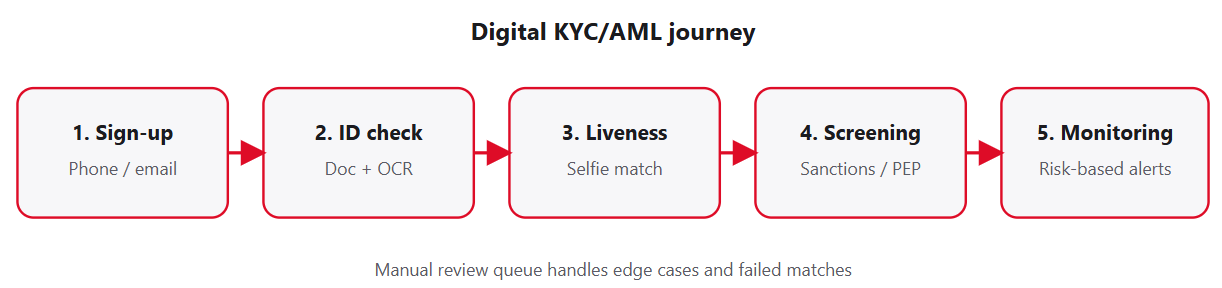
What a KYC/AML stack includes
- Identity verification: document capture, OCR, authenticity checks and database lookups.
- Biometric liveness and face match: blocks spoofed selfies and deepfakes.
- Sanctions, PEP and adverse media screening: run at onboarding and re-run on list updates.
- Transaction monitoring: rules and models that flag structuring, rapid movement of funds and unusual corridors.
- Case management and SAR/STR filing: a back-office workflow for analysts, with audit trails.
- Record retention: secure, access-controlled storage aligned with local retention rules.
Cost tip: most teams integrate a specialist KYC vendor rather than build verification in-house. Expect a one-time integration cost plus a per-verification fee. Build your own rules engine and case tooling only when volume justifies it.
BaaS vs Core Banking: The Biggest Infrastructure Decision
Your ledger and account infrastructure is the heart of the neobank. You have three realistic routes:
What to check before choosing a BaaS partner
- Which licences, geographies and account types are supported.
- Ledger design: are you reconciling against the partner's source of truth in real time?
- Sponsor bank stability and regulatory standing. Several BaaS ecosystems have faced regulatory scrutiny and platform failures, so plan for ledger reconciliation and vendor-exit options from day one.
- API quality, sandbox availability, webhooks, and SLAs.
- Pricing model: per account, per transaction, or platform fee.
Keep your product logic in your own microservices and wrap vendor APIs behind an abstraction layer. That is the cheapest insurance against lock-in. Teams that want to launch lean can start with a fintech MVP on BaaS and move deeper later, and our MVP development team can scope that path.
Card Issuing: Virtual, Physical and Controls
Cards drive daily engagement and interchange revenue. Most neobanks use a card issuing processor instead of becoming a processor themselves.
- Virtual cards issued instantly at sign-up, with provisioning to Apple Pay and Google Pay.
- Physical cards with fulfilment, activation and PIN management.
- In-app controls: freeze/unfreeze, spending limits, merchant and country restrictions.
- Real-time authorization: your system approves or declines at the point of sale, within a tight response window.
- Tokenization and 3-D Secure for safer online payments.
- Disputes and chargebacks workflow for operations teams.
Plan for card programme fees, minimum volumes, card production costs and scheme membership through your issuer. If you also plan stored-value features, review our digital wallet integration services to see how wallets and cards can share one ledger.
Fraud Detection: From Rules to Machine Learning
Instant payments make fraud faster and more expensive. A layered approach works best.
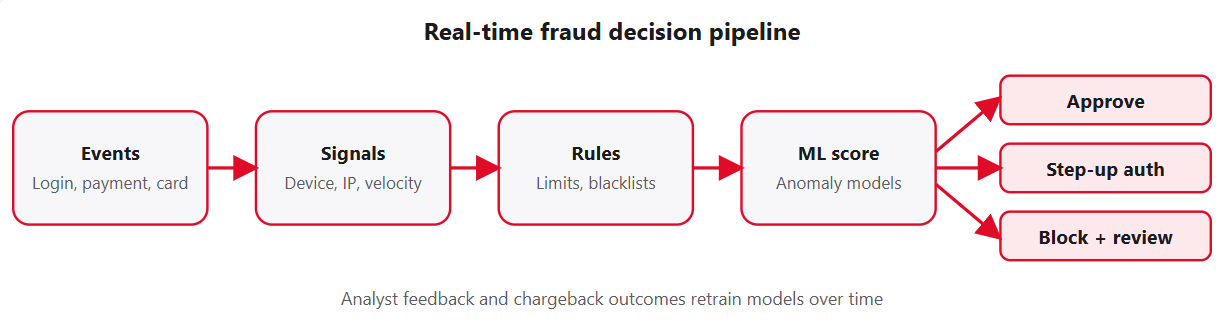
- Device and behavioural signals: device fingerprinting, SIM-swap and emulator detection, typing and navigation patterns.
- Rules: velocity limits, new-payee caps, geo and merchant restrictions.
- ML scoring: anomaly and supervised models trained on labelled outcomes.
- Step-up authentication: biometrics, OTP or app confirmation for risky actions.
- Account takeover and authorised push payment (APP) scam defences: payee warnings and cooling-off for large first-time transfers.
- Analyst tools: case queues, explainable alerts and feedback loops.
Want to go further with predictive models? See our AI in fintech services.
PCI DSS and Security Architecture
If your platform stores, processes, or transmits cardholder data, PCI DSS applies. The current standard is PCI DSS v4.x, and your scope depends heavily on architecture.
Ways to shrink PCI scope (and cost)
- Use a PCI-compliant issuer-processor and never store full card numbers (PAN) or CVV yourself.
- Use hosted fields or SDKs and tokenization for card display and provisioning.
- Segment networks so cardholder data environments are isolated.
Security baseline for a digital bank
| Area | Practice |
| Data protection | TLS 1.2+ in transit, AES-256 at rest, field-level encryption, HSM or cloud KMS for keys |
| Authentication | MFA, biometrics, device binding, secure session management, SCA where required |
| Application security | OWASP MASVS/ASVS alignment, certificate pinning, jailbreak/root detection, code obfuscation |
| Infrastructure | Private networks, WAF, secrets management, least-privilege IAM, centralised logging |
| Testing | SAST/DAST in CI, annual third-party penetration tests, dependency scanning |
| Resilience | Multi-AZ deployment, backups, disaster recovery drills, incident response plan |
| Governance | Audit logs, access reviews, SOC 2 or ISO 27001 readiness, data-retention policy |
Secure, observable cloud infrastructure is part of compliance, not an extra. Our DevOps services cover CI/CD, monitoring, and hardening for regulated workloads.
Key Factors Affecting Neobank Software Development Cost
Several technical and business factors influence neobank software development cost. Understanding these elements helps control project budgets.
Product Features
Feature selection directly affects development effort.
A basic neobank includes account registration, payments, transaction history, and user notifications.
Advanced platforms add financial insights, lending services, investment tools, and multi-currency accounts.
Each additional service increases engineering workload and infrastructure requirements.
Security and Compliance
Digital banking platforms handle sensitive financial data. Security implementation becomes essential.
Security architecture includes encryption protocols, fraud monitoring systems, and secure authentication.
Financial applications also require regulatory compliance systems such as KYC verification and AML monitoring.
Compliance infrastructure increases fintech app development cost.
Financial Infrastructure Integrations
Neobanks operate through integrations with financial service providers.
Common integrations include card issuing platforms, payment gateways, identity verification services, and banking APIs.
Engineering teams build secure API connections and test transaction reliability.
Companies planning fintech products often evaluate fintech app developers with experience in financial integrations.
Digital banks must support thousands of users and large transaction volumes.
Backend architecture must support high-performance data processing.
Cloud infrastructure improves system reliability and scalability.
Architecture decisions influence long-term operational cost.
Development Expertise
Development quality influences both product stability and cost efficiency.
A skilled neobank app development company delivers secure architecture and faster product delivery.
Fintech engineering expertise reduces technical risk during product development.

The features of neobank app platforms determine user adoption and platform value. Successful digital banks include several core services.
Digital Account Registration
Users open bank accounts through mobile onboarding.
The process includes document verification, identity authentication, and biometric checks.
Digital onboarding reduces customer acquisition friction.
Instant Payments and Transfers
Users expect fast financial transactions.
Neobank platforms support domestic transfers, peer-to-peer payments, and bill payments through the mobile interface.
Payment network integrations enable seamless transactions.
Expense Tracking and Financial Insights
Many digital banking users seek better financial management tools.
Expense tracking categorizes transactions and shows spending patterns.
Financial dashboards help users monitor budgets.
Virtual and Physical Card Services
Neobanks issue virtual debit cards immediately after account creation.
Users complete online purchases through virtual cards.
Physical card services support ATM withdrawals and retail transactions.
Transaction Notifications
Real-time alerts notify users about payments, transfers, and account activity.
Notifications increase transparency and user trust.
Choosing the Right Neobank Tech Stack
The neobank tech stack supports secure transactions and scalable performance.
Development teams select technologies based on reliability and integration compatibility.
- Mobile development technologies include Swift, Kotlin, and Flutter.
- Backend services often run on Node.js, Java, or Python frameworks.
- Cloud infrastructure platforms include AWS, Microsoft Azure, and Google Cloud.
- Database systems often include PostgreSQL and MongoDB.
- Technology selection affects platform scalability and maintenance costs.
Building a digital bank requires a structured development process.
Each stage contributes to platform stability and regulatory compliance.
Product Strategy and Market Research
Product teams begin with market research and customer analysis.
The research stage identifies user needs, target markets, and revenue models.
Competitive analysis also guides feature planning.
Fintech MVP Development
Many fintech startups launch a minimum viable product during early stages.
A fintech MVP includes core banking features such as account management, payment transfers, and transaction history.
Launching an MVP validates product demand before large-scale investment.
Product teams studying fintech MVP development strategies often reduce early development costs.
Full Product Development
After product validation, engineering teams expand the platform.
New features include financial analytics, lending services, and advanced payment infrastructure.
Backend infrastructure scales to support growing user bases.
Testing and Security Validation
Financial software requires extensive testing.
Quality assurance teams perform security testing, performance evaluation, and compliance validation.
Testing protects user data and transaction integrity.
Deployment and Product Growth
Product deployment introduces the digital banking platform to users.
Engineering teams monitor system performance and release feature updates.
Continuous improvement increases platform stability.
The Neobank App development cost varies depending on development scope and product complexity.
Appic Softwares offers affordable fintech development services for startups and financial organizations.
Typical cost distribution appears below.
| Development Stage | Estimated Cost |
| Product Research and Planning | $1,000 – $5,000 |
| UI and UX Design | $2,000 – $8,000 |
| Backend Development | $3,000 – $25,000 |
| Mobile Application Development | $3,000 – $20,000 |
| Security Implementation | $500 – $10,000 |
| Testing and Deployment | $500 – $7,000 |
Total development cost ranges between 10,000 dollars and 80,000 dollars when development occurs through Appic Softwares.
This pricing structure supports fintech startups entering digital banking markets.
How Businesses Reduce Fintech App Development Cost
Strategic planning helps control development budgets.
Many startups begin with an MVP instead of launching a full banking ecosystem.
Cloud infrastructure reduces hardware expenses.
Modular architecture simplifies feature expansion.
Experienced engineering teams prevent development delays.
Organizations planning digital banking platforms often analyze fintech app development cost benchmarks during budgeting.
Why Businesses Choose Appic Softwares for Neobank Development

Digital banking platforms require specialized fintech expertise.
Appic Softwares provides end-to-end neobank software development services.
Engineering teams deliver secure mobile applications, scalable backend systems, and financial integration infrastructure.
Services include product consulting, UI design, neobank app development, backend architecture, and compliance integration.
Businesses choose Appic Softwares for several reasons, and it provides:
- Affordable development cost
- Experienced fintech engineering teams
- Secure digital banking architecture
- Scalable cloud infrastructure
- Continuous product support
These capabilities support reliable neobank platform development.
Demand for digital banking services continues to grow across global markets. Financial institutions and startups invest in mobile banking platforms to reach digital users.
Launching a secure digital bank requires the right technology partner.
Appic Softwares helps organizations build scalable fintech platforms with structured development and affordable pricing.
Discuss your product vision. Define development scope. Build a secure neobank platform with experienced fintech engineers.