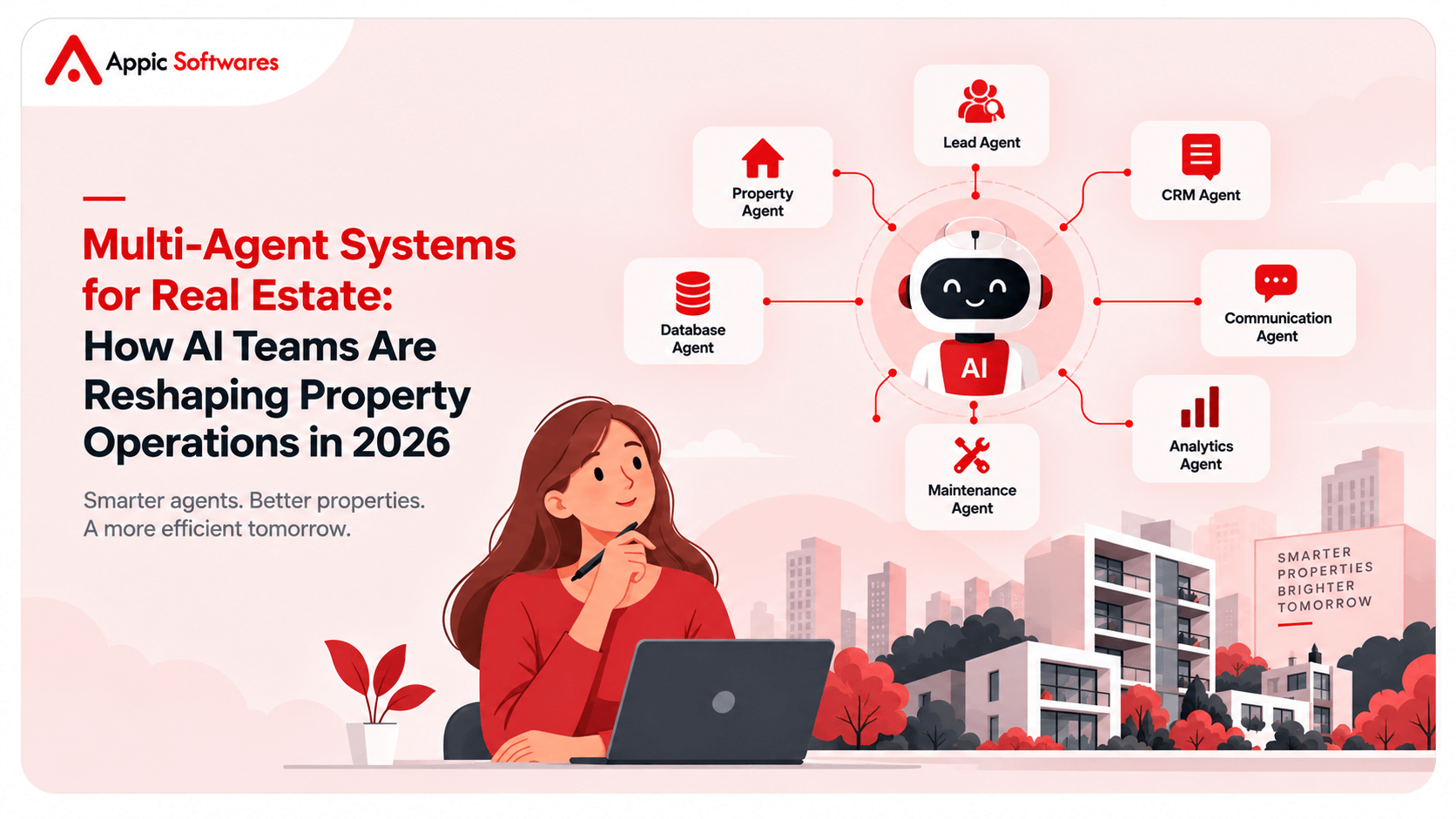
Multi-Agent Systems for Real Estate: How AI Teams Are Reshaping Property Operations in 2026
Real estate businesses are managing more information and customer interactions than ever. A single property enquiry can involve customer details, property availability, pricing, documents, agent assignments, appointments, follow-ups, and internal updates. Property managers also need to manage maintenance requests, tenant communication, inspections, invoices, and reporting.
The challenge is not simply having access to this information. The bigger challenge is making different systems, teams, and workflows work together efficiently.
This is where AI Generative is moving beyond simple chatbots and entering coordinated business workflows.
Multi-agent AI allows several specialized AI agents to work together toward a shared business goal. One agent can qualify a lead, another can search property data, another can update a CRM, while another prepares communication or reporting. Human employees can remain involved at important decision points.
For companies exploring PropTech solutions, this approach can connect workflows that traditionally operate across separate tools and platforms.
What Are Multi-Agent Systems in Real Estate?
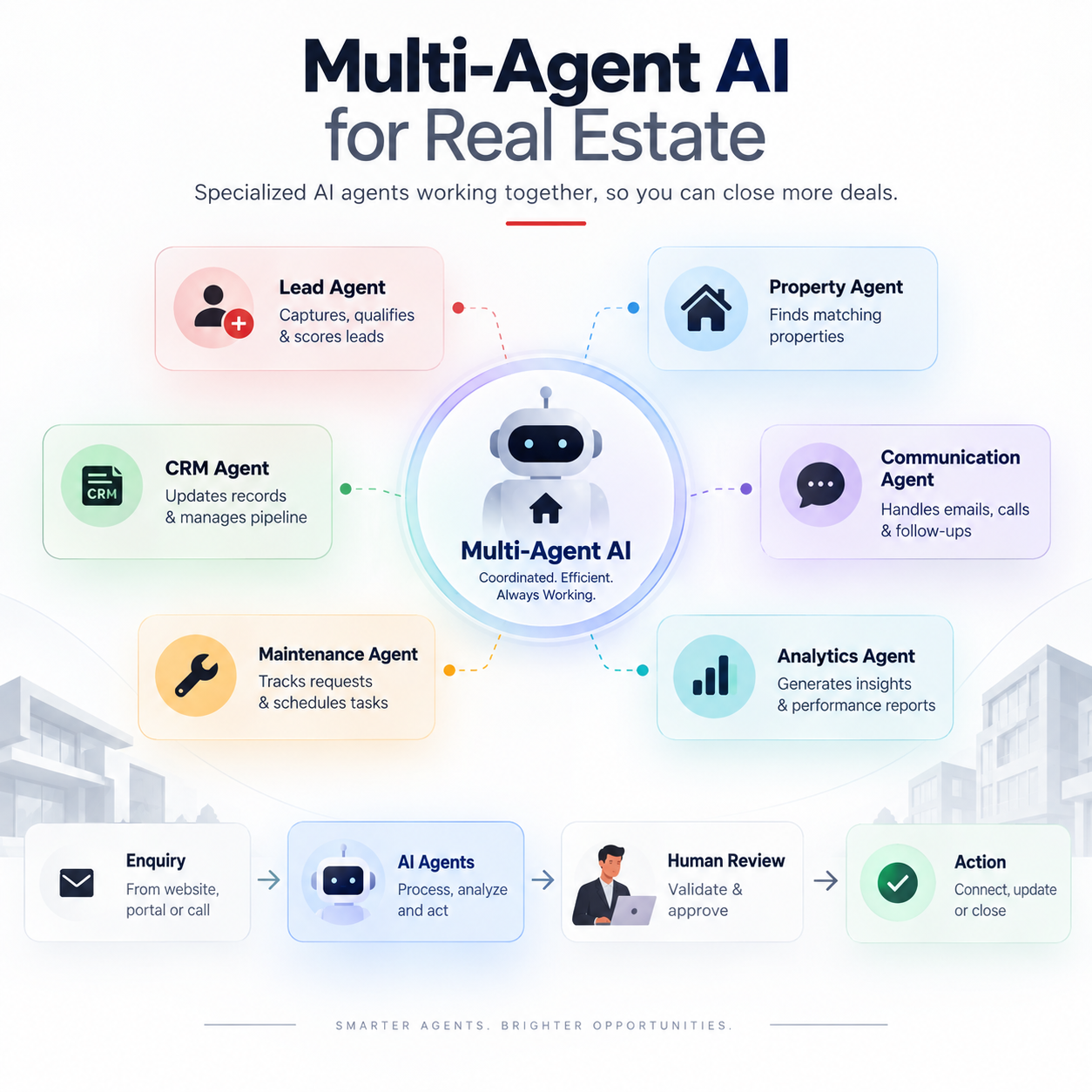
A multi-agent system is a group of specialized AI agents that work together toward a shared objective. Think of it as a digital team where every agent has a defined responsibility.
A Lead Agent can understand a new enquiry. A CRM Agent can check customer records. A Property Agent can search approved inventory. A Matching Agent can compare customer requirements with available properties. A Communication Agent can prepare the next message, while an Analytics Agent can record the outcome.
The important difference is coordination.
Instead of one AI assistant trying to handle every task, multiple agents can work through a controlled workflow. This model can become part of real estate software development solutions where AI is connected to existing business systems rather than operating separately.
Human employees can also review important recommendations or approve sensitive actions before anything is completed.
For companies investing in AI development services, multi-agent architecture provides a way to divide complex workflows into smaller, manageable AI tasks.
Why Real Estate Is a Strong Use Case for Multi-Agent AI
Real estate involves many repetitive and time-sensitive processes. Teams often move information between real estate CRM software, property databases, email, messaging platforms, calendars, spreadsheets, listing systems, and property management tools.
This can create delays and disconnected information.
A lead may arrive in one system but be followed up through another. Property availability can change before a customer receives an update. Maintenance requests can remain in an inbox while managers decide who should handle them.
There is also a large amount of unstructured information, including customer messages, property descriptions, documents, inspection notes, and maintenance requests.
Multi-agent systems can help organize and coordinate these activities while keeping people involved where professional judgment is required.
For businesses investing in PropTech software development, the value is not simply adding more AI. The value comes from connecting the right workflows, data sources, business rules, and user interfaces.
This is also where software development for real estate can help companies connect AI with the systems they already use.
Key Multi-Agent Use Cases in Real Estate
1. Lead Qualification and Routing
A Lead Agent can review information submitted through a website, mobile app, email, or messaging channel.
It can identify:
- Property type
- Preferred location
- Budget
- Buying or renting intent
- Timeline
- Customer preferences
- Communication history
When connected to real estate CRM software, the system can prepare a structured customer record or create a task for the responsible salesperson.
A real estate app development company can also integrate this workflow directly into a customer-facing property application, allowing enquiries from the app to move automatically into the sales pipeline.
2. Buyer-Property Matching
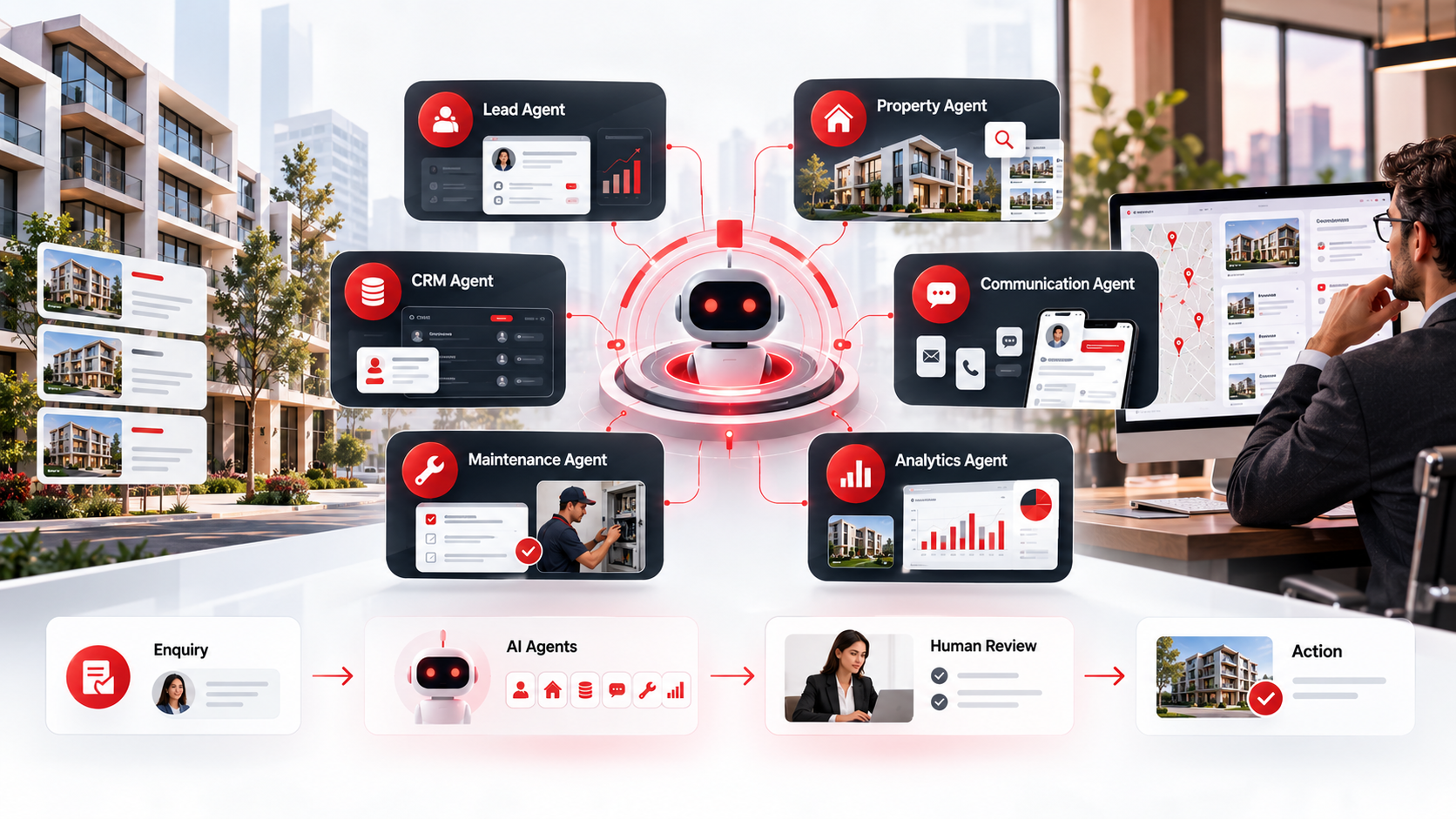
Customers may provide requirements such as location, budget, bedrooms, amenities, commute preferences, and property type.
A Property Agent can search approved inventory while another agent evaluates customer preferences. The system can then prepare a shortlist instead of requiring an employee to manually search hundreds of records.
For businesses using property development software, this type of AI workflow can also help organize information across projects, developments, units, and customer requirements.
Recommendations should always rely on current and trusted property data.
3. Automated Follow-Ups
A Communication Agent can prepare personalized follow-ups based on a customer's stage in the sales journey.
It can identify the next step, draft a message, and create a reminder for the sales team.
For example, if a potential buyer has viewed a property but has not responded to the agent, the system can identify the status and prepare a suitable follow-up.
Businesses can also define approval levels so sensitive communications require employee approval before being sent.
This can be particularly useful when building real estate app development solutions that combine customer communication, lead management, and CRM workflows.
4. Property Management
Property management software can become a central source of operational information for AI agents.
A multi-agent workflow can help organize:
- Tenant requests
- Inspection schedules
- Lease reminders
- Property updates
- Vendor communication
- Maintenance records
- Property documents
For property developers and managers, property development management software can also connect project information with operational workflows, giving teams a more structured way to manage properties and related activities.
5. Maintenance Coordination
A tenant might report a leaking tap through a mobile application.
A specialized agent can classify the request, check property records, identify previous issues, create a maintenance ticket, and notify the right team.
If the business uses real estate mobile app development, maintenance requests can be submitted directly through the tenant application.
Human managers can remain responsible for exceptions, vendor selection, and cost approvals.
6. Sales and Marketing
Specialized agents can analyze available properties, identify customer segments, prepare draft listing content, organize campaign information, and summarize engagement.
A real estate app development solution can bring these workflows closer to agents and sales teams through internal dashboards.
Final messaging, campaign strategy, pricing decisions, and customer-facing content can remain with the marketing team.
7. Reporting and Analytics
An Analytics Agent can gather information from connected systems and prepare summaries covering:
- Lead conversion
- Property enquiries
- Occupancy
- Maintenance activity
- Sales pipeline
- Response times
- Marketing performance
- Customer engagement
This can reduce repetitive reporting work and give management teams a clearer view of operational activity.
How Multi-Agent Systems Work With Real Estate Software
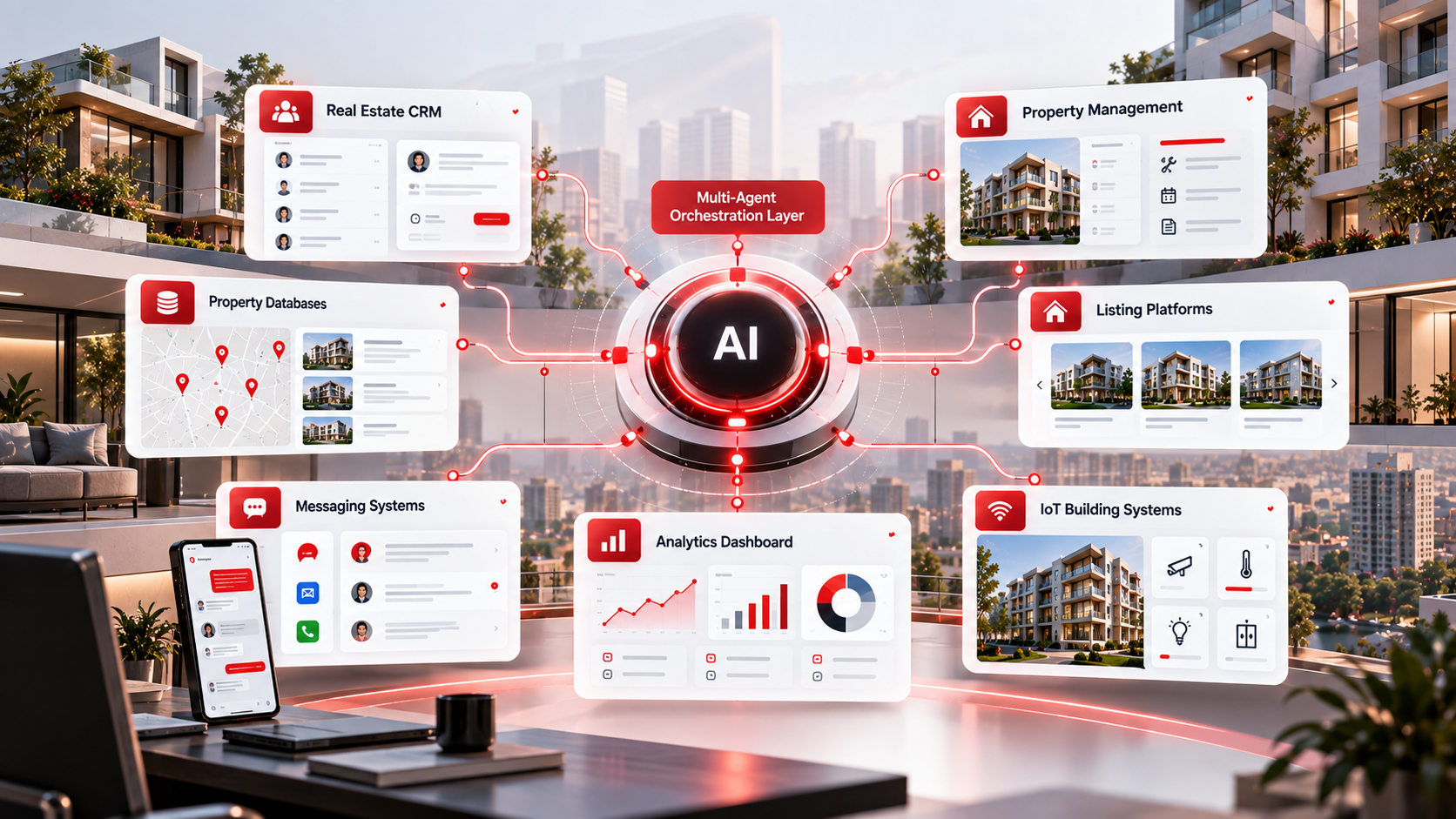
Multi-agent AI becomes more useful when it can interact with the software a business already uses.
A practical architecture may connect:
- Real estate CRM software
- Property management software
- Property databases and listing platforms
- Calendars and appointment systems
- Email and messaging platforms
- Document management tools
- Analytics dashboards
- IoT and building systems
A simplified workflow could look like:
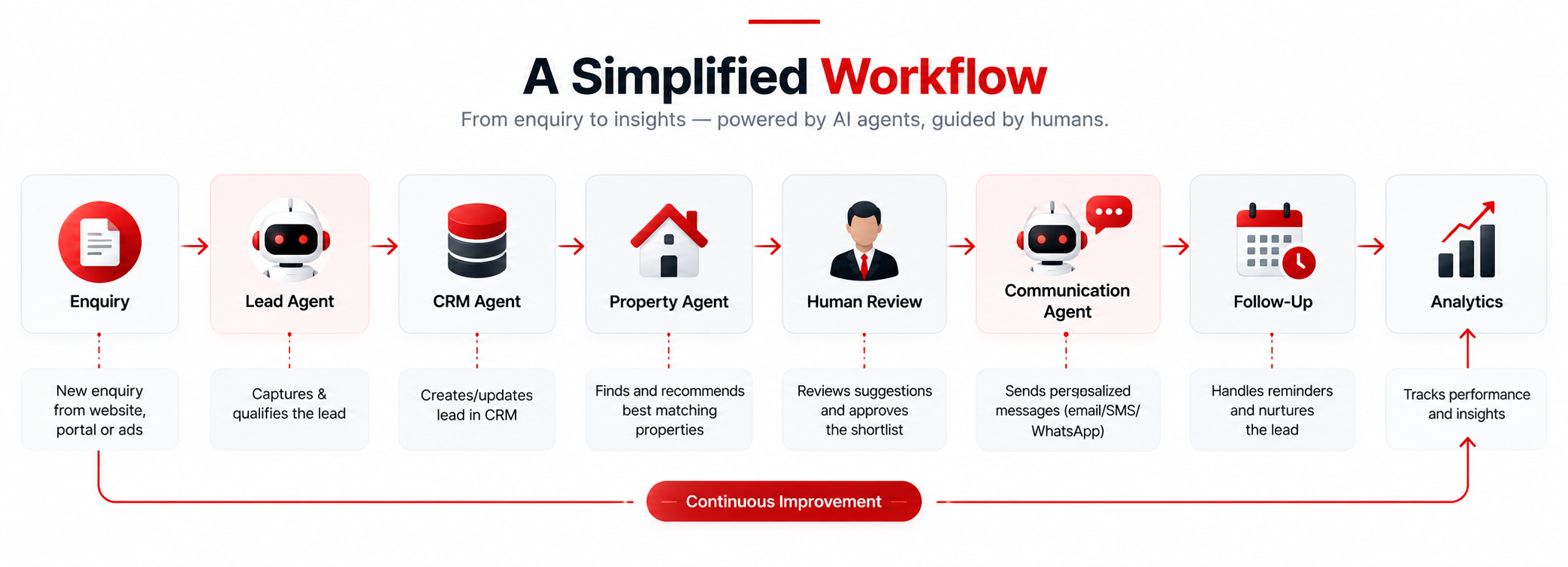
The orchestration layer controls how agents communicate and what actions they are allowed to take.
For example, a Property Agent may read listing data but not change pricing. A Communication Agent may prepare an email but require approval before sending it.
Agents should not have unrestricted access to every business system.
This controlled architecture is an important part of real estate software development services, especially when AI needs to work with customer, property, financial, or operational data.
Multi-Agent Systems vs. Traditional Real Estate Automation
Traditional automation generally follows predefined rules.
For example:
New enquiry → Send email → Create CRM task → Notify salesperson
This approach works well when a process is predictable.
AI agents can handle more flexible situations. They can interpret information, select approved tools, coordinate several steps, and respond to changing inputs.
However, traditional automation is still useful.
Rules can control sensitive actions while AI supports:
- Language processing
- Classification
- Summarization
- Information extraction
- Flexible decision support
- Workflow coordination
A combination of traditional automation and AI software development services can therefore be useful for businesses that want more flexible workflows without removing existing controls.
Benefits of Multi-Agent Systems for Real Estate
Faster Response Times
Automated processing can reduce the time between an enquiry and the next action.
Less Repetitive Work
Employees can spend less time copying information between systems and preparing routine summaries.
Better Workflow Coordination
Specialized agents can coordinate tasks that previously required multiple manual handoffs.
Improved Visibility
Managers can get a clearer view of leads, properties, maintenance requests, and operational activity.
Scalable Operations
Automation can help teams handle more processes as enquiry volume or property portfolios grow.
These benefits depend on data quality, integrations, clear permissions, monitoring, and appropriate human oversight.
Challenges and Risks
Data Quality
Incomplete or outdated property data can produce unreliable outputs.
Security and Permissions
Agents may interact with sensitive customer, financial, property, and business information. Access should therefore be limited according to each agent's responsibility.
AI Hallucinations
AI can produce convincing but incorrect information. Important outputs should be grounded in trusted sources and verified before high-impact actions are taken.
Monitoring
Logs, alerts, approval workflows, and performance monitoring can help identify errors and unusual behavior.
Integration Complexity
Connecting CRM systems, property databases, messaging platforms, property management software, analytics systems, and other tools can require significant technical work.
Implementation Cost
A multi-agent system may involve APIs, orchestration, security, user interfaces, monitoring, data architecture, testing, and ongoing maintenance.
Human Approval
Pricing changes, contracts, financial decisions, sensitive tenant issues, and other high-impact actions may require human review.
How to Build a Multi-Agent Real Estate Solution
Building a useful multi-agent system starts with the business workflow rather than the AI model.
1. Map the Workflow
Document the current process and identify delays, repetitive tasks, manual handoffs, and disconnected systems.
2. Select One High-Value Use Case
Start with one practical area such as:
- Lead qualification
- Property matching
- Maintenance triage
- Automated follow-ups
- Reporting
3. Define Agent Responsibilities
Give each agent a specific role such as Lead Agent, Property Agent, CRM Agent, Communication Agent, or Analytics Agent.
4. Connect Trusted Data
Identify which systems contain authoritative information and make sure agents use approved data sources.
5. Add Human Approval Points
Define which actions can happen automatically and which require employee approval.
6. Measure and Improve
Track useful metrics such as response time, manual workload, conversion rates, ticket resolution time, or reporting effort.
A real estate software development company can help design this architecture around existing systems instead of forcing a business into an entirely new workflow.
For example, an established brokerage may keep its current CRM and connect AI agents through APIs, permissions, and controlled workflows.
The Role of a Real Estate Software Development Company
Building a reliable multi-agent system involves more than connecting an AI model to a chatbot.
A development partner may work across:
- AI agent orchestration
- API development
- CRM integrations
- Property management integrations
- Dashboard development
- Authentication
- Role-based permissions
- Data pipelines
- Monitoring and logging
- Custom workflow development
- AI chatbot development
- AI-powered automation
For businesses looking for real estate app development services, the same architecture can be extended to customer-facing applications, internal dashboards, and property management platforms.
The objective should be to create an AI-enabled system that fits the company's existing operations rather than adding technology without a clear business purpose.
How a Real Estate App Development Company Can Add Multi-Agent AI
Multi-agent functionality can become part of customer-facing web and mobile applications.
A real estate app development company can integrate specialized agents into applications used by buyers, tenants, agents, property managers, brokers, and internal teams.
Possible features include:
- AI-powered property recommendations
- Customer enquiry handling
- Appointment scheduling
- Tenant request processing
- Personalized notifications
- Property search assistance
- Internal sales dashboards
- Automated task creation
- Lead qualification
- AI-powered customer support
- Property matching
For example, a customer could ask an application to find properties matching specific requirements.
The AI system could interpret the request, search approved property data, present relevant options, and then connect the customer with a human agent.
This approach can be part of broader real estate app development solutions where AI works alongside search, CRM, communication, analytics, and property management features.
AI Development for PropTech: What's Next?
The direction of AI in real estate is moving beyond simple chat interfaces.
As businesses connect more systems, AI can become part of larger operational workflows where agents gather information, prepare actions, coordinate tasks, and request approval when needed.
For businesses investing in PropTech development, this creates opportunities to connect previously isolated systems across:
- Sales
- Property management
- Maintenance
- Customer service
- Marketing
- Analytics
- Operations
A PropTech development company can help businesses evaluate where AI agents, automation, APIs, and custom software can fit into existing workflows.
Similarly, businesses exploring Best PropTech development company options should evaluate development capabilities around integrations, security, scalability, AI architecture, and ongoing support rather than looking only at the AI model itself.
Adoption still depends on data quality, security, integration capabilities, cost, regulatory requirements, and user trust.
Human expertise remains important for negotiations, relationship management, complex property decisions, legal matters, and situations requiring professional judgment.
How Appic Softwares Can Help With AI-Powered Real Estate Solutions
Businesses looking to modernize their property workflows can combine real estate app development services, AI development, CRM integration, and custom software into one connected solution.
Appic Softwares can help businesses plan and develop custom digital solutions around their existing processes, including real estate applications, CRM-connected workflows, AI features, dashboards, automation, and property management systems.
Depending on the business requirement, the solution can include:
- Custom real estate application development
- AI agent integration
- AI chatbot development
- Real estate CRM integration
- Property search and matching
- Lead management
- Automated follow-ups
- Property management workflows
- Analytics dashboards
- API integrations
- Custom AI software development
- AI development services
- Web and mobile application development
Instead of replacing every existing tool, the goal can be to connect the systems that already work for the business and introduce automation where it creates practical value.
For companies planning a new real estate software development project or upgrading an existing platform, this approach can help create a more connected and scalable digital workflow.
Conclusion
Multi-agent systems are changing how businesses can use AI in real estate.
Instead of treating AI as a single chatbot, companies can use specialized agents to coordinate different parts of a workflow.
Lead qualification, property matching, follow-ups, maintenance, reporting, marketing, and customer communication are practical areas for experimentation.
The strongest starting point is the business problem, not the technology.
Real estate companies can begin with one repetitive workflow, connect reliable data, define agent responsibilities, establish human approval points, and measure results.
For brokers, property managers, developers, and PropTech companies, the opportunity is to build more connected workflows where people and AI systems work together in a controlled and measurable way.
Whether the goal is real estate app development, PropTech software development, AI automation, CRM integration, or a complete custom platform, the technology should ultimately support a clear business workflow and customer experience.
Frequently Asked Questions
What are multi-agent AI systems in real estate?
Multi-agent AI systems use multiple specialized AI agents to handle different real estate tasks. For example, one agent can qualify leads, another can search properties, while another can update the CRM or prepare follow-ups. These agents can work together through a controlled workflow with human approval where needed.
How can multi-agent AI improve real estate operations?
Multi-agent AI can help automate repetitive tasks such as lead qualification, property matching, customer follow-ups, maintenance requests, reporting, and data coordination. When integrated with existing real estate software, it can help teams reduce manual work and improve workflow visibility.
Can a real estate app development company integrate AI agents into an existing app?
Yes. A real estate app development company can integrate AI agents into an existing web or mobile application. Depending on the requirements, AI can support property search, recommendations, customer enquiries, appointment scheduling, lead management, notifications, and other workflows.
How does multi-agent AI work with real estate CRM software?
AI agents can connect with real estate CRM software through APIs and controlled integrations. For example, a Lead Agent can qualify an enquiry, a CRM Agent can update the customer record, and a Communication Agent can prepare a follow-up based on the lead's stage.
What is the role of AI in PropTech software development?
AI can support different areas of PropTech software development, including property search, lead qualification, customer support, property management, maintenance coordination, analytics, and workflow automation. Multi-agent systems can connect several of these functions into a coordinated workflow.
Related Articles
How Agentic AI Is Transforming Real Estate Operations in 2026
Tarot App Development: Architecture, AI, and the Real Cost of Building a Platform Users Trust