Real estate operations involve many moving parts: new inquiries arrive through websites and messaging apps, property inventory changes frequently, buyers expect quick answers, and teams must coordinate viewings, documents, approvals, payments, and maintenance. When these activities are managed across disconnected spreadsheets, CRMs, inboxes, and property systems, important details can be missed.
The challenge is not simply the volume of work. It is the number of handoffs between people and platforms. A lead may receive an initial response but never get a follow-up. A property may be recommended after it is no longer available. A maintenance request may be logged without a clear owner. Agentic AI in Real Estate is becoming important in 2026 because it can help coordinate multiple steps around a defined goal, while keeping people involved in decisions that require judgment, accountability, or sensitivity.
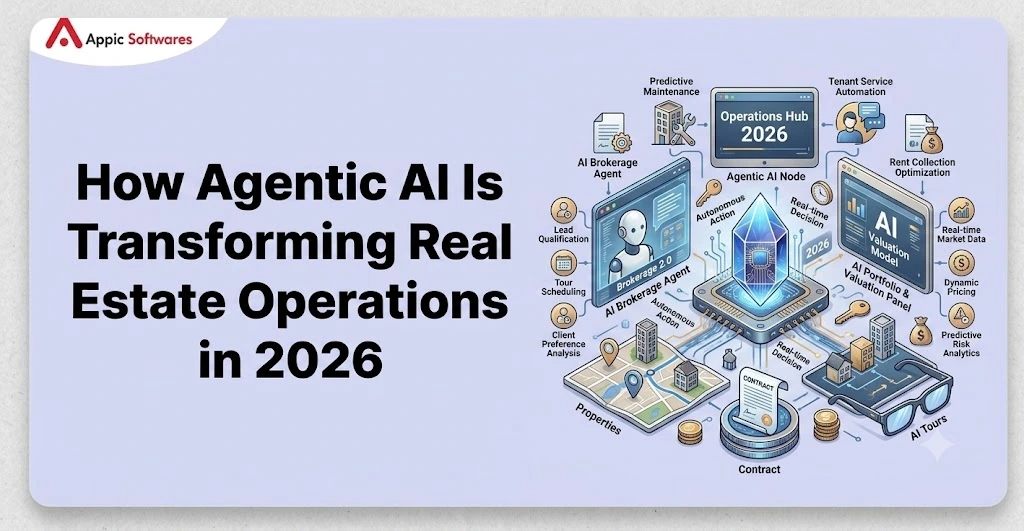
Businesses looking to connect these processes can explore custom software solutions designed around their specific operational needs. How Agentic AI Connects Real Estate Operations
What Is Agentic AI?
Agentic AI refers to AI systems designed to work toward a goal by planning and carrying out a sequence of tasks. Instead of only answering a question or generating text, an
AI agent can interpret an objective, decide what steps are needed, use approved tools, check the result, and continue until the workflow is complete or a human needs to intervene.
In a real estate setting, an agent might receive a buyer inquiry, identify missing details, search connected property inventory, prepare a shortlist, offer available viewing times, send a confirmation, and update the CRM. Each action would depend on integrations, business rules, data quality, and permissions. The agent should not be treated as unrestricted or fully independent.
For example, if a buyer asks for a three-bedroom property near a school within a specific budget, the agent can ask clarifying questions, check current listings, rank suitable options, and schedule a viewing. A sales professional can then take over for negotiation, financial guidance, or any situation requiring personal judgment.
 How an AI Agent Handles a Buyer Inquiry
Traditional AI vs Generative AI vs Agentic AI
These three terms are related, but they describe different capabilities. Traditional AI generally analyzes data and predicts outcomes. Generative AI creates new content based on instructions and available context. Agentic AI uses reasoning, tools, and workflows to take actions toward a goal.
| AI type | Main purpose | Typical capability | Real estate example |
| Traditional AI | Predicts | Finds patterns and estimates outcomes | Predicting lead conversion or property demand |
| Generative AI | Creates | Produces text, summaries, or other content | Writing listing descriptions or drafting replies |
| Agentic AI | Acts | Plans tasks, uses tools, and coordinates actions | Scheduling viewings and updating a CRM |

Traditional AI vs Generative AI vs Agentic AI in Real Estate
1. Smarter Lead Qualification
Real estate teams often receive incomplete inquiries. A message may include only a budget or a preferred location, leaving agents to collect the remaining details manually. An AI agent can ask structured follow-up questions about budget, location, property type, size, amenities, buying timeline, financing stage, and intended use.
Once the information is collected, the system can classify the lead, identify urgency, route it to the right team, and create a complete CRM record. This can reduce repetitive data entry and help sales staff focus on conversations that need human attention. In real estate CRM software development, agentic workflows can also trigger reminders when a lead has not received a response or when a promised follow-up is due.
Lead scores should be treated as decision support, not final truth. A high score does not guarantee a sale, and a low score may reflect incomplete data rather than low intent.
2. More Accurate Property Matching
Property matching becomes more useful when the system understands the buyer’s complete requirements instead of relying only on keywords. An AI agent can compare budget, location, property type, size, amenities, availability, possession timeline, and other preferences against the current inventory.
This is especially useful for businesses using property development software, where inventory may include multiple projects, units, configurations, pricing bands, and construction stages. The quality of the recommendation depends on accurate, updated data. If availability, pricing, or property attributes are outdated, even an advanced AI system can produce unreliable results.

AI-Powered Property Matching
3. Faster Customer Communication and Follow-Ups
Speed matters in real estate, but consistency matters just as much. Agentic AI can support instant responses to common questions, appointment confirmations, viewing reminders, post-visit messages, feedback collection, and lead re-engagement. A real estate chatbot can handle routine conversations while passing complex requests to a person.
The most effective approach is not to remove human communication. It is to make sure routine communication happens on time and that agents have the context they need when they join the conversation. Sensitive complaints, negotiation, financial questions, and high-value customer interactions should have a clear human handoff.
4. Property Management and Maintenance Automation
Property managers handle recurring requests from tenants, owners, vendors, and internal teams. An AI agent can categorize maintenance requests, identify missing details, create service tickets, assign work based on predefined rules, send status updates, and remind vendors when deadlines are approaching.
When connected with property development management software or a property management platform, these workflows can improve visibility across open requests and reduce the need for manual status checks. However, emergency issues, safety concerns, legal matters, access disputes, and sensitive tenant situations should be escalated immediately to qualified staff.

AI-Powered Property Maintenance Workflow
5. Better Data Analysis and Reporting
Real estate businesses generate large amounts of operational data: inventory changes, lead sources, viewing activity, sales pipeline movement, customer demand, occupancy, maintenance costs, and team performance. Agentic AI can collect information from approved systems, summarize trends, prepare recurring reports, and highlight unusual changes.
For example, a daily report could identify projects with rising inquiry volume, listings with low engagement, leads waiting too long for follow-up, or maintenance categories generating the highest cost. Managers still need to validate the data and apply market knowledge before making pricing, hiring, investment, or operational decisions.
6. Document and Workflow Automation
Real estate work includes contracts, application forms, ownership records, approvals, inspection documents, invoices, and compliance materials. AI can classify documents, extract selected fields, summarize content, identify missing information, route approvals, send reminders, and update records.
These capabilities can reduce administrative effort, but they do not remove the need for review. Legal, ownership, contract, compliance, and financial documents should be checked by the appropriate professional before they are accepted or used for important decisions.
What Real Estate Businesses Need Before Adopting Agentic AI
Start With a Specific Workflow
Businesses should avoid trying to automate every department at once. Start with one workflow that has a clear problem and measurable outcome, such as:
- Reducing new inquiry response time
- Automating appointment reminders
- Routing maintenance requests
- Improving CRM data entry
- Preparing daily sales or operations reports
A focused pilot makes it easier to measure time saved, error rates, customer satisfaction, and the number of cases that still require human intervention.
Connect Reliable Data Sources
Agentic AI is only as useful as the systems it can access. Before implementation, businesses should review data quality, ownership, permissions, and integration requirements across:
- CRM platforms
- Property listing and inventory systems
- Website forms
- Communication tools
- Calendar systems
- Property management software
- Document management platforms
This is a central consideration in software development for real estate because the goal is not merely to add an AI feature. The goal is to connect the right information and actions without creating another isolated tool.
Define Permissions and Human Oversight
Every AI workflow should have clear boundaries. Teams need to decide what the agent can read, what it can change, which actions require approval, when a conversation must be transferred to a person, how data is protected, and how every action is recorded.
A useful implementation includes audit logs, role-based access, approval checkpoints, fallback procedures, and monitoring for incorrect or unexpected actions. These safeguards help businesses adopt automation without losing control.
The Role of Custom Real Estate Software Development
Real estate businesses rarely operate in exactly the same way. A broker may prioritize lead distribution and follow-ups, a developer may need project inventory and buyer engagement, and a property manager may focus on maintenance, tenant communication, and owner reporting. This is why custom real estate software development can be valuable when off-the-shelf tools do not fit the existing process.
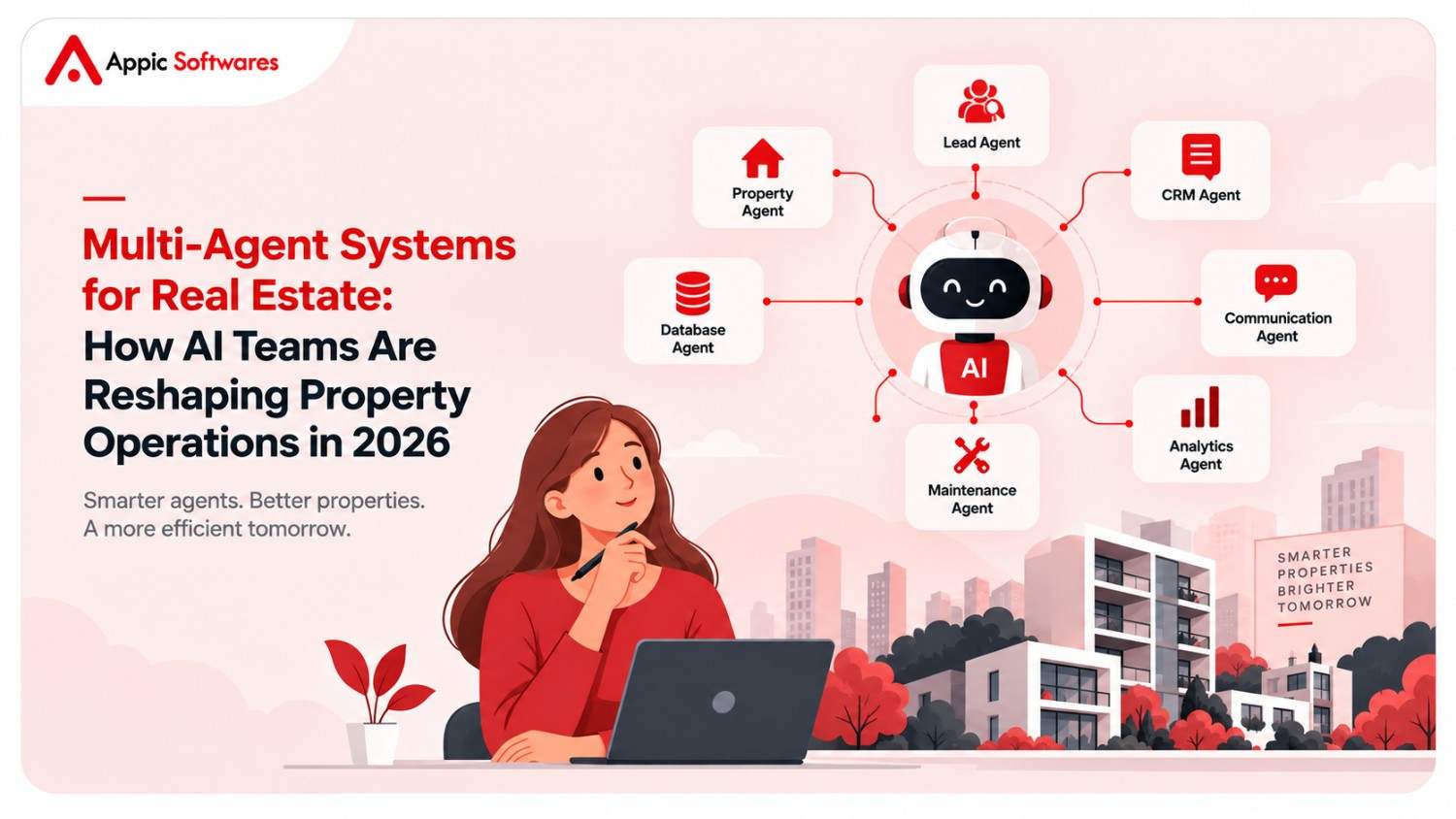
A capable real estate software development company can design integrations and workflows around the business’s actual operations. Depending on the need, a solution may combine lead management, property inventory, buyer-property matching, customer communication, sales pipelines, reporting dashboards, maintenance workflows, and AI-powered automation.
Businesses evaluating a real estate app development company should look beyond the AI label and examine integration experience, security practices, scalability, user experience, and ongoing maintenance. Real estate app development services are most effective when they solve a specific operational problem and remain easy for employees and customers to use.
The right approach may involve a web dashboard, mobile app, CRM extension, internal automation layer, or a connected platform rather than one large system built all at once.

Connected Real Estate Technology Ecosystem
Challenges and Considerations
Data Quality
Duplicate records, outdated listings, inconsistent property details, and incomplete customer profiles can lead to poor recommendations and incorrect actions. Data cleanup should come before automation.
Privacy and Security
Real estate systems may contain personal, financial, identity, and ownership information. Access controls, encryption, secure integrations, retention policies, and responsible vendor selection are essential.
Integration Complexity
Connecting legacy software, CRMs, listing platforms, calendars, communication tools, and document systems can require significant planning. Integration work should be tested in stages.
Human Trust
Employees need to understand what the AI does, what it cannot do, and how to correct it. Transparent workflows and clear escalation paths support adoption.
Cost and Maintenance
AI solutions require ongoing monitoring, integration maintenance, model updates, security reviews, and process improvements. The long-term operating cost should be included in the business case.
What the Future of Agentic AI in Real Estate May Look Like
Over time, agentic AI may become more closely connected to the daily tools used by brokers, developers, property managers, and operations teams. Instead of working as a separate chatbot or reporting feature, it may coordinate a sequence such as:
Inquiry → Qualification → Property Matching → Viewing → Follow-Up → CRM Update → Sales Handoff
The likely direction is not a fully automated real estate business. Human expertise will remain important for trust, negotiation, local knowledge, relationship management, accountability, and decisions involving risk. AI can handle more coordination and repetitive work, allowing professionals to spend more time on the parts of the job where judgment matters most.
Conclusion
Agentic AI in Real Estate is changing how businesses can coordinate everyday operations. Its value comes from connecting tasks that are often handled separately: responding to inquiries, qualifying leads, matching properties, scheduling viewings, managing maintenance, preparing reports, and updating business systems.
The benefits can include faster responses, more relevant property recommendations, less repetitive work, and better operational visibility. But successful adoption depends on more than choosing an AI tool. Businesses need a clear starting problem, reliable data, secure integrations, defined permissions, and human oversight.
For real estate companies planning their next technology investment, a practical first step is to identify one workflow where better coordination can produce a measurable improvement—and build from there.