Artificial intelligence is no longer an emerging technology reserved for large enterprises and research labs. Companies are rapidly deploying AI at an unprecedented scale. The 2026 AI Index Report shows that in three years, 53% of the population has adopted generative AI. The most intriguing aspect of it is that AI is one of the quickest-to-be-adopted technologies in history. The report also revealed that the value of generative AI tools was estimated to be $172 billion by early 2026.
Almost every business, every startup, and every enterprise is heavily investing in AI app development to maintain a competitive advantage. These apps range from health platforms driven by AI to smart finance apps and ecommerce app personalization. AI app development is revolutionising numerous industries ranging from healthcare to banking, eCommerce, and even enterprise automation, with organisations pouring money into its development to stay ahead of the competition.
India is emerging as a global leader in the deployment of AI in the workplace. According to BCG’s AI at Work 2026 report, India is an emerging leader in AI adoption among managers and front-line workers globally.
To stay ahead of the competition, more and more firms are investing in custom AI development services to build intelligent apps that improve customer experience, automate operations, lower costs, and unlock new potential for growth.
This guide covers all the important topics that businesses need to know about developing AI apps, such as the technologies, use cases, development processes, prices, and leading practices.
What Is AI App Development?
An AI agent app decides its own next step. Given a goal such as "resolve this refund request", it reads the case, calls the order system, checks policy, and acts or escalates, looping until the goal is met or a limit is hit. Building one means engineering that loop and everything around it: tools, memory, permissions, evaluationn,n and monitoring.
Not every AI feature needs this. The table shows where each pattern fits, so you can avoid paying for autonomy you do not need.
| Pattern | Who decides the steps | Best for | Main risk |
| Fixed workflow with an AI step | You, in code | Predictable processes: classify, extract, summarise | Breaks on cases you did not script |
| Chatbot / RAG assistant | The user, one question at a time | Answering from documents | Wrong answers; no ability to act |
| AI agent | The model, within limits you set | Multi-step tasks across several systems | Compounding errors, runaway cost, unsafe actions |
| Multi-agent system | Several models, coordinated | Work that splits into specialist roles | Complexity and debugging effort |
Decision rule: if you can write the steps down in advance, build a workflow. Reach for an agent only when the path varies from case to case and a wrong action is recoverable or gated by a human.
What Makes an Application AI-Powered?
AI app development is the process of designing software programs that use artificial intelligence technologies to perform tasks that usually need human intelligence.
NLP follows a set of rules, but AI applications can look at data, learn from patterns, build content, make predictions, and make decisions automatically.
Enterprise adoption is accelerating as well. According to recent industry reports, almost 88% of companies have implemented AI in some way, and AI agents have gained a prominent place in enterprise software strategies.
For example, an AI-powered healthcare application like a remote patient monitoring app can analyze patient records and identify risk factors, while an AI-powered retail application can recommend products based on browsing history and purchase behavior.
Is the demand real? Adoption versus failure data
Agent adoption is rising faster than agent success. Gartner expects 40% of enterprise applications to include task-specific agents by the end of 2026, up from under 5% in 2025 (Gartner, Aug 2025). In the same year, it forecast that over 40% of agentic AI projects will be canceled by the end of 2027, citing cost, unclear value,ue and weak risk controls, and estimated that only about 130 of the thousands of vendors claiming agentic products are real (Gartner, Jun 2025).

Source: Gartner press release, 25 Jun 2025 (poll of 3,412 webinar attendees, Jan 2025
The developer side shows the same gap between use and trust. Two-thirds of respondents said AI results are "almost right, but not quite" (Stack Overflow, 2025).

Source: Stack Overflow Developer Survey 2025, AI section
Scale matters too. McKinsey's 2026 survey of 1,719 respondents found 40% of large firms are scaling agents against 22% of smaller ones, and 37% report some EBIT impact from AI (McKinsey, Aug 2026). Stanford's AI Index reports organizational AI adoption of 88% in 2025, up from 55% in 2023 (Stanford HAI, 2026).
What this means for a buyer: demand is real, but the winners will be projects with a narrow goal, measurable value, and controls built in from day one.
Build, buy or no-code: which route fits?
There are three routes, and the right one depends on how unusual your workflow is and how much control you need over data and actions. Google's AI Overviews for this topic currently cite tool builders such as Replit, MindStudio, and Firebase, so many readers start with no-code and only later hit its limits.
| Route | Typical fit | Control | Main limit |
| No-code agent builder | Internal prototypes, simple automations, validating an idea | Low: you work inside the platform's blocks | Hard to enforce custom permissions, testing, and audit trails |
| Open framework, built in-house | A team with ML and backend engineers and a clear scope | High | You own evaluation, monitoring and on-call |
| Custom build with a development partner | Production systems tied to your data, systems and compliance needs | High | Higher upfront cost; partner quality varies widely |
Rules of thumb we use with clients:
- Start with no-code if the agent touches no sensitive data and a failure costs little.
- Move to a custom build when the agent writes to your core systems, handles customer or regulated data, or needs a measurable accuracy bar before launch.
- Keep the model layer swappable. Prices and capabilities change quickly, and locking into one provider is the most common avoidable cost.
Why Are Businesses Investing in AI App Development?
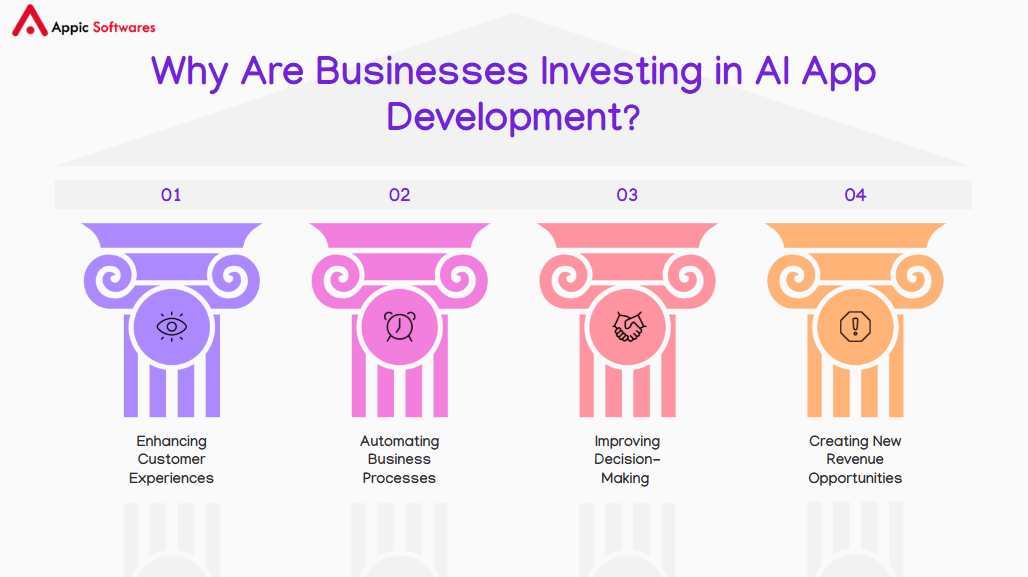
AI has become the most effective approach to optimize operational efficiency, augment consumer experiences, es and create new revenue sources. This is why businesses are investing in AI app development.
Enhancing Customer Experiences
Today, everyone wants a personalized consumer experience. AI-based applications monitor the behaviour and preferences of users to provide recommendations, personalised content, and smart support.
Streaming services like Netflix use your watching history to suggest new content. Retail platforms recommend products based on customers’ interests. AI assistants can help you in finding the instant solutions and guidance.
These features enhance consumer satisfaction and improve conversion rates and client retention.
Automating Business Processes
There are still a lot of business processes that use repetitive manual tasks.
AI applications can automate tasks like:
- Customer support
- Document processing
- Appointment scheduling
- Data entry
- Workflow management
Automation saves on operational expenses and enables staff to be more productive by concentrating on higher-value tasks.
Improving Decision-Making with Data
Organizations create vast amounts of data daily.
The data is then analyzed by AI algorithms to find patterns, detect anomalies, and forecast future events to derive actionable insights.
AI-powered analytics are used by businesses to:
- Forecasting demand
- Fraud detection
- Maximize stock
- Strengthen operational planning
This enables executives to make faster and better-informed decisions.
Creating New Revenue Opportunities
AI is helping businesses to create new product lines and services.
AI-powered assistants, recommendation engines, intelligent analytics platforms, and types of AI agents that generate new value for customers are being developed by companies.
For entrepreneurs trying to disrupt traditional sectors with creative solutions, AI app development is a game-changer. AI app development is an opportunity for companies to revolutionize old sectors with creative solutions.
What Are the Most Popular AI App Development Use Cases?
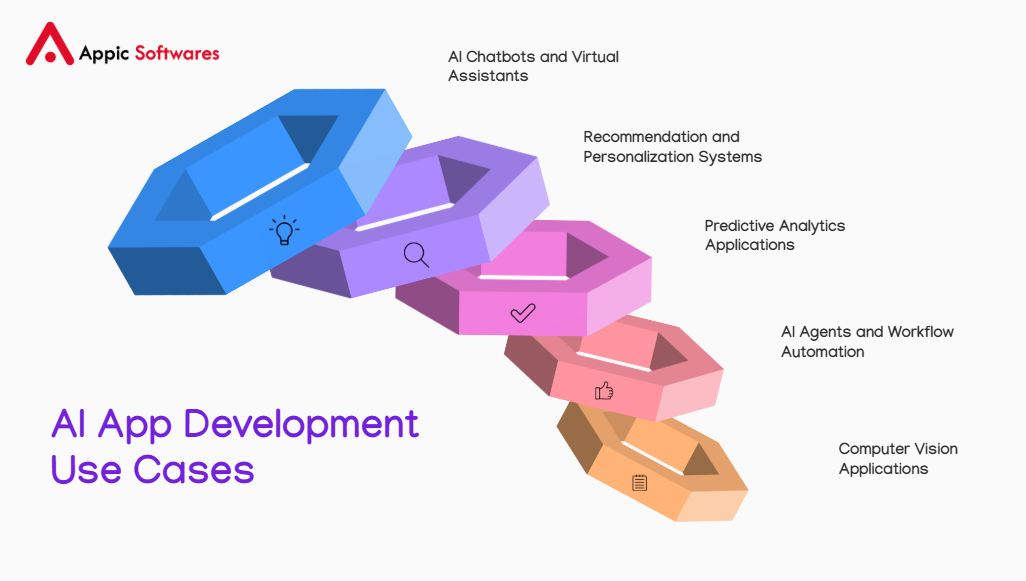
AI app development is no longer limited to large technology companies. Businesses across industries are using AI-powered applications to solve practical challenges. AI applications are transforming virtually every industry.
AI Chatbots and Virtual Assistants
AI app development is not just for big tech companies anymore. Companies in all sorts of industries are employing AI-based apps to address real-world problems. AI applications are revolutionizing nearly every industry.
Recommendation and Personalization Systems
Recommendation engines analyze customer behavior to suggest products, content, or services. An eCommerce company can deploy recommendation engines and best AI for ecommerce that analyze customer behavior and suggest products likely to generate higher conversions.
Popular examples include streaming platforms, eCommerce websites, and digital learning applications.
Predictive Analytics Applications
Predictive analytics blends past data and machine learning to make predictions. Financial institutions leverage AI-driven fraud detection systems that track transactions in real-time and identify suspicious behaviors before they turn into significant concerns. Businesses employ predictive analytics for better forecasting, risk assessment, and operational planning.
AI Agents and Workflow Automation
AI agents can do things, interact with software systems,s and automate activities. Companies are using AI technologies for route optimization for waste collection, to anticipate maintenance needs, and increase supply chain efficiency.
More and more organizations are utilizing AI agents for customer service, operations, HR processes, and organizational efficiency.
Computer Vision Applications
Computer vision allows programs to process and make sense of visual input. Examples are facial recognition, the analysis of medical images, systems for quality control,l and autonomous vehicles.
Real-World Examples of AI App Development
Klarna's AI Customer Service Assistant
Financial technology startup Klarna has developed an AI-powered customer service assistant that can perform the work of hundreds of people and still keep customers satisfied.
Klarna’s AI assistant has helped them uncover faster answers to the most common customer issues, get back to consumers faster, and manage their business more efficiently. This product is an example of how an AI app will assist businesses to take care of everything without hurting the customer experience.
Netflix's Recommendation Engine
Netflix employs AI-powered recommendation engines to analyze what individuals have seen, what they like, how long they watch, and how engaged they are with the material.
Netflix’s recommendation system predicts the movies and TV shows you'll love the most. This, in turn,n gives the customer a very personal experience. Netflix has talked up personalization a lot as one of the most essential strategies to keep users coming back.
These are some of the most popular examples of AI app development. These are just some of the ways machine learning may help improve customer happiness and expand a business.
Spotify's Personalized Music Discovery
Spotify is using AI to create services like 'Discover Weekly' to enable you to design your own mix and locate new music. They check out your listening history, what type of music you prefer, and how other similar listeners listen to you.
The best suggestions you receive from Spotify come when you share your preferences. One of Spotify’s main competitive advantages is that it uses AI to personalize like this. That’s a sign of how AI can help apps engage people more.
JPMorgan Chase's AI-Powered Document Analysis
JPMorgan Chase is using AI to go through legal and financial documents that previously would have taken a lot of time to handle manually. This substitutes human review methods with a quicker approach to processing large amounts of data with fewer personnel. Automating human effort in these complex types of tasks is helping organizations like JPMorgan Chase become more productive.
AI App Development Frameworks and Technologies
Selecting the right technologies and AI development framework is critical for successful AI app development.
Large Language Models (LLMs)
LLMs like GPT are widely used to create modern AI applications. They have the ability to generate content, analyze documents, and facilitate intelligent automation. LLMs are helping businesses and consumers communicate more effectively with machines.
Machine Learning and Deep Learning
Machine Learning helps applications to identify patterns, make predictions, and improve performance.
Machine learning algorithms allow applications to determine and recognize patterns. The ability of deep learning models to identify the most relevant features for image recognition, word processing & advanced analytics has made them very useful in these areas.
Vector Databases and RAG Architecture
Retrieval-Augmented Generation (RAG) combines LLMs' ability to create language and knowledge with the ability of external knowledge storage systems to retrieve relevant information and generate appropriate responses.
Natural Language Processing (NLP)
NLP helps applications understand, interpret, and generate human language.
This technology is the backbone of chatbots, virtual assistants, sentiment analysis tools, and document processing solutions.
Cloud Infrastructure for AI Applications
Cloud platforms provide the compute power to train, implement,t and scale AI applications.
These allow companies to build AI-driven applications without a huge investment in on-premises technology.
How an AI agent app is built
A production agent has six parts. The model is only one of them, and usually not where projects fail.
| Component | What it does | Design choice that matters |
| Model | Reasons and picks the next action | Use a small, cheap model for routine steps and a stronger one only for hard decisions |
| ols | APIs and database calls the agent can make | Give each tool the narrowest permission that works; prefer read-only first |
| Memory and retrieval (RAG) | Supplies case history and company documents | Retrieval quality drives answer quality more than model choice |
| Orchestration | Controls the loop, retries, and step limits | Cap steps and spend per task so one bad run cannot run away |
| Guardrails | Validates inputs and outputs, blocks unsafe actions | Require human approval for irreversible actions such as payments or deletions |
| Evaluation and monitoring | Tests accuracy before launch and tracks it after | A fixed test set of real cases, rerun on every change |
Single agent or multi-agent?
Start with one agent and a small set of tools. Split into several agents only when one prompt can no longer hold the instructions for every role, because each handoff adds latency and a new place for errors.
Step-by-step build process, with timeline
Timelines below are Appic's planning ranges for a mid-complexity agent, not a guarantee. Simple agents run shorter, and multi-system builds longer.
| Stage | What happens | Typical duration | Failure to watch for |
| 1. Scope the task | Pick one goal, define "done" and the cost of a wrong action | 1–2 weeks | Goal too broad to test |
| 2. Prepare data and access | Clean documents, set up API access and permissions | 2–3 weeks | Data not ready, discovered late |
| 3. Prototype | Build the loop with 2–3 tools on real cases | 2–4 weeks | Demo works, edge cases do not |
| 4. Evaluate | Build a test set and measure accuracy and cost per task | 2–3 weeks | No agreed accuracy bar |
| 5. Harden and integrate | Add guardrails, approvals, logging and production integrations | 3–5 weeks | Security reviewed too late |
| 6. Launch and monitor | Staged rollout, then track accuracy, cost, and escalations | Ongoing | Quality drifts unnoticed |
Overall, that is roughly 3 to 5 months from kickoff to a monitored launch. The stage most often skipped is evaluation, and it is the one that tells you whether the project belongs in the 40% Gartner expects to be canceled.
What does AI agent app development cost?
Cost has two parts: the build, paid once, and the running cost, paid per task. Most guides give only the first, so both are shown here.
Build cost: Appic's indicative range.s
Appic Softwares has integrated AI into client products including Astroguide, Constromat and LienZone, with project budgets from about $20,000 to $100,000 depending on complexity. The tiers below are indicative planning ranges, not quotes.
| Tier | What is included | Indicative budget | Typical timeline |
| Focused agent | One goal, 1–2 tools, retrieval over your documents, basic guardrails | $20,000–$35,000 | 6–10 weeks |
| Integrated agent | Several tools and systems, approvals, evaluation suite, dashboards | $35,000–$65,000 | 3–5 months |
| Multi-agent / enterprise | Specialist agents, role-based access, compliance controls, custom monitoring | $65,000–$100,000+ | 5–8 months |
What moves a project up a tier is the number of systems it must write to, the accuracy bar you require, and data or compliance constraints.
Running cost: a per-task model
We modelled one task as 8 model calls, each with 3,000 input and 500 output tokens (24,000 input and 4,000 output tokens in total).

Appic model built from Anthropic's published API prices (platform.claude.com/docs/en/about-claude/pricing), checked 2026-10-06. Fees only; excludes hosting, engineering, ng and monitoring.
A mid-priced model costs about $0.09 per task, so 10,000 tasks a month is under $900 in model fees. Choosing the model per step, routing easy steps to the cheapest tier, is the largest lever. Real budgets also include hosting, vector storage, logging, evaluation runs, uns and engineering time, which are project-specific.
How this compares with third-party estimates
Published build-cost ranges from other agencies vary widely and are vendor self-estimates, usually unsourced, so treat them as marketing rather than benchmarks. We show our own assumptions so you can rerun the numbers with your volumes.
Why agent projects fail, and the control for each
Gartner links the forecast cancellations to escalating costs, unclear business value, and inadequate risk controls (Gartner, Jun 2025). Each has a concrete engineering control.
| Failure | How it shows up | Control to build in |
| Costs escalate | Loops and retries multiply model calls | Step and spend caps per task; route easy steps to cheaper models |
| Value is unclear | Demo impresses, nobody can say what improved | One measurable goal and a baseline before build |
| Wrong answers | Output is "almost right", which developers report most often | Test set of real cases, accuracy bar, human review for low-confidence cases |
| Unsafe actions | Agent changes or deletes the wrong record | Least-privilege tools, approval for irreversible actions, full audit log |
| Poor data | Retrieval returns stale or conflicting documents | Data cleanup and ownership before prototype |
| "Agent washing" | Vendor relabels a chatbot or script as an agent | Ask to see the loop, tool calls, and evaluation results |
| Drift after launch | Accuracy falls as data and models change | Monitoring, scheduled re-evaluation, rollback path |
Use cases by industry
Appic has integrated AI into Astroguide, Constromat, and LienZone. Project-level details are not published here. The patterns below are where agents fit best today, because the task is repetitive, the data exists, and a human can approve the final action.
| Industry | Agent task | Human checkpoint |
| Customer support | Look up an order, check policy, draft or issue a resolution | Approval above a refund threshold |
| Construction and legal tech | Extract deadlines and obligations from documents and flag risks | Professional reviews flagged items |
| Finance operations | Match invoices to purchase orders, chase exceptions | Approval of payments |
| Healthcare admin | Prepare prior-authorisation packets from records | Clinician signs off |
| Sales and marketing | Research accounts, draft outreach, update the CRM | Rep approves before sending |
Customer support is the most documented case. Klarna's AI assistant handled two-thirds of customer inquiries in its first month (2.3 million chats). In 2025, the company reversed course to add human agents back, its CEO acknowledging that cost-cutting had come at the expense of quality (Customer Experience Dive, May 2025). The lesson is the one in the table: keep a human checkpoint where quality matters.
How to evaluate an AI agent development partner
This checklist comes from an agency, so apply it to us as well.
- Ask for the loop. A real agent shows the plantools,s and stop conditions, not only a chat window.
- Ask for evaluation results. A partner should show a test set, accuracy, latency, and cost per task from a past project.
- Check the controls. Permissions, approval steps, audit log, and spend caps should be standard, not extras.
- Check model flexibility. You should be able to swap the model without a rebuild.
- Ask who owns what. Code, prompts, test sets and data should be yours.
- Ask for a staged plan. A paid prototype with an agreed accuracy bar beats a fixed-price promise on an unproven idea.
- Verify references. Speak to a client whose project is live, not only to one in a demo.
Where AI agent apps are heading
Gartner projects that at least 15% of day-to-day work decisions will be made autonomously through agentic AI by 2028, up from 0% in 2024, and that 33% of enterprise software applications will include agentic AI by 2028, up from under 1% in 2024 (Gartner, Jun 2025). Gartner also notes that many use cases branded "agentic" do not need an agent at all.
Two design choices protect you as this plays out: keep the model layer swappable, and invest in your evaluation set. The test set and the data pipeline outlast any single model.
How to Choose the Right AI App Development Company
Selecting the right development partner can significantly impact the success of your AI initiative.
Evaluate AI Expertise
AI development requires specialised expertise in areas such as machine learning, generative AI, large language models, cloud infrastructure, and application development.
Find a partner with proven experience in building AI-powered applications, not just providing AI as an add-on service
Review Industry Experience
Different industries have varying sets of standards and requirements. Healthcare apps need to deal with HIPAA compliance, app development, and security; Financial Apps need methods to prevent fraud and minimize risks; and retail apps need to focus on personalizing the customer’s experience.
Assess the Development Process
To be successful in AI development requires more than just writing code.
The right AI development partner will be able to help you define business objectives, identify potential AI technologies to utilize, prepare data, develop the application, and support after launch.
Using a defined methodology for developing your application will enable you to achieve the expected results, while reducing the chances of incurring costly mistakes.
Consider Long-Term Support
Continuous optimization is necessary for AI applications.
Models must be updated, data pipelines must be monitored, and new business requirements will arise as time goes on.
Select a development partner like Appic Softwares who can support your ongoing maintenance and support after launch so that you can build a successful long-term AI App.
Why Do Businesses Choose Custom AI App Development?
Off-the-shelf AI tools can address what we often consider to be generic problems, but they are typically not designed around your specific needs as an organization.
Custom AI applications allow organizations to build applications to match their internal operations, their customers, and to enable their overall business to grow.
For companies looking for a competitive advantage within their industry, the potential for custom AI app development to create another layer of value above and beyond what a generic software product would create. It can make them far more beneficial and deliver far more long-term business outcomes.
Conclusion

Build an agent only where the path varies and a wrong action is recoverable. Start with one goal, a baseline and a test set, and budget for running costs as well as the build. If you want a second opinion on scope, tier, and model choice, talk to Appic Softwares before committing to a build.
Industry Research & References: