Best Flight and Hotel APIs for Travel App Development

Digital platforms has taken over the travel industry as almost everyone book their flights, hotels, and trips through various mobile apps and websites. You must be the one who is looking to establish yourself in the travel industry. But there is one most important thing you are forgetting and that API integration. For that, you will require trustworthy APIs to efficiently access hotels and flights inventory. For API integration, you must partner with the best travel app development company that provides them the access to these resources.
So, there are some reliable and unreliable APIs. An efficient and reliable API will allow customers to book a flight or hotel faster and with more accurate reservations compared to an unreliable API. If you selects an unreliable API, you may experience that the performance is not so good and it leads to revenue loss because nowadays customers shifts easily to different apps or websites.
This guide explains what are the leading hotel and flight APIs for travel app development when implementing flight and hotel reservations, including projected market growth for the travel industry, as well as investment opportunities in travel application development, travel app development costs as well as API integration costs, return on investment, features offered by different travel applications, good practices for selecting an API for your business, and what the average cost of travel application development is.
Travel Industry Market Growth and Investment Opportunity
The global travel industry continues to grow at a good pace. Grand View Research has predicted that the online travel industry market will reach 1316.17 billion dollars by 2033, growing at the CAGR of 9.0%. This growth will be primarily driven by increasing smartphone use, as well as increasing online bookings.
The travel app market generated over $1.1 trillion revenue in 2025.
AI in travel & tourism is expected to grow from $3373.0 billion in 2024 to $13868.8 million by 2030, showing massive adoption.
What Are Flight and Hotel APIs?
Flight and hotel APIs connect travel apps with airline and hotel databases. These APIs fetch real time pricing, availability, schedules, and booking information.
Travel APIs connect with global distribution systems. Major systems include Amadeus, Sabre, and Travelport. These systems aggregate data from airlines and hotels worldwide.
API integration reduces development time. Businesses avoid direct contracts with airlines and hotels. APIs also improve scalability and performance.
Best Flight APIs for Travel App Development

Amadeus Flight API
- Best for: startups and enterprise
- Pricing: free tier plus pay per call
- Sandbox: yes
Amadeus Flight API provides global airline inventory with real time pricing and booking functionality. You access search, pricing, availability, and booking endpoints through REST APIs. Amadeus offers strong documentation and developer tools, which reduces integration time.
Amadeus suits startups and enterprise platforms planning global travel coverage. You scale gradually using the free tier and move to paid plans as traffic increases.
Sabre Flight API
- Best for: enterprise platforms
- Pricing: custom
- Sandbox: yes
Sabre Flight API provides airline reservation systems, fare search, and booking management. Large travel agencies and corporate booking platforms rely on Sabre. You access extensive airline partnerships and enterprise level reliability.
Sabre suits large travel platforms handling high booking volume. The onboarding process requires approval and technical setup.
Travelport Flight API
- Best for: scalable platforms
- Pricing: custom
- Sandbox: yes
Travelport Flight API aggregates airline inventory across multiple global distribution systems. You access search, availability, and booking endpoints. Travelport supports global travel applications.
Travelport suits businesses planning multi region expansion. Developers integrate using REST APIs and developer documentation.
Skyscanner API
- Best for: aggregators
- Pricing: free plus paid
- Sandbox: yes
Skyscanner API focuses on flight comparison across airlines and travel providers. You retrieve pricing data and redirect users to airline or OTA booking pages. Skyscanner provides clean REST APIs and strong documentation.
Skyscanner suits startups building travel search engines and comparison platforms. You implement search functionality quickly without handling direct booking.
Duffel API
- Best for: startups
- Pricing: per booking
- Sandbox: yes
Duffel Flight API provides modern airline distribution. Developers integrate using REST APIs and developer friendly documentation. Duffel supports direct booking and ancillary services.
Duffel suits startups building modern travel apps with simplified integration.
Repriced AI
- Best for: travel apps and frequent travelers seeking automated price optimization
- Pricing: 25% fee on savings found (free otherwise)
- Inventory: global coverage for major hotels and airlines
Repriced AI specializes in automated price tracking and rebooking for existing flight and hotel reservations. The platform automatically scans booking receipts from a user's connected email and monitors for price fluctuations across a wide range of providers. When a price drop occurs for an identical booking, the tool facilitates a rebooking to capture the lower rate, ensuring the best possible deal even after the initial purchase.
Repriced AI suits travel platforms looking to offer dynamic price protection features to their users without building complex monitoring logic from scratch. Its success-based fee model aligns with user savings, making it a valuable tool for optimizing travel budgets and enhancing the post-booking experience for global travelers.
Best Hotel APIs for Travel App Development

Expedia API
- Best for: mid size platforms
- Pricing: commission based
- Inventory: global
Expedia Hotel API provides access to one of the largest hotel inventories globally. You retrieve hotel listings, room availability, pricing, images, and booking details. Expedia aggregates hotels from multiple regions, which helps platforms targeting global users.
Expedia suits businesses planning to build full scale travel platforms with global hotel coverage. You integrate booking functionality, filters, and search features using Expedia endpoints. Expedia also provides content such as hotel descriptions, amenities, and images.
Booking.com API
- Best for: global platforms
- Pricing: commission based
- Inventory: millions of properties
Booking.com API provides access to millions of hotels, apartments, and vacation rentals. You retrieve hotel listings, pricing, availability, and booking functionality. Booking.com maintains strong global coverage across regions.
Booking.com suits travel apps targeting global travelers. You integrate search filters, hotel comparison, and booking functionality. Booking.com also provides property content including ratings, amenities, and location details.
Agoda API
- Best for: Asia focused apps
- Pricing: commission based
- Inventory: strong Asia coverage
Agoda API focuses on hotel inventory across Asia markets. You retrieve hotel listings, pricing, and availability through API endpoints. Agoda offers competitive pricing across Asian destinations.
Agoda suits travel platforms targeting Asia based users. You integrate search filters, booking features, and hotel comparison functionality. Agoda also provides hotel content including images, amenities, and location details.
It provides competitive pricing which helps travel apps attract users searching for affordable hotels.
Hotelbeds API
- Best for: agencies
- Pricing: contract based
Hotelbeds API provides access to global hotel inventory through B2B partnerships. You retrieve hotel listings, availability, and pricing. Hotelbeds also offers travel services including transfers and activities.
Hotelbeds suits travel agencies and B2B travel platforms. You integrate multiple services including hotels, transfers, and travel experiences. Hotelbeds supports large scale travel applications.
It offers negotiated rates which helps businesses improve margins.
Airbnb API
- Best for: alternative stays
- Pricing: commission based
Airbnb API provides vacation rentals, apartments, and unique stays. You integrate alternative accommodation options into your travel platform. Airbnb inventory includes homes, apartments, and unique properties.
Airbnb suits travel apps targeting long stay travelers and alternative accommodations. You provide users with options beyond traditional hotels.
Airbnb inventory attracts users searching for unique travel experiences.
Travel App Development Cost
Travel app development cost depends on features, API integrations, and complexity. Below is a detailed cost breakdown.
| App Type | Features Included | Estimated Cost | Development Time |
| Basic Travel App | Flight search, hotel search, login, booking | 10000 to 30000 USD | 2 to 3 months |
| Standard Travel App | Booking, payments, filters, notifications | 30000 to 50000 USD | 3 to 6 months |
| Advanced Travel App | AI recommendations, analytics, chatbot | 50000 to 70000 USD | 6 to 9 months |
| Enterprise Travel App | Multi API integration, automation, AI agent | 70000 to 80000 USD | 9 to 12 months |
Additional Cost Breakdown
| Development Component | Estimated Cost |
| UI and UX Design | 5000 to 15000 USD |
| API Integration | 5000 to 25000 USD |
| Backend Development | 10000 to 50000 USD |
| AI Integration | 10000 to 40000 USD |
| Maintenance | 15 percent yearly |
These estimates vary based on project scope and development team location.
Essential Features for Travel App Development
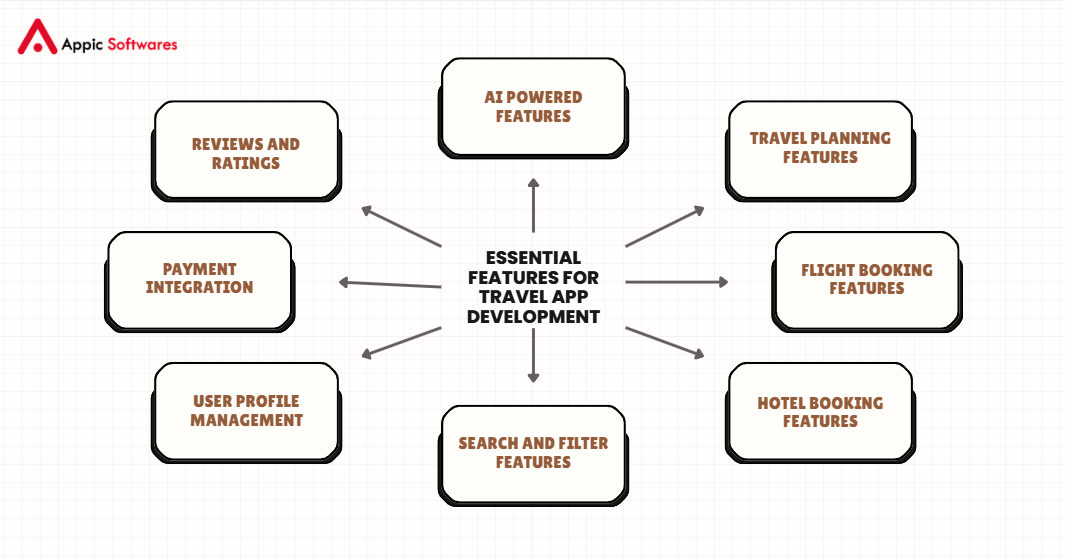
Travel apps require a combination of essential and advanced travel app features. Each feature improves usability, conversion, and retention.
Flight Booking Features
Flight booking features form the foundation of a travel app. Users search flights based on location, date, and price. The system displays airline options and pricing. Users select flights and complete bookings.
Real time availability improves booking accuracy. Booking confirmations and ticket management improve user experience.
Hotel Booking Features
Hotel booking features allow users to search accommodations. Users filter hotels based on price, location, and ratings. The platform displays room availability and pricing.
Users book hotels and receive confirmation. Booking history improves repeat bookings.
Search and Filter Features
Search filters improve user experience. Users filter flights by airline, price, duration, and stops. Hotel filters include amenities, ratings, and location.
Advanced search improves conversion rates.
User Profile Management
User profiles store travel preferences. Users access booking history and saved destinations. Profile management improves convenience.
Repeat users complete bookings faster.
Payment Integration
Payment integration supports credit cards, wallets, and online banking. Secure payment gateways improve trust. Payment security protects user data.
AI Powered Features
AI improves travel recommendations. A travel AI agent development is important because analyzes user preferences and suggests trips. AI improves personalization.
A Virtual travel booking agent answers user queries and assists bookings. AI automation improves conversion rates.
Travel Planning Features
Travel planning features allow users to build itineraries. Users manage trips and travel schedules. Trip planning improves user engagement.
Reviews and Ratings
Reviews and ratings help users make decisions. User feedback improves trust. Reviews increase conversions.
How to Choose the Best Travel API
Choosing the right travel API requires careful evaluation. Your decision affects performance, scalability, and cost.
API Coverage
You should evaluate airline and hotel coverage. Global travel apps require worldwide coverage. Regional apps require local providers. Coverage affects booking options and pricing.
API Pricing Structure
API providers follow different pricing models. Some charge per booking. Others charge subscription fees. You should calculate long term costs before selecting an API.
API Reliability
Reliable APIs improve performance. Frequent downtime leads to booking failures. You should review uptime and performance metrics.
Integration Complexity
Some APIs require complex integration. Developer friendly APIs reduce development time. Good documentation improves implementation.
Scalability
Your travel app should support growth. Scalable APIs support high traffic. Growth without scalability leads to performance issues.
Support and Documentation
Technical support reduces development delays. Detailed documentation improves integration speed. You should choose APIs with strong developer support.
Working with travel app development companies improves API selection. Experienced developers help integrate APIs efficiently.
Investment and Return on Investment
Businesses that offer digital solutions to customers traveling may have numerous recurring booking opportunities, several different monetization methods, and ever-increasing global demand for their online travel services.
Revenue Through Booking Commissions
Travel applications have a majority of their income tied to booking commissions earned off the total number of flights or hotels booked through their platforms. As noted in Statista and various travel industry reports, hotel booking commissions typically range from 5% - 15%, while flight bookings are between 1% - 5%, based on the relationship with the airline's partnership.
Let's say, if your travel app receives 5,000 bookings per month and earns an average of $8.00 in booking commission fees, the total monthly revenue generated would be $40,000. As your application expands its number of bookings each month, you will experience a natural increase in revenue without significantly increasing operational costs. Therefore, using this model creates significantly higher profit margins and long-term ROI.
Service Fees as a Source of Revenue
Service fees are another source of consistent revenue for travel applications. All travel applications charge for certain convenience items such as booking fees, cancellation fees, and itinerary changes. The average amount charged for these types of fees ranges between $5.00 and $25.00 depending on the type of transaction.
If your application processes 10,000 bookings per month and earns an average of $7.00 in service fees, then the monthly revenue generated would be $70,000, solely from service fees.
Future of Travel App Development
Travel technology continues to evolve as user expectations change. Businesses adopting new technologies improve user experience and increase bookings.
Artificial Intelligence in Travel Apps
Artificial Intelligence and Machine Learning are changing how Travel Applications operate. A Travel AI agent monitors the user’s movements, and suggests destinations, flights and hotels to the users. A virtual travel booking agent AI provides instant responses and helps users complete bookings. Automated support reduces operational costs and improves efficiency.
Voice Search and Voice Booking
Voice search continues to grow. Voice enabled booking systems greatly simplify the process of planning travel and have added to the accessibility for the end user in relation to booking their travel. Organizations that have incorporated voice search capability into their travel platforms have achieved an overall improvement in their overall user experience.
Predictive Pricing and Smart Recommendations
The use of Predictive Pricing to assist the user with decisions on the best day to book both a flight and accommodation, through the analysis of price trends and regular historical comparisons of prices over a period of time by a Travel App will develop an increased level of trust amongst users of agencies that provide them with predictive pricing.
Smart Itinerary Planning
Travel apps now offer automated itinerary planning. Users receive complete travel schedules including flights, hotels, and activities. This improves convenience and enhances user experience.
Real Time Travel Updates
Real time updates inform users about delays, cancellations, and gate changes. Travel apps providing real time updates improve reliability and customer satisfaction.
Super Travel Apps
Super travel apps combine flights, hotels, transportation, and travel activities in one platform. This improves user retention and increases booking frequency.
Businesses adopting these trends gain competitive advantages and improve customer experience.
Final Thoughts
If you are planning to to build a travel platform. You need the right APIs, features, and development strategy. Our travel app development experts at Appic Softwares help you build scalable platforms with flight and hotel API integration.
We will analyze your business requirements and recommend the best travel APIs. Our team develops high performance travel applications with secure payment systems and user friendly interfaces. We also integrate AI features to improve personalization and booking conversions.

Launch your travel platform with confidence. Turn your idea into a revenue generating travel app. Contact our team today and take the next step toward building your travel business.
FAQs
What is the best flight API for travel app development?
Amadeus, Sabre & Travelport are still the predominant flight APIs available for use when developing travel apps because they provide global airline coverage and real-time pricing and booking capabilities. Companies will continue using these APIs because they are proven reliable and have the ability to grow as the demand for travel app continues to increase.
How much does travel app development cost?
The travel app development cost varies based on the features & functionality available. Basic travel apps range from approximately $10,000-$30,000, while advanced travel apps can cost anywhere from $50,000-$80,000. In addition to these costs, there can be ongoing expenses associated with maintaining the application, acquiring the necessary licenses for using an API, as well as any web hosting fees.
How long does travel app development take?
Travel app development can take anywhere from 2-12 months to complete depending on the complexity and the number of integrations with third-party services. A typical basic travel application takes between 2-3 months to develop, while an advanced travel application with Artificial Intelligence will take approximately 6-12 months.
Why you should invest in travel app development?
Travel applications generate a reliable revenue source through commissions, subscriptions, and special payment methods. As more people travel worldwide, the demand for travel applications continues to grow, thus, investments toward developing travel applications will provide long term revenue for the businesses that invest in developing these types of products.
Frequently Asked Questions
What is the best flight API for travel app development?
Amadeus, Sabre & Travelport are still the predominant flight APIs available for use when developing travel apps because they provide global airline coverage and real-time pricing and booking capabilities. Companies will continue using these APIs because they are proven reliable and have the ability to grow as the demand for travel app continues to increase.
How much does travel app development cost?
The travel app development cost varies based on the features & functionality available. Basic travel apps range from approximately $10,000-$30,000, while advanced travel apps can cost anywhere from $50,000-$80,000. In addition to these costs, there can be ongoing expenses associated with maintaining the application, acquiring the necessary licenses for using an API, as well as any web hosting fees.
How long does travel app development take?
Travel app development can take anywhere from 2-12 months to complete depending on the complexity and the number of integrations with third-party services. A typical basic travel application takes between 2-3 months to develop, while an advanced travel application with Artificial Intelligence will take approximately 6-12 months.
Why you should invest in travel app development?
Travel applications generate a reliable revenue source through commissions, subscriptions, and special payment methods. As more people travel worldwide, the demand for travel applications continues to grow, thus, investments toward developing travel applications will provide long term revenue for the businesses that invest in developing these types of products.
Related Articles
Multi-Agent Systems for Real Estate: How AI Teams Are Reshaping Property Operations in 2026
How Agentic AI Is Transforming Real Estate Operations in 2026