How Much Does It Cost to Build an App Like Uber? 2026
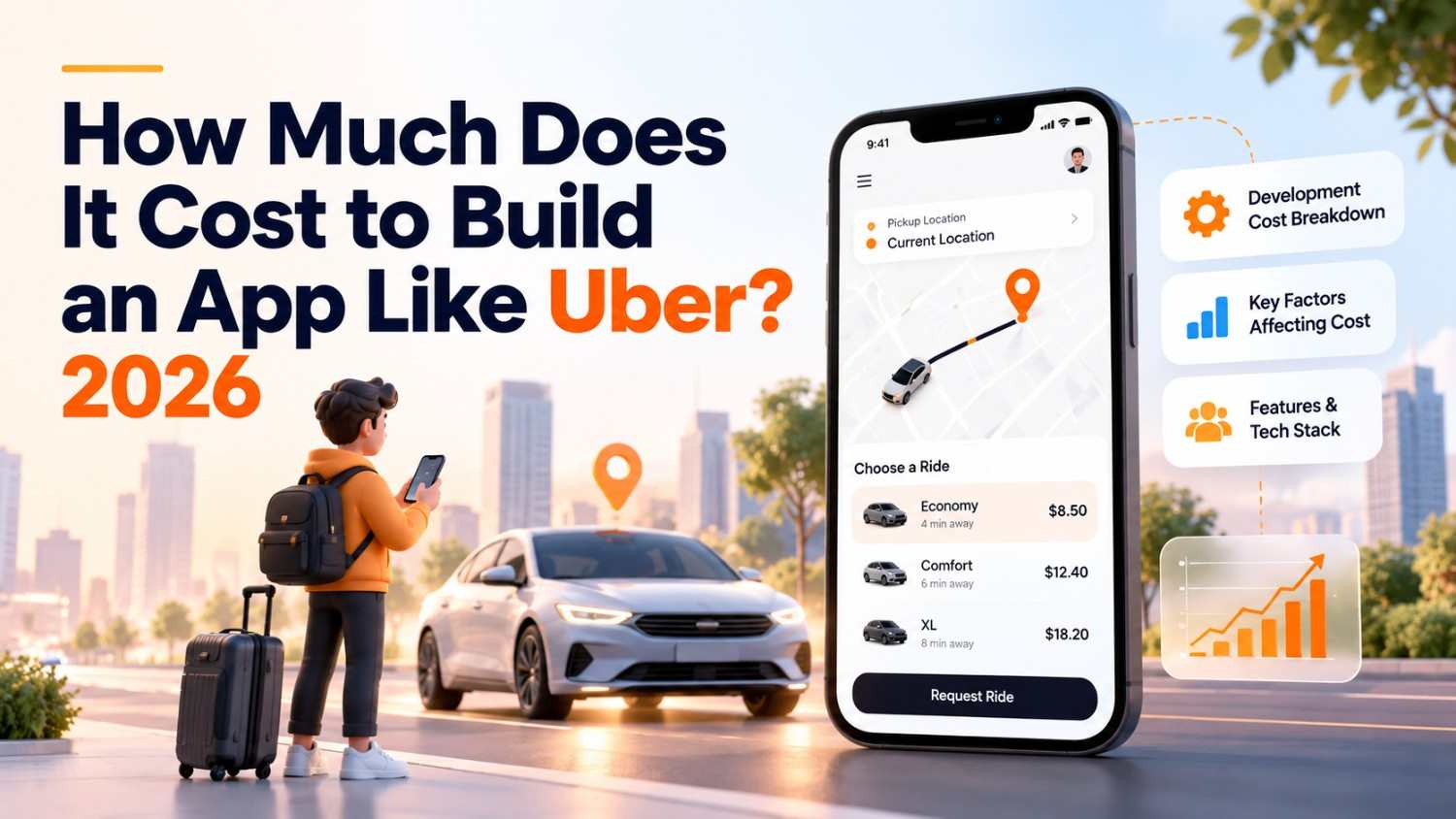
How much does it cost to build an app like Uber? In 2026, a ride-hailing MVP costs about $42,500 to $255,000 and a full platform about $115,500 to $693,000, depending mostly on where your team is based. Those ranges cover a rider app, a driver app and an admin panel. Running costs then add roughly $1.03 to $1.06 per ride.
An Uber-like app is a ride-hailing platform made of three connected products, a rider app, a driver app and an admin panel, joined by a real-time backend that matches riders to nearby drivers, prices each trip and splits the payment between driver and platform. "Uber clone" usually means the same product built or licensed for another brand, not a copy of Uber's code.
This guide is for founders, CTOs and mobility operators in the US, UK and Australia who need a budget they can defend. You will get an hour-based cost model for three build tiers, regional rates from named sources, API running costs taken from official pricing pages, a per-ride cost model at three volumes, a build vs clone script vs white-label decision table and a launch licensing checklist for California, London and New South Wales.
Key takeaways
- Our hour model puts an Uber-like MVP at about 1,700 hours and a full platform at about 4,620 hours (estimate), which is $42,500 at $25 per hour and $693,000 at $150 per hour.
- Card fees dominate running costs: at Stripe's US list price of 2.9% plus 30 cents (Stripe, 2026), payments are about 83% to 85% of our modelled per-ride technology cost on a $20 fare.
- Google Maps Platform gives 10,000 free calls per month for each Essentials SKU and 5,000 for each Pro SKU, so a pilot of 1,000 rides a month can run its maps at $0 (Google Maps Platform, 2026).
- Regulation is part of the build: California charges $1,000 for a new TNC permit application and requires a $0.10 Access for All fee on every trip (CPUC).
- Uber itself completed 3,867 million trips in Q2 2026 on $58.0 billion of gross bookings (Uber Q2 2026 results, SEC filing), which is why copying Uber's full feature set is the wrong starting budget.
Planning a taxi, chauffeur or ride-sharing product? Appic Softwares designs and builds rider apps, driver apps and admin panels as part of our on-demand app development services, starting with a scoped MVP and a written estimate you can test against the numbers below.
How much does it cost to build an app like Uber in 2026?
An app like Uber costs about $42,500 to $255,000 as an MVP, $75,000 to $450,000 as a mid-tier product and $115,500 to $693,000 as a full platform. The spread comes from two numbers: how many hours the scope needs and what each hour costs in your chosen region.
The ranges below are our estimate. We multiplied the feature hours in the next sections by three blended hourly rate bands: $25 to $40 (India), $40 to $75 (Eastern Europe) and $100 to $150 (US agency). The regional section explains where those rates come from.
| Build tier | Scope | Hours (estimate) | India team | Eastern Europe team | US agency | Timeline |
| MVP | One city, cross-platform rider and driver apps, basic admin, card payments, one ride type | 1,700 | $42,500 to $68,000 | $68,000 to $127,500 | $170,000 to $255,000 | 3 to 4 months |
| Mid-tier | Adds surge pricing, scheduled rides, in-app chat, promotions, richer admin and reporting | 3,000 | $75,000 to $120,000 | $120,000 to $225,000 | $300,000 to $450,000 | 5 to 6 months |
| Full platform | Multi-city, multiple ride types, masked calling, safety suite, referrals, analytics, compliance reporting | 4,620 | $115,500 to $184,800 | $184,800 to $346,500 | $462,000 to $693,000 | 6 to 9 months |
Published competitor ranges are close to ours at the low end and disagree at the top. Cleveroad (2025) quotes $40,000 to $60,000 for a basic build and $300,000 or more for a feature-rich one. Appinventiv (2026) gives $40,000 to $300,000. TekRevol (2026) starts its basic MVP tier at $30,000.
Most of those ranges do not show the hours behind them. Ours does, so you can swap in any quoted rate and check a vendor's number line by line.
Takeaway: Budget for hours first and rates second. A 1,700-hour MVP is the realistic floor for a working rider app, driver app and admin panel.
Why does an Uber-like app cost more than a typical app?
An Uber-like app costs more because you are building three products and a real-time system, not one app. Every trip moves through the rider app, the backend, the driver app and the admin panel within seconds, and each hand-off needs its own screens, logic and tests.
Rider app
The rider app handles sign-up with phone verification, pickup and drop-off search, fare estimates, booking, live driver tracking, in-app payment, ratings, receipts and trip history. On an MVP this is the most visible product, so most of the design hours go here.
Driver app
The driver app covers onboarding with document upload, an online and offline toggle, trip requests with accept and decline, navigation to pickup and drop-off, earnings and payout history. It must also stream the driver's location every few seconds while online, which drives backend and database load.
Admin panel
The admin panel is a web app for your operations team. It approves drivers, manages fares and zones, handles refunds and disputes, shows live trips on a map and exports the trip records regulators ask for. Teams that skip it end up running the business from database queries.
Real-time backend
The backend matches riders with drivers, calculates fares, keeps trip state in sync across both phones and settles payments. Uber says it grew to "around 2,200 critical microservices" before reorganising them into domains (Uber Engineering, 2020). A new entrant needs a small fraction of that, but the matching and trip-state logic still carries the heaviest engineering risk.
Takeaway: Price the rider app, driver app, admin panel and backend as four workstreams. Quotes that mention only "the app" usually leave out the admin panel or the dispatch logic.
What features does an Uber clone need, and what does each cost?
An Uber clone needs about 15 feature groups for an MVP and about 19 for a full platform. Matching and dispatch, live tracking, payments and the admin panel take the most hours.
The table shows our hour estimates per feature group across all three apps and the backend. The MVP cost column applies an example $50 blended hourly rate so you can see relative weight. Multiply the hours by your own rate for a real quote.
| Feature group | MVP hours | Full platform hours | MVP cost at $50/hour |
| Discovery, UX and UI design for rider, driver and admin | 160 | 400 | $8,000 |
| Sign-up, phone OTP and profiles | 80 | 140 | $4,000 |
| Driver onboarding, documents and verification | 80 | 200 | $4,000 |
| Maps, place search and geocoding | 120 | 220 | $6,000 |
| Fare estimate and pricing engine (surge on full) | 60 | 240 | $3,000 |
| Matching and dispatch | 160 | 400 | $8,000 |
| Live trip tracking and trip state | 120 | 220 | $6,000 |
| Payments, driver payouts and refunds | 120 | 260 | $6,000 |
| Push and SMS notifications | 40 | 80 | $2,000 |
| Ratings, trip history and receipts | 60 | 120 | $3,000 |
| In-app chat and masked calling | 0 | 160 | $0 |
| Safety: SOS, trip sharing, ride PIN | 40 | 160 | $2,000 |
| Promotions and referrals | 0 | 140 | $0 |
| Scheduled rides, multi-stop and ride types | 0 | 240 | $0 |
| Admin panel: drivers, trips, zones, disputes | 160 | 400 | $8,000 |
| Analytics and compliance reporting | 40 | 160 | $2,000 |
| Cloud setup, DevOps and CI/CD | 120 | 240 | $6,000 |
| QA and testing | 200 | 500 | $10,000 |
| Project management | 140 | 340 | $7,000 |
| Total | 1,700 | 4,620 | $85,000 |
Two assumptions shape these numbers. First, the rider and driver apps share one cross-platform codebase each (Flutter or React Native) instead of separate iOS and Android builds. Second, maps, payments and messaging use third-party APIs rather than in-house systems.
Other published estimates sit in the same range. SPDLoad (2026) estimates 1,514 hours for its outsourced build, and Cleveroad (2025) estimates 1,100 to 1,350 hours for its single-platform module total.
Takeaway: Matching, tracking, payments and the admin panel are 560 of the 1,700 MVP hours in our model. Cut features elsewhere first.
How much does Uber app development cost by region?
Uber app development costs roughly 2.5 to 6 times more with a US agency than with an India-based team for the same hours. Published rates differ by source, so the table shows each publisher's figure side by side.
| Region | Published rate | Source and year | Blended rate used in our model |
| India | Under $25 per hour (average for app development companies) | Clutch (2026) | $25 to $40 |
| South Asia | $24 to $31 junior, $31 to $41 senior | Accelerance (2025) | $25 to $40 |
| Ukraine and Poland | $25 to $49 (Ukraine), $50 to $99 (Poland) | Clutch (2026) | $40 to $75 |
| Europe | $31 to $39 junior, $64 to $76 senior | Accelerance (2025) | $40 to $75 |
| United States | $25 to $49 per hour (Clutch directory average); median developer wage $135,980 a year | Clutch (2026); US BLS (May 2025) | $100 to $150 (assumption) |
The US figures need care. Clutch's directory average of $25 to $49 per hour is low for a US-based delivery team. The BLS median wage of $135,980 works out to about $65 per hour over 2,080 hours, and that is salary only, before benefits, office costs and agency margin.
Our $100 to $150 US band is therefore an assumption, not a published rate. Replace it with the rates on the quotes you receive.
Location is only one variable. Time-zone overlap, product ownership and communication cost matter as much as the hourly figure. Our guide to the overall cost to create an app covers those trade-offs for any app type.
Takeaway: Use the published rates as a sense check, then compare vendors on total hours and team seniority. A cheap rate on an inflated hour count is not a saving.
How long does it take to build an Uber-like app?
An Uber-like app takes about 3 to 4 months to build as an MVP and 6 to 9 months as a full platform, with a team of five to seven people. Timelines stretch when driver onboarding rules, payment payouts or licensing requirements are discovered late.
Our timeline estimate assumes each person delivers about 130 productive hours a month. Five people deliver roughly 650 hours a month, so 1,700 MVP hours take about 3 months, plus buffer for app store review and pilot fixes.
Published timelines vary. AllCloneScript (2026) gives 3 to 4 months for an MVP and 8 to 12 months or more for an enterprise platform. Appinventiv (2026) gives 2 to 3 months for a basic build and 9 months or more for an advanced one. Across all app types, Clutch (2026) reports a typical timeline of about 11 months.
A typical MVP schedule runs in five phases:
- Discovery and design, weeks 1 to 3: confirm the launch city, ride types, fare rules and regulatory requirements, then design the three apps.
- Core backend, weeks 3 to 8: accounts, trip state, matching, fare calculation and payment flows.
- Rider and driver apps, weeks 4 to 11: screens, maps, live tracking and notifications, built in parallel.
- Admin panel and QA, weeks 9 to 13: driver approval, refunds, reporting, then end-to-end testing with real devices on real streets.
- Store release and pilot, weeks 13 to 16: Apple and Google review, a closed pilot with a small driver group and fixes from live trips.
Takeaway: Plan for about 16 weeks to a live MVP pilot. Start the licensing work in week one, because a permit can take longer than the code.
What tech stack does Uber use, and what should you use?
Uber runs a very large microservice platform with its own geospatial tooling, while a new ride-hailing app needs a much smaller stack built on cross-platform mobile code, a managed cloud and third-party maps and payments.
What Uber runs
Uber describes a Domain-Oriented Microservice Architecture (DOMA) that groups about 2,200 critical microservices into domains and layers (Uber Engineering, 2020). For location data it built H3, a hexagonal grid system "optimizing ride pricing and dispatch", which it open-sourced in 2018 (Uber Engineering, 2018).
H3 is the one Uber component a startup can use directly. It is free, and it gives you a ready-made way to group drivers and demand into zones for matching and surge pricing.
Recommended stack for a 2026 Uber-like MVP
| Layer | Recommended options | Why |
| Rider and driver apps | Flutter or React Native; native Swift or Kotlin only for background location edge cases | One codebase per app for iOS and Android |
| Admin panel | React or Next.js web app | Fast to build tables, filters and maps |
| Backend API | Node.js (NestJS) or Go, as a modular monolith | Simpler to run than microservices at MVP volume |
| Database | PostgreSQL with PostGIS; Redis for live driver locations | Geospatial queries and fast nearby-driver lookups |
| Real-time sync | WebSockets, or Cloud Firestore for live trip state | Rider sees the driver move without polling |
| Spatial indexing | Uber H3 | Zones for matching and surge pricing |
| Maps and routing | Google Maps Platform, or Mapbox or Amazon Location Service | Place search, routes, ETAs and traffic |
| Payments | Stripe with Stripe Connect | Card charges plus split payouts to drivers |
| Messaging | Firebase Cloud Messaging for push; Twilio for SMS and OTP | Free push, pay-per-message SMS |
| Hosting | AWS (ECS on Fargate) or Google Cloud | Managed containers, no servers to patch |
Ride-hailing shares most of this stack with food and parcel delivery. If you are weighing several on-demand models, our guide to on-demand mobile app development compares them.
Takeaway: Copy Uber's ideas, not its architecture. A modular monolith with H3, PostGIS and managed APIs carries an MVP well past its first city.
What do maps, payments and SMS cost each month?
Maps, payments and SMS are usage-priced, so they cost little at pilot volume and grow with every ride. The table lists the official 2026 list prices we used in the per-ride model.
| Service | Official list price (2026) | Free allowance | Source |
| Google Maps SDK for Android and iOS (map display) | No per-call charge | Unlimited | Google Maps Platform pricing list |
| Places Autocomplete requests | $2.83 per 1,000 | 10,000 a month | Google Maps Platform pricing list |
| Place Details Essentials and Geocoding | $5.00 per 1,000 each | 10,000 a month each | Google Maps Platform pricing list |
| Compute Routes Pro (traffic-aware) | $10.00 per 1,000 | 5,000 a month | Google Maps Platform pricing list |
| Compute Route Matrix Essentials | $5.00 per 1,000 elements | 10,000 a month | Google Routes API billing |
| Navigation SDK request | $25.00 per 1,000 | 1,000 a month | Google Maps Platform pricing list |
| Stripe card payments (US domestic) | 2.9% plus 30 cents per charge; +1.5% international cards | None | Stripe pricing |
| Stripe Connect (you set pricing) | $2 per monthly active account, 0.25% of payout volume, 25 cents per payout | None | Stripe Connect pricing |
| Twilio SMS (US) | $0.0083 per segment plus carrier fees of $0.0035 to $0.005 | None | Twilio SMS pricing |
| Twilio Verify (OTP) | $0.05 per successful verification plus SMS fee | None | Twilio Verify pricing |
| Firebase Cloud Messaging (push) | No cost | Unlimited | Firebase pricing |
| Cloud Firestore | $0.03 per 100,000 reads; $0.09 per 100,000 writes | 50,000 reads and 20,000 writes a day | Google Cloud Firestore pricing |
| AWS Fargate (US East) | $0.000011244 per vCPU second; $0.000001235 per GB second | None | AWS Fargate pricing |
| App store accounts | Apple $99 a year; Google Play $25 once | Not applicable | Apple; Google Play |
Two billing rules catch teams out. Google replaced its $200 monthly credit with free calls per SKU from 1 March 2025 (Google Maps Platform, 2026). Route Matrix is billed per element, meaning origins multiplied by destinations, and any traffic-aware route is billed at the Pro rate (Google, 2026).
Takeaway: At list prices, maps and messaging are cheap per call. The bill grows through call volume per ride, so design the app to make fewer calls.
What does each ride cost to run? A per-ride model at three volumes
Each ride costs about $1.03 to $1.06 in technology and payment fees in our model, and card processing is about 83% to 85% of that. Maps, SMS, payouts and hosting together come to about $0.15 to $0.18 per ride.
This is an estimate built only from the official prices above. The assumptions per completed ride are:
- 5 Places Autocomplete requests, 1 Place Details call and 1 reverse geocode for the pickup.
- 2 traffic-aware Compute Routes Pro calls, one for the fare quote and one at trip start.
- 1 Route Matrix call checking 10 nearby drivers, which bills 10 elements.
- Map display through the mobile Maps SDK at no charge, and driver navigation handed to the driver's own maps app.
- 1 SMS per ride at $0.0083 plus a $0.005 carrier fee; all other alerts by free push.
- A $20 average fare, 75% paid out to the driver, one weekly payout per driver and one active driver per 100 rides a month.
- 250 Firestore reads and 250 writes per ride for live tracking, and 2, 4 or 12 Fargate tasks of 1 vCPU and 2 GB.
- First paid tier prices with no volume discounts, so large volumes are slightly overstated.
| Monthly cost line | 1,000 rides | 10,000 rides | 100,000 rides |
| Google Maps Platform APIs | $0.00 | $713.20 | $9,186.70 |
| Twilio SMS | $13.30 | $133.00 | $1,330.00 |
| Stripe Connect payouts | $68.33 | $683.33 | $6,833.33 |
| AWS Fargate hosting | $72.08 | $144.16 | $432.48 |
| Cloud Firestore | $0.00 | $2.01 | $29.01 |
| Technology subtotal | $153.71 | $1,675.70 | $17,811.53 |
| Stripe card processing | $880.00 | $8,800.00 | $88,000.00 |
| Total per month | $1,033.71 | $10,475.70 | $105,811.53 |
| Cost per ride | $1.03 | $1.05 | $1.06 |
Route Matrix is the largest maps line at scale: $4,950 of the $9,186.70 at 100,000 rides. Filtering candidate drivers by H3 cell or straight-line distance before calling the API, and checking 5 drivers instead of 10, roughly halves that line.
Turn-by-turn navigation inside your driver app changes the picture. At $25 per 1,000 Navigation SDK requests, one request per ride would add about $0.025 per ride above the free 1,000.
Takeaway: Negotiate card rates before you negotiate cloud bills. At a $20 fare, Stripe's 88 cents per ride outweighs every other line in the model.
How much does it cost to maintain an app like Uber?
Maintaining an app like Uber costs about 15% to 25% of the original build each year, plus the usage-based running costs above. On a $68,000 MVP, that is about $10,200 to $17,000 a year in engineering time.
Published maintenance ranges differ slightly. Cleveroad (2025) uses 15% to 20% a year. AllCloneScript (2026) uses 15% to 25%. SPDLoad (2026) uses 10% to 20%.
Maintenance for a ride-hailing app usually covers:
- Yearly iOS and Android releases that change background location and notification rules.
- Maps, payments and SMS API version changes and deprecations.
- Security patches, dependency updates and penetration test fixes.
- New reports or data fields that regulators add to your licence conditions.
- Bug fixes found by drivers on real roads, devices and networks.
The fixed fees are small: Apple charges $99 a year and Google Play charges $25 once. For a wider view of post-launch budgets across on-demand models, see our breakdown of on-demand app development costs.
Takeaway: Budget 15% to 25% of the build each year for engineering, then add per-ride running costs on top. They are separate lines.
Should you build custom, buy an Uber clone script or use white-label?
An Uber clone script is worth it when you need to test demand in one city within weeks and accept another vendor's roadmap. Custom development is worth it when pricing, dispatch or the driver experience is your advantage, or when investors will ask who owns the code.
| Factor | Custom build | Clone script | White-label SaaS |
| Upfront cost | Highest: full hour model above | Licence fee plus rebranding and fixes | Setup fee, low |
| Ongoing cost | Your team or vendor, 15% to 25% a year | Your team must patch unfamiliar code | Monthly or per-ride fee to the vendor |
| Time to first ride | 3 to 4 months for an MVP (estimate) | Weeks, plus fixes | Weeks |
| Code ownership | Yours | Licensed; check the terms | Vendor's |
| Changing dispatch or pricing logic | Full control | Possible but slow in unknown code | Limited to vendor settings |
| Code quality and security | You set the standard | Unknown until audited | Vendor's responsibility |
| Fit for regulator reporting | Built to your licence conditions | Often needs rework | Depends on vendor features |
| Best for | Funded startups and operators with a differentiated model | Low-budget local tests | Existing taxi or chauffeur fleets going digital |
A middle route is common. Teams validate with a white-label product, then commission a custom build once they know which features riders and drivers actually use.
Takeaway: Buy speed with a clone script or white-label only if you can live with its limits. Build custom when the product itself is the business.
What licences do you need to launch a ride-hailing app in the US, UK and Australia?
You need a regulator's permit or authorisation before taking paid bookings in most ride-hailing markets, and each one adds features your app must support. The checklist below covers three large launch markets: California, London and New South Wales.
| Requirement | California (CPUC) | London (TfL) | New South Wales (P2P Commissioner) |
| Licence | TNC permit; $1,000 new application, $100 renewal | Private hire operator licence, up to 5 years | Booking service provider authorisation |
| Fees per trip or fleet | $0.10 Access for All fee per trip | Fee set by fleet size, from £2,000 over 5 years for 0 to 10 vehicles | $1.20 levy per passenger service transaction |
| Driver checks | National criminal background check and sex offender database | Fit and proper test; DBS checks for booking staff | Driver names and licence numbers on record |
| Vehicle rules | Inspection before service, then every 12 months or 50,000 miles | Vehicle registration in booking records | Safety Management System covering journeys |
| Data and records | Required reports to CPUC | Booking records per trip; weekly driver and vehicle upload every Monday | Keep booking details for at least 2 years |
| Insurance | $1,000,000 primary commercial cover in Periods Two and Three, as CPUC defines them | See TfL PHV/102 guidance | Check state requirements |
| App features this creates | Fee line on receipts, inspection expiry tracking, zero tolerance reporting | Voice contact during trips, data export, staff register | Levy reporting, record retention, safety incident logs |
Sources: CPUC basic information for TNCs and the CPUC TNC page; TfL private hire operator licence; NSW Point to Point Transport Commissioner. Rules change, so confirm with each regulator before launch.
Use this pre-launch checklist:
- Confirm which regulator covers your launch city and which licence class fits your model.
- Apply early: TfL says a typical application can take up to 16 weeks.
- Map every record the regulator requires to a database field and an admin export.
- Add per-trip fees and levies to the fare engine and receipts.
- Build driver document expiry tracking for licences, inspections and insurance.
- Arrange insurance that covers each trip period your regulator defines.
- Write your safety, complaints and zero tolerance procedures before the pilot.
Takeaway: Licensing is a product requirement, not just a legal task. Each rule above becomes a field, a report or a screen in the build.
How do ride-hailing apps make money?
Ride-hailing apps make money mainly by keeping a share of each fare and paying the rest to the driver. Uber's Mobility revenue was $7,363 million on $28,988 million of Mobility gross bookings in Q2 2026, about 25.4% by our calculation (Uber, SEC filing, 2026).
That 25.4% is a ratio of reported revenue to gross bookings, not Uber's stated commission rate, and Uber's revenue accounting differs by market. Treat it as context, not a target.
Common revenue models for a new platform:
- Commission or service fee on each fare.
- Dynamic pricing in busy zones, which Uber measures with H3 cells.
- Booking fees and cancellation fees.
- Rider subscriptions with discounted fares.
- Driver subscriptions in place of commission, used by some smaller platforms.
- Corporate accounts billed monthly.
Run the model above against your take rate. At a $20 fare and a 20% commission you keep $4, and our modelled $1.03 to $1.06 in technology and payment costs comes out of that before marketing, insurance and support.
Takeaway: Decide your revenue model before design starts, because commissions, subscriptions and surge pricing each need different fare engine and payout logic.
Can you build an Uber MVP for under $50,000?
Yes, an Uber MVP can come in under $50,000, but only with an offshore team at about $25 to $29 per hour on the 1,700-hour scope, or with a narrower scope. At a $40 blended rate the same MVP costs $68,000.
An MVP is the smallest version that proves riders will book and drivers will accept trips in one market. Our guide to building an MVP for a startup covers the method. For ride-hailing, the plan looks like this:
- Pick one city, one ride type and one payment method.
- Build the rider app and driver app in one cross-platform framework.
- Keep the admin panel to driver approval, live trips, refunds and exports.
- Use Stripe Connect for payouts instead of a custom wallet.
- Send drivers to their own maps app for navigation.
- Delay chat, scheduled rides, promotions and multi-stop trips to phase two.
- Launch a closed pilot with a small driver group and measure fill rate, pickup time and repeat bookings.
Cutting the MVP to about 1,200 hours by trimming design, admin and analytics would cost $48,000 at $40 per hour (estimate). Do not cut QA or the matching logic: a failed first ride is hard to recover from with both riders and drivers.
Appic Softwares runs this kind of scoped first release through its MVP development services. The same phased approach applies to related models, as our guide to creating an on-demand delivery app shows.
Takeaway: Under $50,000 is possible with an offshore team and a disciplined scope. Spend the savings on the pilot, not on extra features.
Next steps: get a costed plan for your ride-hailing app
The cost to build an app like Uber in 2026 runs from about $42,500 for an offshore MVP to $693,000 for a full platform from a US agency. Running costs then add about $1.03 to $1.06 per ride on a $20 fare. Your own number depends on scope, team location and the licence rules in your launch city.
Appic Softwares builds rider apps, driver apps, admin panels and dispatch backends through our on-demand app development team. Share your launch city, ride types and target date through our contact form, and we will send back a scoped feature list, an hour estimate and a timeline you can compare against this guide.
Frequently Asked Questions
How much does it cost to build an app like Uber?
Building an app like Uber costs about $42,500 to $255,000 for an MVP and $115,500 to $693,000 for a full platform in 2026. The estimate covers a rider app, driver app, admin panel and backend. India-based teams sit at the low end and US agencies at the high end of each range.
How long does it take to build an Uber-like app?
An Uber-like MVP takes about 3 to 4 months with a team of five, based on roughly 1,700 hours of work. A mid-tier product takes 5 to 6 months and a full multi-city platform 6 to 9 months. Licensing and app store review can add time, so start both early.
What features does an Uber clone need?
An Uber clone needs phone sign-up, place search, fare estimates, booking, driver matching, live tracking, card payments, driver payouts, push alerts, ratings and trip history. The driver app needs onboarding and an online toggle. The admin panel needs driver approval, refunds, live trip views and regulator exports.
How much does it cost to maintain an app like Uber?
Maintenance usually costs 15% to 25% of the original build each year for updates, fixes and security work. Published estimates range from 10% to 25%. Usage costs come on top: our model puts maps, SMS, payouts, hosting and card fees at about $1.03 to $1.06 per ride on a $20 fare.
What tech stack does Uber use?
Uber runs about 2,200 critical microservices organised into domains, according to its engineering blog in 2020, and built the open source H3 hexagonal grid for pricing and dispatch. A new ride-hailing app can start smaller with Flutter or React Native, Node.js or Go, PostgreSQL with PostGIS, Redis, Google Maps and Stripe Connect.
Is an Uber clone script worth it?
An Uber clone script is worth it for a low-budget test in one city where speed matters more than control. It is a poor fit if dispatch, pricing or driver experience is your advantage, because you inherit unfamiliar code. Audit the code and licence terms before buying, and plan for rework.
How do ride-hailing apps make money?
Ride-hailing apps mainly keep a share of each fare and pay the rest to drivers. Other models include booking fees, cancellation fees, dynamic pricing, rider subscriptions, driver subscriptions and corporate accounts. In Q2 2026, Uber's Mobility revenue equalled about 25.4% of Mobility gross bookings, by our calculation from its filing.
Can I build an Uber MVP for under $50,000?
Yes, if an offshore team delivers the 1,700-hour MVP scope at about $25 to $29 per hour, or if you cut scope to around 1,200 hours. Limit the MVP to one city, one ride type and card payments, use Stripe Connect for payouts, and keep QA and matching logic intact.
What does each ride cost to run on an Uber-like app?
Our model puts running costs at about $1.03 to $1.06 per ride at 1,000 to 100,000 rides a month, using official 2026 list prices and a $20 fare. Card processing is about 83% to 85% of that. Maps, SMS, payouts and hosting together add about $0.15 to $0.18 per ride.
Do I need a licence to launch a ride-hailing app?
Usually yes. California requires a CPUC TNC permit, London requires a TfL private hire operator licence and New South Wales requires booking service provider authorisation. Each adds fees, driver checks, record keeping and reporting that your app must support, so confirm the rules with the regulator before launch.
Related Articles

How U.S. Startups Validate Ideas Using No-Code MVPs
Gartner predicts that by 2025, 70% of all new business apps will use low-code or no-code technologies. This is a big increase from 2023, when less than 25% of new business applications used these technologies. And you know, while access to resources and startup culture is booming, the challenge lies in validating your startup idea […]

MVP for Startups: A 90-Day Plan, Cost Examples, Tech Stack Choices and Mistakes to Avoid
If you’re a startup founder in the U.S. and looking for an MVP for a startup, you probably know how overwhelming it can be to turn a great idea into a real, working product. From design and development to user testing and launch, it’s a lot. But what if we told you there’s an MVP […]
On Demand Mobile App Development Guide for Businesses

Doctor on Demand App Development: Features, Architecture, Compliance, Cost and Timeline in 2026
How to Build an On Demand App Cost and Features Guide

How To Start An On-Demand Delivery App Business?
The on-demand economy has grown in popularity over the past decade. Companies like Uber and Airbnb were the first to creatively utilize this model, and since then, it has transformed how businesses function and how consumers perceive services across many sectors. Today, the ability to create on-demand delivery apps has further revolutionized various industries, offering convenience […]