On Demand Mobile App Development Guide for Businesses
A few years ago, ordering groceries meant visiting a supermarket, walking through aisles, waiting in checkout lines, and carrying bags home.
Today, if a customer runs out of groceries at 9 PM.
Instead of driving to a store, they open Blinkit and receive their order within minutes.
A patient develops a mild fever and wants medical advice without visiting a clinic. They book a virtual consultation through an app like Practo.
A homeowner discovers a leaking pipe and schedules a plumber through Urban Company before the damage spreads.
These experiences have one thing in common. They remove friction. An experienced on demand app development company can help businesses create an app based on long-term requirements rather than short-term trends.
Consumers no longer compare businesses only on price or quality. They compare them for convenience. The company that solves a problem faster often wins the customer.
This transformation has changed the way firms operate. Healthcare, logistics, retail, food delivery, transportation and home services companies are spending extensively in an on demand mobile app development to fulfill increased client expectations.
However, developing a successful on-demand app is not simply about launching an app and waiting for users to come.
Many entrepreneurs spend months building functionality only to realize they solved the incorrect problem. Others bring in clients, but not enough service providers to satisfy demand.
In this article we look at what businesses should know before investing in an on demand app, how successful companies are building scalable platforms and techniques that separate market leaders from failing ventures.
The Growth of the On-Demand Economy
Many people believe the rise of on-demand services was due to the power of smartphones.
Smartphones were a part of it, but the greater reason is convenience.
Consumers are finding traditional methods more and more frustrating.
Think about transportation.
Before ride-sharing applications, ordering a cab usually meant calling a local taxi service and waiting without knowing when the car would come. Uber transformed the whole experience. Before entering the vehicle, customers can check the driver's location, expected time of arrival, fare estimate and route.
The technology was not groundbreaking in itself but the consumer experience was.
Not all patients who need an instant consultation prefer to go to a hospital. If you work and need food after work, you may not have time to go to the cafe. A homeowner with a broken air conditioner wants help right away and not days later when a technician can come.
Businesses that solve these difficulties add value.
Statista reports that global mobile app revenue is on the rise as customers increasingly rely on digital platforms for their daily needs. This pattern points to a broader move towards convenience driven decision-making.
For businesses, this creates a simple reality.
Customers expect services to fit into their schedules rather than adjusting their schedules around businesses.
Why Most On-Demand Apps Fail Before They Scale
Success stories dominate headlines.
Failed startups rarely receive the same attention.
For every Uber or DoorDash, hundreds of on-demand platforms struggle to gain traction despite investing heavily in technology.
The reason is surprisingly simple.
Many founders focus on building an app instead of starting an e-commerce marketplace or any other marketplace.
An app is only one component of the business.
The real challenge is creating an ecosystem where customers and service providers continuously engage with each other.
The Supply and Demand Problem
Imagine launching an on demand food delivery app in a city.
You spend months developing the platform and invest heavily in marketing. Thousands of users download the application within the first few weeks.
Everything looks promising.
Then customers begin placing orders.
The problem?
Only a handful of restaurants joined the platform.
Customers encounter limited options and eventually return to established competitors.
Now imagine the opposite scenario.
You onboard hundreds of restaurants but fail to attract enough customers.
Restaurants receive very few orders and gradually stop using the platform.
This challenge is one of the biggest reasons marketplace businesses fail.
Uber spent years balancing riders and drivers across different cities. The company offered incentives to drivers when supply was low and promotional discounts when demand needed stimulation.
Successful on demand app solutions focus as much on marketplace dynamics as they do on technology.
Bonus read - Top Development Trends For On Demand Applications
The Trust Challenge
Trust often determines whether a customer completes a transaction.
Consider an app like Urban Company.
The company is not merely connecting homeowners with technicians.
It is convincing customers to allow strangers into their homes.
Without trust, the business model collapses.
This is why successful platforms invest heavily in verification systems, ratings, reviews, service guarantees, and customer support.
Technology enables transactions.
Trust enables growth.
The Retention Problem
Many startups celebrate downloads. But, every experienced business focuses on retention.
A customer who uses an app once has limited value. And, a customer who returns every week creates sustainable revenue.
The most successful on-demand platforms become part of daily routines.
People do not consciously think about opening Uber when they need transportation.
It has become a habit.
Creating that habit is far more difficult than acquiring the initial download.
Understanding Different On-Demand Business Models

Not all on-demand platforms operate the same way.
The business model affects revenue generation, operational complexity, and long-term scalability.
Businesses need to decide on the model before investing in custom on demand app development.
Marketplace Model
Most of the automobiles on its platform are not owned by the company.
Instead, it allows communication between riders and drivers.
This strategy scales well because companies don’t need to own inventory or have massive support teams.
But you’ve got to work on keeping the marketplace balanced all the time..
Aggregator Model
Aggregators ensure consistent client experiences across numerous suppliers.
Practo demonstrates this model effectively.
Patients are able to find doctors, book appointments and receive healthcare services on one platform. This approach has also contributed to the growing demand for doctor on demand app development, as healthcare providers look for ways to offer faster and more accessible care.
The software makes the decision-making process easier for the users and provides visibility to the healthcare providers.
Hyperlocal Model
Hyperlocal platforms are focused on delivery of product or service in a particular geographical area.
Blinkit and Zepto built their businesses around speed.
The success of these companies relies on strategically located warehouses, effective supply routes and efficient logistics.
Hyperlocal platforms are not like marketplace firms and they often own and run their own inventory and fulfillment operations.
Subscription-Based Model
Some firms have membership-based recurring revenue.
Amazon Prime & Netflix are the best and most successful examples for this model.
Customers pay recurrent charges in exchange for benefits like faster delivery and exclusive services.
This concept builds predictable revenue streams and drives consumer loyalty.
The most successful organizations frequently use a mix of models, rather than relying on a single source of revenue.
Also read - Subscription Commerce: A Complete Guide
What Makes Customers Return to an On-Demand App?
There are lots of companies who assume that more functionality equals higher user engagement.
Customers actually come back because an app solves an issue better than the alternatives.
Several factors influence repeat usage.
Speed Creates Competitive Advantage
Blinkit's growth illustrates how speed influences customer behavior.
Customers often use the platform because they need something immediately.
A forgotten grocery item, an urgent household requirement, or a last-minute need creates demand.
Fast fulfillment becomes the primary value proposition.
Predictability Builds Loyalty
People appreciate reliability.
Uber's estimated arrival times reduce uncertainty.
Customers know approximately when the vehicle will arrive and when they will reach their destination.
Predictability improves trust and encourages repeat usage.
Convenience Reduces Friction
The fewer actions required to complete a task, the better the experience.
Companies continuously optimize user journeys to eliminate unnecessary steps.
A customer should not need to navigate multiple screens to perform a simple action.
Personalization Improves Engagement
Streaming platforms have demonstrated the power of personalization.
The same principle applies to on-demand businesses.
A grocery app that remembers frequently purchased items provides a better experience than one requiring users to search repeatedly.
Modern on demand mobile app development increasingly focuses on personalization because customers now expect experiences tailored to their preferences.
Industry-Wise Applications of On-Demand Platforms
The concept of on-demand services extends far beyond transportation and food ordering applications.
Different industries use the model to solve different challenges.
Healthcare
Healthcare platforms help patients access medical services without visiting clinics unnecessarily.
For example, a patient with a minor illness can consult a doctor through a telemedicine app development and obtain prescriptions remotely.
This improves accessibility while reducing pressure on healthcare facilities.
Home Services
Urban Company transformed how people hire service professionals.
Instead of searching for local technicians and comparing providers manually, customers can book verified professionals through a single platform.
The company simplified a traditionally fragmented market.
Grocery Delivery
Blinkit and Instamart demonstrate how technology can improve convenience in everyday shopping.
Customers save time while businesses create new purchasing opportunities.
Logistics and Courier Services
Businesses increasingly use on-demand platforms for package delivery and logistics management.
Real-time tracking and route optimization improve efficiency and customer satisfaction.
Also read - Logistics App Development Cost: A Complete Cost Guide
Education
Educational platforms now connect students with tutors, mentors, and coaches on demand.
This model provides flexible access to learning opportunities.
The diversity of these applications highlights why businesses across industries continue investing in on demand app development services.
The Core Architecture Behind Every Successful On-Demand Platform
The businesses may differ, but the architecture of the successful on-demand platforms is the same.
Most platforms have three operating layers and one intelligence layer.

The fourth layer has gained increased importance in recent years. This intelligence layer uses analytics, automation and artificial intelligence to enhance decision making.
For example, ride-sharing companies leverage previous demand data to optimally locate drivers before peak hours.
Food delivery services anticipate demand spikes on weekends and holidays. Healthcare apps evaluate appointment trends to improve scheduling efficiency.
These skills deliver operational benefits that competitors can’t easily copy.
That’s why more and more organizations are starting to see on demand mobile app development as more than just a software project.
The app itself is simply the customer side of things.
The true value is frequently in the systems working behind the scenes.
How to Build an On-Demand App That Scales
When it comes to really executing, many new businesses fail, even when they have identified a real market opportunity. They become obsessed with features, screen design and launch dates, while ignoring the operational realities that drive long-term success.
The on-demand economy often doesn't win by building the most attractive app. They win because they designed systems that keep on running efficiently as demand rises.
For Uber, the difficulty was never to create a booking UI. The objective was to handle millions of ride requests across multiple cities while maintaining a seamless customer experience.
Similarly, Blinkit's competitive advantage is not its mobile application. The major benefit is that it can work across inventory and fulfillment facilities and delivery partners and routing systems all at the same time.
If you are investing in on demand mobile app development, you shouldn’t look just at the launch phase. It’s about more than just making an app. The idea is to develop a scalable business.
The Development Process Behind Successful On-Demand Apps
Many founders make the mistake of starting with development.
The process should begin with validation.
Market Validation Comes First
Before you start investing in business app development, you need to know whether there is an actual need in the market.
One of the most typical mistakes for startups is solving an issue that customers don’t think is essential.
For example, several grocery delivery firms existed before the popular brands like Instamart and Blinkit. Most of them failed because the consumer was not yet ready to change his shopping habits.
The timing was wrong.
Today, the expectations of consumers have shifted drastically, thereby creating a far bigger opportunity.
- Validation often consists of:
- Interviews with customers
- Analysis of competitors
- Customer surveys
- Landing page testing
- Pilot programs
This process helps businesses reduce risk before investing heavily in development.
Building an MVP Instead of a Full Product
One reason Uber succeeded was its simplicity during the early stages.
The initial version was mostly directed toward connecting passengers and drivers.
It didn’t have all the features we have now.
There are a lot of firms who try to launch with dozens of complicated features.
This strategy adds to the expenditures, stretches the deadlines and complicates testing.
An MVP for startups helps collect feedback rapidly and improve based on actual user behavior.
Designing Around User Behavior
The best apps remove friction.
Think about how often people use Uber.
Most users make a reservation in seconds.
The experience is intuitive so there’s no time spent on figuring out how the application works.
The design of user experience should aim at eliminating choice fatigue and making actions simple.
The less friction faced by clients, the more likely they are to transact.
Essential Features Depend on the Industry
One of the biggest misconceptions surrounding custom on demand app development is that every app requires the same features.
Different industries have different priorities.
A grocery delivery platform operates differently from a healthcare application.
Features Often Found in Ride-Sharing Platforms
Uber and Lyft and other platforms often rely on:
- Real time tracking of location
- Automatic fare collection
- Driver-passenger interaction
- Dynamic Rates
- Ride receipts & history
These features help boost transparency and efficiency throughout the booking process.
Features Often Found in Healthcare Platforms
Healthcare apps usually require:
- Scheduling appointments
- Video consults
- EHRs (Electronic health records)
- Prescription Handling
Unlike transportation apps, healthcare platforms also need to comply with strong privacy and compliance standards.
Features Often Found in Grocery Delivery Apps
Companies like Blinkit and Instamart focus a lot on:
- Track your delivery
- Recommended products
- Digital payments
- Inventory management
Inventory accuracy is particularly crucial since unavailable products have a direct impact on consumer satisfaction.
This is why businesses should prioritize industry-specific requirements instead of blindly copying competitors.
Choosing the Right Technology Stack
The choice of technology impacts on development costs, maintenance requirements and scalability.
Many firms chase trendy technologies rather than picking tools that fit their needs.
A good technological stack usually consists of:
- Flutter or React Native for cross-platform development
- Node.js, Python, or Java for backend systems
- AWS, Azure, or Google Cloud for infrastructure
- Third-party APIs for maps, payments, and communication
The right combination depends on factors such as expected user volume, required integrations, and future growth plans.
How Much Does On Demand Mobile App Development Cost?
Cost is often one of the first questions businesses ask.
The challenge is that no universal answer exists.
A telemedicine application and a food delivery platform may have completely different technical requirements.
Instead of asking how much an app costs, businesses should ask what drives development expenses.
Several factors influence overall investment:
- Feature complexity
- Number of user roles
- Third-party integrations
- Design requirements
- Security and compliance needs
- Scalability expectations
The table below shows the estimated on demand mobile app development cost at Appic Softwares. The final cost depends on the app's features, complexity, integrations, and business requirements.
Appic Softwares offer affordable on-demand app development solutions starting from $10,000. Whether you need a basic MVP or a fully scalable platform, our team helps businesses build high-quality applications that fit their budget and growth goals.
| Development Level | Estimated Cost |
| Basic MVP App | $10,000 - $20,000 |
| Standard On-Demand App | $20,000 - $40,000 |
| Advanced On-Demand App | $40,000 - $60,000 |
| Enterprise-Grade On-Demand Platform | $60,000 - $80,000+ |
Why AI Is Becoming Essential for On-Demand Platforms
Artificial intelligence is no longer limited to large technology companies.
Many modern on demand app solutions rely on AI to improve customer experiences and customer experiences.
One area where AI creates significant value is demand forecasting.
Imagine a food delivery platform preparing for a major sporting event.
Historical data can help predict increased order volumes, allowing businesses to allocate resources before demand spikes.
Another example is route optimization.
Delivery companies use machine learning algorithms to identify faster routes and reduce delivery times.
AI also supports personalization.
Streaming services introduced many consumers to recommendation engines. Similar systems now help on-demand platforms suggest products, services, and providers based on customer preferences.
The result is a more relevant experience and higher engagement rates.
Common Mistakes Businesses Make During Development
Many challenges are avoidable.
Yet businesses continue making the same mistakes repeatedly.
Building Too Many Features Too Early
More features do not always create more value.
In many cases, complexity creates confusion.
Successful businesses focus on solving one problem exceptionally well before expanding functionality.
Ignoring Scalability
Some startups design systems for their first thousand users without considering future growth.
As user numbers increase, performance problems begin to appear.
Scalability planning should happen during the early stages of development.
Underestimating Operational Challenges
Technology often receives the majority of attention.
Operations frequently receive less.
However, logistics, customer support, onboarding, and quality control often determine whether an on-demand business succeeds.
Selecting a Development Partner Based Only on Cost
The lowest quote is not always the best option.
Poor architecture, weak security practices, and inadequate support frequently lead to higher long-term expenses.
Businesses should evaluate expertise, communication, and industry experience alongside pricing.
How to Choose the Right Development Partner
Choosing the right development partner can significantly impact the outcome of a project.
A strong development team contributes more than technical expertise.
They help businesses avoid costly mistakes, identify opportunities, and create scalable solutions.
When evaluating providers of on demand app development services, businesses should review previous projects carefully.
Ask questions such as:
- Have they built marketplace platforms before?
- Do they understand the target industry?
- How do they approach scalability?
- What post-launch support do they provide?
The answers often reveal more about a company's capabilities than its portfolio alone.
The Future of On-Demand Mobile Applications

Consumer expectations are always developing.
The next wave of on-demand platforms will not be about delivering services but delivering intelligent experiences.
Customers increasingly want apps to anticipate their demands.
Grocery apps might even suggest things before people look.
Imagine a healthcare platform that could recommend follow-up appointments based on treatment history.
A logistics platform might optimize delivery automatically, without any manual intervention.
Companies who adopt these ideas are likely to have a considerable competitive edge.
Failure to adapt may mean that companies may struggle to compete in increasingly saturated marketplaces.
Conclusion
The rise of Uber, Blinkit, DoorDash, Practo and Urban Company is a sign to the effectiveness of convenience-first business strategies.
However, successful on-demand mobile app development involves much more than just designing an app.
Businesses need to analyze customer behavior, validate demand, select the correct business model, build scalable technology underpinnings, and continuously optimize operations.
The most successful firms see technology as an enabler, not the whole answer.
When organizations combine excellent strategy with solid execution, on-demand platforms may drive sustainable development, build stronger customer relationships and create long-term competitive advantages.

FAQs
1. What is on demand mobile app development?
On demand mobile app development is the process of making apps that let customers get goods or services in real time. Some popular examples are Uber, Blinkit, DoorDash and Urban Company, where consumers can book services, place orders and track requests right from their smartphones.
2. What is the cost of on demand app development?
On demand mobile app development costs somewhere between $10,000 to $80,000 or more based on the app’s features, complexity, integrations and scalability requirements. Basic MVP is cheaper but high end sophisticated platforms with AI, real time tracking and custom features are more expensive.
3. How long does it take to build an on-demand mobile app?
The timeline of the project will be dependent on the project scope and its feature needs. Developing a simple on-demand software can take between 2 to 4 months, while developing a complex solution with several user panels, real-time functionality and third-party connectors can take 6+ months.
4. What features should an on-demand mobile app include?
An effective on-demand mobile app should have user registration, booking for services, real-time tracking, secure payment choices, notifications, ratings and reviews and an admin dashboard. The specific elements will vary by sector and company strategy.
5. How on-demand mobile apps make money?
On-demand mobile applications make money through commissions, subscriptions, delivery fees, adverts, premium memberships, or service costs. Many organizations use several revenue models to boost profitability and develop recurring revenue streams.
Related Articles
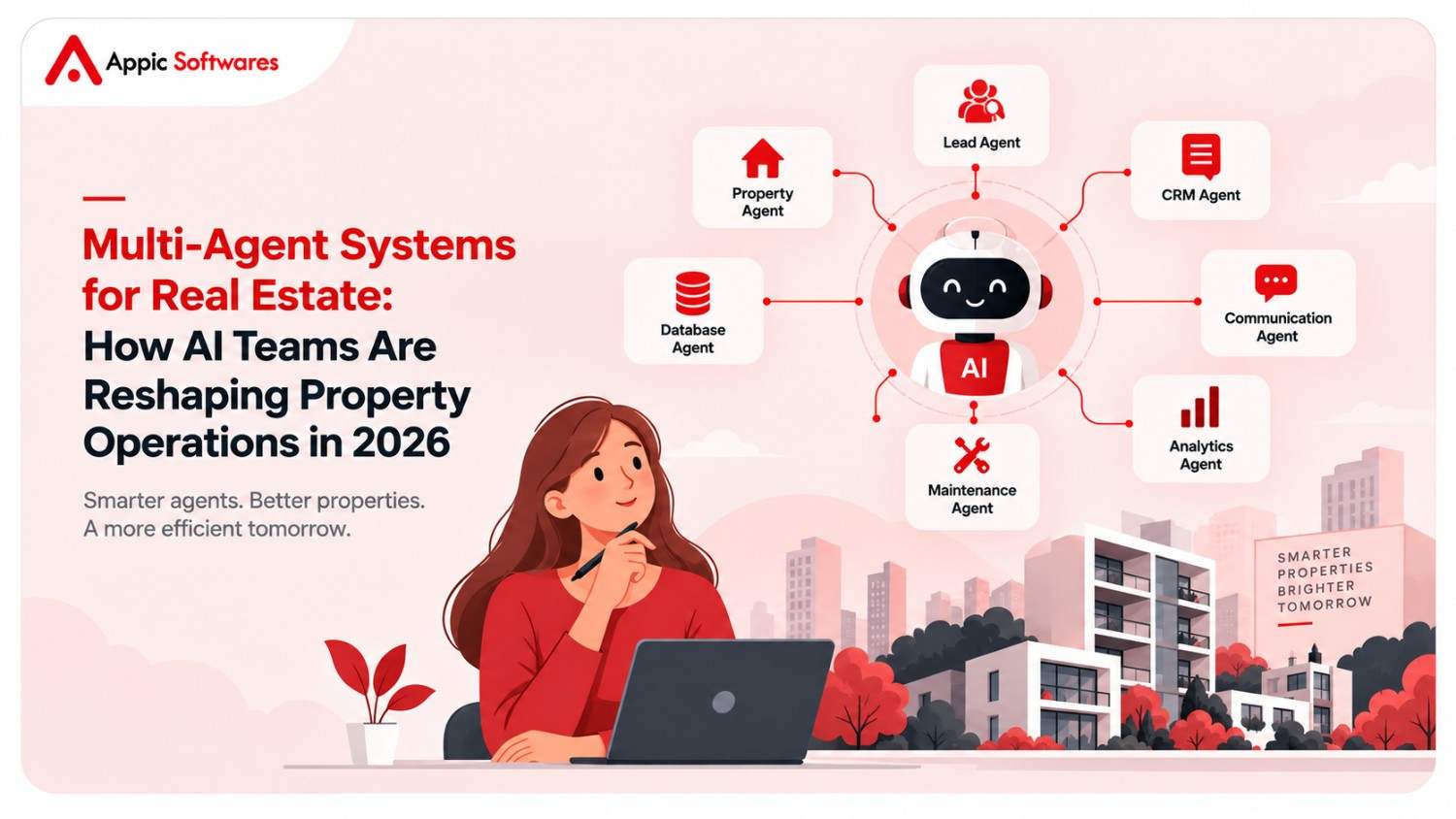
Multi-Agent Systems for Real Estate: How AI Teams Are Reshaping Property Operations in 2026
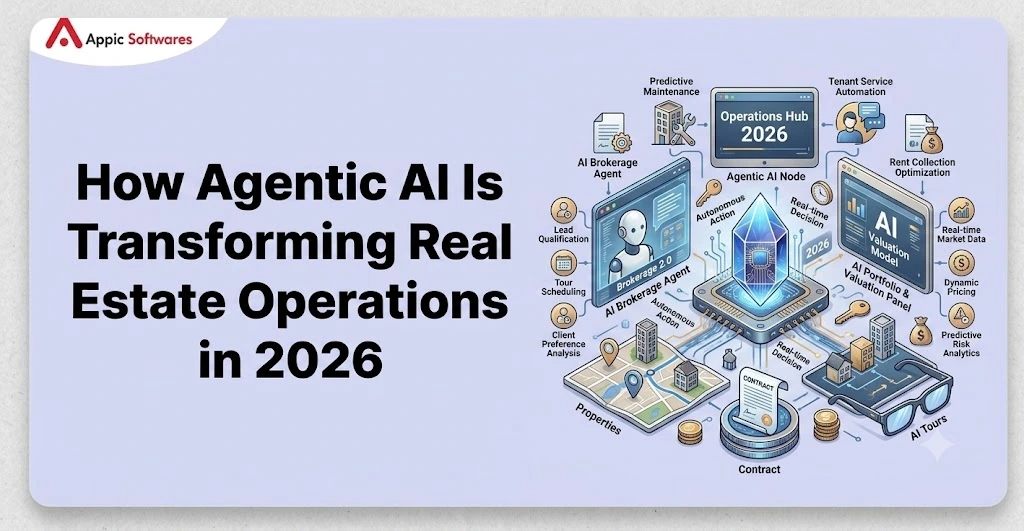
How Agentic AI Is Transforming Real Estate Operations in 2026