How Much Does It Cost to Create an Urban Company Clone?
Customers now book cleaners, beauticians, plumbers, and electricians from a phone instead of calling around. If you want to build an app like Urban Company, the real challenge is not the booking screen. It is trust, pricing, payouts and provider quality at scale. This guide covers the full Urban Company clone blueprint, including KYC, service areas, dynamic pricing, commissions, refunds and provider ratings, plus cost and timeline.
A purpose-built on-demand home services app development partner can deliver the customer app, provider app and admin dashboard as one scalable marketplace.
Understanding the Urban Company Business Model
Urban Company is a service marketplace that links customers with vetted professionals. It does not perform services itself; it runs the platform for bookings, payments, scheduling, reviews, and support. Per Entrackr, it serves 6.8 million annual transacting customers across 51 cities and 17 categories, with a net transaction value of Rs 3,271 crore.
That model needs three connected systems and a strong backend, which directly drives your Urban Company clone development cost.
The business model consists of:
- Customer reservations
- Onboarding service provider
- Managing appointments
- Secure Payments
- Reviews and ratings
- Customer service
- Analytics & Reporting
This structure needs several apps and a strong backend system, which has a direct impact on the cost of development.
Why Businesses Want to Create an Urban Company Clone
Consumer behavior has changed to convenience and rapid access to services. Today, people prefer to book professionals through mobile apps because:
- House Cleaning
- Beauty services
- Plumbing
- Electrical work
- Bug control
- Repair of appliances
- Housekeeping
- Car wash
Marketplace firms also grow quicker than traditional services organizations as they are able to connect demand and supply without personally managing big service staff.
Bonus Read: How to start an ecommerce marketplace in Saudi Arabia?
Key Components Required to Create an Urban Company Clone
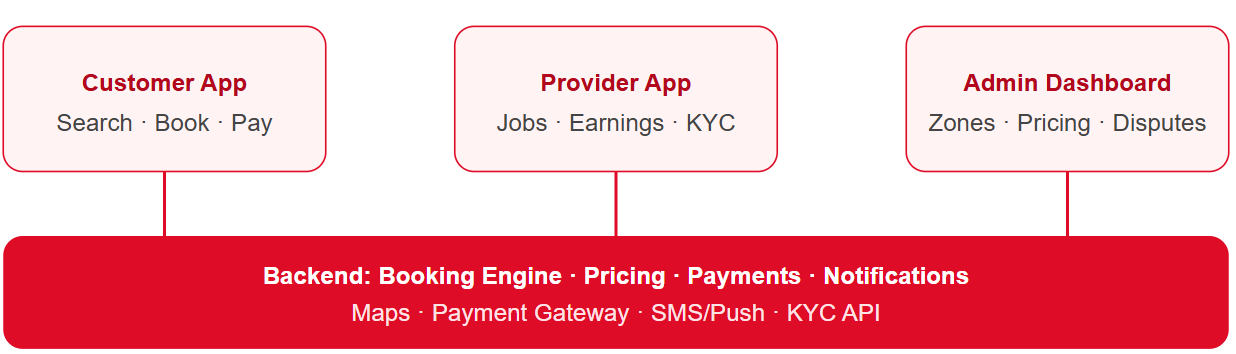 Most entrepreneurs think that an Urban Company clone is just one mobile app. In reality, a complete solution requires three separate systems.
Customer App
One of the most crucial elements of an Urban Company clone is the customer app. It allows consumers to search for services, book professionals, make payments, track reservations, and organize appointments all in one platform. A carefully thought-out customer app enhances the user experience and contributes to a higher customer retention rate.
Service Provider App
The service provider app is built to help professionals run their day-to-day business smoothly. Service providers are able to build and maintain their profiles, accept or reject reservations, update their availability, check their profits, view their employment history, and manage consumer requests. This program can be used by professionals to deliver services smoothly and increase efficiency.
Also Read: Top 12 cloud AI service providing companies
Admin Dashboard
The admin dashboard is the main control panel of the Urban Company clone platform. Administrators can use it to handle clients, service providers, bookings, payments, commissions, service categories, customer support requests, and disputes. It also provides statistics and analytics that help enterprises to track the success of the platform and make informed decisions.
Provider KYC and Verification
Trust is your product. Every provider should pass verification before receiving a single job.
- Government ID and selfie match (Aadhaar, PAN or passport depending on region).
- Address proof and police or background verification.
- Bank account verification for payouts.
- Skill assessment, certificates and training modules.
- Admin approval queue with re-verification reminders for expiring documents.
Use certified KYC APIs rather than manual review alone, and store documents encrypted to meet data protection rules.
Service Areas and Geofencing
Start in one city and expand zone by zone. Service area management lets admins control where each service is available.
- Draw city, zone, or pincode boundaries on a map and assign categories to each.
- Match customers only with providers inside the serviceable radius.
- Set different prices, commissions, and working hours per zone.
- Show a waitlist message when a customer is outside coverage.
This is essential for the multi-city operations that large platforms depend on.
Dynamic Pricing
Dynamic pricing balances supply and demand without manual changes. Common triggers include:
| Dynamic Pricing Trigger | Example |
| Peak Hours or Weekends | Higher prices for evening AC repair slots |
| Low Provider Availability | Surge pricing when few experts are nearby |
| Urgency | Premium for same-hour bookings |
| Job Size | Pricing based on rooms, hours, or appliance count |
| Demand-Light Slots | Discounts to fill idle service capacity |
Keep pricing transparent: show the final price before payment and cap surges. Predictive models can be added later through AI app development.
Commissions and Payouts
Commission is the core revenue stream. Build a flexible engine, not a single fixed percentage.
- Commission by category, city, provider tier, or promotion.
- Automatic tax, gateway fee, and tip handling.
- Weekly or instant payouts with a wallet and settlement reports.
- Penalties and incentives (cancellation fines, streak bonuses).
Refunds, Cancellations and Disputes
Clear refund rules reduce support load and protect both sides.
- Free cancellation window, then tiered fees closer to the slot.
- Full refund if the provider cancels or does not arrive.
- Partial refund for incomplete or poor service, with photo or chat evidence.
- Refund to original payment method or in-app wallet.
- Dispute workflow in the admin panel with status tracking and SLA timers.
Provider Ratings and Quality Control
- Two-way ratings after every job, with tags such as punctuality and behaviour.
- Verified reviews only from completed bookings.
- Weighted score using recent jobs, cancellations and repeat customers.
- Auto-warning, retraining or suspension below a threshold.
- Higher-rated providers get priority dispatch and lower commission tiers.
Other Features Worth Including
Real-time tracking, in-app chat and calling, coupons, subscriptions and memberships, multi-language support, SOS and safety tools, and analytics. Related verticals such as salon apps, laundry apps and car service apps can be added as new categories later.
Factors That Affect the Cost to Create an Urban Company Clone
Several technical and business factors influence pricing.
Platform Selection
The platforms you choose affect development effort and cost.
Common options include:
- Android app
- iOS app
- Web application
- Admin dashboard
Cross-platform frameworks reduce costs compared to separate native applications.
Feature Complexity
Feature requirements have a major impact on development expenses.
Basic functionality requires less investment.
Advanced features increase development time:
- Real-time tracking
- AI-powered recommendations
- Dynamic pricing
- Advanced analytics
- Multi-language support
- Multi-city management
UI and UX Design
User experience plays a major role in customer retention. a
Simple gateways require less design effort.
Custom workflows, animations, and advanced interactions increase development costs.
Third-Party Integrations
Most marketplace platforms depend on external services.
Common integrations include:
Payment Gateways
- Razorpay
- Stripe
- PayPal
Read More: How much does it cost to build payment getaway website?
Maps and Navigation
- Google Maps
Communication Services
- SMS verification
- Push notifications
- Email notifications
Every integration adds front-end effort and ongoing operational expenses.
Cost Breakdown by Development Phase
CreatiServer-Side Company clone involves multiple development stages.
| Development Stage | Description | Budget Estimate |
| UI/UX Design | Design teams produce user journeys, wireframes, and visual interfaces. | 10% to 15% |
| Front-End Development | Front end development is the software people see and the interfaces to the company. | 20% to 25% |
| Server Side Programming | Backend systems take care of business logic, users, payments and bookings. | 25% to 30% |
| API Integrations | Third-party connectors link your app to other services. | 10% to 15% |
| Quality Assurance | Testing helps make sure the software is stable and performs well. | 10% to 15% |
Cost Based on Application Complexity
The most important factor in Urban Company clone pricing is feature scope.
Basic MVP
An MVP focuses on launching quickly and validating market demand.
Features include:
- User registration
- Service listings
- Booking management
- Online payments
- Ratings and reviews
Estimated Cost: $10,000 to $30,000
Suitable for startups entering a local market.
Mid-Level Marketplace
A mid-level solution adds operational and marketing features.
Features include:
- Real-time booking updates
- Provider dashboards
- Coupons and discounts
- Push notifications
- Advanced search filters
Estimated Cost: $30,000 to $60,000
Suitable for businesses targeting multiple service categories.
Enterprise-Level Platform
Enterprise platforms support large-scale operations.
Features include:
- AI recommendations
- Dynamic pricing
- CRM integration
- Multi-city operations
- Advanced analytics
- Multi-language support
Businesses researching the best AI for e-commerce often implement similar recommendation systems to improve customer engagement and booking conversions.
Estimated Cost: $60,000 to $80,000+
Suitable for companies planning large-scale expansion.
Technology Stack for Urban Company Clone Development
Technology selection affects performance, scalability, and maintenance costs.
Frontend Technologies
Popular options include:
- Flutter
- React Native
These frameworks support Android and iOS development through a shared codebase.
Backend Technologies
Common backend frameworks include:
- Node.js
- Laravel
- Django
Many businesses combine marketplace platforms with AI app development to automate customer support, personalize recommendations, and improve operational efficiency.
Cloud hosting supports scalability and security.
Popular providers include:
- Amazon Web Services (AWS)
- Google Cloud Platform (GCP)
- Microsoft Azure
Infrastructure costs increase as bookings and user activity grow.
How Long Does It Take to Create an Urban Company Clone?
The time to develop an urban company can vary based on complexity.
MVP Development
Timeline: 3 to 4 months
Mid-Level Marketplace
Timeline: 4 to 7 months
EnterpriseSolution
Timeline: 7 to 12 months
Custom features, integrations, and testing requirements can also influence the final timeline.
Hidden Costs Most Founders Ignore
Many entrepreneurs just think of the development cost and not the operating costs.
Hosting & Infrastructure
Server costs go up due to traffic, bookings and data storage.
App Store Fees
To publish mobile applications, you need:
- Developer Account for Apple
- Google Play Developer Account
Maintenance & Updates
- Applications must always be improved
- Bug fixes
- Security Patch
- Performance tuning
- Updates for OS compatibility
Annual maintenance is usually 15%-20% of the original development expense.
Customer Service Systems
Growing marketplaces often need:
- Chat features live
- CRM systems
- Ticket management software
These recurring costs need to be budgeted for in the long run.
Urban Company Clone vs Traditional Service Business
| Factor | Urban Company Clone | Traditional Service Business |
| Scalability | High | Limited |
| Revenue Streams | iple | Single |
| Geographic Expansion | Faster | Slower |
| Automation | Extensive | Limited |
| Operational Efficiency | Higher | Lower |
Digital marketplaces support expansion without increasing operational complexity at the same rate as traditional service businesses.
Revenue Models for Urban Company Clone Apps
An Urban Company clone is running on many revenue streams.
Commission For Each Booking
The platform receives a fee from each fulfilled service booking. This is the key revenue stream for most home services marketplace apps.
Featured Listings
Service companies pay for premium placement in search results and service categories to boost visibility.
Pricing Plans
Professionals pay monthly or yearly subscription fees for premium services, priority support and other business opportunities.
Revenue From Advertising
Businesses and service providers pay to advertise their services through sponsored placements inside the app.
Conveniences Fees
The portal also charges clients a tiny convenience fee on each booking, generating an extra revenue stream.
Combining these revenue streams allows an Urban Company clone to generate steady revenue, while also supporting long-term business growth.
Clone Script vs Custom Development
Many founders compare ready-made clone scripts with custom development.
Clone Script
Advantages:
- Less initial investment
- Faster launch
Limitations:
- Few customizing options
- Security issues
- Limits to scalability
Custom Development
Advantages:
- Enhanced performance
- Solid security
- Complete ownership
- Scalability in the long run
Many development agencies specializing in B2B e-commerce development also build marketplace platforms because both models require complex user workflows, transactions, and reporting systems.
Custom development requires a larger initial investment but provides greater flexibility for future growth.
Cost to Create an Urban Company Clone
The final budget depends on features, integrations, and project cost coverage
| App Type | EstimatedCost |
| Basic MVP | $10,000 to $30,00 |
| -Level Marketplace | $30,000 to $60,000 |
| Enterprise Platform | $60,000 to $80,000+ |
Most of the time advanced automation features, recommendation systems, and predictive scheduling increase the overall AI app development cost project. Startups are reducing risk by launching an MVP first and then later they expand based on the market feedback and user demand.
Why Choose Appic Softwares to Create an Urban Company Clone
The Urban Company clone development cost depends on your business goals, target market, feature needs, and growth plans. Building a simple MVP is cheaper than creating an enterprise-gradeplatform that needs more investment because of its complex features and infrastructure needs.
Appic Softwares helps enterprises build scalable UrbanCompany clone apps with customer-centric features, a secure infrastructure, and flexible architecture to enable future growth. In thefeature-richcalability, user experience and operational efficiency will be the critical success factors for on-demand services businesses. Focus on the basics, validate demand, scale up smart and you’ll have a solid platform for ongoing development.
Planning to create an Urban Company clone?
Let Appic Softwares design a feature rich platform to connect customers and service providers with a seamless booking experience.
Get in touch today to discuss your project.
Frequently Asked Questions
How much does it cost to build an app like Urban Company?
An MVP costs roughly $10,000 to $30,000, a mid-level marketplace $30,000 to $60,000, and an enterprise platform $60,000 to $80,000 or more.
How long does it take to build an Urban Company clone?
About 3 to 4 months for an MVP and up to 12 months for an enterprise solution.
How do you verify service providers?
Through KYC: ID and selfie match, background check, bank verification, and a skill test, followed by admin approval.
How does dynamic pricing work in a home services app?
Prices adjust by time, demand, provider availability, urgency and job size, with caps and a clear final price shown before payment.
Related Articles
Multi-Agent Systems for Real Estate: How AI Teams Are Reshaping Property Operations in 2026
How Agentic AI Is Transforming Real Estate Operations in 2026