Top 5 eLearning Mobile Apps in 2026: Features, Stats and What to Learn From Them
The top eLearning mobile apps in 2026 are Duolingo, Coursera, Khan Academy, Google Classroom and Quizlet. They lead for different reasons: Duolingo for habit-building, Coursera for career courses, Khan Academy for free school-level learning, Google Classroom for teachers and Quizlet for self-study. This guide gives current numbers for each, what they do well and what you can borrow if you are building your own eLearning app. If you plan to build your own, compare the e-learning app development companies we reviewed for 2026.
Key Takeaways
- Duolingo reported 58.7 million daily active users and 12.7 million paid subscribers in Q2 2026, which shows how far habit design and a freemium model can scale.
- Coursera reported 205 million registered learners in Q1 2026 and merged with Udemy in 2026.
- Khan Academy, a nonprofit, reported 189.6 million registered users in the 2024-25 school year, including 2.0 million Khanmigo AI tutor users.
- AI tutors are now built into the leaders: Duolingo, Khan Academy, Google Classroom and Quizlet all offer them.
- The features worth copying are streaks and rewards, short lessons, progress tracking, AI help tied to the learner's own material, and a clear free-to-paid path.
Why are eLearning mobile apps growing?
Learners want short lessons they can finish on a phone, and schools and employers want results they can measure. Market estimates for mobile learning vary widely. Published forecasts put the 2030 market anywhere from about $96 billion to $388 billion, depending on whether a report counts only apps or all mobile-delivered learning (GII Research listing). Treat any single figure as a rough guide. The usage numbers from the apps themselves are easier to trust, and they are below.
How do the top 5 eLearning mobile apps compare?
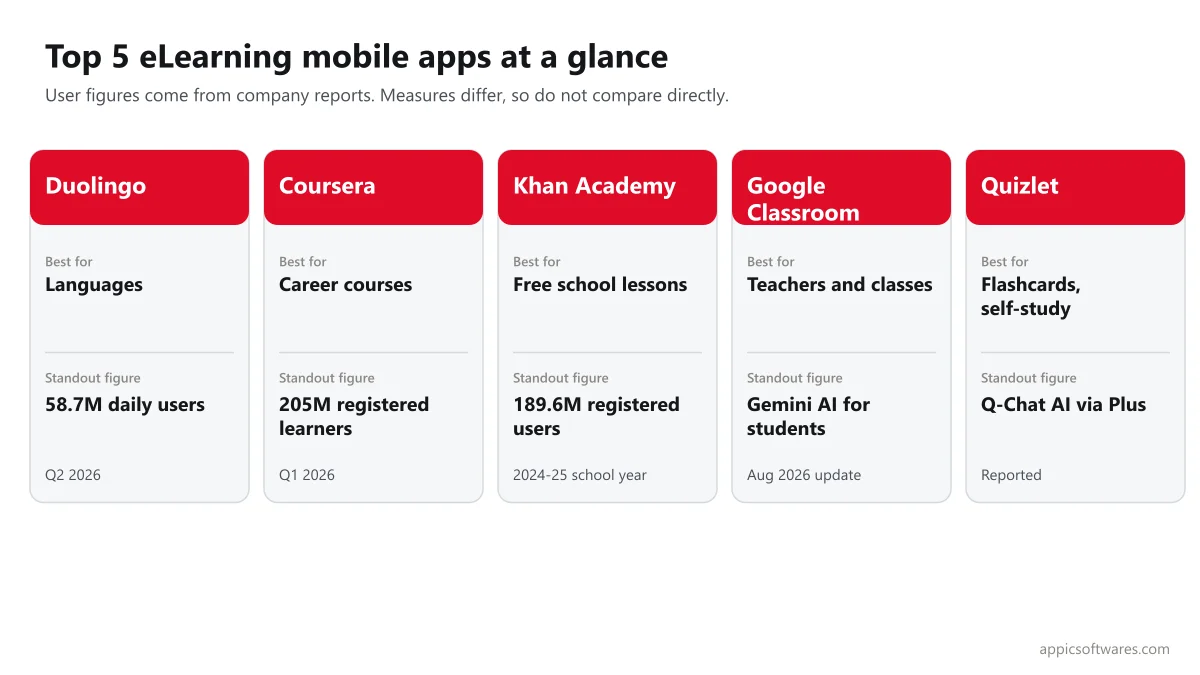
| App | Best for | Latest user figure | How it makes money |
| Duolingo | Learning languages daily | 58.7M daily users, 140.6M monthly users (Q2 2026) | Subscriptions plus ads |
| Coursera | Career courses and credentials | 205M registered learners (Q1 2026) | Subscriptions, courses, enterprise |
| Khan Academy | Free school-level lessons | 189.6M registered users (2024-25) | Nonprofit, funded by donations |
| Google Classroom | Teachers running classes | Not published in the sources we checked | Part of Google Workspace for Education |
| Quizlet | Flashcards and self-study | Reported over 60M monthly users (unconfirmed) | Free tier plus Plus subscription |
The numbers are not directly comparable. Duolingo reports daily and monthly active users, Coursera and Khan Academy report registered users, and registered counts include people who may no longer use the app.
1. Duolingo: the benchmark for habit-building
Duolingo teaches languages through short, game-like lessons. In Q2 2026 it reported 58.7 million daily active users (up 23% year over year), 140.6 million monthly active users, 12.7 million paid subscribers and revenue of $298.5 million. Current-user retention hit a record 84% (Duolingo Q2 2026 shareholder letter, Pulse 2.0). Part of the growth came from a one-time Streak Revival campaign in June that about 15.4 million learners joined.
- What it does well: streaks, rewards and bite-sized lessons keep people coming back daily.
- What to copy: one clear daily habit, visible progress and a free tier good enough to build the habit before asking for payment.
- Watch out for: gamification only works when the lessons are good. Points alone do not teach.
Want to build something similar? See how to create an app like Duolingo.
2. Coursera: courses and credentials at scale
Coursera partners with universities and companies to offer courses, certificates and degrees. It reported 205 million cumulative registered learners at the end of Q1 2026 (Coursera Q1 2026 results). Its filings describe an all-stock merger with Udemy completed in 2026, and Q2 2026 revenue of $298.6 million, including $103.8 million related to the merger (Coursera 10-Q, June 30, 2026).
- What it does well: credible content partners, structured learning paths and credentials employers recognize.
- What to copy: offline downloads, course progress syncing across devices and clear certificates at the end.
- Watch out for: registered learners are a cumulative count, so they overstate how many people are active today.
3. Khan Academy: free learning with an AI tutor
Khan Academy is a nonprofit offering free lessons and practice. Its annual report for the 2024-25 school year lists 189.6 million registered users, 104.9 million yearly active learners and 2.0 million Khanmigo users, its AI tutor (Khan Academy annual report). Khanmigo is a good example of AI built into a learning flow: it guides learners with questions instead of handing over answers.
- What it does well: mastery-based practice, free access and teacher tools.
- What to copy: an AI helper that asks guiding questions, and clear progress per skill.
- Watch out for: a free model needs donors or another funding source. Plan your revenue early.
4. Google Classroom: the teacher's workspace
Google Classroom lets teachers create classes, share materials, set assignments and give feedback. In 2025 Gemini AI tools became available across all Google Workspace for Education editions (Google Workspace Updates, June 2025). In August 2026 Google announced that Gemini in Classroom would open to students of all ages, where admins allow it, starting August 10, 2026, with prompts tied to a specific class and assignment and the ability to create flashcards and practice quizzes from course materials (Google Workspace Updates, August 2026). Availability depends on each school's admin settings.
- What it does well: assignment flow, grading and integration with Google Drive and other Google tools.
- What to copy: teacher dashboards, announcements and AI that works on the teacher's own materials.
- Watch out for: school apps need admin controls and strong student privacy from day one.
For cost and features, read cost of creating an app like Google Classroom.
5. Quizlet: flashcards and AI study tools
Quizlet offers flashcards, study modes and games built from learners' own sets. One directory listing puts it at over 60 million monthly users, which we could not confirm from Quizlet itself. Its AI study assistant, Q-Chat, is described by reviewers as available through the paid Quizlet Plus plan, not the free tier (Tool Directory). Check Quizlet's own pricing page for current prices.
- What it does well: simple content creation and a free tier that gets students started.
- What to copy: let learners create their own content, and put AI features behind a clear paid plan.
- Watch out for: user-made content needs moderation and quality checks.
Planning your own eLearning app? Tell us who it is for and we will help you pick the first features worth building. Get your project scoped
What features do the best eLearning mobile apps share?
These are our observations from the five apps above.
| Feature | Why it matters | Seen in |
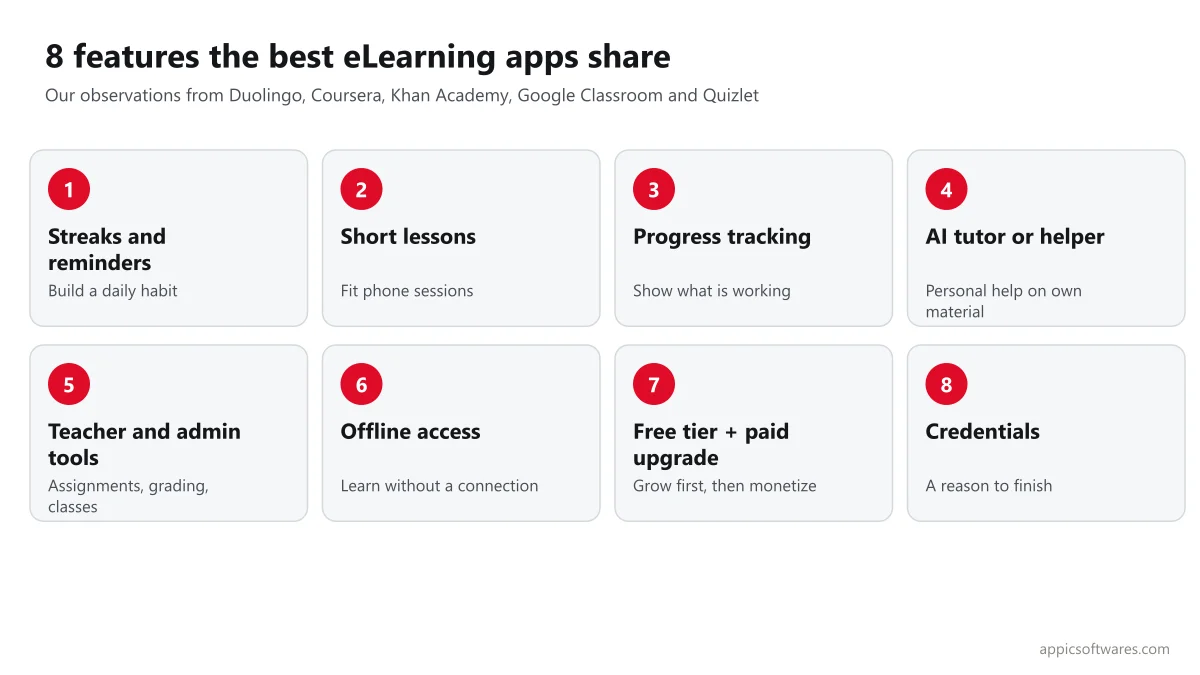
| Streaks, rewards and reminders | Builds a daily habit | Duolingo |
| Short lessons | Fits phone sessions | Duolingo, Khan Academy, Quizlet |
| Progress tracking | Shows learners and teachers what is working | All five |
| AI tutor or study helper | Personal help on the learner's own material | Duolingo, Khan Academy, Google Classroom, Quizlet |
| Teacher or admin tools | Assignments, grading, class management | Google Classroom, Khan Academy |
| Offline access | Lets people learn without a connection | Coursera and others |
| Free tier with a paid upgrade | Grows the user base, then monetizes | Duolingo, Quizlet |
| Credentials | Gives learners a reason to finish | Coursera |
How do eLearning apps make money?
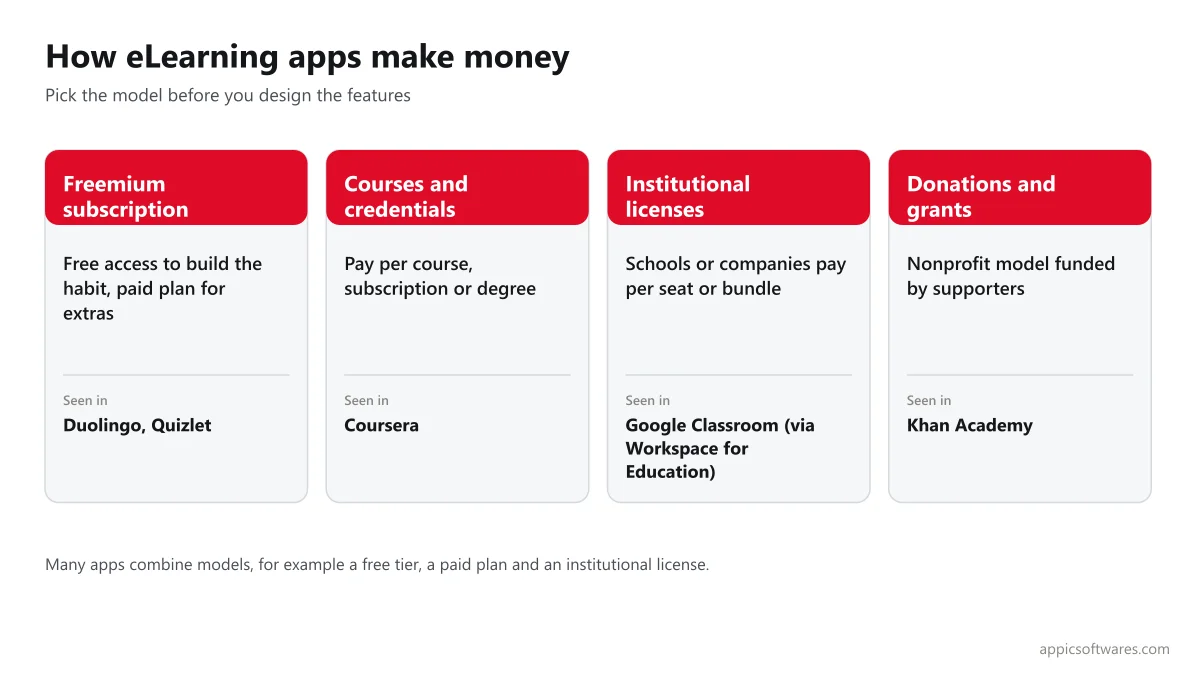
- Freemium subscription: free access to hook users, paid plan for extras (Duolingo, Quizlet).
- Course sales and certificates: pay per course, subscription or degree (Coursera).
- Institutional licenses: schools or companies pay per seat or bundle (Google Classroom through Workspace for Education).
- Donations and grants: nonprofit model (Khan Academy).
- Ads and partnerships: a supporting revenue line for some free apps.
Free MVP scoping session: share your learners, subject and revenue model. We will outline the features, the stack and a cost range for a first version. Book your session
How do you build an eLearning mobile app?
- Define the learner and the outcome. One audience and one result, such as "pass a language test" or "finish a certificate".
- Choose the learning format. Short lessons, live classes, video, quizzes or a mix.
- Pick the revenue model early. It shapes your features and your free tier.
- Design the habit loop. Reminders, streaks, progress and rewards that fit your subject.
- Add AI where it helps. Personal practice, explanations and feedback, with limits on wrong answers.
- Build an MVP. Sign-up, one learning path, progress tracking and payments.
- Measure and improve. Track lesson completion, retention and what makes people quit.
More guides: gamified learning apps development guide, types of edtech apps and how to create an edtech app like Photomath.
How Appic builds eLearning and education apps
Appic Softwares has built custom software since 2018, with offices in Jaipur (India), Frisco, Texas (USA) and Munich (Germany), and holds a 5.0 rating on Clutch from 24 verified reviews. Our education app development team builds learning apps, and our LMS development company page covers custom learning management systems. We add AI tutoring and personalization through AI development services, and we help early teams launch with MVP development. Typical Appic projects start around $10,000. See our Klassbook project and our portfolio.
What changed from the earlier version of this list?
An earlier version of this post, written in 2022, listed Google Classroom, Seesaw, Duolingo, Photomath and Quizlet. We kept Google Classroom, Duolingo and Quizlet, added Coursera and Khan Academy, and removed Seesaw and Photomath because we could not verify current 2026 usage data for them. The 2022 market figure ($250 billion in 2020) is no longer used.
Ready to build your eLearning app? Send us your audience, subject and revenue idea. We will reply with an MVP plan, a stack recommendation and a cost range you can share with your team or investors. Talk to our team
Frequently Asked Questions
What are the top eLearning mobile apps in 2026?
Five of the most widely used are Duolingo for languages, Coursera for career courses, Khan Academy for free school-level lessons, Google Classroom for teachers, and Quizlet for flashcards and self-study. Rankings differ by country and by learner type, so the best app depends on what you want to learn.
Which eLearning app has the most users?
It depends on the measure. Duolingo reported 58.7 million daily and 140.6 million monthly active users in Q2 2026. Coursera reported 205 million cumulative registered learners in Q1 2026, and Khan Academy 189.6 million registered users in 2024-25. Registered users are not the same as active users.
How do eLearning apps make money?
Most use freemium subscriptions, course or certificate sales, institutional licenses, or donations. Duolingo and Quizlet offer free tiers and paid plans. Coursera sells courses, subscriptions and enterprise plans. Khan Academy is a nonprofit funded by donations, and Google Classroom is offered through Workspace for Education.
What features should an eLearning app have?
The common ones are short lessons, progress tracking, reminders and streaks, quizzes, an AI tutor or study helper, teacher or admin tools, offline access and a clear free-to-paid path. Add credentials or certificates if learners need proof of completion. Start with the few features that serve your first audience.
How much does it cost to build an eLearning app?
Appic projects typically start around $10,000 for an MVP. The final cost depends on features such as video, live classes, AI tutoring, payments, admin panels and the number of platforms. Share your scope with us and we will give you a feature list, timeline and cost range.
Can AI replace teachers in eLearning apps?
No. The leading apps use AI as a helper. Khanmigo guides learners with questions, and Gemini in Classroom works from the teacher's own materials. Teachers still set goals, check understanding and handle sensitive cases. AI works best for practice, explanations and feedback at scale.
Related Articles

Migrating From WordPress To Magento?
Is your WordPress website struggling to keep up with your growing product catalog, complex store functionalities, or customer expectations? If yes, it might be time to upgrade your eCommerce platform, and Magento (now Adobe Commerce) is a powerful option that offers better performance, scalability, and customization. However, migrating from WordPress to Magento isn’t just about […]

Gym Management System App Development and Its Essential Features:
What is GYM management software? GYM management system software! Don’t you know what it is? Let me explain, In simple words, gym management software is a type of software that helps GYM owners by providing essential services to manage their fitness business easily and effectively. Gym management software can be called by other names such […]
Tarot App Development: Architecture, AI, and the Real Cost of Building a Platform Users Trust

How to Create a Fitness App and How Much Does it Cost?
Essentials Of Making Fitness Apps From Scratch As you are reading this that means you are looking to create a fitness application. But there is one question bothering you, where to start? How do you build a solid application that will provide an incredible user experience? Don’t worry here I am t oday to help […]
How Much Does It Cost to Create an Urban Company Clone?

Is Apple restricting your applications ?
Apple is proposing account deletion in your app On June 30, the iOS App policy for speedy application consideration and data storage remains in effect. Whether an account is deleted, it wil l be cleared from the developer’s data, along with all the others that explain the account that its creator is just not legally […]