AI Healthcare Software Development: Use Cases, Examples & Insights

Have you ever thought about what it takes to be a smart healthcare founder who knows how to tackle crippling administrative burdens, severe data silos, high rates of claim denials, and difficulty scaling operations? Well, the only difference is that by partnering with an experienced healthcare software development company, you can build HIPAA-compliant, AI-powered solutions. It will help you serve your patients more effectively and systematically.
This change comes as a priority, especially when the global AI in healthcare market is experiencing rapid expansion, with projections estimating the market size between $29 billion and $61 billion by the end of 2026.
AI in healthcare development can be used to power surgical-assistance robots, discover novel connections in genetic codes, automate administrative work, customize treatment options, and much more. In this blog, we will understand how you can transform your healthcare business with AI by looking at its examples and use cases.
What Is AI In Healthcare?
The application of machine learning, natural language processing, deep learning, and other AI technologies to improve patient and healthcare provider experiences is called artificial intelligence in healthcare. Health practitioners can better manage their resources and tackle different facets of healthcare more proactively thanks to AI’s data-processing and prediction skills.
Health administrators can find electronic health data more quickly, physicians can diagnose patients more quickly and accurately, and clients can receive more individualized and timely care thanks to this technology.
Use Cases For AI Healthcare Software Development
Medical Imaging And Diagnostics
Artificial Intelligence has become a cornerstone, especially in medical imaging and diagnostics. Advanced algorithms and intense learning models excel in analyzing radiological images like X-rays, MRIs, and CT scans with
exceptional accuracy. These tools support radiologists by detecting abnormalities that may go unnoticed by the human eye.
Example: Early Cancer Detection
AI is instrumental in identifying cancers at an early stage, such as breast cancer through mammograms or lung cancer via CT scans. By swiftly and precisely analyzing large datasets of image data, AI facilitates earlier diagnosis, enabling timely treatment that can save lives.
Predictive Analytics For Patient Care
AI-driven predictive analytics empower healthcare providers to forecast patient needs, track disease progression, and minimize hospital readmissions. By examining patient history, genetic data, and health markers, AI predicts patients at higher risk for specific conditions. Explore more about its role in data analytics in healthcare.
Example 1: Preventing Hospital Readmissions
AI systems assess patient data, including medical history, lab results, and vital signs, to predict the likelihood of hospital readmissions. Hospitals can then develop personalized care plans for discharged patients, improving recovery and cutting costs.
Example 2: Chronic Disease Management
AI is reshaping how chronic conditions like diabetes, hypertension, and heart disease are managed. Smart devices and wearables use AI to provide personalized care and real-time monitoring. These systems notify patients and healthcare providers of necessary interventions, preventing complications.
Drug Discovery And Development
AI is revolutionizing drug discovery, a traditionally slow and costly process, by predicting how various compounds interact with biological systems. This significantly reduces the time required to identify viable drugs. It plays a core role in machine learning in healthcare by finding patterns and speeding up decision-making.
Example 1: Accelerating Drug Discovery
Pharmaceutical companies use AI to analyze large datasets of chemical compounds to identify potential drug candidates. Platforms like IBM Watson and Insilico Medicine aid in repurposing existing drugs and designing entirely new compounds.
Example 2: Personalized Medicine
AI also plays a key role in personalized medicine by analyzing individual genetic and medical data. This enables the development of tailored treatments that match a patient’s unique genetic profile, improving therapeutic outcomes.
Virtual Health Assistants And Chatbots
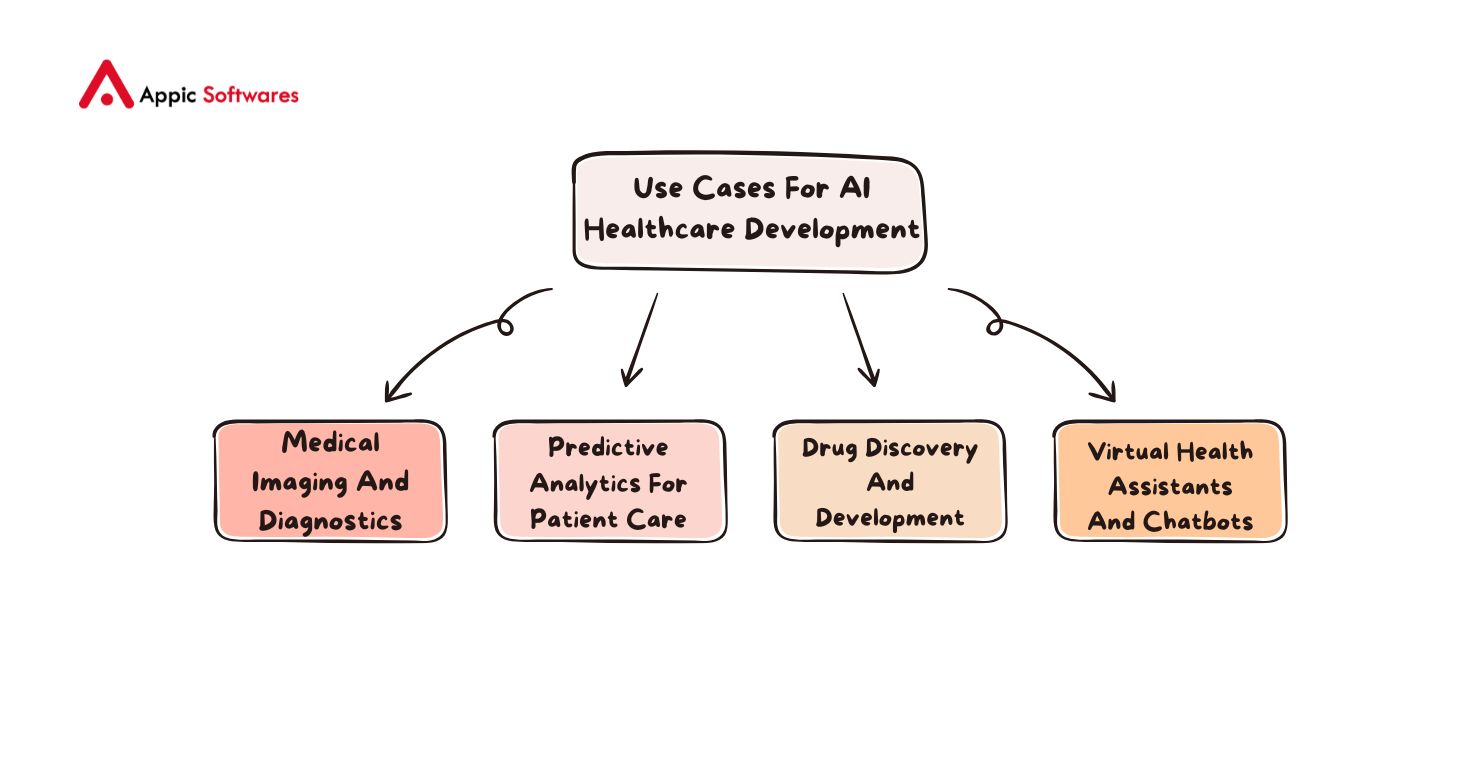
AI-powered virtual assistants or AI healthcare chatbot development are transforming healthcare interactions, offering features like answering health queries, booking appointments, and sending medication reminders. These tools enhance patient engagement and ease the workload of medical staff. Learn more about their development through healthcare mobile app development.
Example 1: Symptom Checkers
AI chatbots, such as Ada Health and Babylon Health, help users assess symptoms and provide initial recommendations. These tools guide patients toward appropriate care, reducing unnecessary doctor visits.
Example 2: Remote Patient Monitoring
AI-enabled wearables and mobile health apps monitor patient conditions in real-time. This continuous data analysis allows healthcare providers to intervene early when abnormalities are detected.
Robotic Surgery
Systems like the da Vinci Surgical System use AI to enhance minimally invasive procedures. These robotic systems are especially effective in delicate surgeries, such as heart valve repairs and prostatectomies, providing unparalleled precision. This represents a key area within AI implementation in healthcare.
Example: AI-Assisted Minimally Invasive Surgeries
Systems like the da Vinci Surgical System use AI to enhance minimally invasive procedures. These robotic systems are especially effective in delicate surgeries, such as heart valve repairs and prostatectomies, providing unparalleled precision.
Administrative Workflow Automation
Administrative tasks in healthcare often consume significant time and resources. AI is streamlining these processes by automating scheduling, billing, and patient record management. Discover more use cases with our guide to AI agents in healthcare.
Example 1: Enhancing Billing Accuracy
AI systems optimize billing by automating data entry and reducing errors. Tools like Olive streamline complex medical billing processes, decreasing administrative burdens.
Example 2: Optimizing Scheduling And Staffing
AI predicts patient demand to optimize staff schedules, ensuring hospitals have adequate personnel during busy periods. This improves efficiency and minimizes wait times and staff fatigue.
Personalized Treatment Plans
AI enables the creation of highly personalized treatment plans by analyzing a patient’s genetic, lifestyle, and medical history.
Example 1: Precision Oncology
AI assists oncologists in designing customized cancer treatment plans. Evaluating genetic and clinical data, it suggests therapies most likely to succeed for specific cancer types. Companies like Tempus and Foundation Medicine are leading this innovation.
Example 2: Cardiovascular Care
AI tools analyze data from electronic health records (EHRs), wearables, and genetic profiles to create tailored treatment plans for heart disease patients. This includes medication recommendations and lifestyle changes to optimize outcomes.
Natural Language Processing (NLP) In Medical Research And Documentation
AI-powered NLP tools are transforming healthcare documentation and research by analyzing vast amounts of data quickly and efficiently.
Example 1: Simplifying Clinical Documentation
NLP tools like Dragon Medical One transcribe doctors’ speech into structured medical notes in real time, reducing time spent on paperwork and allowing more focus on patient care.
Example 2: Research Assistance
AI-driven NLP platforms like IBM Watson for Health process large volumes of medical literature to identify trends and generate insights, accelerating research and discovery efforts.
AI In Healthcare Examples: Real World Impact
We compiled a list of AI in healthcare use cases and examples to help you better grasp this quickly developing topic. Here are four real-world examples of AI systems that have moved from concept to measurable clinical and operational results.
1. Google DeepMind & Moorfields Eye Hospital: Early Disease Detection
While going through AI healthcare software development, you must know that Google DeepMind partnered with Moorfields Eye Hospital in London. The partnership aimed at training AI models on over 14,884 retinal scans. As a result, the AI matched or outperformed world-leading eye specialists in detecting over 50 sight-threatening conditions, with a referral accuracy of 94%
The major role was played by speed. Especially for conditions like glaucoma and macular degeneration, which typically take days to diagnose, were flagged in under 30 seconds.
Key Learnings: AI diagnostics didn't just surpass human accuracy, but also delivered results at a speed that no clinical team can replicate manually.
2. Insilico Medicine: Drug Discovery in 46 Days
If you still rely on traditional healthcare methods, it will take around 4-5 years and millions of dollars of spendings just to identify a viable drug candidate. Looking at this, Insilico Medicine used its generative AI platform to identify a novel drug candidate for idiopathic pulmonary fibrosis (IPF). It's a deadly lung disease that was discovered in just 46 days, at a fraction of conventional costs.
In this, AI designed a molecule from the initial phase itself. Every effort was made to evaluate how it would behave in the human body and shortlisted it for preclinical trials. By the end of 2023, the drug moved to Phase II human trials, which was the biggest landmark in the field of AI driven pharmacuetical developments.
Key Takeaways: With the help of artificial intelligence, the drug discovery time is reduced from years to weeks. Niu
3. Intermountain Healthcare: Reducing ICU Readmissions by 35%
Intermountain Healthcare is known to be the largest health system in the US. They deployed a predictive AI model to evaluate patients with a high risk of deterioration after being moved out of the ICU. Almost 100 variables were analyzed, such as vitals, lab results, and medical history, in real time.
As a result, 35% reduction in unexpected ICU readmissions, along with a measurable drop in patient mortality. Nurses received early warning signals hours before the crisis, giving care teams time to intervene before conditions became critical.
Key Takeaway: From improving patient outcomes to reducing the cost of care by preventing expensive emergency escalations, predictive AI does it all.
Companies Using AI In Healthcare
1. Cleerly

Using coronary computed tomography angiography (CCTA) studies, Cleerly measures atherosclerosis (plaque), stenosis, and the risk of ischemia non-invasively using FDA-approved machine learning (ML) methods. A 3D model of the patient’s coronary arteries is created by the company’s AI, which also recognizes the lumen and vessel walls, finds and measures stenoses, and counts and classifies plaque. Health care professionals receive the measurements to aid in diagnosis and individualized care. Customers can use Cleerly’s web platform to examine outcomes in detail as well.
2. Enlitic

By first reading clinical information and then using machine learning to evaluate and interpret the data, Enlitic’s AI-powered software helps radiologists save time. To improve radiologists’ workflow even more, the business acquired Laitek, a provider of medical imaging data conversion and routing services. In order to give healthcare practitioners better administration, processing, and sharing of patient data across the healthcare ecosystem, Enlitic’s AI technology also integrates with data management apps.
3. Qure.ai

Medical imaging experts can now diagnose and treat patients more quickly thanks to Qure.ai’s automated interpretation of radiology exams, including X-rays, CT scans, and ultrasounds, using AI and deep learning technology. Qure.ai provides a variety of support, including ongoing education and training, as well as individualized onboarding. Users can also access the venture capital-backed company’s technology through a mobile device.
What Is The Cost For AI Healthcare Software Development?
Building an AI healthcare solution isn't a one-size-fits-all investment. The cost depends on what you're building, how complex the AI layer needs to be, and the compliance requirements your product must meet. Here's a transparent breakdown to help you self-qualify and plan your budget realistically.
Cost Breakdown By Project Tier
| Basis | MVP | Mid-Tier Product | Enterprise Solution |
| Cost Range | $8,000 – $25,000 | $25,000 – $150,000 | $150,000 – $1,000,000+ |
| Timeline | 2 – 4 months | 4 – 9 months | 9 – 24 months |
| AI Capability | Pre-built AI APIs (OpenAI, Google Health AI) | Custom ML models + integration | Proprietary AI models, trained on your data |
| Core Features | Symptom checker, appointment booking, basic EHR | Predictive analytics, NLP documentation, wearable integration | Real-time diagnostics, drug discovery pipelines, multi-hospital deployment |
| Compliance | Basic HIPAA guidelines | Full HIPAA + HL7/FHIR integration | HIPAA + FDA SaMD compliance + audit trails |
| Ideal For | Startups validating an idea | Growth-stage healthtech companies | Hospital systems & pharma enterprises |
What Drives The Cost Up?
Understanding what inflates your budget helps you make smarter scoping decisions early:
1. AI Model Complexity: Using a pre-built API (like GPT-4 for a symptom checker) costs significantly less than training a custom deep learning model on your own clinical dataset. Custom models are more accurate for your use case, but require large, labelled datasets and specialist ML engineers.
2. Compliance & Security Architecture: HIPAA compliance isn't optional — it's foundational. Expect to budget 15–20% of your total development cost purely for security architecture, encrypted data storage, access controls, and audit logging. If your product qualifies as a Software as a Medical Device (SaMD) under FDA guidelines, add regulatory documentation costs on top.
3. EHR & Third-Party Integrations: Connecting your AI solution to existing Electronic Health Record systems (Epic, Cerner, Athenahealth) via HL7/FHIR APIs adds significant complexity. Each integration requires custom mapping, testing, and ongoing maintenance.
4. Data Infrastructure: AI runs on data. If you're building a diagnostic or predictive model, you need a HIPAA-compliant data pipeline, ingestion, cleaning, storage, and version control. This infrastructure often costs $10,000–$40,000 before a single model is trained.
5. Ongoing Maintenance: AI models drift over time as clinical patterns change. Budget 15–20% of your initial build cost annually for model retraining, performance monitoring, and regulatory updates.
Quick Cost Estimator
| Build | Estimated Cost Range |
| AI-powered symptom checker chatbot | $10,000 – $30,000 |
| Remote patient monitoring app with wearable integration | $30,000 – $80,000 |
| Predictive analytics dashboard for hospital readmissions | $50,000 – $150,000 |
| NLP-based clinical documentation tool (like DAX) | $80,000 – $200,000 |
| Custom medical imaging AI (X-ray / MRI analysis) | $150,000 – $500,000+ |
| Full-scale AI hospital management platform | $300,000 – $1,000,000+ |
Latest Trends In AI Healthcare Software Development
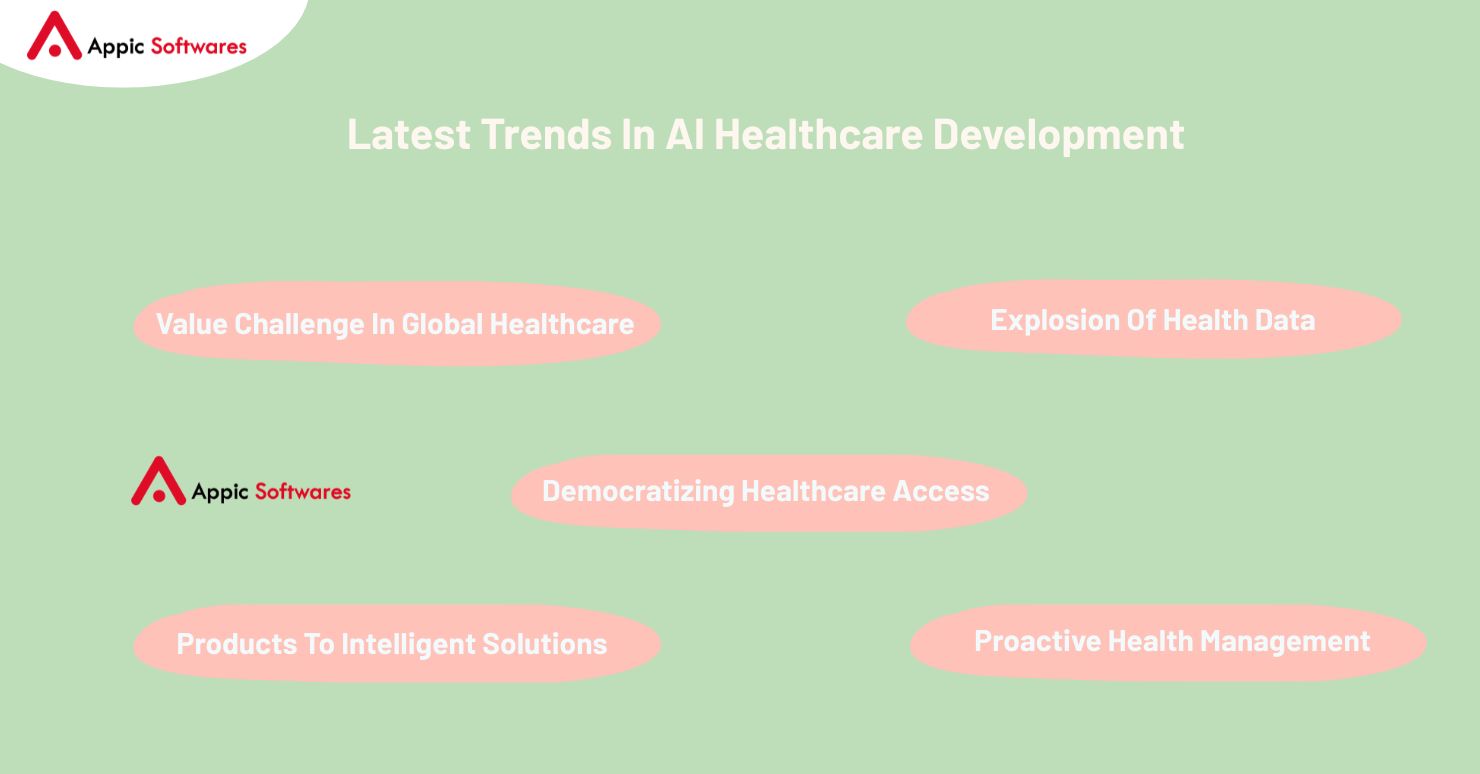
The Value Challenge In Global Healthcare
Healthcare systems worldwide are grappling with rising demand from chronic diseases, escalating costs, and aging populations. Current hospital-centric infrastructures, designed for acute episodes, struggle to address chronic and long-term care needs effectively.
The Explosion Of Health Data
Health-related data has grown exponentially, reaching over 4 zettabytes by 2013, with predictions of further growth. A significant 80% of this data is unstructured, making it inaccessible to humans without advanced tools. AI is essential to harnessing this wealth of information, enabling timely and informed healthcare decisions.
Evolving From Products To Intelligent Solutions
Healthcare innovation is shifting from product-based care to intelligent, collaborative solutions. The integration of AI, robotics, and augmented reality paves the way for precision medicine, predictive analytics, and outcome-focused healthcare delivery.
Democratizing Healthcare Access
Technological advancements in connectivity and mobile devices are democratizing healthcare access. AI embedded in everyday tools empowers consumers to monitor their health, make informed decisions, and partner effectively with providers for better care.
The Rise Of Proactive Health Management
IoT and AI innovations have heightened public willingness to take control of their health. Consumers are embracing technologies that offer care anywhere, breaking traditional healthcare boundaries and fostering proactive health management.
This convergence of trends ensures that AI and robotics will define the future of healthcare, driving transformative change across the industry.
Conclusion
Artificial intelligence is revolutionizing the healthcare industry, offering unprecedented opportunities to enhance patient care, improve operational efficiency, and reduce costs. From early diagnosis and personalized treatment to robotics-assisted surgeries and predictive analytics, AI continues to redefine what is possible in healthcare. Moreover, trends like proactive health management, democratized healthcare access, and the rise of intelligent solutions indicate that AI will remain a driving force in shaping the future of healthcare.
FAQs
1. What are the key use cases of AI in healthcare?
AI is widely used in healthcare for early disease diagnosis, personalized treatment plans, robotic surgeries, administrative task automation, and virtual health assistants. Technologies like machine learning and NLP help analyze medical data quickly and accurately. You can explore more examples in our AI agents in healthcare guide.
2. How much does it cost to develop an AI healthcare app?
The development cost for an AI healthcare app can range from $10,000 to over $80,000, depending on complexity, AI features, and integration needs. A simple MVP might cost between $8,000 and $15,000.
3. Why should healthcare startups hire AI healthcare developers?
Hiring experienced healthcare developers ensures your AI solution is HIPAA-compliant, secure, and designed for real-world clinical workflows. Skilled developers bring domain knowledge that helps transform ideas into scalable products. Check out how to hire healthcare developers to kickstart your AI project.
Related Blogs:-
Frequently Asked Questions
1. What are the key use cases of AI in healthcare?
AI is widely used in healthcare for early disease diagnosis, personalized treatment plans, robotic surgeries, administrative task automation, and virtual health assistants. Technologies like machine learning and NLP help analyze medical data quickly and accurately. You can explore more examples in our AI agents in healthcare guide.
2. How much does it cost to develop an AI healthcare app?
The development cost for an AI healthcare app can range from $10,000 to over $80,000, depending on complexity, AI features, and integration needs. A simple MVP might cost between $8,000 and $15,000.
3. Why should healthcare startups hire AI healthcare developers?
Hiring experienced healthcare developers ensures your AI solution is HIPAA-compliant, secure, and designed for real-world clinical workflows. Skilled developers bring domain knowledge that helps transform ideas into scalable products. Check out how to hire healthcare developers to kickstart your AI project. Related Blogs:- Data Analytics In Healthcare Hire Healthcare Developers: Roles, Responsibilities
Related Articles
Multi-Agent Systems for Real Estate: How AI Teams Are Reshaping Property Operations in 2026
How Agentic AI Is Transforming Real Estate Operations in 2026