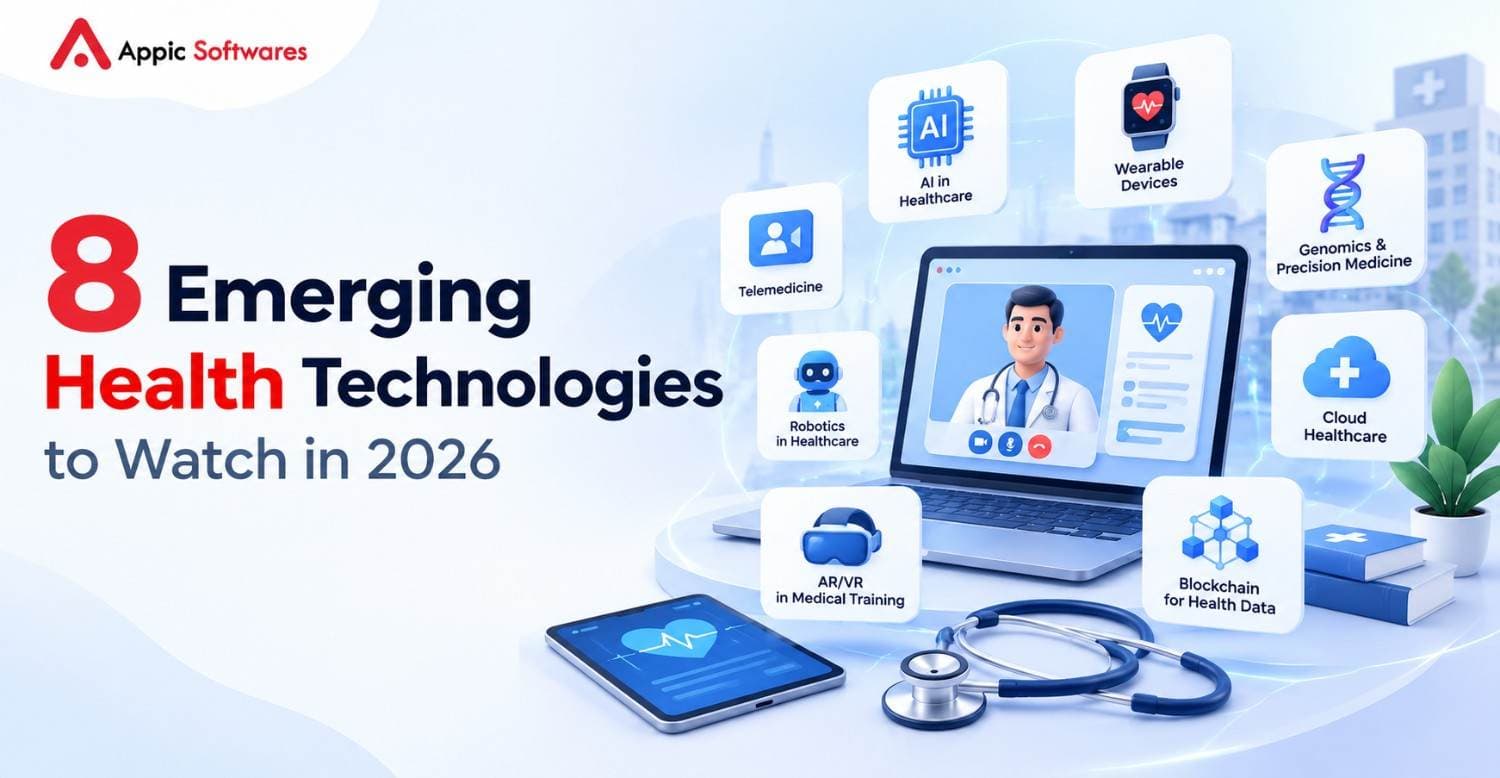
8 Emerging Health Technologies To Look For In 2025
Emerging health technologies are changing how care is delivered, measured, and paid for. AI now reads medical images and drafts clinical notes, virtual care is mainstream, wearables stream vital signs to care teams, and patient data is finally moving between systems. The money reflects it: Grand View Research values the global digital health market at USD 347.4 billion in 2025 and projects USD 1,830.4 billion by 2033, a 23.4% CAGR from 2026 to 2033 (Grand View Research).
This guide explains eight technologies that matter in 2026, what each does, where the risks are, and how product teams can build with them. It includes four data charts and a process flow, so you can see the trends and not just read about them.
In this guide: market growth, eight technologies, a comparison table, a remote monitoring flow, compliance basics, how to build, FAQs, and sources.
Digital Health Is Growing Fast: The Numbers
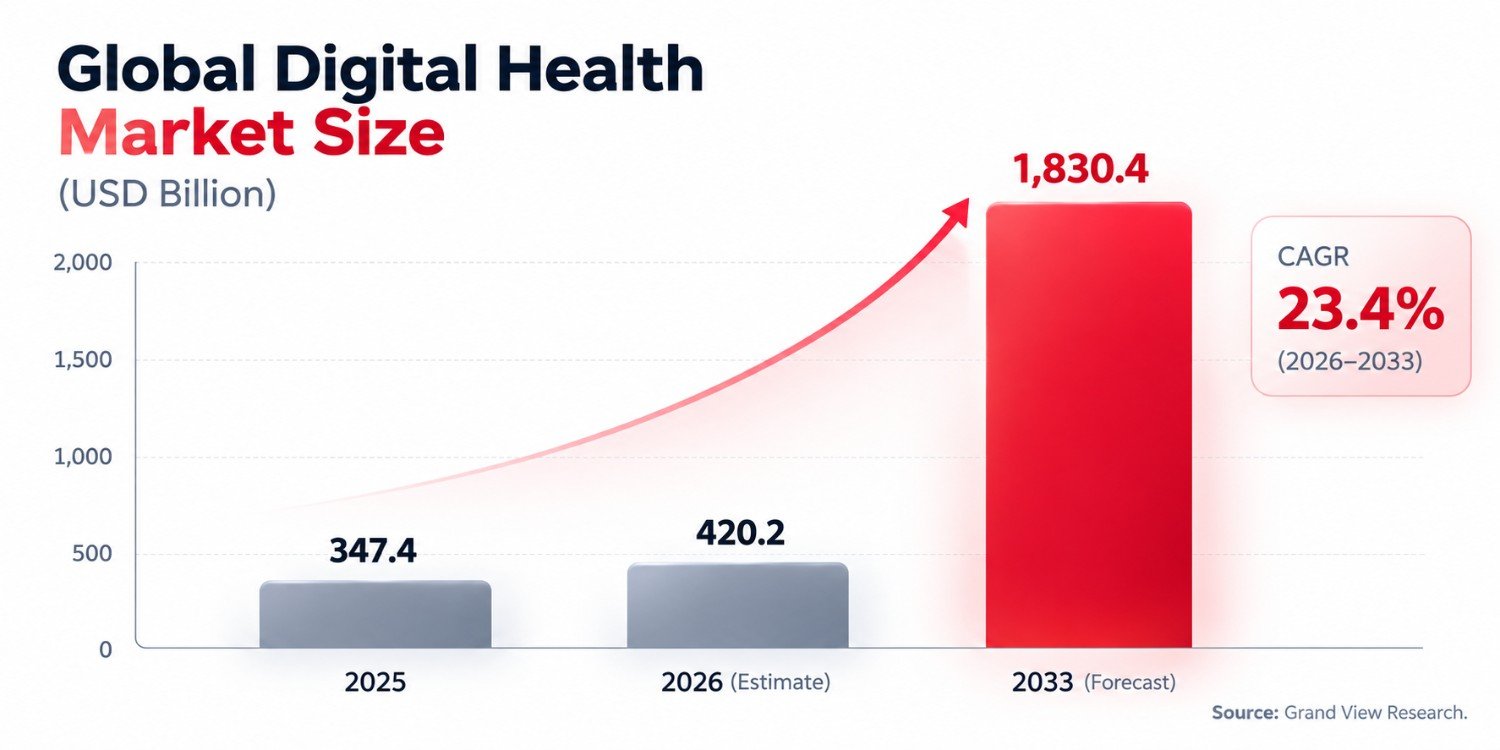
Growth is led by telehealth, which held 44.7% of digital health revenue in 2025, and by North America, which held a 37.1% share (IT-Online summary of Grand View Research).
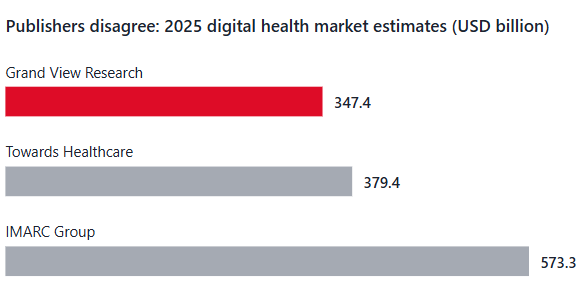
Market-size estimates vary widely because publishers define “digital health” differently. IMARC Group counts USD 573.3 billion for 2025 (IMARC Group) and Towards Healthcare counts USD 379.44 billion (Towards Healthcare). Use the direction of growth, not one exact number.
8 Emerging Health Technologies in 2026
1. AI diagnostics and clinical decision support
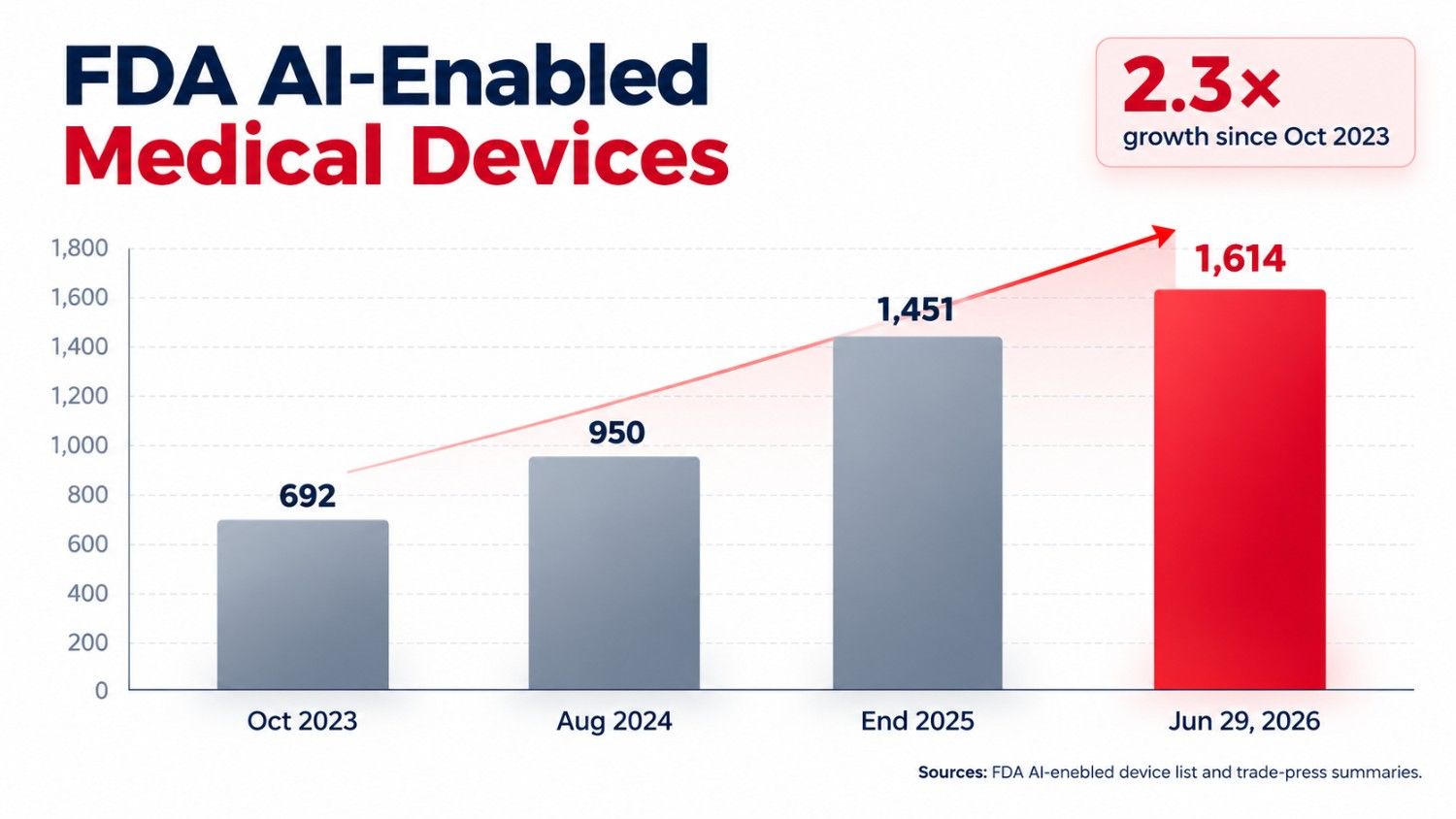
AI models that read X-rays, CT scans, ECGs, and pathology slides, flag urgent cases, and support clinical decisions. The FDA’s AI-enabled medical device list names over 1,600 authorized devices as of 2026, and the FDA says the list is not comprehensive (FDA).
Use cases: imaging triage, arrhythmia detection, risk scoring. Watch-out: check whether your software counts as a regulated medical device, and validate models on your own patient population.
Where Fda- authorized AI Devices Are Used
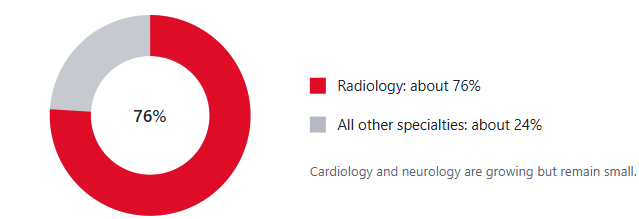
Radiology dominates because AI performs well on standardized, high-volume image data. In 2026, about 76% of authorized AI devices were radiology tools, with cardiology and neurology next (MedTech Dive, Complizen). Read more in our guide to integrating AI in healthcare.
2. Generative AI and ambient clinical documentation
Ambient AI “scribes” listen to a visit, draft the clinical note, and fill in the record so clinicians spend less time typing. They are one of the fastest-adopted uses of generative AI in care delivery.
Use cases: visit notes, discharge summaries, patient message drafts. Watch-out: informed consent and disclosure. Reports in 2026 describe lawsuits over AI scribing without adequate consent and new US state laws that require telling patients when AI is used in clinical interactions (AI Corner, March 2026). Keep a clinician in review of every note.
3. Telehealth and virtual care
Video visits, virtual triage, hospital-at-home, and digital front doors now sit alongside in-person care. Telehealth was the largest digital health segment in 2025 with a 44.7% revenue share (IT-Online).
Use cases: primary care visits, mental health, chronic care follow-ups, specialist e-consults. Watch-out: licensing across regions, equity of access, and secure video and records. See our doctor on demand app development and medicine delivery app development services.
4. Remote patient monitoring and wearables
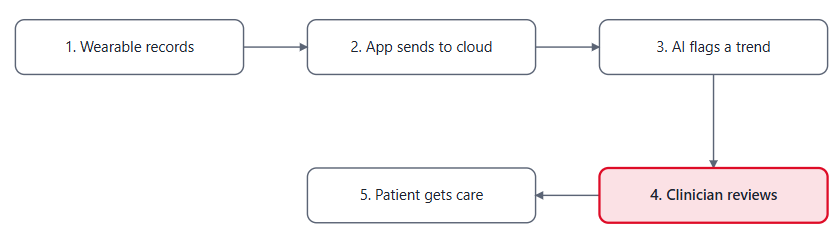
Wearables and home devices (glucose monitors, blood pressure cuffs, ECG patches, smartwatches) send vital signs to care teams, so problems are spotted between visits. AI can flag worrying trends, but a clinician should decide what to do.
Use cases: diabetes, heart failure, post-surgery recovery, elder care. Watch-out: alert fatigue, device accuracy, and data privacy. We build wearable apps and IoT solutions for this.
5. Digital therapeutics and mHealth apps
Software-based programs deliver evidence-based care, such as cognitive behavioral therapy, diabetes coaching, or rehabilitation exercises, through a phone. Diabetes was the largest application segment of digital health in 2025, with over a 25% share (Grand View Research).
Use cases: chronic disease management, mental health, medication adherence, fitness. Watch-out: proving outcomes and, for some products, regulatory clearance. See our fitness app development services.
6. Robotics and advanced surgical technology
Robot-assisted surgery, surgical navigation, and AI-guided planning give surgeons finer control and richer data during procedures. Hospitals also use service robots for logistics, disinfection, and rehabilitation.
Use cases: minimally invasive surgery, orthopedic planning, rehabilitation. Watch-out: high capital cost, training needs, and proof that outcomes beat standard care.
7. Genomics and precision medicine
Sequencing, biomarker testing, and gene editing let clinicians match treatments to a patient’s biology. The FDA approved the first CRISPR-based therapy for sickle cell disease in December 2023, opening a new treatment category.
Use cases: oncology, rare disease, pharmacogenomics. Watch-out: cost, access, and the sensitivity of genetic data, which needs strict consent and storage controls.
8. Interoperable and secure health data
Standards such as HL7 FHIR, cloud platforms, and privacy-preserving analytics let hospitals, labs, payers, and apps share data safely. This is the foundation that makes the other seven technologies work together. See how ERP for healthcare connects patient, billing, and inventory data.
Use cases: patient portals, referral workflows, population health, research. Watch-out: consent, role-based access, audit logs, and compliance with HIPAA, GDPR, and local laws.
Comparing the Eight Technologies
| Technology | Main benefit | Key risk | Maturity (our assessment) |
| AI diagnostics | Faster, more consistent reads | Model bias, validation gaps | Established in radiology |
| Ambient AI documentation | Less clinician typing | Consent, note accuracy | Growing |
| Telehealth | Access and convenience | Licensing, digital divide | Established |
| Remote monitoring and wearables | Earlier detection | Alert fatigue, privacy | Growing |
| Digital therapeutics | Scalable behavioral care | Outcome proof, regulation | Growing |
| Robotics | Precision, smaller incisions | Cost, training | Established in some specialties |
| Genomics | Personalized treatment | Cost, data sensitivity | Early to growing |
| Interoperable health data | Connected records | Security, consent | Growing |
Compliance and Safety Basics
- Know if you are a medical device: software that diagnoses or treats may need FDA clearance or equivalent approval in your market.
- Protect patient data: encrypt data in transit and at rest, use role-based access, and keep audit logs. Follow HIPAA in the US, GDPR in the EU, and local rules such as India’s DPDP Act, 2023.
- Keep humans in the loop: clinicians should review AI output that affects care.
- Test for bias: validate models across age, sex, ethnicity, and region.
- Disclose AI use: some US states now require telling patients when AI is used in clinical interactions.
How to Build a Health Technology Product
- Pick one clinical problem: such as missed follow-ups or slow imaging triage.
- Check regulation: decide early whether the product is a regulated device.
- Privacy design: plan consent, access control, and data retention from day one.
- Integrate through standards: use HL7 FHIR and APIs to connect to EHRs, labs, and devices.
- Pilot with clinicians: measure outcomes, time saved, and safety before scaling.
- Monitor and improve: track accuracy, drift, and user feedback after launch.
Appic Softwares offers healthcare software development, AI development, and mobile app development for health startups and providers, plus blockchain work where tamper-proof records matter.
Conclusion
The next wave of health technology is practical: AI that supports clinicians, virtual and remote care that reaches patients at home, and data standards that let systems work together. The winners will pair new technology with clinical proof, strong privacy, and human oversight.
Planning a health technology product? Explore Appic’s healthcare software development services or talk to our team.
Frequently Asked Questions
What are the emerging health technologies in 2026?
Key trends are AI clinical documentation, AI diagnostics and imaging, virtual care and hospital at home, remote monitoring and wearables, digital therapeutics, genomics, interoperability, robotics and healthcare cybersecurity. AI documentation, imaging AI and virtual care show the most real-world use. Others are growing more slowly or face heavier regulation.
How much funding does digital health get?
Rock Health counted $7.4 billion of US digital health funding in the first half of 2026 across 244 deals, up from $6.4 billion in the first half of 2025. Twenty rounds of $100 million or more made up 45% of the capital, which shows that money is concentrated in fewer, larger companies.
How many AI medical devices has the FDA authorized?
The FDA lists more than 1,500 AI-enabled medical devices. One analysis counted 1,524 through Q1 2026 and another counted 1,614 by late June 2026. Roughly three-quarters are radiology tools. Counts differ by source and date, so check the FDA's AI-enabled device list for the current official number.
Do AI scribes really save doctors time?
Results vary. In a vendor-sponsored poll of 103 physicians, 42% reported no time saved on a typical day while 20% reported more than an hour. Large health systems have reported wide use. Benefits depend on the specialty, the EHR integration and how much editing the notes need.
What regulations apply to health apps?
It depends on the product and market. Software that diagnoses, treats or monitors disease may be a regulated medical device in the US and EU. HIPAA covers protected health information in the US, and GDPR covers health data in Europe. Telehealth and licensing rules differ by state and country. Consult a regulatory specialist.
How much does it cost to build a healthcare app?
Appic projects typically start around $10,000 for a focused MVP. Cost depends on features, integrations with EHRs and devices, AI models, security and compliance work, and clinical validation if needed. Share your idea with us and we will give you a feature list, timeline and cost range.
Related Articles

Hospital App Development: Mobile Guide to FHIR, Cost and Rollout

5 Best Medical Technology Integration To Look For In 2024
Nearly every day, new medical technology is developed. The majority of businesses in the healthcare sector make use of these developments not only to help ease some of the administrative burdens but also to lay the groundwork for an improved system as a whole. In the current era, knowing the most significant new medical technology […]

IT Outsourcing In Healthcare: How And Benefits Of Hiring

5 Key Features In Remote ECG Monitoring System Development
Take a close look at how remote ECG monitoring systems are developing to learn more about the future of healthcare. Learn about the key elements influencing this cutting-edge technology, such as advanced analytics and real-time data transmission. Discover the essential factors propelling the development of Remote ECG Monitoring Systems and stay ahead of the curve […]
Doctor on Demand App Development: Features, Architecture, Compliance, Cost and Timeline in 2026