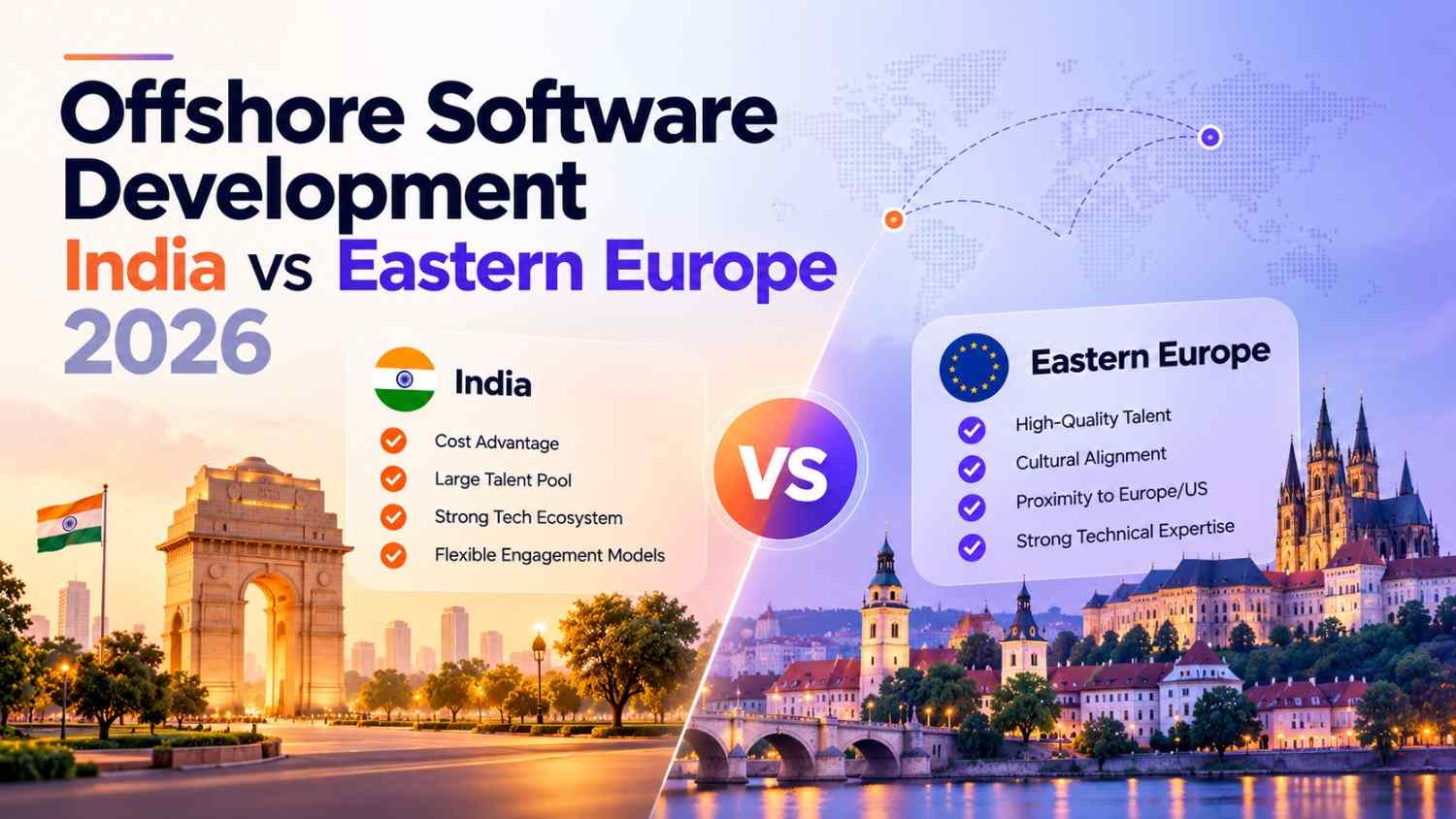
For offshore software development, India vs Eastern Europe is mainly a trade between price and shared working hours. Published 2026 rates put India at about $18 to $49 an hour and Poland at $45 to $99. Eastern Europe gives UK and US East Coast teams far more overlap. India suits cost-led scaling and Australian buyers.
Offshore software development is the practice of hiring an engineering team in another country, usually several time zones away, to design, build or maintain software under contract. In outsourcing usage, "Eastern Europe" means Central and Eastern Europe: Poland, Romania, Ukraine, Bulgaria, Czechia, Hungary, the Baltic states and Serbia. Some publishers file Poland and Czechia under "Central Europe", so check which countries a quoted rate covers.
This guide is for CTOs and founders in the US, UK and Australia who are choosing a region for an outsourced or dedicated team in 2026. You will get sourced 2026 rates by country, talent pool figures, an exact overlap-hours table for New York, San Francisco, London and Sydney, the data protection rules on each side, the main risks, a labelled cost estimate for a 5-person team, a weighted scorecard and a decision checklist. Appic Softwares is headquartered in Jaipur, India, so we sell India-based teams; this guide says plainly where Eastern Europe is the better choice.
Key takeaways
- 2026 vendor-published rates put India at $18 to $49 an hour, Poland at $45 to $99, Ukraine at $30 to $70 and Romania at $25 to $99 (Decode, 2026; Uptech, 2026).
- India's tech industry employs about 5.95 million people in FY26, according to Nasscom (2026), while the whole EU had 10.45 million ICT specialists in 2025 and Poland 778,800 (Eurostat, 2026).
- On a 09:00 to 17:00 day, London shares 7 hours with Warsaw but only 2.5 to 3.5 hours with Bengaluru; Sydney shares 2.5 to 3.5 hours with Bengaluru and none with Warsaw.
- The EF English Proficiency Index 2025 ranks Romania 11th, Poland 15th, Ukraine 45th and India 74th of 123 countries.
- GDPR already applies in EU member states such as Poland and Romania; India's DPDP Rules 2025 phase in their main obligations by 13 May 2027, and India has no EU adequacy decision.
If you already know India fits your budget and time zone, you can hire dedicated developers in India through Appic Softwares. If you are still deciding, read on: the scorecard below shows when we would point you to Eastern Europe instead.
India vs Eastern Europe: which region suits which buyer?
India suits buyers who want the lowest rates, large teams and fast hiring across many stacks. Eastern Europe suits buyers who need long daily overlap with the UK or US East Coast, strong spoken English and EU data protection by default.
| Factor | India | Eastern Europe | Edge |
| Hourly rate, 2026 published ranges | $18 to $49 | $25 to $99 by country; $30 to $80 for senior engineers region-wide | India |
| Talent scale | About 5.95 million tech workers (Nasscom FY26) | Poland 778,800, Czechia 248,200, Romania 207,800 ICT specialists (Eurostat 2025); Ukraine about 303,000 (Lviv IT Cluster 2025) | India |
| Overlap with London, standard day | 2.5 to 3.5 hours | 6 to 7 hours | Eastern Europe |
| Overlap with New York, standard day | 0 hours | 1 to 2 hours | Eastern Europe |
| Overlap with Sydney, standard day | 2.5 to 3.5 hours | 0 to 1 hour | India |
| EF EPI 2025 rank (of 123) | 74th | Romania 11th, Poland 15th, Ukraine 45th | Eastern Europe |
| Privacy law | DPDP Act 2023, main rules apply from 13 May 2027 | GDPR in EU members; Ukraine and Serbia sit outside the EU | Eastern Europe (EU members) |
| Main delivery risk | Attrition at large firms, shift fatigue on US overlap | War risk in Ukraine, senior talent competition, higher rates | Depends on country |
Choose India when budget, team size or an Australian time zone matter most. Choose Eastern Europe, and usually an EU member such as Poland or Romania, when you are a UK or EU buyer with personal data in scope and want most of the working day shared. US West Coast buyers get almost no natural overlap with either region, so cost and talent should decide.
Takeaway: India wins on price and scale; Eastern Europe wins on overlap with London and New York and on EU-native data protection.
Is it cheaper to outsource to India or Eastern Europe?
Outsourcing to India is cheaper than Eastern Europe on every 2026 rate source we checked. At the midpoint of each publisher's range, India's hourly rate is about 23% to 50% lower than Poland, Ukraine or Romania (our calculation from the Decode and Uptech ranges below).
Rates are not official statistics. They are published by outsourcing firms and rate-research companies, and each uses a different basis. The table shows each publisher and what its numbers cover, so you can compare like with like.
| Publisher (date) | India | Poland | Ukraine | Romania | Basis stated |
| Decode (updated Oct 2026) | $18 to $40 | $45 to $65 | $30 to $55 | $25 to $50 | Software engineer, mid to senior, established agencies |
| Uptech (updated Feb 2026) | $25 to $49 | $50 to $99 | $40 to $70 | $50 to $99 | Mid to top tier companies listed on Clutch |
| Innowise (2025 rates, updated 2026) | $20 to $40 (Asia, senior) | $50 to $65 | Not given | $40 to $55 | Senior engineers |
| The Contrast (Jun 2026) | $20 to $40 | $35 to $80 (region) | $35 to $80 (region) | $35 to $80 (region) | Senior engineers, indicative |
| Accelerance (Nov 2025) | $31 to $41 (Asia, senior) | $64 to $76 (all Europe) | $64 to $76 (all Europe) | $64 to $76 (all Europe) | Survey of 60 partner firms; Europe as a whole, countries not listed |
The publishers disagree most on Poland and Romania. Decode puts Romania at $25 to $50, while Uptech puts it at $50 to $99. India's ranges are tighter, from $18 at the low end (Decode) to $49 at the top (Uptech).
Accelerance (2025) also reports that rates fell year over year: nearly 8% in Asia and 4.4% in Europe, based on its survey of 60 software development partners. That softening helps buyers in both regions in 2026.
Hourly rate is only part of the cost. Management time, rework, onboarding and the hours your own team spends waiting for answers all count. Our guide to evaluating total IT outsourcing cost lists those hidden lines. If you are comparing offshore with hiring at home, see our cost analysis of outsourcing to India versus hiring in the USA. For a wider view of other regions, see our offshore developer rates comparison across regions.
Takeaway: India is cheaper in every 2026 source, by roughly a quarter to a half at range midpoints, but the gap is smallest against Ukraine and, on Decode's figures, Romania.
How big is India's developer talent pool compared with Eastern Europe?
India's developer talent pool is several times larger than any single Eastern European country, and larger than Central and Eastern Europe combined. The figures below come from industry bodies, national statistics and platform data, each measuring something slightly different.
India
India's technology industry will employ about 59.5 lakh (5.95 million) people directly in FY26, up from 58.15 lakh in FY25, according to Nasscom figures reported by ETV Bharat (February 2026). Nasscom projects FY26 industry revenue of $315 billion, with exports of $246 billion.
On GitHub, India had 21.9 million developers in 2025, up from 4.5 million in 2020, and ranks second worldwide, according to GitHub Octoverse (2025). GitHub says India added more than 5.2 million developers in 2025 and projects 57.5 million by 2030. GitHub accounts include students and hobbyists, so treat this as a signal of pipeline, not of hireable seniors.
Eastern Europe
The EU employed more than 10 million ICT specialists in 2025 (10.45 million in Eurostat's dataset), 5.0% of total employment, according to Eurostat (2026). That EU figure includes Western Europe. Eurostat's ICT specialists dataset gives 2025 counts of 778,800 in Poland, 248,200 in Czechia, 212,500 in Hungary, 207,800 in Romania and 141,500 in Bulgaria. "ICT specialist" is broader than "software developer": it also covers network, support and IT management roles.
Ukraine is outside the EU, so it is not in Eurostat's count. The Lviv IT Cluster's IT Research Ukraine 2025 counts about 303,000 IT specialists, of whom 245,000 live and work in Ukraine and 58,000 work abroad, as reported by Scroll.media (December 2025).
The Stack Overflow Developer Survey 2025 drew over 49,000 responses from 177 countries: 7.2% came from India, 2.7% from Ukraine and 2.5% from Poland. Survey share reflects community engagement, not headcount.
Scale matters most when you need to hire many people quickly or need a niche stack. For a team of 5 to 15 engineers, a mature Polish or Romanian vendor can usually staff common stacks too. For many parallel hires, India's depth is hard to match.
Takeaway: India's tech workforce of about 5.95 million dwarfs Poland's 778,800 ICT specialists, so India wins on scale and hiring speed; Eastern Europe is deep enough for most small teams.
Which Eastern European countries are best for software outsourcing?
Poland, Romania, Ukraine, Czechia and Bulgaria are the most common Eastern European choices for software outsourcing. Poland has the largest pool, Romania the best English scores, Ukraine the lowest rates among the big three, and Czechia the highest senior rates in Innowise's data.
| Country | ICT specialists, 2025 | EF EPI 2025 rank | Engineer rate range, 2026 | EU member (GDPR) | Best for |
| Poland | 778,800 (Eurostat) | 15th | $45 to $99 (Decode, Uptech) | Yes | Large nearshore teams for UK and EU buyers |
| Romania | 207,800 (Eurostat, estimate) | 11th | $25 to $99 (Decode, Uptech) | Yes | Strong English, mid-range cost |
| Ukraine | About 303,000 (Lviv IT Cluster) | 45th | $30 to $70 (Decode, Uptech) | No | Lower cost, experienced product engineers, with continuity planning |
| Czechia | 248,200 (Eurostat) | 23rd | $55 to $70 senior (Innowise) | Yes | Senior specialists, higher budget |
| Bulgaria | 141,500 (Eurostat) | 18th | $25 to $45 (Decode) | Yes | Lower-cost EU option |
| India (for comparison) | About 5.95 million tech workforce (Nasscom) | 74th | $18 to $49 (Decode, Uptech) | No | Scale, cost, Australia overlap |
EF ranks come from the EF EPI 2025 rankings and EF's country pages for Ukraine and India.
Takeaway: For EU data and UK overlap, Poland and Romania are the safest Eastern European picks; Ukraine trades lower rates for higher continuity risk.
What is the time zone overlap with the US, UK and Australia?
On a standard 09:00 to 17:00 day, Eastern Europe overlaps 6 to 7 hours with London and 1 to 2 hours with New York, while India overlaps 2.5 to 3.5 hours with London and Sydney and none with the US. Neither region overlaps with San Francisco without shift work.
We calculated these figures from IANA time zone rules for mid-July 2026 and mid-January 2027. Assumptions: both sides work 09:00 to 17:00 local time, Monday to Friday. India does not use daylight saving time; the US, UK, EU, Ukraine and Sydney do, on different dates. Each cell shows July / January.
| Buyer city | India, IST (Bengaluru, Jaipur) | Poland, CET (Warsaw) | Romania, Ukraine, EET (Bucharest, Kyiv) |
| New York | IST is 9.5 / 10.5 h ahead; overlap 0 / 0 h | 6 / 6 h ahead; overlap 2 / 2 h | 7 / 7 h ahead; overlap 1 / 1 h |
| San Francisco | 12.5 / 13.5 h ahead; overlap 0 / 0 h | 9 / 9 h ahead; overlap 0 / 0 h | 10 / 10 h ahead; overlap 0 / 0 h |
| London | 4.5 / 5.5 h ahead; overlap 3.5 / 2.5 h | 1 / 1 h ahead; overlap 7 / 7 h | 2 / 2 h ahead; overlap 6 / 6 h |
| Sydney | 4.5 / 5.5 h behind; overlap 3.5 / 2.5 h | 8 / 10 h behind; overlap 0 / 0 h | 7 / 9 h behind; overlap 1 / 0 h |
Most offshore teams shift their day to buy overlap. The next table shows the vendor-side working hours needed to share 4 hours with the buyer's working day: 09:00 to 13:00 for New York, San Francisco and London, and 13:00 to 17:00 for Sydney, which starts its day before the vendor. This is the cost of overlap that hourly rates hide.
| Buyer city | India shift for 4 shared hours (July / January) | Poland shift | Romania or Ukraine shift |
| New York | 14:30 to 22:30 / 15:30 to 23:30 IST | 11:00 to 19:00 all year | 12:00 to 20:00 all year |
| San Francisco | 17:30 to 01:30 / 18:30 to 02:30 IST | 14:00 to 22:00 all year | 15:00 to 23:00 all year |
| London | 09:30 to 17:30 / 10:30 to 18:30 IST | None needed (7 h already) | None needed (6 h already) |
| Sydney | 08:30 to 16:30 / 07:30 to 15:30 IST | 05:00 to 13:00 / 03:00 to 11:00 | 06:00 to 14:00 / 04:00 to 12:00 |
Read the second table as a fairness test. A Polish team serving New York moves its day by 2 hours. An Indian team serving New York moves it by 5.5 to 6.5 hours, into the late evening. That works for a few overlap roles but wears down a whole team over a year. For London, an Indian team only shifts by 0.5 to 1.5 hours. For Sydney, India is the clear winner.
Watch the weeks in March, October and November when one side has changed clocks and the other has not. Overlap moves by an hour, and recurring meetings break.
Takeaway: Eastern Europe is the better choice for UK buyers who want a shared working day and for New York teams that want short daily syncs; India is better for Sydney and workable for London with a small shift.
How do English and communication compare?
Eastern European EU members score higher on general English proficiency than India. The EF English Proficiency Index 2025 ranks Romania 11th (score 605), Poland 15th (600), Bulgaria 18th (594) and Czechia 23rd (582) of 123 countries and regions, while Ukraine ranks 45th (526) and India ranks 74th (484).
Treat that ranking with care. EF EPI measures adults who take EF's online test, not software engineers. English is a working language of Indian business, higher education and the IT industry, and engineers at client-facing Indian vendors use it daily. In practice, the gap shows up more in spoken fluency and directness in meetings than in written specs and pull requests.
Communication style matters as much as grammar. Teams in either region may avoid saying "no" to a client, or may wait for detailed tickets instead of challenging requirements. You can test for this before signing:
- Run the second interview as a live technical discussion, not a quiz.
- Ask the proposed lead to push back on part of your brief.
- Check written status updates from a current project, with client details removed.
- Agree how blockers are raised, and how quickly, in the contract or statement of work.
Takeaway: On EF EPI 2025, Romania, Poland and Bulgaria rank far above India; for client-facing roles, test spoken English in interviews rather than relying on a country ranking.
Is code quality better in Eastern Europe or India?
Code quality depends on the vendor and the people assigned, not on the country. We found no independent, current dataset that compares code quality by country, and claims that one region writes better code are usually marketing.
Both regions have world-class engineers and weak shops. India's larger market means a wider spread: more top-tier teams and more low-cost generalists. Eastern Europe has a reputation for strong computer science education, but that does not guarantee a given vendor's process.
Measure quality directly. These steps work in either region:
- Ask for anonymised code samples or a public repository written by the people you will get.
- Run a paid pilot of 2 to 4 weeks on a real, small feature.
- Have your own senior engineer review every pull request during the pilot.
- Check automated test coverage, CI pipeline and code review rules on the pilot repository.
- Track lead time, defect rate and rework for the pilot, then decide.
Our step-by-step guide to outsourcing software development covers vendor vetting in more detail.
Takeaway: Neither India nor Eastern Europe writes better code by default; a paid pilot with your own code review is the only reliable test.
How do I protect IP and data when outsourcing to India or Eastern Europe?
Protect IP with a contract that assigns all work product to you, with your own control of repositories and accounts, and with a vendor that holds a recognised security certification. Protect personal data by matching the vendor's location to your legal transfer rules.
Security certifications to ask for
- ISO/IEC 27001:2022, the international standard for an information security management system, published by ISO. Ask for the certificate and check that its scope covers the delivery centre that will serve you.
- SOC 2, an attestation report under the AICPA Trust Services Criteria covering security, availability, processing integrity, confidentiality and privacy. Ask whether the report is Type I (controls at a point in time) or Type II (controls over a period).
Data protection law on each side
The General Data Protection Regulation (EU) 2016/679 applies directly in EU members such as Poland, Romania, Czechia and Bulgaria. For an EU or UK buyer, an EU-based vendor sits inside the same legal framework.
India is not on the European Commission's list of adequacy decisions, so EU personal data sent to an Indian vendor needs a transfer tool such as the Commission's standard contractual clauses (2021). The same applies to Ukraine and Serbia, which are outside the EU.
India's own law is the Digital Personal Data Protection Act, 2023. The government notified the DPDP Rules on 14 November 2025 with an 18-month phased compliance period, according to a Press Information Bureau explainer (November 2025). That document lists penalties of up to ₹250 crore for failing to keep reasonable security safeguards. Hogan Lovells (2025) notes that most core obligations, including notice, consent, security safeguards and breach notification, apply from 13 May 2027.
Contract and access controls
- Put an IP assignment clause in the master services agreement that covers all code, designs and documents on creation or on payment.
- Require each engineer to sign confidentiality and IP terms with the vendor that flow through to you.
- Keep source code, cloud accounts and CI/CD in your own organisation, with the vendor as invited users.
- Use production data only when needed; give the team masked or synthetic data by default.
- Write an offboarding checklist: revoke access, rotate secrets and confirm deletion of local copies.
- Have local counsel in the vendor's country review enforcement and governing law.
Takeaway: EU-based Eastern European vendors are simpler for GDPR; Indian and Ukrainian vendors need standard contractual clauses, and in every region you should own the repositories and the IP clause.
Is Ukraine still a safe outsourcing destination?
Ukraine's IT industry is still delivering in 2026, but it carries real continuity risk from the war, so it suits buyers who plan for disruption. Exports of computer services reached $6.66 billion in 2025, up 3.3% on 2024, according to National Bank of Ukraine data published by the Lviv IT Cluster (February 2026).
The same cluster's IT Research Ukraine 2025 counted about 303,000 IT specialists, with 58,000 working abroad, and found that 1 in 5 is considering emigration, as reported by Scroll.media (December 2025). That points to stable delivery overall, with a steady drain of people.
If you choose a Ukrainian vendor, ask for:
- A written business continuity plan covering power cuts, internet loss and mobilisation of staff.
- Documented backup power and connectivity at offices and for remote engineers.
- Team members or a delivery centre in a second country, often Poland, that can take over.
- Code and documentation kept in your repositories, so another team can continue.
Takeaway: Ukraine remains a working outsourcing market with $6.66 billion of 2025 exports, but only choose it with a tested continuity plan and a second-country fallback.
What are the main risks, and how do you reduce them?
The main risks are attrition and shift fatigue in India, war and senior talent competition in Eastern Europe, and currency moves in both. Each has a practical control.
| Risk | Where it bites | Evidence | How to reduce it |
| Attrition | India, especially large IT firms | TCS reported 12-month trailing attrition of 13.3% in its Q2 FY27 fact sheet (Business Today, October 2026). We found no comparable public benchmark for Eastern European vendors. | Name key people in the contract, require a notice period and paid overlap for handover, keep documentation in your repositories. |
| Shift fatigue | India serving the US | The shift table above: an Indian team's day moves 5.5 to 6.5 hours later to share 4 hours with New York. | Shift only 1 or 2 overlap roles, rotate them, and use written async updates for the rest. |
| War and continuity | Ukraine | 58,000 Ukrainian IT specialists work abroad (Lviv IT Cluster 2025). | Continuity plan, backup power, second-country team. |
| Currency | Both | The rupee hit an all-time low of 96.96 per US dollar in May 2026 (Business Today, October 2026). | Fix the contract currency, agree an annual rate review date, and cap increases. |
| Senior talent competition | Poland, Czechia | Highest rate ranges in the region (Uptech, Innowise 2026). | Lock in named seniors; mix senior leads with mid-level engineers. |
| Vendor lock-in | Both | Applies to any outsourced team. | Own accounts and code, require documentation, keep a 30 to 60 day exit clause. |
Engagement model also changes your risk. A dedicated team you direct gives more control than a fixed-scope project. Our comparison of outsourcing and outstaffing models explains the trade-offs.
Takeaway: Every risk on this list has a contract or process control; write them into the agreement before work starts, whichever region you pick.
What does a 5-person team cost in India vs Eastern Europe?
A 5-person offshore team costs an estimated $278,400 to $355,200 a year in India, against $528,000 to $715,200 in Poland, based on 2026 published rates. Ukraine falls between the two, and Romania spans most of that range because Decode and Uptech disagree on Romanian rates.
This is an estimate, not a quote. Assumptions:
- Team: 1 tech lead, 3 software engineers, 1 QA engineer, billed at one blended engineer rate.
- Hours: 160 per person per month, 12 months, so 9,600 billable hours a year.
- Low case: midpoint of Decode's 2026 engineer range. High case: midpoint of Uptech's 2026 range.
- Excludes your own management time, travel, tools, licences and any shift allowance.
| Country | Blended rate (Decode mid / Uptech mid) | Monthly team cost | Annual team cost (estimate) |
| India | $29 / $37 | $23,200 to $29,600 | $278,400 to $355,200 |
| Ukraine | $42.50 / $55 | $34,000 to $44,000 | $408,000 to $528,000 |
| Romania | $37.50 / $74.50 | $30,000 to $59,600 | $360,000 to $715,200 |
| Poland | $55 / $74.50 | $44,000 to $59,600 | $528,000 to $715,200 |
On these assumptions, the India team costs $249,600 to $360,000 a year less than the Poland team. Against Ukraine, the gap is $129,600 to $172,800. Romania's range is wide because Decode and Uptech disagree so much on Romanian rates.
Use the gap to decide whether overlap is worth paying for. If your product needs 6 or more shared hours a day with London, part of the Poland premium buys real speed. If the team can work mostly async, the India saving can fund extra engineers or a longer runway. Early-stage companies can read our advice on hiring offshore developers as a startup.
Takeaway: On 2026 published rates, a 5-person team costs about $250,000 to $360,000 a year less in India than in Poland; decide whether Eastern Europe's overlap is worth that premium for your product.
Weighted decision scorecard: India vs Poland, Romania and Ukraine
The scorecard turns this guide's data into one number per country for your buyer city. It is our indicative scoring, so change the weights and scores to match your priorities.
Scores run from 1 (weak) to 5 (strong). Each total is the weighted score out of 100. Basis for each score: cost from the rate table, talent from Nasscom and Eurostat, English from EF EPI 2025, data protection from GDPR membership and adequacy status, delivery risk from attrition, currency and war risk, and overlap from our time zone table.
| Criterion | Weight | India | Poland | Romania | Ukraine |
| Cost | 30 | 5 | 2 | 3 | 4 |
| Talent scale | 15 | 5 | 4 | 3 | 3 |
| English (EF EPI 2025) | 10 | 2 | 5 | 5 | 3 |
| Data protection fit for EU or UK data | 15 | 3 | 5 | 5 | 3 |
| Delivery risk (higher is safer) | 10 | 4 | 4 | 4 | 2 |
| Overlap: London buyer | 20 | 3 | 5 | 5 | 5 |
| Overlap: New York buyer | 20 | 1 | 3 | 2 | 2 |
| Overlap: San Francisco buyer | 20 | 1 | 1 | 1 | 1 |
| Overlap: Sydney buyer | 20 | 3 | 1 | 1 | 1 |
| Total for a London buyer | 100 | 78 | 77 | 80 | 72 |
| Total for a New York buyer | 100 | 70 | 69 | 68 | 60 |
| Total for a San Francisco buyer | 100 | 70 | 61 | 64 | 56 |
| Total for a Sydney buyer | 100 | 78 | 61 | 64 | 56 |
Use one overlap row only, the one for your city. On these weights, Romania edges India for a London buyer, India and Poland are close for New York, and India leads clearly for San Francisco and Sydney. If you raise the overlap weight to 30 or more, Eastern Europe wins for London and New York. If you cut the data protection weight because no EU personal data is in scope, India's lead grows.
Takeaway: On default weights, Romania wins narrowly for London, New York is a near tie, and India leads for San Francisco and Sydney; your weights decide the close calls.
Can you combine India and Eastern Europe in a hybrid model?
Yes. A hybrid model puts the roles that need overlap or EU data access in Eastern Europe and the bulk of build and test capacity in India. The aim is to get most of Eastern Europe's overlap at a cost closer to India's.
Common hybrid patterns:
- Nearshore lead, offshore pod: a tech lead or product-facing engineer in Poland or Romania works your hours, while an India pod builds and tests with a 2 to 4 hour handover window.
- Data split: components that process EU personal data are built and run by an EU team, while front ends, internal tools and test automation sit in India.
- Follow-the-sun support: India covers the early part of the day for Sydney and London, and Eastern Europe covers the afternoon for London and the morning for New York.
- Phase split: discovery and architecture with high-overlap staff, then scale-out delivery in India once the backlog is stable.
Hybrids add coordination cost. They work when one party owns the overall plan, all teams share one repository and ticket system, and handovers follow a written template.
Takeaway: A hybrid of a small Eastern European overlap team with an Indian delivery pod can capture much of both regions' strengths, if one owner runs the plan.
Decision checklist: India or Eastern Europe?
Work through these steps in order before you sign with a vendor in either region.
- Write down your city and the minimum shared hours a day your team needs.
- Check the overlap table above; drop any region that cannot meet that minimum without unsustainable shifts.
- List whether EU or UK personal data is in scope; if yes, prefer an EU member or plan standard contractual clauses.
- Set a budget using the 5-person cost estimate, adjusted for your team size.
- Fill in the weighted scorecard with your own weights.
- Shortlist 3 vendors in the leading region, and 1 in the runner-up region as a benchmark.
- Ask each for ISO/IEC 27001 scope, SOC 2 report if you need one, and their continuity plan.
- Run a paid pilot of 2 to 4 weeks with your own code review.
- Sign a contract with IP assignment, named key people, a fixed currency and a 30 to 60 day exit clause.
- Review rate, overlap and quality after 90 days and adjust the team mix.
Takeaway: Decide on overlap and data rules first, then cost; a short paid pilot settles the rest.
Next steps: build your offshore team
If the scorecard points to India, Appic Softwares can help. We are an India-headquartered product development company with offices listed in Frisco, Texas and Munich, Germany. We build web, mobile and AI products and provide dedicated developers for clients in the US, UK and Australia.
Start with a short scoping call: we will map your stack, overlap needs and team size, and tell you honestly if a nearshore team fits better. Explore hiring dedicated developers in India or contact our team to discuss your project.
Rates, exchange rates and data protection timelines in this guide were checked in October 2026. Recheck them before you sign.