Appic Softwares Logo - Custom Software and App Development Company
  • AI/ML
  • Services
  • Industries
  • Platform
  • Hire Talent
  • Our Company
  • Blog
Contact Us
Appic Softwares Logo - Custom Software and App Development Company
AI
  • AI Development
  • AI Agent
  • Micro SaaS Development
  • Finish Lovable/Cursor Website
  • AI Consulting
  • Enterprise AI Development
  • AI in Fintech
Generative AI
  • Generative AI Development
  • Generative AI Integration
  • LLM Development
  • Adaptive AI Development
  • Generative AI in Real Estate
ML
  • Machine Learning Development
  • ML Model Engineering
  • ML Ops Consulting
  • ML & Data Science Consulting
Custom App Development
  • Mobile App Development
  • Enterprise Mobile App Development
  • IPhone Mobile App Development
  • Ionic App Development
  • Wearable App Development
  • Android Mobile App Development
  • IoT App Development
Software Development Services
  • Software Development
  • Flutter App Development
  • No-Code / Low-Code
  • Angular App Development
  • FlutterFlow Development Company
  • PWA Development Company
  • Next.Js Development Company
  • Supabase Development Company
  • MVP Development
  • Web Development Company
  • Startup Software Development
Blockchain
  • Blockchain Development Services
  • Blockchain Consulting Services
  • Substrate Development
  • Polygon Blockchain Development
  • Hypeledger Blockchain Development Services
  • Golang Development
  • Cosmos Development
  • Solana Blockchain Development
  • Tezos Development
Web 3
  • Web3 Development
  • Rust Development
Maintenance And Support
  • Maintenance & Support
Integration Services
  • Digital Wallet Integration
  • Custom Chat Integration Service
  • Property Recommendation Engine
  • Real Estate Chatbot
  • Real Estate CRM
Astrology
  • Ready-Made Astrology App Development
  • Astrology API Integration App Development
  • Astrology App Development
  • Temple Management App Development
Finance
  • Finance App Development
  • Trading App Development
  • Insurance App Development
  • Mobile Banking App Development
  • Loan Lending App Development
  • Fintech App Development Company In Saudi Arabia
Education
  • LMS App Development
  • EdTech App Development
Real Estate
  • Real Estate App Development
  • Proptech App Development
  • Floor Plan App Development
  • Commercial Real Estate App Development
  • Real Estate Reporting App Development
  • Property Management App Development
  • Real Estate MLS App Development
  • Virtual Property App Development
Industrial Manufacturing and Recycling
  • Waste Management Software Development
On Demand
  • On Demand App Development
  • Laundry App Development
  • On Demand Home Services App Development
  • Salon App Development
  • Logistic App Development
  • Ticket Booking App Development
  • Media & Entertainment App Development
  • Events App Development
  • Restaurant App Development
  • Agriculture App Development
  • Travel App Development
  • Automotive App Development
  • Dating App Development
  • Car Service App Development
  • AI Skincare App Development
E-Commerce
  • Social Commerce App Development
  • Ecommerce App Development
  • Ecommerce App Development in Saudi Arabia
Pet Care
  • Pet Care App Development
  • Veterinary App Development
  • Pet Food Delivery App Development
  • Pet Tracking App Development
  • Pet Training App Development
  • Pet Social Networking App Development
  • Dog Walker App Development
  • Dog Park Tracker App Development
Health
  • Healthcare Software Development
  • Doctor on Demand App Development
  • Medicine Delivery App Development
  • Fitness App Development
DevOps
  • DevOps Services
  • DevOps Automation Services
  • DevOps Infrastructure Management
Adobe
  • Adobe Commerce Development
  • Adobe Cloud Development
  • Adobe Marketplace
  • Adobe B2B Marketplace
  • Adobe POS
  • Adobe Integration
Salesforce
  • Salesforce Development
  • Salesforce Implementation
  • Salesforce Integration
Microsoft
  • Power BI Development
Pega
  • Pega Development
  • Pega Consulting
Drupal
  • Drupal Development Services
  • Drupal Mobile App Development
  • Drupal Ecommerce Development
  • Drupal Migration & Upgradation
  • Drupal Consulting Company
  • Headless Drupal Development
Hire Developers
  • Hire Developer
  • Hire Software Development Team
  • Cost of Hiring Developers
  • Vetting Process
  • How We Hire
Hire Front-End Developers
  • Hire WeWeb Developer
  • Hire React Developer
  • Hire Flutter Flow Developer
  • Hire React Native Developer
  • Hire Flutter Developer in Saudi Arabia
Hire Back-End Developers
  • Hire Node.js Developer
  • FlutterFlow Firebase
  • GraphQL
  • Rowy
  • BuildShip Developer
Hire CMS Developers
  • Hire Wordpress Developer
  • Hire WooCommerce Developer
  • Hire Drupal Developer
  • PrestaShop
  • Shopify
  • Strapi
  • Hire Strapi Developer
Hire AI Engineers
  • Hire AI Engineers
  • Hire Generative AI Engineers
  • Hire Prompt Engineers
  • Hire AWS Bedrock Developer
Hire Digital Marketing Experts
  • Hire Digital Marketing Expert
  • Hire SEO Experts
  • Hire Digital Marketing For Real Estate
Company Information
  • Portfolio
  • Case Studies
  • Videos
  • About Us
  • Partner with Us
  • Client Testimonials
Blog
Contact Us
Recycling & Landfill Management Systems
Appic Softwares Logo - Custom Software and App Development Company
  • AI/ML
  • Services
  • Industries
  • Platform
  • Hire Talent
  • Our Company
  • Blog
Contact Us
Appic Softwares Logo - Custom Software and App Development Company
AI
  • AI Development
  • AI Agent
  • Micro SaaS Development
  • Finish Lovable/Cursor Website
  • AI Consulting
  • Enterprise AI Development
  • AI in Fintech
Generative AI
  • Generative AI Development
  • Generative AI Integration
  • LLM Development
  • Adaptive AI Development
  • Generative AI in Real Estate
ML
  • Machine Learning Development
  • ML Model Engineering
  • ML Ops Consulting
  • ML & Data Science Consulting
Custom App Development
  • Mobile App Development
  • Enterprise Mobile App Development
  • IPhone Mobile App Development
  • Ionic App Development
  • Wearable App Development
  • Android Mobile App Development
  • IoT App Development
Software Development Services
  • Software Development
  • Flutter App Development
  • No-Code / Low-Code
  • Angular App Development
  • FlutterFlow Development Company
  • PWA Development Company
  • Next.Js Development Company
  • Supabase Development Company
  • MVP Development
  • Web Development Company
  • Startup Software Development
Blockchain
  • Blockchain Development Services
  • Blockchain Consulting Services
  • Substrate Development
  • Polygon Blockchain Development
  • Hypeledger Blockchain Development Services
  • Golang Development
  • Cosmos Development
  • Solana Blockchain Development
  • Tezos Development
Web 3
  • Web3 Development
  • Rust Development
Maintenance And Support
  • Maintenance & Support
Integration Services
  • Digital Wallet Integration
  • Custom Chat Integration Service
  • Property Recommendation Engine
  • Real Estate Chatbot
  • Real Estate CRM
Astrology
  • Ready-Made Astrology App Development
  • Astrology API Integration App Development
  • Astrology App Development
  • Temple Management App Development
Finance
  • Finance App Development
  • Trading App Development
  • Insurance App Development
  • Mobile Banking App Development
  • Loan Lending App Development
  • Fintech App Development Company In Saudi Arabia
Education
  • LMS App Development
  • EdTech App Development
Real Estate
  • Real Estate App Development
  • Proptech App Development
  • Floor Plan App Development
  • Commercial Real Estate App Development
  • Real Estate Reporting App Development
  • Property Management App Development
  • Real Estate MLS App Development
  • Virtual Property App Development
Industrial Manufacturing and Recycling
  • Waste Management Software Development
On Demand
  • On Demand App Development
  • Laundry App Development
  • On Demand Home Services App Development
  • Salon App Development
  • Logistic App Development
  • Ticket Booking App Development
  • Media & Entertainment App Development
  • Events App Development
  • Restaurant App Development
  • Agriculture App Development
  • Travel App Development
  • Automotive App Development
  • Dating App Development
  • Car Service App Development
  • AI Skincare App Development
E-Commerce
  • Social Commerce App Development
  • Ecommerce App Development
  • Ecommerce App Development in Saudi Arabia
Pet Care
  • Pet Care App Development
  • Veterinary App Development
  • Pet Food Delivery App Development
  • Pet Tracking App Development
  • Pet Training App Development
  • Pet Social Networking App Development
  • Dog Walker App Development
  • Dog Park Tracker App Development
Health
  • Healthcare Software Development
  • Doctor on Demand App Development
  • Medicine Delivery App Development
  • Fitness App Development
DevOps
  • DevOps Services
  • DevOps Automation Services
  • DevOps Infrastructure Management
Adobe
  • Adobe Commerce Development
  • Adobe Cloud Development
  • Adobe Marketplace
  • Adobe B2B Marketplace
  • Adobe POS
  • Adobe Integration
Salesforce
  • Salesforce Development
  • Salesforce Implementation
  • Salesforce Integration
Microsoft
  • Power BI Development
Pega
  • Pega Development
  • Pega Consulting
Drupal
  • Drupal Development Services
  • Drupal Mobile App Development
  • Drupal Ecommerce Development
  • Drupal Migration & Upgradation
  • Drupal Consulting Company
  • Headless Drupal Development
Hire Developers
  • Hire Developer
  • Hire Software Development Team
  • Cost of Hiring Developers
  • Vetting Process
  • How We Hire
Hire Front-End Developers
  • Hire WeWeb Developer
  • Hire React Developer
  • Hire Flutter Flow Developer
  • Hire React Native Developer
  • Hire Flutter Developer in Saudi Arabia
Hire Back-End Developers
  • Hire Node.js Developer
  • FlutterFlow Firebase
  • GraphQL
  • Rowy
  • BuildShip Developer
Hire CMS Developers
  • Hire Wordpress Developer
  • Hire WooCommerce Developer
  • Hire Drupal Developer
  • PrestaShop
  • Shopify
  • Strapi
  • Hire Strapi Developer
Hire AI Engineers
  • Hire AI Engineers
  • Hire Generative AI Engineers
  • Hire Prompt Engineers
  • Hire AWS Bedrock Developer
Hire Digital Marketing Experts
  • Hire Digital Marketing Expert
  • Hire SEO Experts
  • Hire Digital Marketing For Real Estate
Company Information
  • Portfolio
  • Case Studies
  • Videos
  • About Us
  • Partner with Us
  • Client Testimonials
Blog
Contact Us
HomeBlogRecycling & Landfill Management Systems

Recycling & Landfill Management Systems

Khushi seth
May 11, 2026
Back to Blog

Table of Contents

Loading headings…

Share this

Frequently Asked Questions

What is a recycling and landfill management systems?

A recycling and landfill management systems is software that manages weighbridge operations, contamination tracking, billing, reporting, material classification, and compliance workflows for waste facilities.

How do landfill management systems reduce revenue loss?

These systems reduce manual entry errors, improve ticket accuracy, track audit history, and maintain accurate customer billing records.

Why is contamination tracking important in recycling facilities?

Contamination tracking helps facilities identify problem routes, reduce residue rates, improve bale quality, and maintain stronger recycling profitability.

Recycling & Landfill Management Systems

Table of Contents

  • Why Recycling and Landfill Operations Need Better Data Control
  • Why Waste Facilities Can't Afford Manual Operations
  • Weighbridge and Scale Management: The Financial Core
  • Custom vs. Off-the-Shelf: Which Works Better?
  • How Appic Softwares Builds Waste Management Platforms
  • The Biggest Problems That Reduce Facility Profitability
  • Core Features Every Recycling and Landfill Management System Needs
  • How Facilities Reduce Contamination Through Better Data
  • Why Landfill Operations Need Stronger Reporting Systems
  • Weighbridge Integration Delivers Fast Operational ROI
  • KPIs That Help Recycling and Landfill Facilities Improve Performance
  • A Practical Implementation Plan for Recycling and Landfill Software
  • Common Mistakes Facilities Should Avoid
  • Why Custom Waste Management Platforms Perform Better
  • Final Takeaway

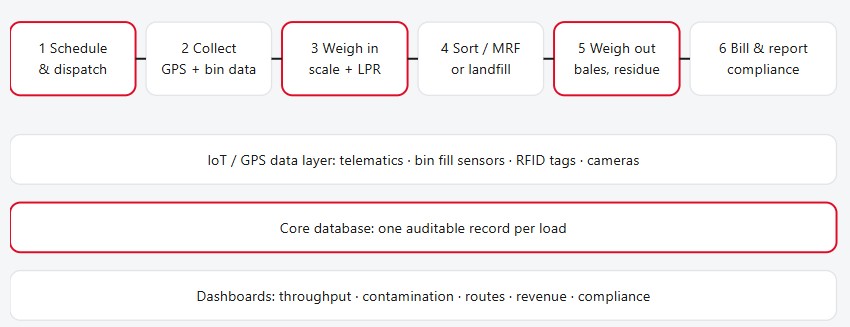
A recycling and landfill management system is purpose-built software that digitises and automates the entire operational lifecycle of a waste facility from inbound load receipts and weighbridge transactions to contamination checks, material classification, compliance reporting, and billing.

Unlike generic ERP or business management software, these systems are designed around the specific physical and regulatory workflows of material recovery facilities (MRFs), transfer stations, landfills, and recycling centres. They eliminate the fragmented, error-prone processes associated with spreadsheets and paper tickets by consolidating every transaction into a single, auditable data environment.

Modern facilities that have deployed custom waste management software report faster queue clearance at weighbridges, fewer billing disputes, stronger contamination traceability, and compliance documentation that holds up under regulatory scrutiny, all of which directly improve margins and reduce liability.

Why Recycling and Landfill Operations Need Better Data Control

Recycling & Landfill Management Systems

Collection operations receive most operational attention. Trucks, pickups, and customer complaints stay visible every day. The largest hidden losses often happen after collection.

Problems begin at:

  • The weighbridge
  • The transfer station
  • The MRF sorting line
  • The landfill gate
  • The commodity tracking stage

When operators enter incorrect weights, invoices become inaccurate. When contamination data is missing, facilities lose material value. When reporting records are scattered, audits become slow and expensive.

The U.S. Environmental Protection Agency reported 292.4 million tons of municipal solid waste generation in 2018. Around 146.1 million tons went to landfills. Landfills also contributed nearly 17.1% of total U.S. methane emissions in 2022. These numbers increase pressure on facilities to improve tracking, reporting, and operational accuracy.

Facilities now need systems that support:

  • Faster reporting
  • Accurate billing
  • Material traceability
  • Compliance readiness
  • Contamination tracking
  • Operational visibility

Why Waste Facilities Can't Afford Manual Operations

The scale of the problem is significant. The U.S. EPA recorded 292.4 million tons of municipal solid waste generated in a single year, with roughly 146 million tons directed to landfills. Methane emissions from landfills account for nearly 17% of total U.S. methane output, placing facilities under growing regulatory pressure to report accurately and reduce environmental impact.

For an individual facility managing hundreds or thousands of load transactions weekly, manual processes introduce risk at every step:

- Scale ticketing errors lead to undercharging or overcharging customers, creating disputes and revenue leakage

- Paper-based contamination records provide no source traceability when a rejected load needs to be traced back

- Disconnected billing systems delay invoicing and increase days-sales-outstanding

- Manual compliance logs take hours to compile and are prone to gaps that trigger audit findings

- No real-time visibility into route, load status, or field activity leaves operations teams reacting rather than managing

A connected landfill management software platform eliminates these failure points by making data capture automatic, accurate, and available in real time across operations, finance, and compliance teams.

Core Modules Every System Must Have

A complete recycling and landfill management system integrates several interdependent modules. Each one contributes to a different dimension of operational control.

Weighbridge / Scale Management handles inbound and outbound vehicle weighing, ticket generation, multi-weight capture, and licence plate recognition (LPR). This is the financial nerve centre of any facility.

Contamination Tracking logs contamination findings at the load level, associates them with specific customers or haulers, and generates rejection records that feed into compliance and billing workflows.

Material Classification provides structured code tables down to product type, grade, and origin so facilities can report material flows with the granularity required by regulators and commodity buyers.

Compliance Reporting automates the generation of environmental reports, waste transfer records, and regulatory submissions. Well-built systems pre-populate reports from transactional data rather than requiring manual data entry.

Route and Field Visibility gives operations managers real-time awareness of driver location, load status, job completion, and exceptions, reducing idle time and improving customer service levels.

Billing and Invoicing integrates with scale transactions to produce accurate, timely invoices with full audit trails. It should support multiple rate structures, customer-level pricing, and e-payment workflows.

Operational Analytics surfaces dashboards and scheduled reports covering throughput, revenue, contamination rates, route efficiency, and compliance KPIs, enabling data-driven management rather than intuition-based decisions.

For facilities looking to extend digital capabilities further, waste management mobile applications connect field teams to back-office functions, including work order management, GPS tracking, route planning, and digital signature capture.

Weighbridge and Scale Management: The Financial Core

Every financial transaction at a waste facility flows through the weighbridge. A missed tare weight, a misclassified product code, or a manually recorded licence plate creates a downstream error that propagates into billing, reporting, and regulatory records.

Effective weighbridge software must deliver:

  • Automatic truck-scale integration that pulls weight data directly from the scale indicator into the ticketing system, eliminating manual transcription
  • Multi-weight module that captures accurate net weights even when multiple products are removed from a single load across different offload points
  • LPR (Licence Plate Recognition) integration that identifies vehicles automatically on entry, retrieves their account and rate information, and reduces queue wait times at busy gates
  • Streamlined ticket entry with intelligent search and pre-populated fields so operators process loads quickly without sacrificing data quality
  • Comprehensive transaction history that provides the audit trail needed during billing disputes, regulatory audits, and contract reviews

Facilities that connect truck scale and indicator data directly to a centralised data management system, rather than relying on operators to manually key in weights, see measurable reductions in scale queue times and billing error rates. The weighbridge management systems built by Appic Softwares integrate multi-dimensional code tables for superior reporting, giving facilities both operational speed and compliance-grade data quality.

Contamination Tracking and Material Classification

Contamination is one of the most costly operational challenges for recycling facilities. A single contaminated load can compromise an entire batch of recovered material, triggering rejection by commodity buyers, increased processing costs, and potential regulatory non-compliance.

Manual contamination processes, handwritten rejection slips, verbal notifications to drivers, and paper logs filed by shift provide no analytical value. They can't tell you which haulers or postcodes produce the most contaminated loads, whether contamination rates are improving or worsening, or whether your facility would pass a spot audit.

A digital contamination tracking module changes this by:

  • Logging contamination findings at the transaction level, linked to the specific load, vehicle, and customer account
  • Generating contamination alerts and rejection records automatically, so haulers receive immediate notification
  • Building a contamination history per customer that supports enforcement, recharging, and contract management
  • Providing trend analysis across time periods, load types, and source locations, enabling targeted operational interventions

Combined with structured material classification using multi-dimensional code tables, facilities gain the data granularity to report material flows accurately and demonstrate compliance with waste acceptance criteria. This also supports Material Recovery Facility (MRF) output reporting, which is increasingly required by environmental regulators and local authority contracts.

Compliance Reporting and Regulatory Readiness

Regulatory requirements for waste facilities are increasing in both scope and complexity. In the United States, the EPA's Solid Waste Regulations, Resource Conservation and Recovery Act (RCRA), and state-level environmental reporting obligations all require accurate, timely, and auditable records. In the UK, the Environment Agency permits conditions, and the Duty of Care regulations impose similar demands.

Facilities that rely on manual data compilation for compliance reporting face several structural risks: reports take days to prepare, data quality depends on individual operator discipline, and any discrepancy between operational records and regulatory submissions creates audit exposure.

A waste compliance reporting software module built into the core system addresses this by:

  • Auto-generating compliance reports from transactional data rather than requiring separate data entry
  • Maintaining a complete, timestamped audit trail of every load, weight, material type, and disposition
  • Flagging anomalies, missing data, out-of-range weights, and unclassified materials before they become compliance gaps
  • Supporting multiple reporting formats and regulatory frameworks within a single platform
  • Providing document management for permits, inspection records, waste transfer notes, and environmental submissions

When a regulatory audit occurs, facilities with integrated compliance reporting can produce complete records quickly, demonstrate traceability from gate to disposal, and show environmental performance data across any time period. Facilities without it often spend weeks preparing documentation and face the risk that records are incomplete or inconsistent.

Route Visibility and Field Operations

For waste facilities that manage collection fleets or field service teams alongside the fixed facility operation, route and field visibility is critical to operational efficiency. Drivers who receive paper route sheets, report back via phone calls, and submit paper job completion records add delay and error to every part of the operation.

Modern waste management mobile applications give field teams access to:

  • Digital work orders with turn-by-turn routing and job-specific instructions
  • Real-time GPS location tracking is visible to dispatch and operations managers
  • Digital proof of service capture, including photos, signatures, and timestamps
  • Instant job status updates that feed back into the central system without manual intervention
  • Exception reporting for missed collections, access issues, and overweight loads

From the operations centre, real-time fleet visibility enables dynamic dispatching, rerouting drivers around traffic or adding urgent jobs without phone calls, and gives customer service teams accurate ETAs and job status information. This reduces inbound call volume and improves service levels simultaneously.

The data generated by field operations also feeds into operational analytics, allowing managers to assess route efficiency, driver productivity, vehicle utilisation, and fuel performance over time. This creates a continuous improvement loop between field performance data and route planning decisions.

Billing, Invoicing, and Revenue Recovery

Billing accuracy directly determines financial performance for waste facilities. Most facilities operate complex rate structures with different prices by customer type, load category, material grade, volume band, and contract terms. Managing this complexity manually is both error-prone and time-consuming.

Integrated billing functionality within a recycling and landfill management system should support:

  • Automatic invoice generation from scale tickets and job completion records, eliminating the lag between service delivery and billing
  • Customer-level rate management with support for contract pricing, volume discounts, and surcharge structures
  • Multi-weight billing that correctly calculates charges when products are separated from loads at different points
  • Smart dashboard capabilities that give finance teams visibility over outstanding invoices, payment status, and billing disputes
  • E-payment integration that offers customers online payment options and reduces collection time and cost
  • Full audit trail on every invoice that links back to the original transaction records, essential for resolving disputes without manual document retrieval

Facilities that integrate billing with their scale management and operational systems consistently recover revenue that was previously leaking through underbilling, missed charges, and late invoicing. The [smart billing and accounting tools](https://appicsoftwares.com/waste-management-software-development/) developed by Appic Softwares integrate into existing back-office systems with dashboard-level visibility over expenses, invoices, statements, and payments.

Operational Analytics and Reporting Dashboards

Data that lives in transaction records has no operational value unless it can be surfaced in a form that enables decision-making. Waste facility managers need to know in real time and historically how their facility is performing across throughput, revenue, contamination, compliance, and cost dimensions.

A well-designed analytics layer within a recycling and landfill management system provides:

  • Throughput dashboards showing loads processed, weights received, and queue times by hour, day, and period
  • Revenue analytics breaking down income by customer, material type, load category, and contract
  • Contamination trend reporting, identifying problem haulers, load types, and time periods for targeted intervention
  • Compliance KPI tracking, flagging any periods or transaction types that fall outside regulatory thresholds
  • Route performance reporting covering driver productivity, fuel efficiency, job completion rates, and service exceptions
  • Custom scheduled reports delivered automatically to operational, financial, and management stakeholders

For facilities implementing an enterprise-level operations stack, asset management solutions with QR code inventory tracking can extend this analytics layer to cover physical asset utilisation, maintenance scheduling, and equipment performance, bringing all facility data into a single management view.

Custom vs. Off-the-Shelf: Which Works Better?

Generic waste management software platforms, whether large enterprise systems or point solutions, are designed around common workflows. For facilities with standard operations, they can provide a reasonable starting point. But waste facility operations are highly variable. The workflows at a dry MRF differ significantly from those at a wet MRF, a mixed waste transfer station, a C&D recycling facility, and a municipal landfill. Generic software rarely handles these differences without costly customisation or workflow compromises.

Off-the-shelf software limitations include:

- Rigid workflow configurations that don't match facility-specific processes

- Licensing costs that scale with users or transaction volume, regardless of actual value delivered

- Integration challenges with existing scale hardware, telematics systems, and accounting platforms

- Feature roadmaps controlled by the vendor, not the facility's operational priorities

- Vendor lock-in that makes migration difficult as the facility's needs evolve

Custom-built systems, developed by an experienced [waste management software development company, address these limitations by:

- Building workflows that match the facility's actual operational processes rather than requiring adaptation

- Integrating directly with the facility's existing hardware and third-party systems from day one

- Scaling cost-effectively as transaction volumes, facilities, or operational complexity grow

- Incorporating proprietary operational logic that provides a competitive advantage

- Remaining adaptable as regulatory requirements, commodity markets, and operational strategies change

The right approach depends on facility scale, operational complexity, integration requirements, and growth trajectory. Facilities planning a significant expansion or operating non-standard workflows typically achieves better long-term outcomes with custom development.

How Appic Softwares Builds Waste Management Platforms

Appic Softwares is a custom software development company with over 12 years of experience building operational platforms for industries including waste management, utilities, logistics, and field services. Their waste management platform development covers the full operational stack:

  • Weighbridge and scale management integration connecting truck scale and indicator data directly to centralised data management systems with LPR automation and multi-weight capture
  • Contamination and material tracking structured classification systems and contamination logging with full audit trails
  • Compliance reporting, automated report generation from transactional data for regulatory submissions
  • Waste management mobile applications field apps for drivers and site teams covering work orders, route planning, GPS tracking, signature capture, and back-office integration
  • Asset management solutions, QR-code inventory tracking for equipment, and asset management with centralised dashboards
  • Billing and accounting integration, smart invoicing tools with e-payment capabilities integrated into existing financial systems
  • Operational analytics, custom dashboards, and reporting for throughput, revenue, contamination, compliance, and route performance

Appic Softwares approaches waste management platform development through a discovery-first process, understanding the specific operational workflows, integration requirements, regulatory obligations, and growth plans of each facility before defining the technical architecture.

The Biggest Problems That Reduce Facility Profitability

Weight and Ticketing Errors

Manual weighbridge operations lead to recurring revenue losses.

Common issues include:

  • Wrong customer selection
  • Incorrect material categories
  • Duplicate transactions
  • Missing audit logs
  • Delayed ticket generation

These errors increase invoice disputes and reduce trust between facilities and customers.

Integrated weighbridge systems solve these problems by capturing transaction data directly from scales. Operators spend less time on manual entry and more time processing vehicles efficiently.

Contamination Losses in Recycling Streams

Contamination reduces commodity value and increases disposal costs.

Facilities dealing with high contamination face:

  • Higher labor costs
  • Lower bale quality
  • Increased residue rates
  • Reduced resale value
  • More landfill diversion failures

Even small contamination reductions improve operational margins significantly. Facilities improve results when contamination data connects directly to:

  • Route identifiers
  • Generator categories
  • Customer accounts
  • Municipality zones
  • Time-based patterns

This data helps operators identify recurring contamination sources instead of guessing.

Compliance Reporting Delays

Regulatory reporting becomes difficult when records stay disconnected.

Facilities often struggle with:

  • Missing documentation
  • Inconsistent waste classification
  • Missing inspection evidence
  • Weak audit history
  • Delayed reporting exports

A centralized system creates structured audit trails and maintains complete transaction history for every inbound and outbound load.

Core Features Every Recycling and Landfill Management System Needs

Recycling & Landfill Management Systems

Scale House and Weighbridge Integration

Weighbridge operations control transaction accuracy across the facility.

Core functions include:

  • Automatic scale integration
  • Ticket generation
  • Customer profile mapping
  • Material classification
  • Audit tracking
  • Gate and RFID integration
  • Camera-based plate capture

Facilities reduce billing disputes when every transaction is digitally recorded from entry to exit.

Businesses improving operational visibility often combine these systems with AI and IoT in waste management solutions for better monitoring and tracking.

Material Classification and Pricing Rules

Consistent material classification improves operational reporting accuracy.

Facilities need:

  • Standard waste categories
  • Contamination severity tracking
  • Rejection workflows
  • Customer-specific pricing rules
  • Time-based pricing controls

Without structured classification rules, operators default to generic categories that reduce reporting accuracy.

Commodity and Bale Tracking

MRFs depend on material quality and inventory visibility.

Commodity tracking systems support:

  • Bale labeling
  • Inventory management
  • Material grading
  • Outbound shipment tracking
  • Residue reporting

Facilities with accurate commodity tracking improve resale decisions and reduce inventory confusion.

Production and Downtime Monitoring

Operational inefficiencies become visible when facilities track production metrics consistently.

Key metrics include:

  • Throughput by shift
  • Downtime duration
  • Residue percentages
  • Equipment performance
  • Contamination hotspots

This operational visibility helps managers improve processing efficiency with measurable data.

How Facilities Reduce Contamination Through Better Data

Contamination control fails when facilities rely on assumptions instead of measurable data.

Modern systems improve contamination management using four steps.

Step 1: Define Contamination Standards

Operators need simple contamination scoring methods.

Facilities often used:

  • Low
  • Medium
  • High

Some facilities use percentage ranges:

  • 0% to 5%
  • 6% to 10%
  • 11% to 20%
  • 20%+

Clear standards improve consistency across inspections.

Step 2: Capture Contamination During Operations

Facilities collect contamination data during:

  • Inbound inspections
  • Tipping floor checks
  • Pre-sort inspections
  • Post-sort residue analysis

Capturing contamination early improves response time.

Step 3: Connect Contamination to Source Data

Facilities improve accountability when contamination links directly to:

  • Routes
  • Zones
  • Hauler contracts
  • Commercial accounts
  • Municipal regions

Operational teams using waste fleet management systems improve route-level contamination analysis and operational tracking.

Step 4: Take Corrective Action

Once contamination becomes measurable, facilities take targeted actions such as:

  • Updating signage
  • Changing pickup frequency
  • Adjusting contracts
  • Applying contamination fees
  • Running focused education campaigns

This improves operational control and reduces avoidable disposal costs.

Why Landfill Operations Need Stronger Reporting Systems

Landfills now face operational and environmental reporting pressure.

Facilities need accurate records for:

  • Waste tonnage
  • Waste categories
  • Daily cover application
  • Inbound vehicle logs
  • Methane-related reporting
  • Inspection records

Weak reporting systems increase audit risk and delay compliance responses.

A centralized platform improves reporting accuracy and maintains historical transaction records in one location.

Weighbridge Integration Delivers Fast Operational ROI

Weighbridge integration produces measurable operational improvements quickly.

Facilities reduce:

  • Manual entry errors
  • Transaction delays
  • Invoice disputes
  • Queue congestion
  • Audit inconsistencies

Operators process vehicles faster while maintaining more accurate transaction records.

Facilities combining weighbridge systems with route optimization for waste collection platforms improve inbound scheduling and reduce congestion during peak operational hours.

KPIs That Help Recycling and Landfill Facilities Improve Performance

Scale House KPIs

Track:

  • Tickets processed per operator
  • Average transaction time
  • Ticket edit percentage
  • Dispute frequency
  • Queue wait times

MRF Performance KPIs

Track:

  • Inbound tonnage by stream
  • Residue percentage
  • Bale quality distribution
  • Downtime minutes
  • Contamination rates

Landfill Performance KPIs

Track:

  • Tonnage by waste category
  • Revenue by generator
  • Compliance report preparation time
  • Audit exceptions
  • Peak traffic patterns

Financial KPIs

Track:

  • Margin by material stream
  • Revenue leakage indicators
  • Customer pricing variance
  • Contamination-related costs

Facilities improve decision-making when leadership teams review operational and financial KPIs together.

A Practical Implementation Plan for Recycling and Landfill Software

Phase 1: Scale House Digitization

Start with:

  • Scale integration
  • Ticket standardization
  • Audit tracking
  • Basic KPI reporting

This phase improves adoption speed and reduces manual work quickly.

Phase 2: Material Classification and Pricing

Implement:

  • Material categories
  • Pricing rules
  • Contamination workflows
  • Customer mapping

This improves billing consistency and reporting accuracy.

Phase 3: Operational Analytics

Add:

  • Throughput monitoring
  • Downtime tracking
  • Contamination attribution
  • Residue reporting

Facilities gain better operational visibility during this phase.

Phase 4: System Integrations

Connect:

  • ERP systems
  • Dispatch software
  • Customer portals
  • Regulatory reporting systems

Businesses implementing a complete waste ops stack blueprint improve coordination between operations, finance, compliance, and customer management teams.

Common Mistakes Facilities Should Avoid

Treating the Weighbridge as a Simple Ticketing Tool

The weighbridge controls financial accuracy across the operation. Poor scale management creates long-term reporting problems.

Using Too Many Material Codes

Operators need simple classification systems. Complex workflows reduce accuracy.

Ignoring Audit Trails

Facilities without transaction history struggle during disputes and audits.

Failing to Attribute Contamination

Contamination data without source tracking limits operational improvement.

Slowing Down Scale Transactions

Software should reduce queue times, not increase them.

Why Custom Waste Management Platforms Perform Better

Recycling & Landfill Management Systems

Many facilities outgrow generic software because operational workflows differ across:

  • Landfills
  • MRFs
  • Transfer stations
  • Organics processing sites
  • Commercial recycling facilities

Custom platforms support:

  • Facility-specific workflows
  • Advanced reporting
  • Custom pricing logic
  • Multi-site management
  • Integration flexibility

Businesses planning custom operational systems choose the best team like Appic Softwares for facility applications, route tracking tools, driver workflows, and field reporting systems.

Final Takeaway

Recycling and landfill profitability depend on operational accuracy.

Facilities improve performance when they:

  • Capture accurate weight data
  • Track contamination consistently
  • Maintain structured audit trails
  • Monitor operational KPIs
  • Integrate reporting systems
  • Reduce manual processes

Modern recycling and landfill management systems help facilities reduce revenue leakage, improve compliance readiness, and maintain stronger operational control across every transaction.

Improve landfill and recycling operations with custom software built for modern waste facilities.

Appic Softwares develops smart waste management platforms with weighbridge integration, contamination tracking, compliance reporting, route visibility, inventory management, and operational analytics. Reduce revenue leakage, improve reporting accuracy, and manage facility operations with better control through scalable digital solutions from Appic Softwares.

Related Articles

Tarot App Development
7/22/2026

Tarot App Development: Architecture, AI, and the Real Cost of Building a Platform Users Trust

Most tarot app guides talk about decks and animations. This one talks about architecture: why AI should interpret readings instead of generating them, what a five-layer platform actually costs to build, and the seven mistakes that quietly kill most tarot startups before they find product-market fit.
Read More
retail software development
6/25/2026

Retail Software Development: Cost, Process, Features & Complete Guide

Learn everything about Retail Software Development, including costs, process, features, timelines, and how to choose the right development partner. Discover why custom retail software helps businesses improve efficiency, enhance customer experiences, and achieve long-term growth with Appic Softwares.
Read More
Astrology ecommerce app
6/25/2026

Build an Astrology E-commerce App for Gemstones, Reports, and Remedies

Astrology application development is in very high demand already by consumers, as they are exhibiting clear intent to use best astrology apps. Consumers will often purchase stones, request reports or look up remedies based on their predictive astrological readings. However, one reason why so many users fail to have a successful journey with today’s available […]

Read More

Our Waste Management Services

Mobile App Development →AI Development Services →Healthcare Software Development →Web Development →

Share Your Ideas Here!

We are all ears!

Get in touch with us

  • Contact info type iconsales@appicsoftwares.com
  • Contact info type icon
    +91 - 8233801424,+91 - 9887354080
  • Contact info type iconlive:appicsoftwares
  • Contact info type icon41/11 Varun Path, New Sanganer Road, Jaipur, Rajasthan
  • Follow Us

Global Presence

Your Partner Everywhere!

India Background

India

41/11 Varun Path, New Sanganer Road, Jaipur, Rajasthan

USA Background

USA

5 Cowboys Way, Suite 300, Frisco, TX 75034, USA

Germany Background

Germany

Magdalenenstraße 34, 80638 München, Germany

Industries

  • All industries
  • Astrology
  • Healthcare
  • Real estate
  • On-demand
  • Travel
  • Education
  • Fitness
  • Pet Care
  • Pet Training

Services

  • iOS App Development
  • Android App Development
  • Software Development
  • Flutter App Development
  • Mobile App Development
  • Ionic development
  • Maintenance & Support

Portfolio

  • Bridl
  • Obdoor
  • Laiqa
  • Rocca Box
  • Plantify
  • City of Cars
  • No-limit-Qr
  • Sync Remote

Platform

  • Artificial Intelligence
  • Blockchain
  • IOT
  • MVP
  • Angular
  • PWA
  • Devops
  • Drupal

About

  • Our company
  • Blog
  • Portfolio
  • Case Studies
  • Let's connect
  • Career

Recognized For Excellence

GoodFirms Award
TopDevelopers.co Award
Clutch Leader Award
DesignRush Award
SelectedFirms Award

© 2026 Appic Softwares. All Rights Reserved. |Privacy Policy