Companies Using AI in Fintech: 8 Real Examples, What They Do and What to Learn

Companies use AI in fintech mainly for five jobs: credit decisions, fraud detection, identity checks, document processing and customer support. Examples include Stripe Radar for payment fraud, Upstart and Zest AI for lending, Socure for identity, Ocrolus for lending documents, Klarna for support and JPMorgan Chase for internal AI tools.
Key Takeaways
- This list has 8 companies, each checked against the company's own site or press release where we could. It is a shortlist of examples, not a ranking.
- Almost every number below is a company claim. Treat results as marketing figures until you can verify them in your own data.
- AI works best in fintech where decisions repeat at high volume: payments, lending, onboarding and support.
- Regulation, explainability and human review matter as much as model accuracy.
- Appic Softwares is a software development company, so we publish this list as a publisher with a commercial interest. We are not affiliated with the companies listed.
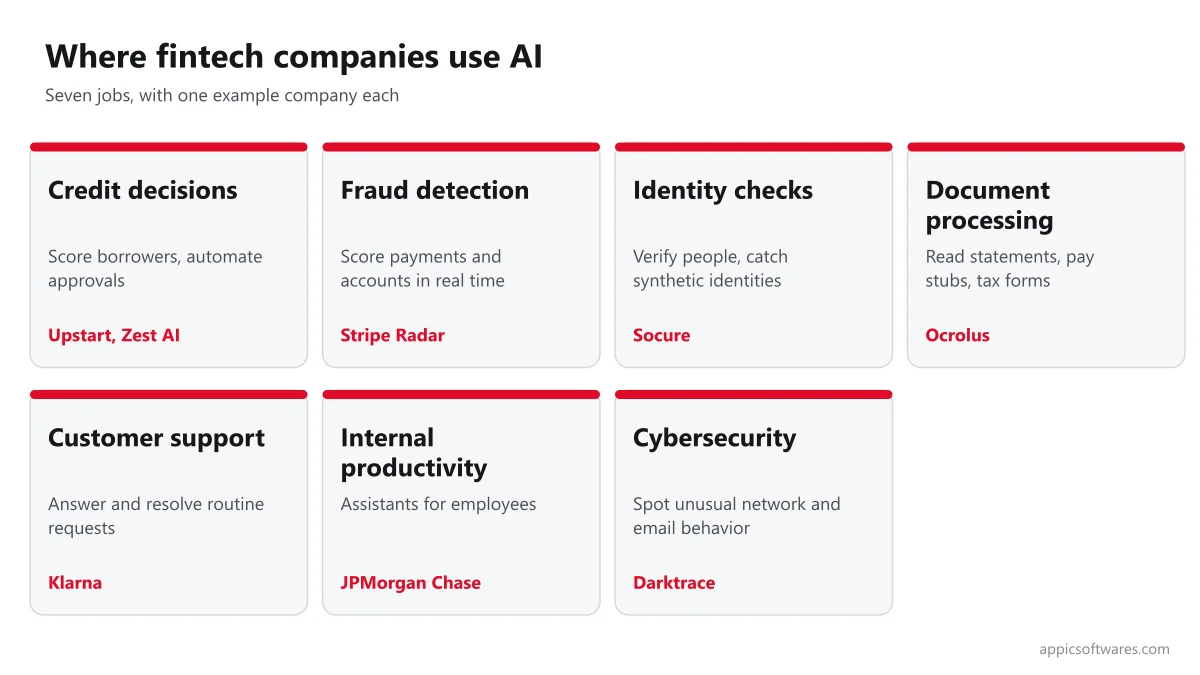
Where do fintech companies use AI?
| Use case | What AI does | Example in this list |
| Credit decisions | Scores borrowers and automates approvals | Upstart, Zest AI |
| Fraud detection | Scores each transaction or account in real time | Stripe Radar |
| Identity and onboarding | Verifies people and detects synthetic identities | Socure |
| Document processing | Reads bank statements, pay stubs and tax forms | Ocrolus |
| Customer support | Answers questions and resolves routine requests | Klarna |
| Internal productivity | Assistants and coding tools for employees | JPMorgan Chase |
| Cybersecurity | Detects unusual behavior on networks and email | Darktrace |
Which companies are using AI in fintech?
Listed alphabetically. Facts come from each company's own website or press release unless noted. Check the links for current figures.
1. Darktrace
Darktrace is a cybersecurity company whose platform is built on AI. Its site describes a behavioral defense platform covering email, networks, people and AI systems, says it serves 10,000+ customers and says it was named a Leader in the 2026 Gartner Magic Quadrant for network detection and response. It is not a fintech company; we include it because banks and fintechs use security tools of this kind. See darktrace.com. We did not confirm its ownership status.
2. JPMorgan Chase
JPMorgan has an internal AI assistant called LLM Suite. Press coverage of the bank's February 2026 update reports about 150,000 employees using it weekly and a 2026 technology budget of about $19.8 billion (Zacks). Sources disagree on total user counts and on AI-specific spending, so we use only the most consistent figures. Check the bank's filings for exact numbers.
3. Klarna
Klarna said in a February 2024 press release that its OpenAI-powered assistant handled 2.3 million conversations in its first month, about two-thirds of customer service chats, and did the work of 700 full-time agents. Coverage questioned how much of that was replacement versus filtering to human support (Pragmatic Engineer). The figures are two years old, so check Klarna's current statements before quoting them.
4. Ocrolus
Ocrolus calls itself an AI workflow and analytics platform for lenders. It reads bank statements, pay stubs and tax documents and supports mortgage, small business and consumer lending. Its site claims document analysis at "over 99+% accuracy" with no method shown, and customers quoted include Better and Fora Financial (ocrolus.com). Treat the accuracy claim as a vendor claim.
5. Socure
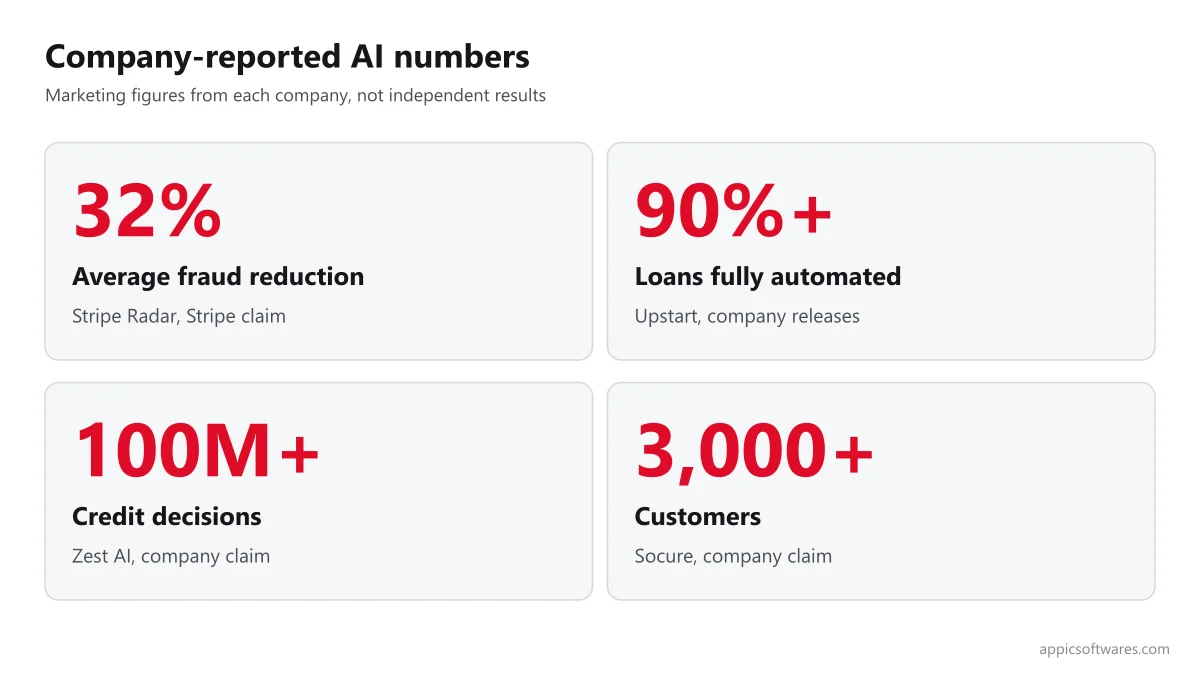
Socure sells identity verification and risk decisioning, with products for identity fraud, synthetic fraud, document and biometric checks, and compliance screening. It says it has over 3,000 customers and works with 19 of the 20 largest US banks (socure.com). These are the company's claims. It also markets a product to detect and credential AI agents.
6. Stripe (Radar)
Stripe Radar is an AI-based fraud product that blocks fraudulent payments, flags suspicious accounts and helps prevent customer abuse. Stripe says it is trained on more than 70 trillion data points across its network and cites a 32% average reduction in fraud and a customer, SiteMinder, that cut fraudulent payment volume by 61% (stripe.com/radar). These are Stripe's marketing figures.
7. Upstart
Upstart runs an AI lending marketplace. Its Q2 2026 results, released August 4, 2026, reported $4.2 billion of originations (558,014 loans), $365 million of revenue and net income of $16.5 million, and its releases say more than 90% of loans are fully automated with no human involvement from Upstart (Barchart reprint). We read the release reprint, not the full filing.
8. Zest AI
Zest AI sells AI underwriting and fraud tools to banks, credit unions and specialty lenders. Its site says it supports 1 in 7 US adults, 100M+ credit decisions and 1,500+ active models, and cites credit union results such as Truliant doubling instant approvals and Idaho Central reaching 75% automated decisioning (zest.ai). The page makes no explicit regulatory approval claim, so check explainability with the vendor.
Planning an AI feature for a fintech product? Tell us the use case and the data you have, and we will help you scope it. Get your project scoped
What do these companies have in common?
- A narrow, repeated decision. Approve or decline, block or allow, verified or not.
- Large volumes of data. Stripe cites network data, Zest AI cites millions of decisions and Upstart cites hundreds of thousands of loans a quarter.
- Humans where it counts. Klarna routes to people, Ocrolus customers describe human-in-the-loop checks, and Upstart reports a share of loans that are not automated.
- Compliance built in. Lending and identity tools need explainability, audit trails and bias testing.
What are the risks of AI in fintech?
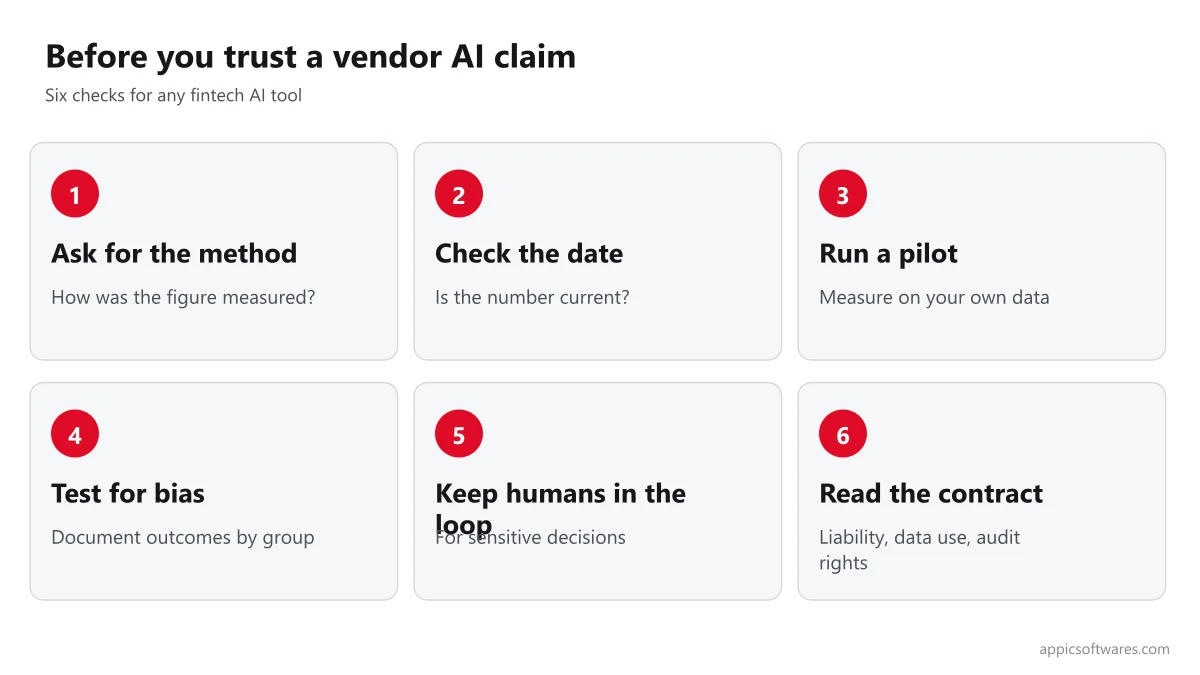
- Bias and fair lending. Models trained on historical data can disadvantage groups. Test and document outcomes.
- Explainability. Lenders usually must explain declines. Prefer models that can.
- Data privacy and security. Limit and encrypt personal data. See cybersecurity in fintech and fintech compliances.
- Over-reliance on vendor claims. Run a pilot and measure against your own baseline.
- Model drift. Performance changes as customers and fraud tactics change.
Free AI fintech scoping session: share your use case, data and compliance needs. We will outline the model approach, integrations and a cost range. Book your session
Should you buy a tool or build AI into your fintech product?
| Approach | Best when | Trade-off |
| Buy a vendor tool | A standard need such as fraud or identity checks | Less control, per-use fees |
| Build custom models | Your data or decisions are unique | Needs data, ML talent and monitoring |
| Combine | Most teams | Needs integration and governance |
Learn more in AI in credit scoring, fintech solutions and best fintech app development companies.
How Appic builds AI fintech solutions
Appic Softwares has built custom software since 2018, with offices in Jaipur (India), Frisco, Texas (USA) and Munich (Germany), and a 5.0 Clutch rating from 24 verified reviews. We build AI fintech solutions, finance apps and machine learning features, and we can provide AI engineers to your team. Our average rate is about $35 per hour, and projects typically start around $10,000.
What changed from the earlier version of this post?
The June 2024 version listed 12 companies with generic descriptions and used market forecasts through 2026 and an unsourced efficiency claim. This update keeps companies we could check against their own sites or releases, adds JPMorgan, Klarna, Stripe and Upstart, labels every figure as a company claim, drops the unsourced statistics and covers risks and buy or build choices. Companies we could not verify (Enova, DataRobot, Scienaptic AI, Kensho, Vectra AI, Trim, Alpaca and ShapeShift) were removed from this version.
Ready to add AI to your fintech product? Send us your use case and data. We will reply with an approach, the compliance steps involved and a cost range you can review with your team. Talk to our team
Frequently Asked Questions
Which companies are using AI in fintech?
Examples include Stripe (Radar fraud detection), Upstart and Zest AI (lending), Socure (identity), Ocrolus (lending documents), Klarna (customer support), JPMorgan Chase (internal AI tools) and Darktrace (cybersecurity). Most figures they publish are company claims, so verify them for your own use case.
How is AI used in fintech?
AI is used for credit scoring and approvals, real-time fraud detection, identity verification, reading financial documents, customer support and internal productivity. It works best on high-volume, repeated decisions where there is plenty of data, and with human review for exceptions.
What are the benefits of AI in fintech?
Companies report faster decisions, lower fraud losses, less manual work and better customer response times. For example, Stripe cites a 32% average fraud reduction and Upstart says over 90% of loans are fully automated. These are company-reported figures, not independent results.
What are the risks of AI in fintech?
Main risks are bias and fair lending issues, lack of explainability, privacy and security of personal data, over-reliance on vendor claims and model drift over time. Regulators expect firms to explain decisions and keep records, so build testing, monitoring and human review into the product.
How much does it cost to build AI into a fintech app?
Costs depend on the use case, data quality, integrations and compliance work. Buying a vendor tool is usually faster and cheaper to start, while custom models cost more upfront. Appic projects typically start around $10,000 for a focused scope. Ask for a scoped estimate.
Should a startup buy or build AI for fintech?
Most startups should buy standard components such as fraud scoring or identity checks and build custom models only where their own data gives an edge. Run a pilot, measure against your baseline and keep a human in the loop for sensitive decisions.
Related Articles
How Much Does It Cost To Create A Healthcare Software In 2026?
Machine Learning In Healthcare: Top Startups, And More
Artificial intelligence and machine learning development services are transforming clinical operations, drug discovery, and data management in healthcare. These services enable hospitals to analyze vast medical data and enhance decision-making accuracy. The impact of deep learning in healthcare continues to grow as more innovative machine learning applications in healthcare emerge. According to Statista, the global […]

Cost Of HIPAA Compliant App Development
Developing a HIPAA-compliant app (for telemedicine, patient records, fitness + healthcare, or hospital management) is more expensive than regular app development because of strict data security, encryption, and compliance requirements. With the rapid growth of health apps and the introduction of stricter privacy regulations, tech companies must continuously review how they collect, process, and store […]

What Are The Steps For AI Implementation In Healthcare?
AI implementation in healthcare means using smart software to help doctors, nurses, and staff. It can learn from data. It can spot patterns in scans and records, speed up tasks, and cut mistakes. By 2026, the US healthcare industry might save $150 billion annually thanks to important clinical health AI applications. The steps for AI […]

Doctor on Demand App Development: Features, Architecture, Compliance, Cost and Timeline in 2026