Banking App Development: 8 Easy Steps To Get Your App

On May 18, 1995, Wells Fargo became one of the first banks to offer internet banking. Three decades later, roughly 2.5 billion people use digital banking worldwide, and customers now expect to do almost everything from a phone. That demand has made banking app development one of the busiest areas of fintech.
This guide covers what a mobile banking app is, how it works, which features to build, how to secure it, how KYC/AML and APIs fit in, what the architecture looks like, and what it costs and how long it takes.
How Does Mobile Banking Work?
Mobile banking is a simplified version of branch banking designed for on-the-go use. Customers download an app from an app store, register, and can then transfer funds, check balances, pay bills, open deposits, and manage cards at any hour.
The basic requirements are a smartphone and an internet connection. Modern apps add SMS requests, push notifications for transaction alerts, and increasingly chat-based support, all aimed at making banking faster and more intuitive.
Market Snapshot
There are over 5 billion unique mobile users worldwide. Large banks such as Bank of America report tens of millions of active mobile users, and mobile payment volumes have grown into the hundreds of billions of dollars a year. For banks and fintechs, a good app is no longer optional; it is the main customer channel.
Why Mobile Banking Apps Matter
The pandemic accelerated adoption by making contactless money movement essential. The benefits that keep customers using apps are:
- Instant transactions: send money any time, including bank holidays, with no branch hours.
- 24x7 availability: no queues, no waiting for a branch to open.
- Stronger security: Face ID, fingerprints, PINs and multi-factor authentication, plus the ability to freeze a lost card or device remotely.
- Full service access: payments, bill pay, statements, transfers and fixed deposits in a few taps.
- Multilingual support: apps can be offered in many languages, removing a common barrier.
- Better money management: spending categories, budgets and alerts encourage saving.
- Faster support: in-app chat, calls and instant card blocking.
Types of Banking and Finance Apps
1. Mobile banking apps
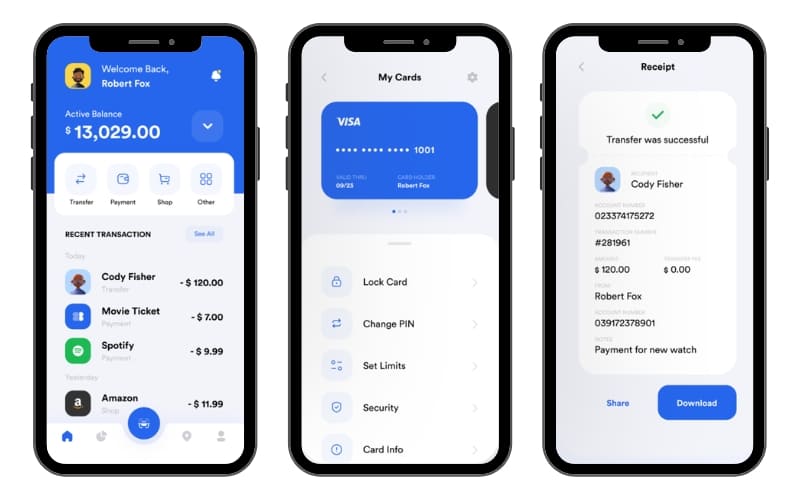
Balances, transactions, transfers and bill payments.
2. Investment apps

Buy and sell stocks, mutual funds and other assets.
3. Digital wallets

Store cards and pay online or in-store.
4. Lending apps

Apply for and receive loans with digital paperwork.
5. Personal finance managers

Aggregate accounts, categorize spending and track investments.
6. Super apps

Combine banking, shopping, payments and other services in one platform.
Current Trends
- Voice payments and voice search for hands-free transactions.
- AI chatbots and assistants that resolve most queries without a call center.
- Biometric and passkey login replacing passwords.
- Contactless payments through NFC and QR codes.
- Open banking and embedded finance, letting third parties plug into the bank through APIs.
- Hyper-personalization driven by transaction data and machine learning.
Why a Banking App Is Good for Business
- Brand strength: a polished app signals a trustworthy, modern institution.
- Customer value: every session is a chance for personalized offers and engagement.
- Lower service cost: self-service reduces branch and call-center load.
- More touchpoints: easier access means more transactions, products sold, and revenue.
- Faster feedback: in-app surveys and analytics show what customers actually use.
Core Features
MVP Features
| Feature | What it does |
| Registration and onboarding | Account creation with identity verification (see KYC section) |
| Biometric login | Face ID, fingerprint,nt and PIN as the main authentication layer |
| Account balances | Real-time balance and account summary |
| Transaction history | Searchable, filterable statement with export |
| Fund transfers | Own-account, intra-bank and interbank transfers (UPI, ACH, SEPA, Faster Payments or local rails) |
| Bill payments | Utilities, mobile recharge and billers |
| Card management | Request, activate, freeze and set limits on cards |
| Push and SMS alerts | Transaction, login and security notifications |
| Expense dashboard | Spending by category with budget alerts |
| Customer support | In-app chat, call and FAQ |
| Data encryption | End-to-end protection of data in transit and at rest |
Full-Product Features
| Feature | What it does |
| QR code payments | Scan to pay or request money |
| Recurring and scheduled payments | Standing instructions and auto-pay for bills |
| NFC and tap-to-pay | Contactless payments with biometric confirmation |
| ATM and branch locator | Map-based search for nearby locations |
| Rewards, cashback and gamification | Incentives for engagement and spending |
| Loans and credit | Digital applications, instant eligibility, EMI calculators |
| Investments | Fixed deposits, mutual funds, stocks, robo-advisory |
| AI assistant | Conversational support and spending insights |
| Multi-currency and international transfers | FX rates and cross-border payments |
| Open banking and account aggregation | View accounts from other institutions |
| Admin and back-office panel | Customer management, disputes, reporting and risk tools |
Security: Building It In From Day One
Security is what separates a banking app from any other app. It must be designed in from the first sprint, not added before launch.
Authentication and access
- Multi-factor authentication (MFA): combine something you know (PIN), have (dev, ICE), and are (biometrics). Use biometric APIs such as Face ID and Android BiometricPrompt, with a secure fallback.
- Device binding: tie a customer's session to a registered device and require re-verification when it changes.
- Step-up authentication: ask for extra verification for high-risk actions such as adding a payee or large transfers.
- Session management: short-lived tokens (OAuth 2.0 / OpenID Connect), refresh token rotation, and automatic logout after inactivity (commonly 5 to 15 minutes) enforced on both client and server.
- Strong customer authentication: required for many payments in the EU and UK under PSD2.
Data protection
- Encryption in transit: TLS 1.2+ everywhere, with SSL/certificate pinning in the mobile app to defeat man-in-the-middle attacks.
- Encryption at rest: AES-256 for databases and backups, with keys held in a hardware security module (HSM) or cloud KMS and rotated regularly.
- Secure storage on device: keep tokens in iOS Keychain and Android Keystore, never in plain preferences or logs.
- Tokenization: replace card numbers with tokens so raw card data never touches your systems. Providers such as VGS reduce PCI scope significantly.
- Passwords: never store them in plain text; use salted, slow hashes such as bcrypt or Argon2.
- Data minimization: collect and retain only what regulation and the product require.
Application and infrastructure security
- Secure coding: follow the OWASP Mobile Application Security Verification Standard (MASVS) and OWASP API Security Top 10.
- Runtime protection (RASP): detect rooted or jailbroken devices, debuggers, emulators and tampering; add code obfuscation.
- API security: rate limiting, input validation, request signing, an API gateway and a web application firewall.
- Fraud detection: machine learning models that score every transaction for anomalies, velocity, device and location risk, and block or challenge suspicious activity in real time.
- Monitoring: centralized logging, SIEM alerts, immutable audit trails, and a tested incident-response plan.
- Testing: static and dynamic analysis in CI, regular penetration tests by an independent firm, and a bug bounty program after launch.
- Zero trust and least privilege: every service and employee gets only the access they need, with network segmentation between environments.
Compliance frameworks
The frameworks you must plan for depend on where you operate:
- PCI DSS for card data handling
- PSD2 and Strong Customer Authentication in the EU and UK
- GDPR (EU), CCPA/CPRA (California) and India's DPDP Act for personal data
- SOC 2 and ISO 27001 for security management and customer assurance
- Local central bank and regulator rules such as RBI guidelines in India, FFIEC in the US and FCA in the UK
KYC and AML Compliance
A bank cannot onboard customers or move money without knowing who they are and monitoring what they do. This is usually the most regulated and time-consuming part of the build.
KYC (Know Your Customer)
A typical digital KYC flow includes:
- Data capture: name, date of birth, address, phone and email, with OTP verification.
- Document verification: the customer photographs a government ID (passport, driver's license, national ID, Aadhaar or PAN where applicable). OCR extracts the data, and the system checks authenticity and tampering.
- Liveness and face match: a selfie or short video proves a live person is present and matches the ID photo, defeating photos, masks and deepfakes.
- Database and registry checks: validate details against government, credit bureau and identity databases (for example video KYC or e-KYC in India).
- Risk scoring: assign a customer risk tier based on geography, occupation, source of funds and product, which decides the level of due diligence.
- Enhanced due diligence (EDD): extra checks and documents for high-risk customers and politically exposed persons (PEPs).
- Periodic review: re-verify customers and refresh data on a risk-based schedule.
AML (Anti-Money Laundering)
- Sanctions and watchlist screening: check customers and counterparties against OFAC, UN, EU and local lists at onboarding and continuously.
- PEP and adverse media screening: identify politically exposed individuals and negative news.
- Transaction monitoring: rules and machine learning models flag structuring, unusual velocity, round-tripping and geographic anomalies.
- Case management: analysts review alerts, document decisions and escalate.
- Suspicious activity reporting: file SARs/STRs with the financial intelligence unit in your jurisdiction within the required window.
- Recordkeeping: retain identity and transaction records for the legally required period (commonly five years or more).
- Travel rule: share originator and beneficiary information on qualifying transfers.
Build or buy?
Most teams integrate a specialist provider rather than building KYC/AML from scratch. Common categories are identity verification (Onfido, Veriff, Jumio, Persona, IDnow), screening and monitoring (ComplyAdvantage, Refinitiv World-Check, LexisNexis, Sumsub) and regional e-KYC services. Choose providers on accuracy, coverage of your countries, speed, pricing per check, and regulatory acceptance. Keep the integration behind your own abstraction layer so you can switch vendors later.
APIs and Integrations
No bank app stands alone. Plan for these integrations early because they often decide the schedule.
| Category | Purpose | Examples |
| Core banking | Accounts, ledgers, products, interest | Temenos, Finacle, Mambu, Thought Machine, Oracle FLEXCUBE, Fiserv |
| Banking-as-a-Service | Licensed accounts and cards without your own bank charter | Unit, Treasury Prime, Solaris, Railsr, Swan |
| Payments and rails | Transfers, cards, wallets | ACH, SEPA, Faster Payments, SWIFT, UPI, Stripe, Adyen, Plaid, Razorpay |
| Card issuing and processing | Virtual and physical cards, authorization | Marqeta, Lithic, Visa and Mastercard programs |
| KYC/AML | Identity, screening, monitoring | Onfido, Jumio, Sumsub, ComplyAdvantage |
| Credit and risk | Bureau data, scoring | Experian, Equifax, TransUnion, CIBIL |
| Open banking | Account aggregation, data sharing | Plaid, TrueLayer, Yodlee, Account Aggregator (India) |
| Notifications | SMS, email, push | Twilio, Firebase, AWS SNS |
| Support and analytics | Chat, CRM, product analytics | Zendesk, Intercom, Mixpanel, Firebase |
API design principles
- Expose a versioned REST or GraphQL API through an API gateway (authentication, throttling, logging).
- Use idempotency keys on every money-moving call so retries never double-charge.
- Use webhooks and message queues for asynchronous events such as settlement and KYC results.
- Follow OAuth 2.0, OpenID Connect, and FAPI profiles for secure open banking access.
- Wrap each third-party service in an adapter so failures or vendor changes do not ripple through your code.
- Document everything with OpenAPI and offer a sandbox for partners.
Architecture of a Banking App
A modern banking platform is usually split into clear layers.
1. Client layer. Native iOS and Android apps, plus an optional web app and admin portal. Banking apps benefit from native development (Swift/SwiftUI and Kotlin/Jetpack Compose) for the best biometric, security and performance support. Flutter and React Native can work for simpler products if native security modules are used.
2. Edge and gateway layer. CDN, web application firewall, DDoS protection, and an API gateway handling authentication, rate limiting g, ng and routing.
3. Service layer (microservices). Independent services, each owning its data:
- Identity and access (login, MFA, device binding)
- Onboarding and KYC
- Accounts and ledger
- Payments and transfers
- Cards
- Notifications
- Fraud and risk
- Reporting and analytics
Start as a well-structured modular monolith if the team is small, and split into microservices as scale demands.
4. Data layer. A relational database (PostgreSQL or similar) for the ledger with strict ACID guarantees; Redis for caching and sessions; a document or search store for logs and activity; an event stream such as Kafka for audit and analytics; and a data warehouse for reporting.
5. Integration layer. Adapters to core banking, payment rails, KYC providers and credit bureaus, connected through queues and webhooks.
6. Infrastructure and DevOps. Containers on Kubernetes, a major cloud (AWS, Azure or GCP) with multi-zone redundancy, infrastructure as code, CI/CD with security scanning, secrets management, backups, disaster recovery and observability (metrics, tracing, alerting).
Key architectural principles
- Treat the ledger as the source of truth, double-entry and append-only.
- Design for high availability (target 99.9% or better) and graceful degradation.
- Make every action auditable with who, what, when, and from where.
- Keep data residency requirements in mind when choosing regions.
- Separate environments and secrets, and never use production data in testing.
How Mobile Banking Apps Are Built: Step by Step

- Research and discovery. Define your audience, regulatory environment, competitors, and unmet needs. Local habits matter: if most of your market pays by credit card or UPI, that feature is not optional.
- Compliance and security foundations. Decide on licensing path (own charter, partner bank or BaaS), data residency, PCI scope and the security architecture before writing feature code.
- Prototype. Build clickable flows for onboarding, login, transfers and cards, and test them with real users.
- UX and UI design. Create a simple, confidence-building interface, especially for large payments, with accessibility and multilingual support.
- Development. Build the back end, APIs and mobile apps in iterative sprints, starting with the core ledger, authentication and onboarding.
- Third-party integrations. Connect KYC, payments, card issuing, notifications and core banking, with sandbox testing for each.
- Testing. Functional, performance, load, security and penetration testing, plus user acceptance testing and a closed beta.
- Launch and iterate. Release gradually, monitor closely, fix issues fast and add features based on usage data and customer feedback.
Technology Stack
| Layer | Common choices |
| iOS | Swift, SwiftUI, UIKit, Xcode |
| Android | Kotlin, Jetpack Compose, Android Studio |
| Cross-platform | Flutter, React Native |
| Back end | Java/Spring Boot, Node.js, Go, .NET, Python |
| Database | PostgreSQL, MySQL, Redis, MongoDB |
| Messaging | Kafka, RabbitMQ, AWS SQS |
| Cloud and DevOps | AWS, Azure, GCP, Docker, Kubernetes, Terraform, GitHub Actions |
| Security | HSM/KMS, WAF, Vault, SIEM, MASVS tooling |
| AI and data | Python, TensorFlow/PyTorch, Snowflake/BigQuery |
Top Challenges
- Biometric authentication. Behavior differs across thousands of Android devices, so testing takes longer than expected.
- KYC verification. Document variety, fraud attempts, and regional rules make accurate, low-friction onboarding hard.
- Third-party integration. Vendor delays, inconsistent documentation and sandbox limits can stall progress, so plan buffer time.
- Fast-changing requirements. Fintech moves quickly; build modular systems that adapt without rewrites.
- Regulation. PCI DSS, GDPR, CCPA, PSD2, local AML laws and central bank rules all apply in different places and change regularly.
- Fraud and scams. Authorized push payment fraud and social engineering require both technology and customer education.
How Much Does It Cost to Build a Banking App?
Costs depend on features, platforms, integrations, compliance, and team location. These are typical ranges for planning, not quotes.
| Scope | What's included | Estimated cost |
| Basic MVP | One or two platforms, onboarding with third-party KYC, balances, transfers, cards via BaaS | $40,000 – $80,000 |
| Mid-level app | Full features above plus bill pay, budgeting, notifications, admin panel, multiple integrations | $80,000 – $150,000 |
| Advanced / neobank | Native iOS and Android, full KYC/AML stack, fraud engine, loans, investments, open banking, analytics | $150,000 – $300,000Enterprise/core |
| e build | Own core banking, multi-country, heavy compliance and scale | $300,000 – $1M+ |
Cost breakdown (approximate share of budget)
- Discovery, product and design: 10–15%
- Mobile app development: 25–30%
- Back end, APIs and ledger: 25–30%
- Security and compliance work: 10–15%
- Testing and QA: 10–15%
- Project management and DevOps: 5–10%
Ongoing costs to budget for
- Maintenance and updates: about 15–20% of build cost per year
- Cloud infrastructure and monitoring
- Per-use fees for KYC checks, SMS, card issuing and payment processing
- Annual penetration tests, audits and certifications (PCI DSS, SOC 2, ISO 27001)
- Compliance staff and fraud operations
- Customer support
What drives cost up or down
- Using BaaS and a licensed partner bank versus building your own core
- Number of countries, currencies and languages
- Custom UI and animation versus standard components
- Level of AI, personalization and analytics
- Developer location (rates vary widely between regions)
How Long Does It Take? Development Timeline
| Phase | Typical duration |
| Discovery, compliance planning and architecture | 3–6 weeks |
| UX/UI design and prototype | 4–6 weeks |
| Core development (back end, ledger, mobile apps) | 12–20 weeks |
| Third-party integrations (KYC, payments, cards) | 4–8 weeks (overlaps with development) |
| Testing, security audit and pen test | 4–6 weeks |
| Regulatory approvals, beta and launch | 4–12 weeks (varies by region) |
Overall estimates
- Lean MVP on a BaaS platform: about 3 to 5 months. A very focused prototype or limited-feature MVP can be ready in 6 to 8 weeks, but it is not a production banking product.
- Full-featured app for one market: about 6 to 9 months.
- Neobank or multi-country platform: 9 to 18 months or more.
Regulatory licensing and partner-bank approvals often take longer than the engineering, so start those conversations on day one.
How AI Is Changing Banking
- Customer service: chatbots and assistants that answer questions in natural language, 24/7.
- Fraud detection: real-time anomaly scoring that blocks suspicious transactions.
- Credit scoring and underwriting: wider data signals help thin-file borrowers and speed approvals.
- Personalized insights: spending analysis, savings nudges and product recommendations.
- AML and compliance: smarter transaction monitoring with fewer false positives, plus automated regulatory tracking.
- Back-office automation: document processing, data entry and reconciliation.
- Robo-advisory and predictive analytics: automated portfolios and market forecasting.
- Biometrics: voice and face recognition for secure, low-friction login.
Any AI that influences credit or compliance decisions must be explainable, tested for bias and auditable, as regulators increasingly require.
How Appic Softwares Can Help
Appic Softwares builds secure, scalable fintech and mobile banking applications, from MVPs to full neobank platforms. With a team of more than 250 professionals, we cover discovery, UX/UI design, native and cross-platform development, KYC/AML and payment integrations, security hardening and post-launch support. We can tailor the app to your market, regulations, and brand.
If you are planning a banking app, talk to our team about your idea, or learn more about our mobile app development company and finance app development services.
Key Takeaways
A successful banking app is planned carefully, secured from the first line of code, compliant with the rules of every market it serves, and built on an architecture that can grow. Get security, KYC/AML, and integrations right, scope an MVP that delivers real value, and iterate based on what customers actually use.
Frequently Asked Questions
How much does it cost to develop a banking app?
The cost of banking app development can range from $40,000 to $250,000+, depending on features, security requirements, platforms, integrations, and development complexity.
How long does it take to develop a banking app?
A basic banking app may take around 4 to 6 months, while a feature-rich banking platform with advanced security, APIs, and third-party integrations can take 8 to 12 months or more.
What features should a banking app have?
Common banking app features include account management, money transfers, bill payments, transaction history, card management, notifications, biometric login, customer support, and fraud monitoring.
How secure should a banking app be?
Security should be a core part of banking app development. Features such as multi-factor authentication, data encryption, biometric authentication, secure APIs, fraud detection, and transaction monitoring help protect user and financial data.
Related Articles
Multi-Agent Systems for Real Estate: How AI Teams Are Reshaping Property Operations in 2026
How Agentic AI Is Transforming Real Estate Operations in 2026