Are you one of the people who are still debating whether or not a front-end framework is necessary for the web application you are developing? Choosing the most appropriate front-end framework for your Drupal website is made more difficult by the emergence of new technologies such as React, Angular, Vue, Backbonejs, Emberjs, and jQuery. Continue reading to learn the answers to these common questions, which will assist you in making an informed decision regarding the front-end framework that is most suitable for your Drupal website.
Why Use a Front-End Framework?
When I was a kid, I used to fantasize about a world that was very similar to the one we live in now. A world dominated by machines, the technologies they employ, and the potential for that machinery to alter the course of history. The web as we know it has been fundamentally altered as a result of the proliferation of new user interfaces and devices. In the realm of digital technology, certain technologies, such as artificial intelligence and the internet of Things, have begun to establish themselves and make an influence. Because of this impact, our vision of a future filled with seamless and feature-packed websites has been altered.
Despite this, and even though freshly web-enabled gadgets continue to dominate, how we develop for the web has progressed. Even though the information presented does not change, how it is communicated can look very different depending on the requirements and the intricacies involved. The next generation of user experiences is here, and users now anticipate that websites to operate effortlessly and quickly.
When faced with such needs, it is difficult to cling to traditional approaches and solutions. Implementing a front-end framework can help eliminate some of the bulk and messiness that occurs as your front-end expands. While it is not difficult to build a sophisticated yet amazing UI/UX with only plain HTML and CSS, it is recommended that you do so. It should come as no surprise that the majority of the industry’s heavy hitters—including Airbnb, GitHub, Forbes, Netflix, Pinterest, and PayPal, among others—that are known for providing excellent user experiences are those that use well-known front-end frameworks such as React, Angular, and Vue.
Headless Drupal and Front-End Frameworks
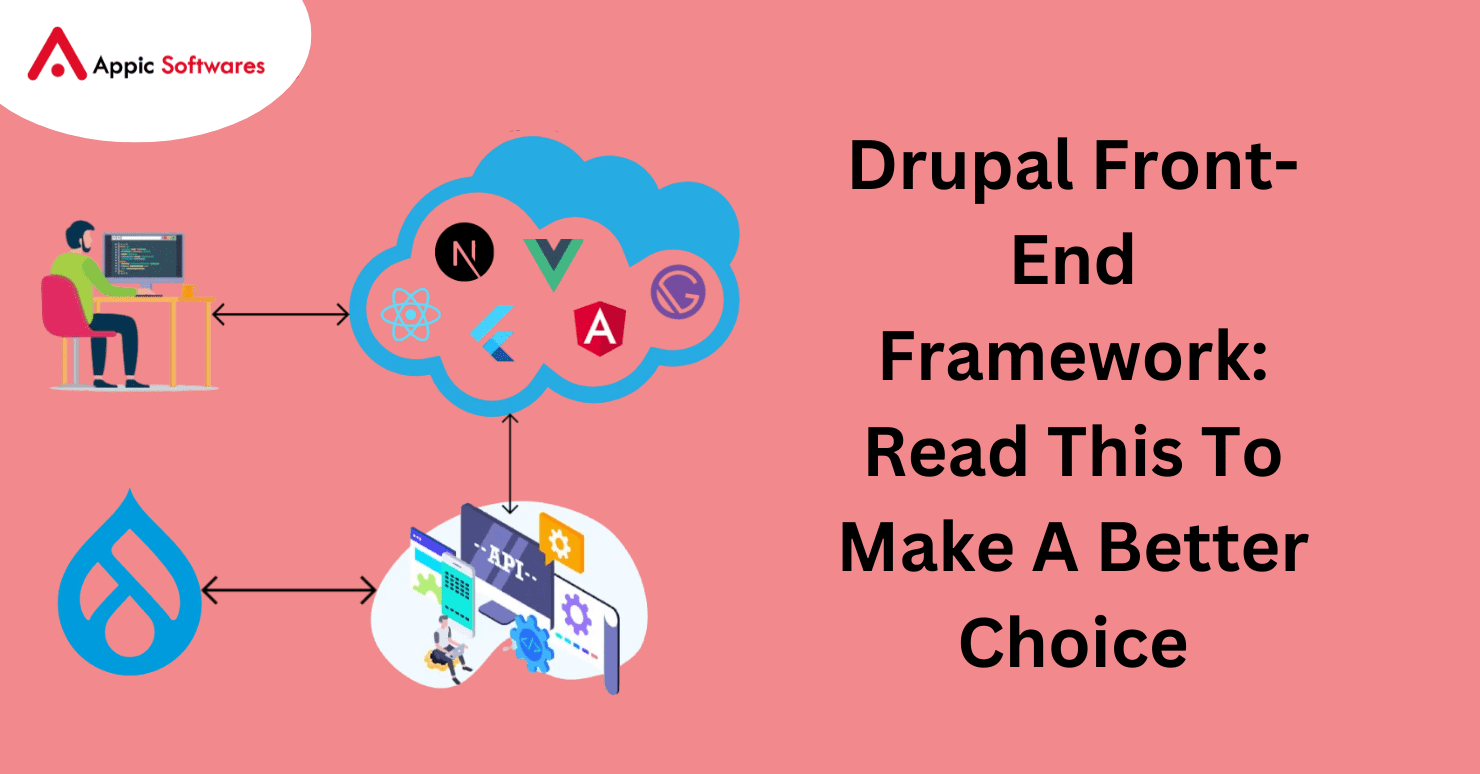
Although Drupal is excellent at managing the backend, its front-end features are not as flexible as those of other content management systems. The requirement for more up-to-date, complex, dynamic, and application-like front-end interfaces was the impetus for the development of headless Drupal, also known as decoupled Drupal. In a Drupal design known as headless, developers have the freedom to construct the front end of the application in any way they see fit, even without utilizing Drupal. Even though Drupal is still used as a backend repository, front-end frameworks can make API calls to communicate with the database directly.
But how do you go about selecting the front-end framework that is most suited for your Drupal website? Even while each framework comes with its own set of benefits and drawbacks, which one is selected for a project is almost entirely determined by the demands and requirements of the organization. Let’s get into further detail about this.

AngularJS
When it comes to interacting with Drupal, the most popular front-end framework on the list is Angular JS, which is also the front-runner in terms of developer preference. It gives you the ability to construct feature-rich dynamic web apps and makes Drupal run more efficiently, which ultimately results in a Drupal website that is dynamic, secure, and captivating. This open-source framework is supported by Google itself, and it gives you the ability to handle your user’s browser without requiring you to fetch data from your server.
Things Developers Like about Angular
- Incredibly lightweight, highly expandable, and packed with a variety of different features.
- An interactive framework, the fruit of which is wonderful functionality such as two-way binding, which makes it possible for user inputs to quickly trigger application objects.
- HTML is beloved by developers, and the fact that AngularJS makes use of simple HTML templates that are easily re-usable, modifiable, and extensible enables them to create dynamic web apps that are packed with interactive features.
- Because it is client-side, AngularJS is very effective at fending off cyberattacks. This is because any data that is trying to circumvent the security cannot go anywhere near the server.
- Massive community support that includes FAQs, how-to guides, and examples of actual use, in addition to comprehensive documentation.
Drupal And AngularJS
Decoupled Drupal, or headless Drupal as it is more frequently known, is getting more popular these days. This is likely because user expectations are continuously evolving and rising. The plan is to make use of a front-end framework to take care of the client-facing interface while taking advantage of the flexibility and powerful back-end features that Drupal provides. What more suitable choice could there be than the interactive AngularJS to handle communication with the browser, while Drupal takes care of the back-end functionality?
Additionally, AngularJS performs an excellent job of offloading some of Drupal’s logic and assisting Drupal in functioning more successfully on the back end of the website. By transferring display logic to the client side of the website and streamlining the back end, it will be possible to create a website with improved performance and increased speed.
VueJS
This extremely adaptable version of JS was developed by Evan You, who formerly worked for Google. It has garnered a lot of attention from developers very rapidly. It is a JavaScript library that may be used for the construction of modern web interfaces. It offers data-reactive components that have an API that is both simple and flexible.
Things Developers Love about Vue
- Vue is built on the shoulders of giants, with a gentle learning curve and a component model. It provides the benefits of reactive data binding and composable view components with a straightforward application programming interface (API).
- VueJS can perform well and increase the overall performance of websites because it utilizes a combination of the best features of both Angular and React, namely two-way binding and Virtual DOM.
- A further advantage is provided by real-time monitoring of the development progress, which also includes an integrated state management system.
- Vue JS employs a development methodology known as component orientation, along with current tooling and modules to support it. People who are using it for the first time feel that it is easy to pick up because the syntax is straightforward to understand.
- On Github, VueJS is currently regarded as one of the most popular and cutting-edge JS frameworks.
- It has widespread adoption and support from an incredible community, both of which are found within the PHP community, which does an excellent job of keeping the documentation up to date.
Drupal And VueJS
Using the official Vue-Resource plugin, Vue gives developers the ability to request and save Drupal content as data objects in their applications.
In conjunction with Vue, Drupal can perform its enchantment on the back end of the application, while the attractive capabilities of the JS take care of the front end. Vue’s ability to develop large-scale applications using small, self-contained, reusable components is made possible by the framework’s component system, which is one of the most powerful aspects of the framework.
ReactJS
ReactJS is more of a library than it is a framework; it is used to construct user interfaces that are based on the idea of reusable components. Its primary purpose is to address the problems that are caused by the sluggishness of the DOM by substituting the real DOM structure with a virtual one. ReactJS, which is an open-source project maintained by Facebook and is one of the most popular options for providing a quick and seamless client-side user experience, is used by some of the largest organizations.
Things Developers Love about React
- Because ReactJS is, by its very nature, very legible and straightforward, it is therefore much simpler to comprehend how components render based on the source files they come from.
- The elimination of the complexity that exists between HTML and JS as a result of the use of ReactJS, which performs an excellent job of integrating HTML and JavaScript into JSX, is a tremendous benefit for developers.
- Monitoring the relatively lightweight virtual DOMs allows React to easily process vast volumes of data effectively. This is made possible via Virtual DOM.
- Because it can be rendered very quickly, ReactJS is an excellent choice for developing rapid public-facing applications and websites that are fluid and provide the best user interface experience possible.
- Because of Facebook’s ongoing commitment to the advancement of React, developers now have access to a wealth of useful documentation, tools, add-ons, and other resources. These are made possible by Facebook’s ongoing support of the project.
- It has widespread adoption and support from an incredible community, both of which are found within the PHP community, which does an excellent job of keeping the documentation up to date.
Drupal And ReactJS
An added benefit that can easily enable consistent mapping of Drupal and React components is a hybrid strategy that uses React to deal with the intricacies of the user experience (UX), while depending on Drupal to handle the content management responsibilities of the website.
One of the most significant shortcomings of Drupal is how it consumes and presents the structure of information to the end user. This is one of the main reasons why Drupal’s performance is so poor. This spirals out of control when the user interactions are difficult, to the point where even the combination of Twig and JQuery is not adequate to handle the intricacies. Integration with a current toolkit such as React, on the other hand, offers all of the necessary modern techniques that perform an excellent job of constructing user experiences that are smooth and rich.
End consumers are now accustomed to websites that perform better than average, and they do not accept anything less than a website that is quick to load, engaging, and provides a satisfying experience for the user. Decoupled Drupal design is now favored since it helps overcome a constraint that Drupal has in terms of rendering the client side. The “headless Drupal” approach makes it possible to enjoy Drupal’s many benefits uninterrupted by its graphical user interface. These three frameworks—Angular, React, and Vue—aren’t the only ones that may be integrated into a program. On the other hand, when it comes to the overall performance of a Drupal website, these themes are the ones that Drupal development companies favor the most. Perform an analysis of them, make sure they fulfill your criteria, and then pick the appropriate framework that may contribute to the development of your company.
Conclusion
Now, in the end, we hope that through this post you were able to learn Drupal front-end development. However, if you are looking for a Drupal development company that can help you with both front-end and backend development then you should check out Appic Softwares.
We have an experienced team of Drupal developers who can help you launch your software with ease. So, what are you waiting for?
Contact us now!