The best education app development company for you is one that has built learning products like yours, knows student data rules such as FERPA and COPPA, and can integrate with learning systems your school or customers already use. This guide compares five education app development companies, including Appic Softwares, which publishes this page. It also covers 2026 costs, compliance and how to choose a partner.
Disclosure: Appic Softwares is one of the five companies and we wrote this guide. We list the companies in alphabetical order, take facts from each company's own site, and mark company claims as claims. This is a shortlist, not a ranking.
Key Takeaways
- Look for education-specific proof: named edtech case studies, LMS and standards experience (SCORM, xAPI, LTI) and a clear student-privacy process.
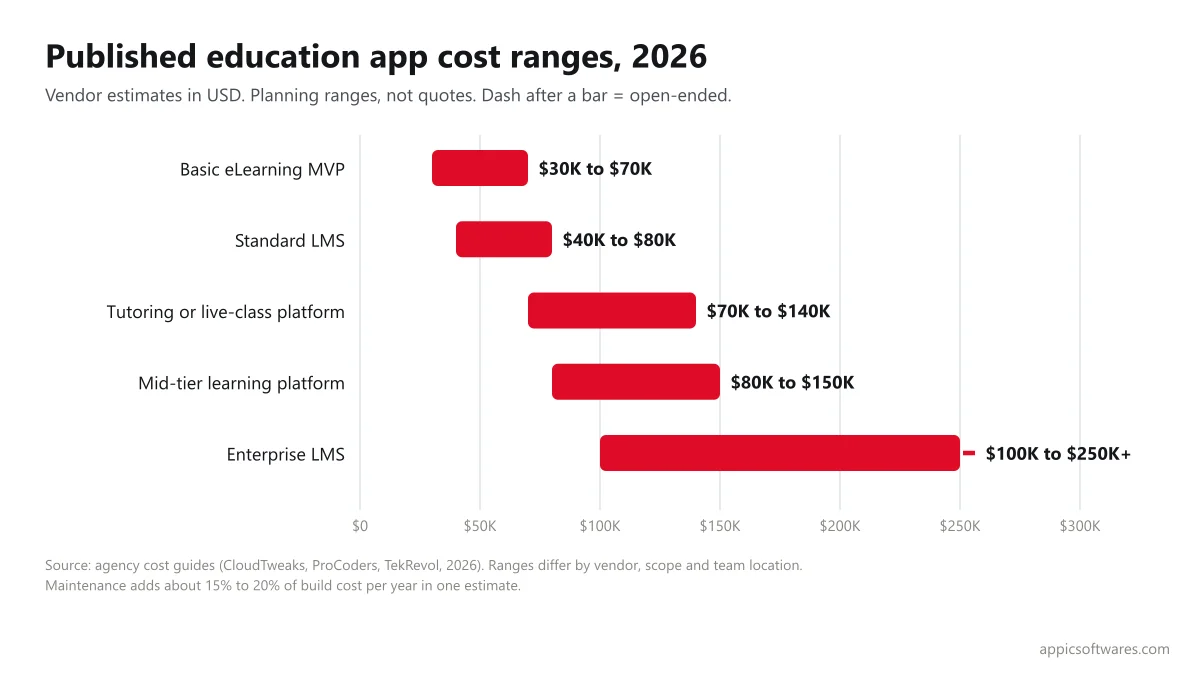
- Published 2026 estimates put a basic eLearning MVP at roughly $30,000 to $70,000 and a mid-tier LMS at $70,000 to $150,000.
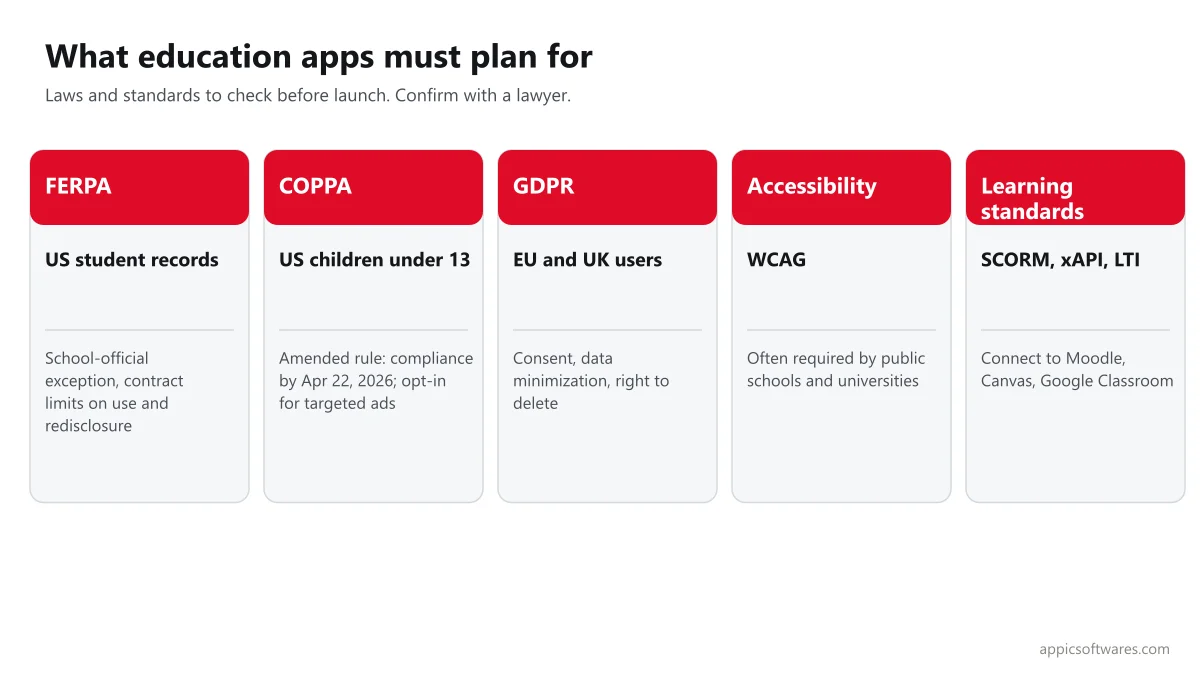
- If your users include children in the US, the FTC's amended COPPA rule has been in force since its compliance deadline of April 22, 2026.
- Ask for a paid discovery phase, check code ownership and test the vendor with a small first release.
- Maintenance is a real cost. One estimate puts it at 15% to 20% of the build cost each year.
Which education app development companies should you shortlist?
| Company | Base | Founded | Education focus | Best for |
| Appic Softwares | Jaipur, India (offices in Texas and Munich) | 2018 | Education apps, LMS, AI tutoring | Startups and SMBs building a first version |
| Brocoders | Tallinn, Estonia | 2014 | Microlearning with AI content generation | AI-driven learning products |
| Cleveroad | Tallinn, Estonia (also Delaware and Oslo) | 2011 | LMS, school apps, tutor and classroom platforms | Standards-heavy education software |
| Geniusee | Austin, Texas (also Warsaw, Stockholm, Kyiv) | 2017 | Edtech, LMS, tutoring platforms | Tutoring and online learning platforms |
| ScienceSoft | McKinney, Texas | 1989 | LMS, eLearning portals, proctoring | Enterprise LMS and long-running programs |
Planning an education app? Tell us who it is for and we will help you pick the first features worth building. Get your project scoped
How did we pick these companies?
- Education-specific evidence: an education or edtech page, or a named learning-product case study on the company's own site.
- Standards and compliance signals: experience with SCORM, xAPI, LTI, accessibility or student-privacy rules.
- Independent reviews: a Clutch profile you can check yourself.
- Verifiable facts: we only used details we could read on each company's own site.
Many agencies list education among their industries but show no education work. We left those out. Ratings and review counts change, so we point you to live profiles. If you want a list focused on online courses and eLearning, see our guide to eLearning app development companies.
Appic Softwares
Appic Softwares is a custom software and AI development company founded in 2018, based in Jaipur, India, with offices in Frisco, Texas and Munich. Our education app development team builds learning apps, and our LMS development page covers custom learning management systems. We add AI tutoring and personalization through AI development services, and see our Klassbook project for a delivered education product.
- Pricing signals: average rate about $35 per hour; typical projects start around $10,000.
- Reviews: 5.0 on Clutch from 24 verified reviews.
- Best for: startups and SMBs that need a focused first version.
- Consider something else if: you need a large enterprise LMS program with a dedicated long-term support desk.
Brocoders
Brocoders is an Estonian company founded in 2014 with 87 engineers, according to its site. Edtech is one of its industry solutions. Its edtech case study, for an unnamed cloud education company, is a microlearning platform with AI content generation, personalized learning support and exam automation, which the company says it delivered on schedule. It lists a 5.0 Clutch rating across 38 reviews (Brocoders).
- Best for: AI-heavy learning products and microlearning.
- Check: the client is not named, so ask for a reference.
Cleveroad
Cleveroad's education page lists custom education apps and edtech SaaS, LMS and learning experience platforms, tutor booking apps, virtual classrooms, school management platforms and assessment tools, plus AI features such as personalized learning paths and automated grading. Its named case studies are a student and parent app for school community software in the USA and an educational hub for DJs in the UK. It says it works with SCORM, xAPI, LTI, WCAG, FERPA, COPPA and GDPR, holds ISO 9001 and ISO 27001 certifications, and shows a 4.9 Clutch rating from 70 reviews (Cleveroad). The page lists standards as areas of expertise and does not say it holds a certification for each.
- Best for: standards-heavy LMS and school platforms.
- Check: the page gives no quantified results for its education case studies.
Geniusee
Geniusee says it was founded in 2017 and has offices in Austin (Texas), Warsaw, Stockholm and Kyiv, with 300+ people. Its edtech services include LMS development and integration, Moodle development, school management software, virtual classrooms, tutor apps and AI for edtech. Its named case study is MyTutor, an online tutoring platform, with 4 million lessons delivered to more than 250,000 learners, a company-reported figure. It shows a 5.0 Clutch rating from 65+ reviews on its site (Geniusee).
- Best for: tutoring marketplaces and online learning platforms.
- Check: other client logos on the page have no project details, so ask for case studies.
ScienceSoft
ScienceSoft has operated since 1989 and says it has 11 years in eLearning development. It builds learning management systems, eLearning portals, learning experience platforms, remote proctoring software and mobile learning. Its case studies include modernizing children's math training apps and a long-running LMS product used in Sweden and Iceland. It lists SCORM, AICC, xAPI and LTI support and says typical MVPs take three to five months. It reports ISO 9001, ISO 27001 and ISO/IEC 27701 certifications (ScienceSoft). These are self-reported.
- Best for: enterprise LMS and programs that need formal process.
- Check: FERPA and COPPA appear only in its cost-estimate form on that page, so ask how it handles them.
How much does it cost to develop an education app in 2026?
Published estimates come mostly from development agencies and differ by scope, so use them as planning ranges. Sources include CloudTweaks, ProCoders and TekRevol.
| What you are building | Typical published range (USD) | Typical time |
| Basic eLearning MVP | About $30,000 to $70,000 | 3 to 5 months |
| Standard LMS | About $40,000 to $80,000 | Varies |
| Mid-tier learning platform | About $80,000 to $150,000 | Varies |
| Tutoring or live-class platform | About $70,000 to $140,000 | Varies |
| Enterprise LMS | About $100,000 to $250,000+ | Varies |
Maintenance and hosting add about 15% to 20% of the build cost each year in one estimate, and another puts first-year hidden costs at 25% to 40%. Location matters too: one guide cites roughly $25 per hour in Asia against $150 in North America. Appic typically starts projects around $10,000 for a focused MVP. For more detail, see our cost of creating an app like Google Classroom.
Free MVP scoping session: share your learners, subject and revenue model. We will outline the features, the stack and a cost range for a first version. Book your session
What compliance rules apply to education apps?
- FERPA (US): protects student education records. Schools can share records with a vendor under the "school official" exception only if the vendor does a service the school would otherwise do, is under the school's direct control for how records are used, and uses the data only for authorized purposes without redisclosing it (Center for Democracy & Technology).
- COPPA (US): covers online services for children under 13. The FTC's amended rule took effect on June 23, 2025, and most operators had to comply by April 22, 2026. It requires separate opt-in consent for targeted advertising and written data retention policies (White & Case).
- GDPR (EU and UK): consent, data minimization and the right to delete, with extra care for children's data.
- Accessibility: WCAG is the common standard, and many public schools require it.
- Learning standards: SCORM, xAPI and LTI let your app work with LMS platforms such as Moodle, Canvas and Google Classroom.
Rules differ by country and state, so confirm requirements with a lawyer before launch.
How do you choose an education app development company?
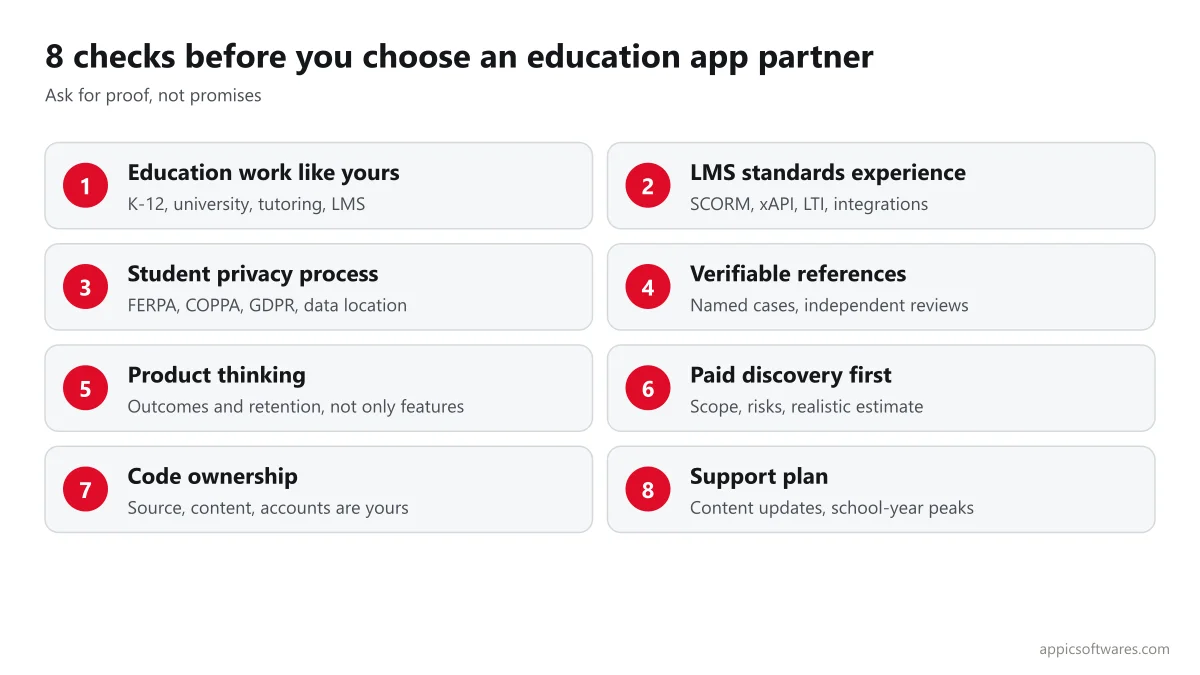
- Ask for education work like yours. A K-12 app, a university LMS and a tutoring marketplace need different skills.
- Check standards experience. SCORM, xAPI, LTI, LMS integrations and accessibility.
- Ask about student privacy. How they handle FERPA, COPPA or GDPR and where data is stored.
- Talk to a past client. Verify case studies and read recent independent reviews.
- Look at product thinking. Good partners ask about learning outcomes and retention, and not just features.
- Start with discovery. A paid scoping phase reduces cost surprises.
- Confirm code ownership. Source code, content and accounts should be yours.
- Plan for support. Content updates, school-year peaks, and fixes need a service level.
What types of education apps can these companies build?
- Learning management systems: courses, assignments, grades and reports. See our LMS development company page.
- Mobile learning apps: lessons, quizzes and progress tracking. Read top eLearning mobile apps.
- Tutoring and live-class platforms: scheduling, video, payments and ratings.
- School and parent apps: attendance, notices, fees and messages.
- Gamified learning: streaks, rewards and levels. Read gamified learning apps development guide.
- AI tutors and assessment: personalized practice, feedback and grading support.
See also types of edtech apps, how to create an app like Duolingo and our MVP development service.
What changed from the earlier version of this list?
The earlier version, published in 2023, listed ten companies with short feature lists, no ratings or prices, and a few typos. This update keeps five companies we could verify from their own sites, adds costs, compliance and a buyer checklist, and removes companies where we could not confirm any education work or current details.
Ready to build an education app? Send us your audience, subject and revenue model. We will reply with an MVP plan, a stack recommendation and a cost range you can share with your team. Talk to our team