
Python Frameworks in 2026: Django, Flask, FastAPI and 20+ Others by Category, and How to Choose
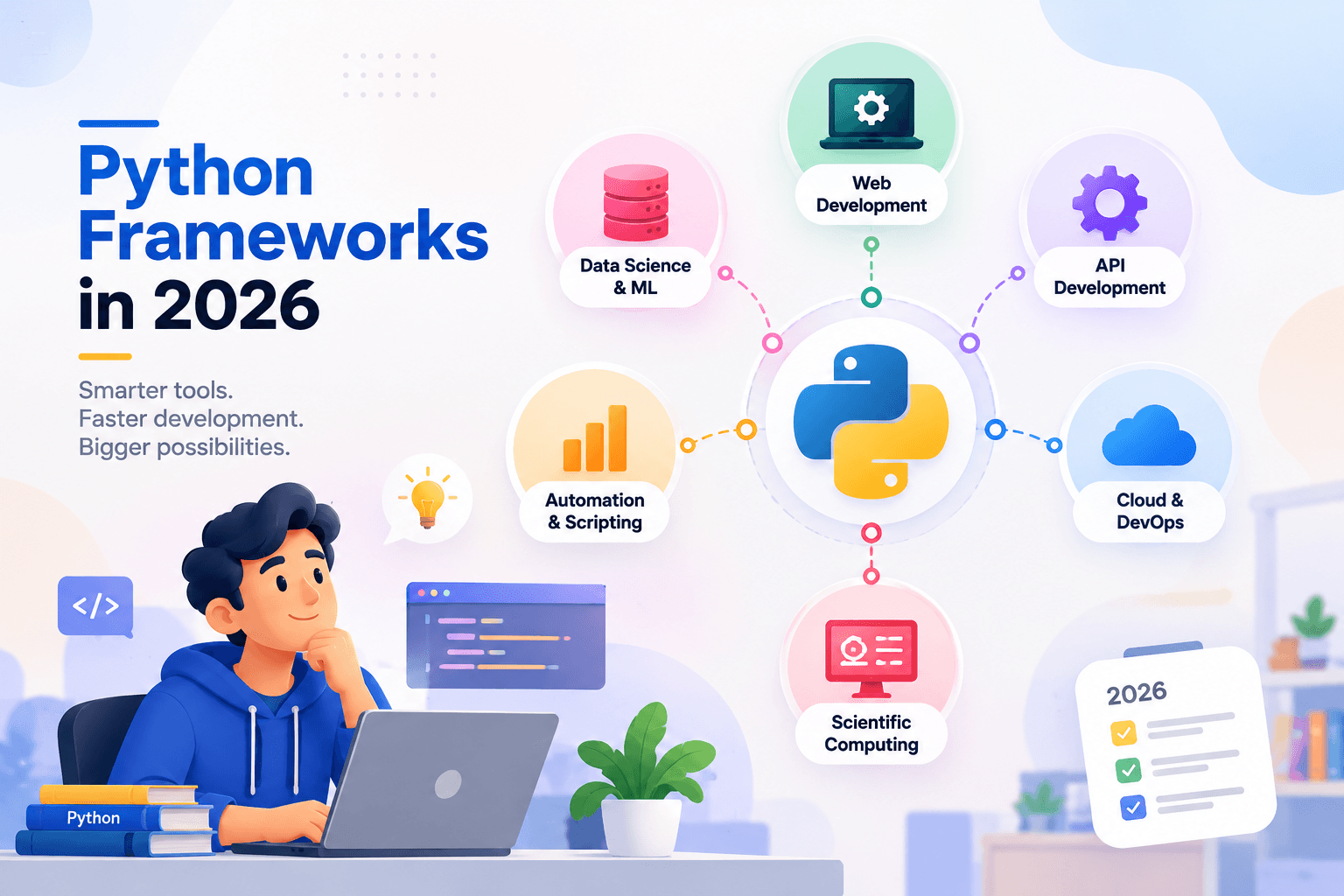
The most used Python web frameworks in 2026 are Django (full-stack), Flask (micro) and FastAPI (modern API framework). Choose Django for content-heavy or data-driven sites with admin and authentication built in, Flask for small apps and custom stacks, and FastAPI for typed, high-performance APIs. Many other frameworks exist, but several older ones are unmaintained, so check activity before you adopt one.
Key Takeaways
- JetBrains' State of Python 2025 article lists FastAPI at 38% (up 9 points) and Django at 35% (up 2) among surveyed developers. The year label in that article is inconsistent, so check the original report.
- Django's download page lists 5.2 LTS (latest 5.2.18, extended support to April 2028), 6.0 (6.0.9) and 6.1 (6.1.2). Flask's latest release was 3.1.3 on February 19, 2026, and it requires Python 3.9 or later.
- A framework gives you structure and calls your code. A library is code you call. Most projects use both.
- Prefer actively maintained projects with recent releases, clear documentation and a community, and check the license.
- Appic is a publisher with a commercial interest in Python development, so verify versions and status yourself.
What is a Python framework?
A Python framework is a set of tools and conventions that gives your application a structure, such as routing, request handling, templates, database access, security helpers and project layout. You fill in the parts that are specific to your product. Python is a general-purpose language released in 1991 by Guido van Rossum, and its frameworks cover web, APIs, data apps and more.
What is the difference between a framework and a library?
| Aspect | Framework | Library |
| Control | The framework calls your code | Your code calls the library |
| Scope | Defines application structure | Solves one task, such as HTTP requests or data frames |
| Examples | Django, Flask, FastAPI | Requests, NumPy, pandas |
What are the types of Python frameworks?
- Full-stack frameworks include most things you need: ORM, templates, authentication, admin and forms. Django is the leading example.
- Microframeworks give routing and a core, and you add the rest. Flask, Bottle and Falcon are examples.
- Asynchronous and API-first frameworks are built for non-blocking I/O and typed APIs. FastAPI, Starlette, Sanic, aiohttp and Tornado are examples.

Which Python frameworks are worth knowing?
Mainstream choices
| Framework | Type | Best for | Status we could confirm |
| Django | Full-stack | Content sites, SaaS back ends, admin-heavy apps | 5.2 LTS (5.2.18), 6.0 (6.0.9), 6.1 (6.1.2) on its download page |
| Flask | Micro | Small apps, prototypes, custom stacks | 3.1.3 released February 19, 2026, BSD-3-Clause, Python 3.9 or later |
| FastAPI | Async, API-first | Typed REST APIs, services, machine learning back ends | Version not confirmed. Check PyPI. |
Other active options (check current status)
| Framework | Type | Notes |
| Starlette | Async toolkit | The ASGI toolkit that FastAPI builds on |
| Pyramid | Flexible, scales small to large | Mature, smaller community |
| Tornado | Async networking | Non-blocking I/O, long-lived connections, created at FriendFeed |
| Sanic | Async | Built for speed with async syntax |
| aiohttp | Async client and server | HTTP client and server on asyncio (the old post called it "HTTP/AIO") |
| Falcon | Micro, API-focused | Minimal and fast for APIs |
| Bottle | Micro, single file | Very small, no dependencies beyond the standard library |
| CherryPy | Minimal, object-oriented | Mature HTTP framework |
| Quart | Async Flask-style | Flask-like API with async support |
| Dash | Data apps | Analytics dashboards on top of Flask and Plotly |
| TurboGears | Micro to full-stack | Combines components, smaller community |
| Hug | API micro | The old post called it the "fastest Python 3 framework". We could not verify that. |
Older or niche frameworks (verify before use)
The earlier version listed CubicWeb, Pylons, Giotto, Growler, Morepath, Pycnic, web2py, Grok, BlueBream, Quixote, weppy and Zope. Several are legacy, merged into other projects or have little recent activity, as far as we know. Zope still underpins some content management systems. We did not check each one, so inspect the release history and issue tracker before you start a new project on any of them.
Sources for versions: Django downloads and Flask on PyPI. We could not load FastAPI's PyPI page for this update.

How popular are they?
JetBrains' State of Python 2025 article lists FastAPI at 38% of surveyed developers, up 9 points from the year before, and Django at 35%, up 2 points (JetBrains). The article's year labels are inconsistent, so treat the percentages as indicative. A separate Django Developer Survey 2024 reported Django as the preferred framework for 74% of Python developers, down from 83% the year before. Flask's figure was not in the results we saw. Secondary articles claim FastAPI passed Flask in GitHub stars, but we did not verify that. Popularity does not decide fit, so choose on your needs.
The earlier version said Django was the "second most popular" framework and quoted "15% of Stack Overflow questions" for 2021 without a source, so we removed both.
Planning a Python project? Tell us your product, data and team, and we will help you pick a stack. Get your project scoped
What do the main frameworks look like?
These minimal examples show the style of each. We did not run them, so test them in your own environment.
# Flask
from flask import Flask

app = Flask(__name__)

@app.get("/")
def home():
    return {"message": "Hello from Flask"}
# FastAPI
from fastapi import FastAPI

app = FastAPI()

@app.get("/")
async def home():
    return {"message": "Hello from FastAPI"}
FastAPI is usually run with an ASGI server such as Uvicorn. Django starts from a project generator (django-admin startproject mysite) and includes an admin, ORM and authentication.
How do you choose a Python framework?
| Your need | Consider |
| A full web app with users, admin and a database | Django |
| A small service or a prototype with custom choices | Flask |
| A typed API with automatic docs and async support | FastAPI |
| Long-lived connections, WebSockets and streaming | Tornado, Starlette-based stacks or an async framework |
| A data dashboard for analysts | Dash or a similar data app tool |
| An existing legacy app | Stay with the framework unless there is a clear reason to migrate |
- Define the product and its main risks: scale, security, speed to market.
- Check maintenance. Recent releases, active issues and supported Python versions.
- Review the ecosystem. Authentication, ORMs, testing and deployment guides.
- Consider your team. Choose what you can hire for and maintain.
- Prototype one feature in your top two choices before you commit.

How Appic helps with Python development
Appic Softwares has built custom software since 2018, with offices in Jaipur (India), Frisco, Texas (USA) and Munich (Germany), and a 5.0 Clutch rating from 24 verified reviews. We offer web development, AI development services and dedicated developers from India. Our average rate is about $35 per hour, and projects typically start around $10,000 for a focused scope. Appic is a publisher with a commercial interest, so compare quotes.
What changed from the earlier version of this post?
The January 2024 version had a 2025 title, a 2023 section heading and a 2024 conclusion, a list of 25 frameworks with no versions or maintenance status, many headings that did not match the framework described (such as "Receptacle", "Give a hug" and "Dream in Blue"), unsourced popularity and benchmark claims, no code and no FAQ. This update groups frameworks by type, adds current release data and survey figures with limits, simple code examples and a selection guide.
Ready to build with Python? Share your product and team. We will reply with a stack recommendation and a cost range. Talk to our team
Frequently Asked Questions
What are the most popular Python frameworks?
Django, Flask and FastAPI are the most used for web development. JetBrains' State of Python 2025 article lists FastAPI at 38% and Django at 35% of surveyed developers, though its year labels are inconsistent. Choose based on your needs, not popularity alone, and check each project's maintenance status.
What is the difference between Django and Flask?
Django is a full-stack framework with an ORM, authentication, admin and templates built in, suited to data-driven apps. Flask is a microframework that provides routing and a core, and you add other pieces yourself, suited to small apps and custom stacks. Both are actively released.
Is FastAPI better than Flask?
FastAPI is built for typed, async APIs with automatic documentation, while Flask is simpler and more general. FastAPI suits API back ends and machine learning services, and Flask suits small apps and prototypes. Prototype one feature in both and compare ease of use, performance and your team's skills.
What is the difference between a framework and a library in Python?
A framework defines the structure of your application and calls your code, while a library is code you call to do one job, such as sending HTTP requests or processing data. Django and Flask are frameworks. Requests, NumPy and pandas are libraries. Most projects use both.
How do I choose a Python framework?
Define your product and its main risks, check maintenance and supported Python versions, review the ecosystem for authentication, ORM, testing and deployment, consider the skills your team can hire for, and prototype one feature in your top two choices. Avoid starting new projects on unmaintained frameworks.
Are older Python frameworks still maintained?
Some are, but several older frameworks are legacy, merged into other projects or have little recent activity, as far as we know. Check the release history, issue tracker and supported Python versions before you start a new project on any older framework. Zope still underpins some content management systems.
Related Articles

Python In Finance: How Python Is A Game Changer In 2025
Technological advancements, irrespective of fields or industries, have become an essential part of the business realm with the arrival of the 4.0 revolution. The financial sector is not exempt from the worldwide competition for technological supremacy. Because banks, investment firms, insurance companies, and other financial institutions rely so heavily on the newest software and technologies, […]

Python 2 V/S Python 3: Which One To Choose In 2025
Python is regarded as a general-purpose, flexible programming language. It is an open-source, high-level language with a simple syntax that is simple to learn. Owing to several benefits (which we will discuss subsequently), the multi-paradigm programming language is highly suitable for a wide range of applications. Python 2 has come a long way since its […]

What Is The Cost Of Python Web Scraping?
Python web scraping is the process of extracting data from websites. It involves using Python programming to collect and interpret data from web pages for tasks like data analysis and research. Python web scraping also helps in building web applications by extracting useful information from websites for various practical purposes. Various tools in the market […]

7 Python Trends To Know In 2025
Python’s adaptability and user-friendliness have made it a popular programming language for companies of all kinds. Giants in the tech sector, including Amazon, Facebook, Instagram, and Uber, have drawn to Python and are using it to develop a wide range of applications. Python’s readability and adaptability make it a great tool for any business. We […]
The Role of AI and Real-Time Inventory in Quick Commerce Success
Q-commerce, or quick commerce, is more than simply a fad. It’s a change in the way people shop. Customers want their deliveries to arrive in 10 to 30 minutes. The model focuses on hyperlocal fulfillment, lightning-fast logistics, and tech-driven precision. But how do businesses keep up with such fast speeds without sacrificing accuracy? The answer […]
10 Most Popular Python Frameworks for Building Websites
Python is a powerful and adaptable programming language that is becoming more and more popular for developing websites. A lot of people use it, it has a simple syntax, and it includes a lot of libraries. This makes it a wonderful language for developing websites that can grow and are safe. Python has a framework […]