E-Commerce Development Companies in Saudi Arabia: How to Choose One in 2026

To choose an e-commerce development company in Saudi Arabia, check five things: experience with the platforms you need (Zid, Salla, Shopify, Adobe Commerce or WooCommerce), local payments and shipping, Arabic and right-to-left design, compliance with Saudi e-commerce rules, and verifiable client references. Compare two or three firms on a pilot scope before you sign.
Key Takeaways
- Market-size estimates for Saudi e-commerce range from about USD 7.6 billion to USD 31 billion depending on the source, so treat any single number with care.
- Electronic payments made up 79% of retail transactions in 2024, according to the Saudi Central Bank (SAMA), as reported by P&S Intelligence.
- Platform choice (hosted store or custom build) matters more than agency size for most first stores.
- Stores must follow the Saudi E-commerce Law, register through the Ministry of Commerce's Business Platform and handle VAT and e-invoicing.
- We publish no ranked list here. Rankings of agencies built on unverified ratings mislead buyers, and Appic is a publisher with a commercial interest.
How big is e-commerce in Saudi Arabia?
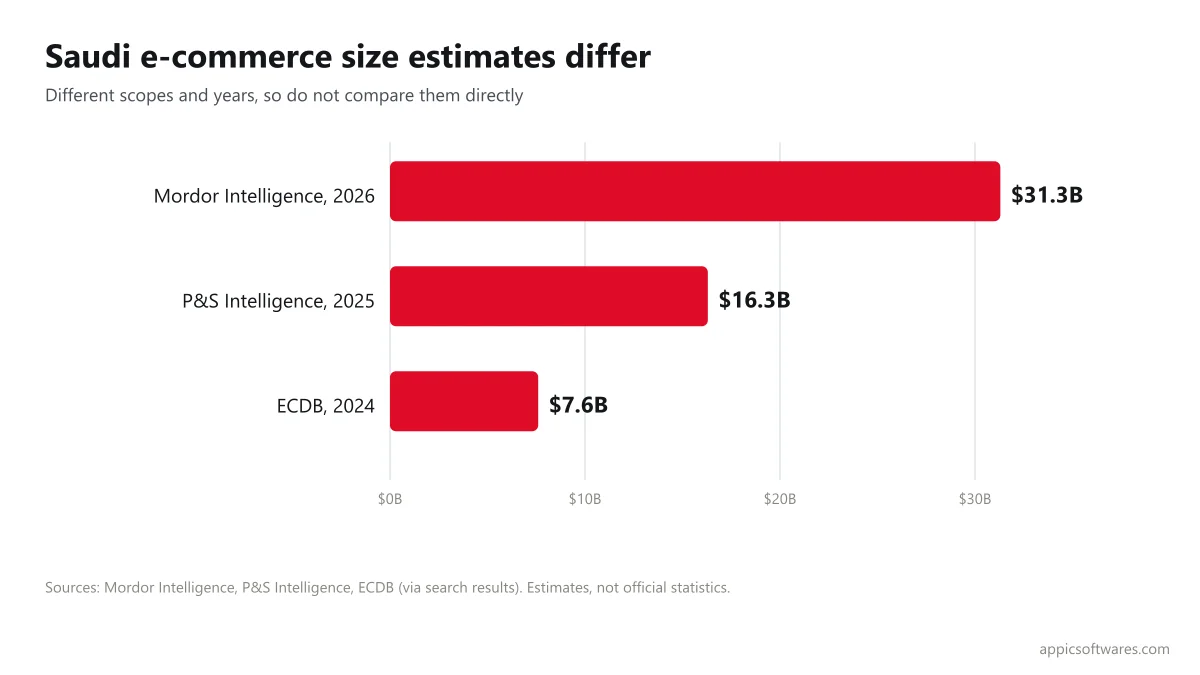
Estimates differ because sources define the market differently. Mordor Intelligence puts 2026 at about USD 31.3 billion, growing to USD 54.9 billion by 2031. P&S Intelligence estimates USD 16.3 billion in 2025 rising to USD 36.6 billion by 2032. ECDB reports about USD 7.6 billion of revenue in 2024. The scopes are not comparable, so use them to see direction, not to plan a budget (P&S Intelligence). P&S credits near-universal internet access, wide smartphone use and Vision 2030 policies that allow foreign ownership of e-commerce businesses.
Which platform should you build on?
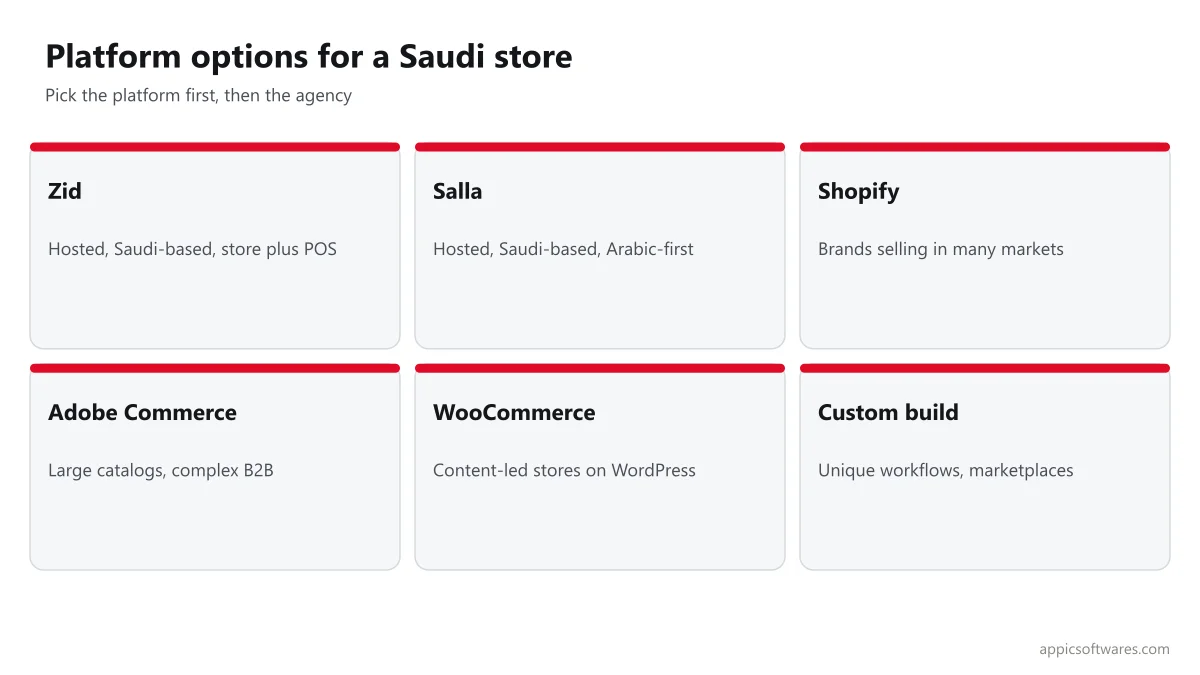
| Option | Best for | Check before choosing |
| Zid (hosted, Saudi-based) | Merchants who want a ready store, payments, shipping and POS in one place | Fees, themes, API limits, supported payment methods |
| Salla (hosted, Saudi-based) | Merchants who want an Arabic-first hosted store | Plans, app store, supported payment and shipping providers |
| Shopify | Global brands selling in many markets | Local payment methods, Arabic and RTL themes, fees |
| Adobe Commerce (Magento) | Large catalogs and complex B2B logic | Hosting and maintenance cost, developer availability |
| WooCommerce | Content-led stores on WordPress | Security, plugin upkeep, performance |
| Custom build | Unique workflows, marketplaces, deep ERP integration | Budget, timeline, who maintains it |
Zid's own site says more than 13,500 merchants use it, that its stores have generated over 10 billion SAR in sales and that it operates in Saudi Arabia, the UAE, Kuwait, Oman, Bahrain, Egypt and Syria (zid.sa). These are Zid's claims. We could not load Salla's site, so we make no Salla claims beyond the fact that it is a Saudi hosted platform. Confirm payment methods such as mada, Apple Pay, Tabby and Tamara on each platform's current documentation.
What Saudi rules should your store follow?
- E-Commerce Law. The law (Royal Decree M/126, 2019) applies to providers selling online in the Kingdom. Secondary guides list required disclosures such as store identity, all-in pricing and a written return and refund policy, with penalties up to SAR 1 million. These are law-firm summaries, so read the official text.
- Registration. The Ministry of Commerce announced in March 2023 that store owners should register on the Business Platform (business.sa) instead of Maroof (Ministry of Commerce). A commercial register or valid professional certificate and a bank account are usually required.
- VAT and e-invoicing. Guides cite 15% VAT on consumer sales. ZATCA's e-invoicing Phase 2 has been rolled out in waves, with the 24th group due by June 30, 2026 per KPMG and other reports. Confirm your own status with ZATCA, since dates and thresholds change.
- Data protection. Check the Personal Data Protection Law with counsel before storing customer data.
Nothing here is legal or tax advice. Ask a Saudi lawyer or tax adviser before launch.
Planning an online store for Saudi customers? Tell us your catalog, platform and payments, and we will help you scope it. Get your project scoped
How do you choose an e-commerce development company in Saudi Arabia?
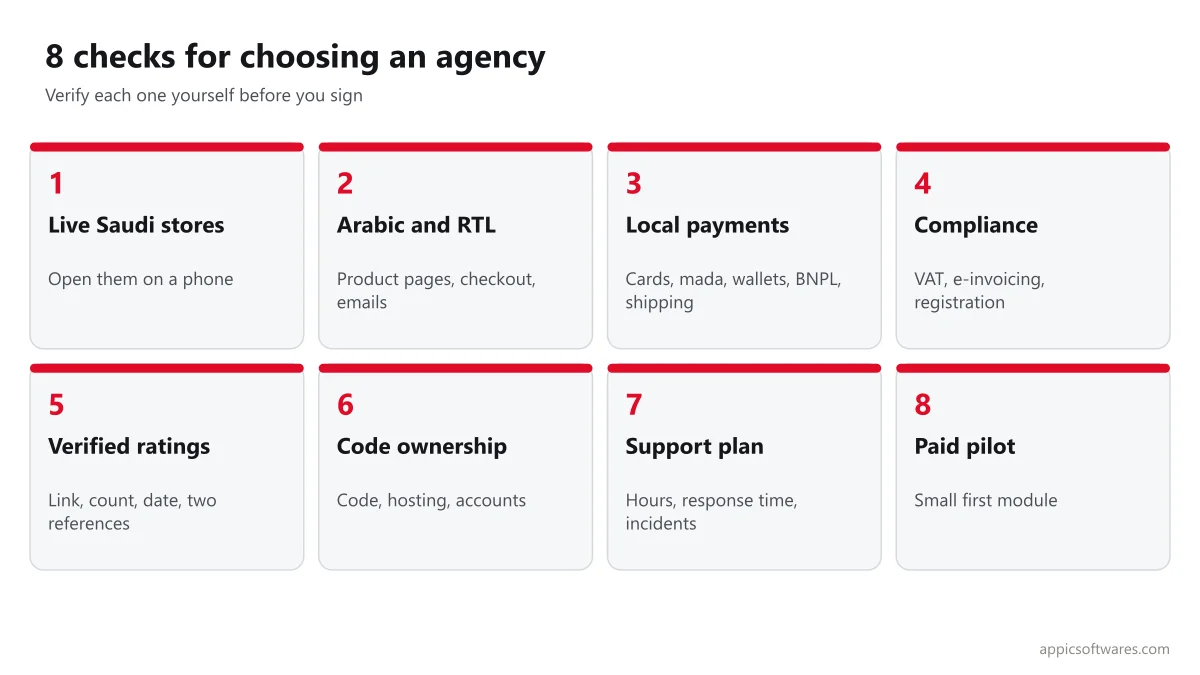
- Look at live stores. Ask for URLs of Saudi stores they built and test them on a phone.
- Check Arabic and RTL quality. Product pages, checkout and emails should read naturally in Arabic.
- Confirm local payments and shipping. Cards, mada, wallets, buy now pay later and local couriers.
- Ask about compliance. VAT, e-invoicing, registration and data protection.
- Verify ratings yourself. Open the review site, check the date and count, and ask for two references.
- Agree scope and ownership. Who owns the code, hosting and accounts after launch.
- Plan support. Hours, response times and who handles incidents.
- Run a paid pilot. A small first module shows how the team works.
What should you watch for in agency "top 10" lists?
- Self-ranking. Many lists are published by agencies that rank themselves first.
- Unlinked ratings. "4.9 on Google" means little without a link, a review count and a date.
- Wrong market. A firm in another country may have no Saudi clients, Arabic experience or local payment know-how.
- Cost labels without data. "Cheapest" and "most expensive" tags need real quotes behind them.
Directories such as TechBehemoths list dozens of Riyadh firms, but their listings are self-reported, so use them to find candidates and verify each one yourself.
Free e-commerce scoping session: share your products, platform and target customers. We will outline the build, integrations, compliance steps and a cost range. Book your session
How much does an e-commerce store cost in Saudi Arabia?
We did not find reliable, independent 2026 price data for Saudi agencies. Costs depend on platform, number of products, custom features, integrations and design in Arabic and English. Hosted platforms cost less to start, and custom builds cost more upfront. Ask each firm for a written estimate with the same scope and compare line by line. Appic projects typically start around $10,000 for a focused scope.
How Appic builds e-commerce stores for the Saudi market
Appic Softwares has built custom software since 2018, with offices in Jaipur (India), Frisco, Texas (USA) and Munich (Germany), and a 5.0 Clutch rating from 24 verified reviews. Appic is not a Saudi-based firm. We work with Saudi clients remotely and build e-commerce apps for Saudi Arabia, e-commerce apps and web platforms, with maintenance and support after launch. For payments and lending features, see our fintech development in Saudi Arabia. Our average rate is about $35 per hour.
What changed from the earlier version of this post?
The August 2023 version was titled "Top 10" but listed 11 firms, said the firms were from the US while targeting Saudi Arabia, ranked Appic first and used unlinked ratings and unsupported claims such as conversion guarantees and "fastest-growing business in America". This update removes the unverified ranked list, adds platform options, Saudi rules, selection checks and market context, and states Appic's position clearly.
Ready to launch an online store in Saudi Arabia? Send us your catalog, platform preference and timeline. We will reply with a plan, the compliance steps involved and a cost range you can review with your team. Talk to our team
Frequently Asked Questions
Check live Saudi stores they built, Arabic and right-to-left quality, local payment and shipping integrations, compliance knowledge (VAT, e-invoicing, registration), verified reviews and clear code ownership. Compare two or three firms on the same written scope and run a small paid pilot before committing to a full build.
It depends on your needs. Zid and Salla are Saudi hosted platforms suited to quick launches. Shopify suits brands selling across markets. Adobe Commerce and custom builds suit large catalogs or unique workflows. Check Arabic support, local payments and fees on each platform before deciding.
Generally yes. The Ministry of Commerce says store owners should register through the Business Platform (business.sa), which replaced Maroof, and usually need a commercial register or professional certificate. Rules change, so confirm requirements with the Ministry of Commerce or a Saudi lawyer before you launch.
Most stores support cards, mada, digital wallets and buy now pay later, plus cash on delivery for some categories. SAMA data reported by P&S Intelligence says electronic payments were 79% of retail transactions in 2024. Confirm each method's availability with your payment provider.
We found no reliable independent price data. Cost depends on platform, catalog size, custom features, integrations and Arabic design. Hosted platforms start cheaper, and custom builds cost more. Appic projects typically start around $10,000 for a focused scope. Get written estimates with identical scope from each firm.
Yes, many stores are built by remote teams, but check Arabic and RTL experience, Saudi payments and shipping know-how, and compliance awareness. Ask for Saudi references and live stores. You will still need your own Saudi registration, VAT and e-invoicing set-up regardless of who builds it.